
Flying for Fun (2007/02)
D.B. Mathews | [email protected]
Thoughts about getting more kids into our hobby
My piece about the Plymouth Internats in the October 2006 issue, noting the ensuing incredible decline in the numbers of youngsters involved in model airplanes, elicited considerable mail. Without exception, those who wrote agreed with my diagnosis of the problem and offered some interesting additional comments. I’ve chosen one of those to quote for further thought; it is from Robert Hixson of San Francisco, California, and he makes some points worth adding to the discussion.
"To say things have changed in America since those days is really an understatement as you clearly know; several changes for young folks today include:
- television,
- money,
- video games, and
- more single-parent homes.
"Yet, the AMA is stronger than ever, world markets in hobby materials are flourishing, and there are more fliers than ever before. We can only do our part, stay involved, enjoy what we have today in model aviation, and hope to have the opportunity to pass on some of what we have learned and experienced. If we can do that, we have been blessed."
Something else to add to the changes in kids' activities in our modern society is the increase in demands on young people's recreational time. Highly organized activities such as baseball, soccer, football, and other sports didn’t exist when most of us were kids.
It is obvious that there is a huge increase in participation in our hobby—particularly in RC. New clubs with new flying fields are popping up across the country, sales of modeling materials and ARFs are booming, and the development of reliable electric-powered models has caused a virtual explosion of flying at nontraditional flying sites, both outdoors and indoors.
Yet the fliers are almost exclusively young adults whose educational, family, and financial situation has opened up time for a hobby. The other important group is the recently retired, who finally have the time and money for a hobby they may have been interested in as youths.
Notably absent from most flying fields are youngsters. With the exception of father-and-son teams, there are few kids. As much as I hate to suggest it, perhaps our efforts as clubs and organizations should be aimed at a different market and age group than we have traditionally centered on. It's possible that we could be rewarded more if we paid more attention to recruiting recent empty nesters and the recently retired. I know that statement will cause some heartburn for many people, but think about it.
Then again, perhaps those programs that have traditionally been aimed at gaining the interest of kids, such as the ubiquitous AMA Cub, are responsible in a way for the previously mentioned newcomers. Perhaps it just takes a long time to get those kids we worked with years ago to finally take interest, but how could that possibly be measured or quantified? Programs aimed at youngsters are a bit like planting seeds; it takes a long time for the seeds to germinate and bloom. It could be that the new people entering our hobby are the fruit of seeds that were planted many years ago. I do not pretend to have any answers to these questions. The only thing I know is that many newcomers are coming into our hobby from someplace.
As I wrote the preceding, another observation occurred to me. Wichita, Kansas (where I live), has an economy strongly based on employees of the major airframe manufacturers and the thousands of workers in the peripheral industries—job shops—that manufacture components for the majors. It is incredible how many of those employees—not just engineers and technical people but machinists, sheet-metal workers, and others involved in aircraft assembly—are modelers. The question is, are they in the aircraft industry because they are modelers, or is it the other way around?
Considering the shortage of skilled workers now and the severe shortage projected in the next few years as many of these workers reach retirement age, are there enough modelers to replace them? Burt Rutan touched on this pending shortage and the desirability of hiring modelers by the industry in his acceptance speech when he was inducted into the Model Aviation Hall of Fame.
As the U.S. automobile manufacturers are forced to lay off more workers, perhaps many of them should be retrained as aircraft workers. To that end, the local city, county, and manufacturers are building a new vocational-education training facility for that exact purpose. Let's hope there are enough young modelers to fill some of these jobs in the future. Frankly, I doubt that there will be.
Radio Orphans
Many of us have old Ace Micropro transmitters and dearly love their simple programming, solid-feeling all-metal gimbals, and other features. Unfortunately, Ace Radio ceased production many years ago, and consequently factory service is no longer available.
I've found a place to have these radio components serviced or repaired, along with many other brands of orphaned radio equipment including Kraft and Pro Line. I highly recommend Radio South (see the ad in this issue). However, there is one caveat to these long-out-of-production units: Radio South has only a limited supply of components that are peculiar to those brands. For more contemporary radios, Tony Stillman, who owns and operates Radio South, also provides superb service.
For modelers still using old-style Airtronics receivers, longtime flying buddy Tom Ames discovered that the JR 9303 "dial-up" transmitter will run those old receivers regardless of the frequency they are on. Other contemporary transmitters, including newer Airtronics models, will not run the old receivers, but the JR 9303 will. The reason is simple: old Airtronics receivers utilize negative switching, while most contemporary receivers use positive switching. If your receiver is still usable but your transmitter has died, get a JR 9303 and save your receiver.
ARFs in the Positive
In the last several months I have been pounding the drum for the Asian ARF manufacturers to consider additional scale prototypes for production. This month I'll present some ARFs that fit that parameter.
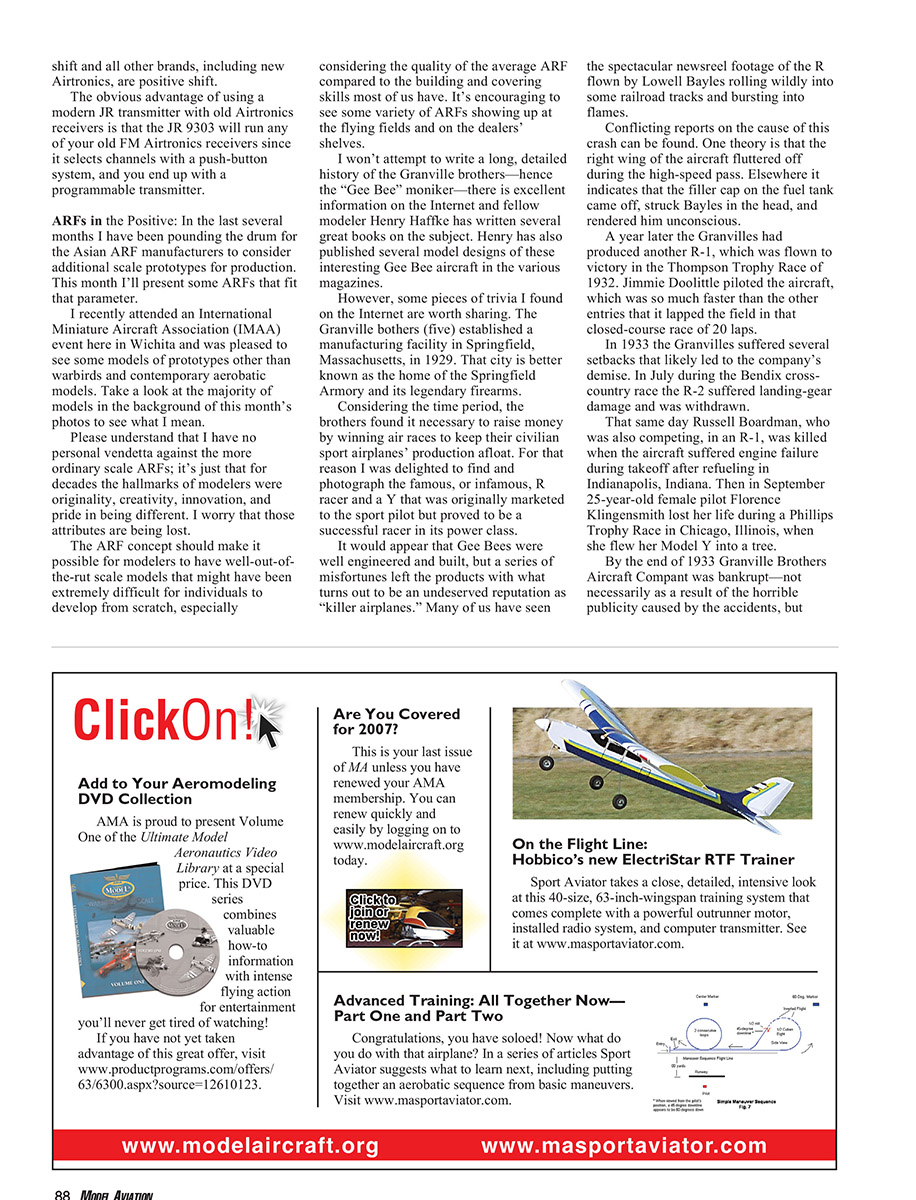
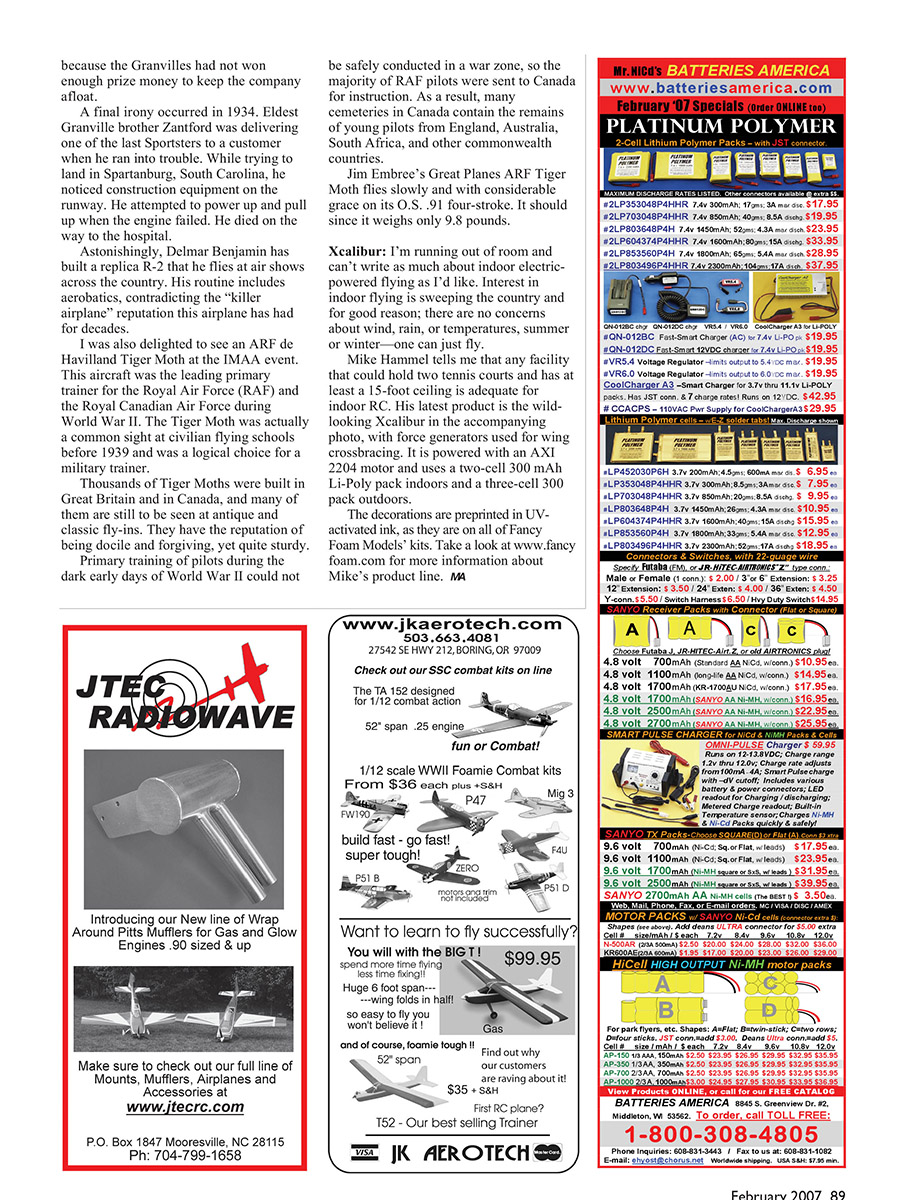
I recently attended an International Miniature Aircraft Association (IMAA) event here in Wichita and was pleased to see some models of prototypes other than warbirds and contemporary aerobatic models. Take a look at the majority of models in the background of this month's photos to see what I mean.
Please understand that I have no personal vendetta against the more ordinary scale ARFs; it's just that for decades the hallmarks of modelers were originality, creativity, innovation, and pride in being different. I worry that those attributes are being lost. The ARF concept should make it possible for modelers to have well-out-of-the-rut scale models that might have been extremely difficult for individuals to develop from scratch, especially considering the quality of the average ARF compared to the building and covering skills most of us have. It's encouraging to see some variety of ARFs showing up at the flying fields and on dealers' shelves.
Gee Bee background and trivia
I won't attempt to write a long, detailed history of the Granville brothers—hence the "Gee Bee" moniker—there is excellent information on the Internet and fellow modeler Henry Haffke has written several great books on the subject. Henry has also published several model designs of these interesting Gee Bee aircraft in various magazines.
Some pieces of trivia I found on the Internet are worth sharing. The Granville brothers (five) established a manufacturing facility in Springfield, Massachusetts, in 1929. That city is better known as the home of the Springfield Armory and its legendary firearms.
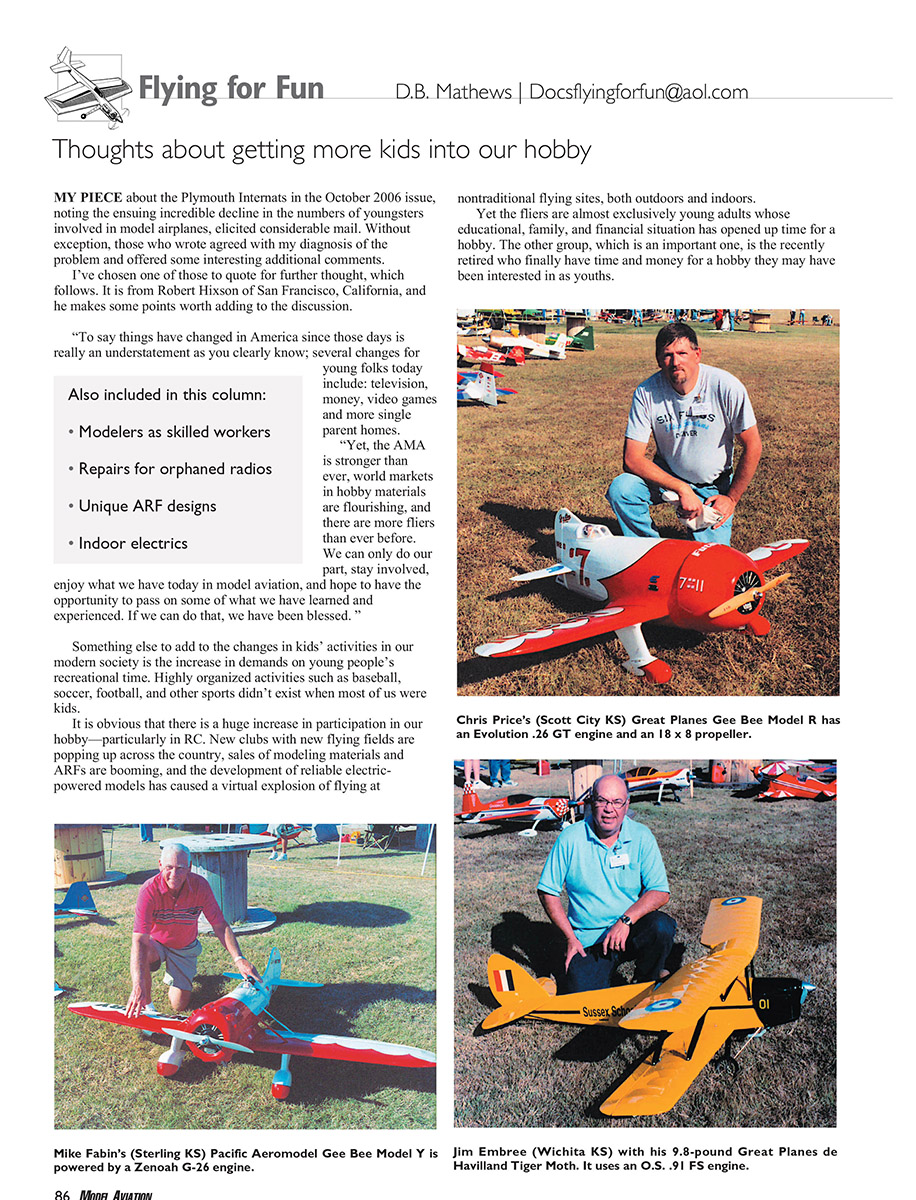
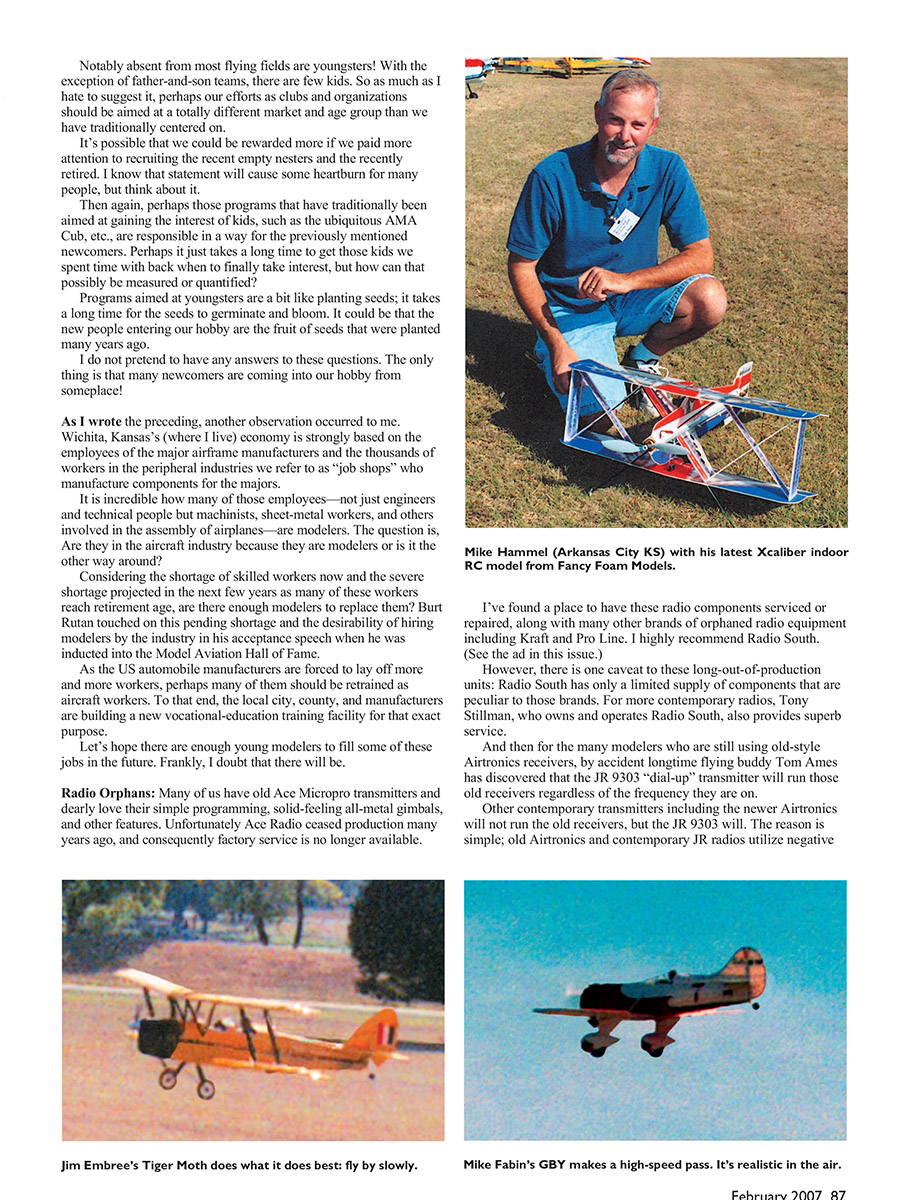
Considering the time period, the brothers found it necessary to raise money by winning air races to keep their civilian sport airplanes' production afloat. For that reason I was delighted to find and photograph the famous—or infamous—R racer and a Y that was originally marketed to the sport pilot but proved to be a successful racer in its power class.
It would appear that Gee Bees were well engineered and built, but a series of misfortunes left the products with an undeserved reputation as "killer airplanes." Many of us have seen the spectacular newsreel footage of the R flown by Lowell Bayles rolling wildly into some railroad tracks and bursting into flames. Conflicting reports on the cause of this crash can be found. One theory is that the right wing of the aircraft fluttered off during the high-speed pass. Elsewhere it is indicated that the filler cap on the fuel tank came off, struck Bayles in the head, and rendered him unconscious.
A year later the Granvilles had produced another R-1, which was flown to victory in the Thompson Trophy Race of 1932. Jimmie Doolittle piloted the aircraft, which was so much faster than the other entries that it lapped the field in that closed-course race of 20 laps.
In 1933 the Granvilles suffered several setbacks that likely led to the company's demise. In July, during the Bendix cross-country race, the R-2 suffered landing-gear damage and was withdrawn. That same day Russell Boardman, who was also competing in an R-1, was killed when the aircraft suffered engine failure during takeoff after refueling in Indianapolis, Indiana. Then on September 1933, 25-year-old pilot Florence Klingensmith lost her life during a Phillips Trophy Race in Chicago, Illinois, when she flew her Model Y into a tree.
By the end of 1933, Granville Brothers Aircraft Company was bankrupt—not necessarily solely as a result of the horrible publicity caused by the accidents, but due to a string of setbacks and financial difficulties.
Transcribed from original scans by AI. Minor OCR errors may remain.

