
A modeler's early experiences
D.B. Mathews | [email protected]
This month's column will not follow a theme, as has been the custom. I thought you might enjoy some quick peeks at unrelated subjects instead.
Actually, all the subjects are related since they involve modelers having fun with their hobby. They begin with a letter from Edwin Moore of New Hampshire. He wrote:
"Regarding your April Flying for Fun; this was read with great interest because my father built a 'Tethered Trainer' about that time (1944). It was framed of basswood or poplar but I can't remember the covering (Silkspan?). He had gotten a prewar Comet 35 motor which we never got running. Either he or I bought a Bullet .275 which ran well.
"He had me release the Tethered Trainer on a baseball diamond and it promptly slacked the lines and crashed at his feet. Unfortunately, neither of us knew anything about opposite wingtip weights, canted line guides, offset thrust, or the effects of dihedral.
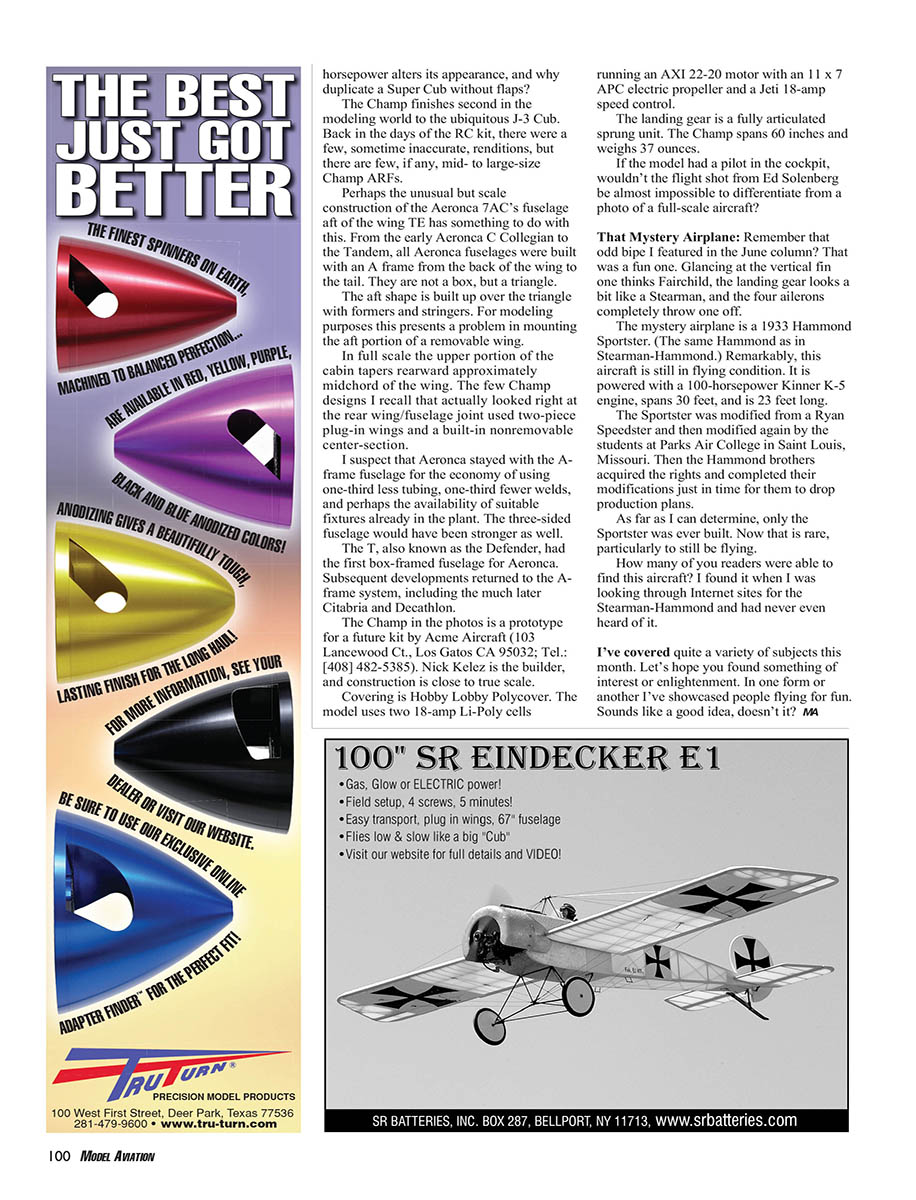
"We then built a Midwest 'Snorky' (CL). A few years back, my second electric RC was a self-designed crutch fuselage with a box pylon for the wing based on that old Snorky."
The Comet 35 Edwin mentions was sold by the familiar Comet Models but built for the company by Earl Vivell pre-World War II. After the war Vivell sold the power plant with his name on it. Since it was one of the first new engines available postwar (about 1945?), I bought one by mail order. I always suspected it was a Comet left over from the prewar period. Nonetheless, mine ran well. It was used in a Buccaneer C Special FF and provided many hours of fun tinkering and even flying.
Edwin had a negative childhood experience with a model airplane, yet he persisted until he was successful and then continued with the hobby for more than 60 years. This raises the question of what personality trait motivated him so much. Countless youngsters have tried the hobby, failed to fly their first models successfully, and never returned. Those of us who have persisted in modeling in spite of the inevitable early disappointments are different from the average person. I hold that to be a virtue, but some would disagree. I have pride in that difference, don't you?
The dividing line: Have you noticed that some model airplanes are reaching huge sizes and that certain tiny man-carrying full-scale designs are actually smaller than models? This brings up the intriguing question of where model airplanes end and Remotely Piloted Vehicles (RPV) begin. (Editor's note: AMA has a model weight limit of 55 pounds. Aircraft that exceed that weight may be flown with a special waiver. See the AMA Safety Code for a complete explanation of this rule.)
Let's compare a huge C-17 Globemaster model built and flown in England and the tiny manned full-scale Cri-Cri built in France. Both are powered with turbines, and their empty weights are close. The 1/9-scale Globemaster III was built in Great Britain for a 15-part series on the Home and Leisure television network. The model is powered by four JetCat P-120 turbines producing 108 pounds of thrust. The Globemaster weighs 250 pounds fueled, spans 20 feet, and the top of the fin is 74 inches high. When I first saw the C-17 I thought, "this is a model airplane?"
Michel Colomban designed the Cri-Cri in 1971, calling it his daughter's nickname in French: cricket. It is an all-metal homebuilt. At one time Zenair Ltd. in Canada produced kits for it, but no longer.
The Cri-Cri will accommodate a wide range of engines, including those used in large model airplanes, lawn mowers, motorcycles, and turbines. The AMT Olympus turbines from the Netherlands produce a total of 80 pounds of thrust.
The Cri-Cri's wing spans 4.9 meters (15.97 feet) and its empty weight is 63 kilograms (139 pounds). The aircraft is capable of a maximum speed, depending on power, of 250 kilometers per hour. It will maintain altitude on one engine.
More than 150 Cri-Cris are currently flying in several countries.
This aircraft can be registered in the "Sportsman" category in the US.
Young at Heart
I have included a photo of Earl Hoffman of California launching his rubber-powered twin pusher. What is astonishing is that Earl is 94 years of age.
When you start thinking you're too old to be building and flying, think about Earl. And I'll bet he is not the oldest active flier around, either.
Twin pushers have been around since at least the early 1900s. The first published construction articles for flying models had that layout.
Some SAM (Society of Antique Modelers) contests include an event for twin pushers. They fly rather well, sometimes better than newer designs, and they will thermal although they look odd doing it.
Many of these old designs used hardwood—not balsa—because balsa didn't come onto the scene as a construction material until much later. The hand-carved twin propellers were contra-rotating. The rubber was wound accordingly. These models were covered with tissue and sealed with either banana oil or nitrate dope.
Champ
During a tour of Alaska several years ago I couldn't help but notice the huge number of float-equipped aircraft bobbing on seemingly every lake or river. The reason is obvious: Alaska has very few roads, runways, or highways but many suitable places for floatplanes.
In the more remote regions of Alaska's interior, the only contact with the outside world is by floatplane, helicopter, or, in a few instances, primitive landing strips. Bush pilots have been delivering everything (even groceries) since the 1920s.
There are no roads into the state capital of Juneau. Fortunately it is on the Pacific Ocean, but you can't drive to it and from it.
The variety of float-equipped aircraft I saw during my touring was interesting. There were de Havilland twin-turboprop Otters, Beavers, a ton of Cessna 170-182s, quite a few Aeronca Champs, Piper Super Cubs and clones, but absolutely no Piper Cubs.
The Cub has enough power to get off the water but is too underpowered to obtain safe altitudes in the mountainous terrain. So why were there Champs?
I was told that it was relatively simple to change the Champ's original 65-horsepower engine to an 85-horsepower or larger engine with few visible exterior modifications. Increasing a Cub's horsepower alters its appearance, and why duplicate a Super Cub without flaps?
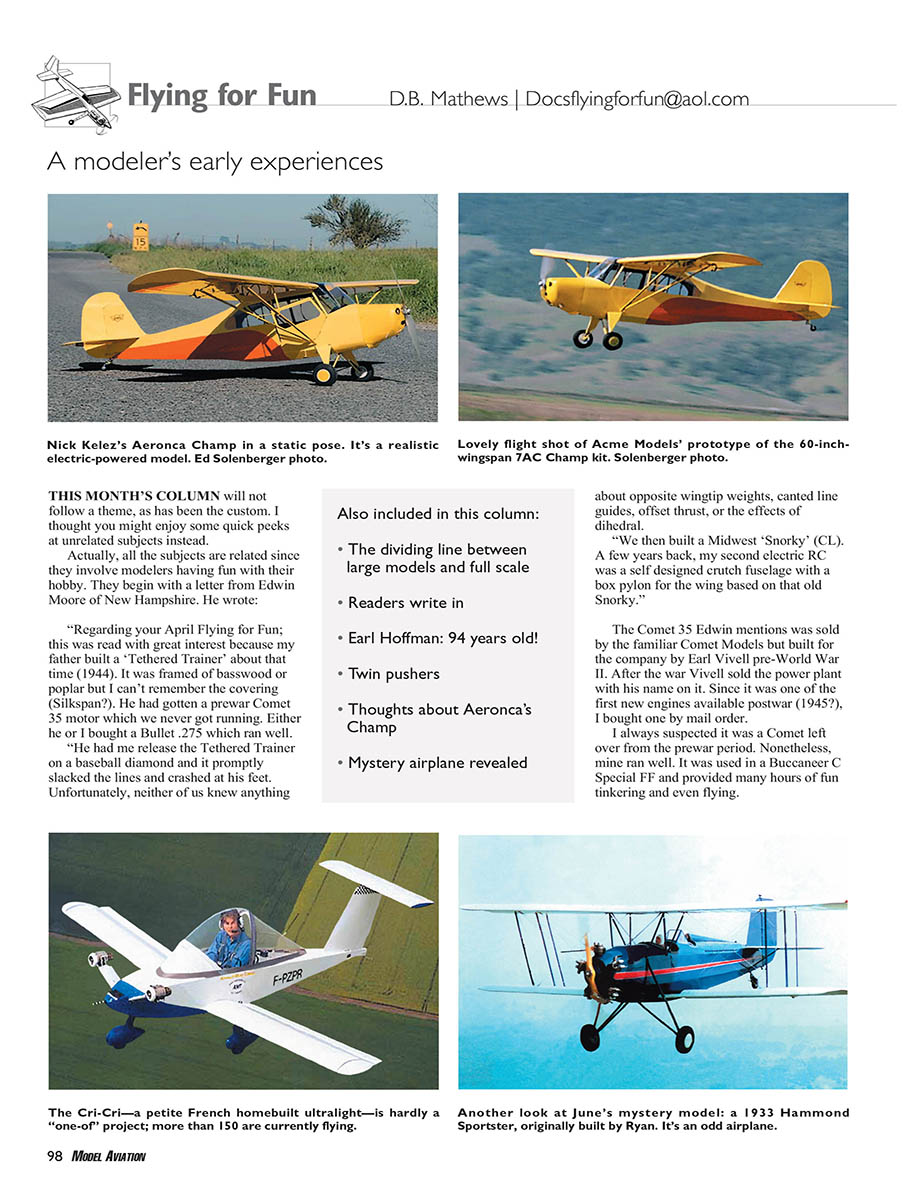
The Champ finishes second in the modeling world to the ubiquitous J-3 Cub. Back in the days of the RC kit, there were a few, sometimes inaccurate, renditions, but there are few, if any, mid- to large-size Champ ARFs.
Perhaps the unusual but scale construction of the Aeronca 7AC's fuselage aft of the wing has something to do with this. From the early Aeronca C Collegian to the Tandem, all Aeronca fuselages were built with an A-frame from the back of the wing to the tail. It was not a box, but a triangle.
The aft shape is built up over the triangle with formers and stringers. For modeling purposes this presents a problem in mounting the aft portion of a removable wing.
In full scale the upper portion of the cabin tapers rearward approximately midchord of the wing. The few Champ designs I recall that actually looked right at the rear wing/fuselage joint used two-piece plug-in wings and a built-in nonremovable center-section.
I suspect that Aeronca stayed with the A-frame fuselage for the economy of using one-third less tubing, one-third fewer welds, and perhaps the availability of suitable fixtures already in the plant. The three-sided fuselage would have been stronger as well.
The T, also known as the Defender, had the first box-framed fuselage for Aeronca. Subsequent developments returned to the A-frame system, including the much later Citabria and Decathlon.
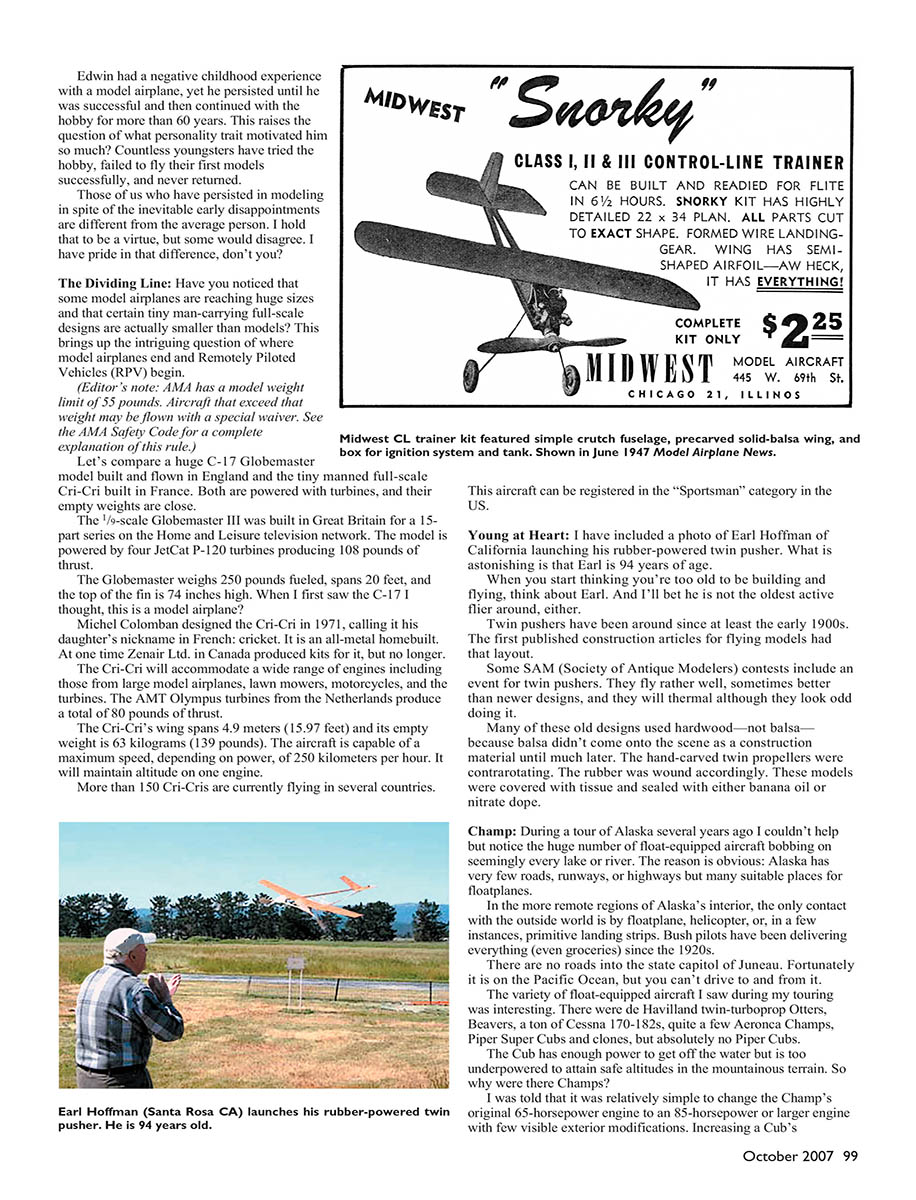
The Champ in the photos is a prototype for a future kit by Acme Aircraft (103 Lancewood Ct., Los Gatos CA 95032; Tel.: [408] 482-8585). Nick Kelez is the builder, and construction is close to true scale.
Covering is Hobby Lobby Polycover. The model uses two 18-amp Li-Poly cells running an AXI 22-20 motor with an 11 x 7 APC electric propeller and a Jeti 18-amp speed control.
The landing gear is a fully articulated sprung unit. The Champ spans 60 inches and weighs 37 ounces.
If the model had a pilot in the cockpit, wouldn't the flight shot from Ed Solenberger be almost impossible to differentiate from a photo of a full-scale aircraft?
That Mystery Airplane
Remember that odd biplane I featured in the June column? That was a fun one. Glancing at the vertical fin one thinks Fairchild, the landing gear looks a bit like a Stearman, and the four ailerons completely throw one off.
The mystery airplane is a 1933 Hammond Sportster (the same Hammond as in Stearman-Hammond). Remarkably, this aircraft is still in flying condition. It is powered with a 100-horsepower Kinner K-5 engine, spans 30 feet, and is 23 feet long.
The Sportster was modified from a Ryan Speedster and then modified again by the students at Parks Air College in St. Louis, Missouri. Then the Hammond brothers acquired the rights and completed their modifications just in time for them to drop production plans.
As far as I can determine, only the Sportster was ever built. Now that is rare, particularly so if still flying.
How many of you readers were able to find this aircraft? I found it when I was looking through Internet sites for the Stearman-Hammond and had never even heard of it.
I've covered quite a variety of subjects this month. Let's hope you found something of interest or entertainment. In one form or another I've showcased people flying for fun. Sounds like a good idea, doesn't it?
MA
Transcribed from original scans by AI. Minor OCR errors may remain.

