
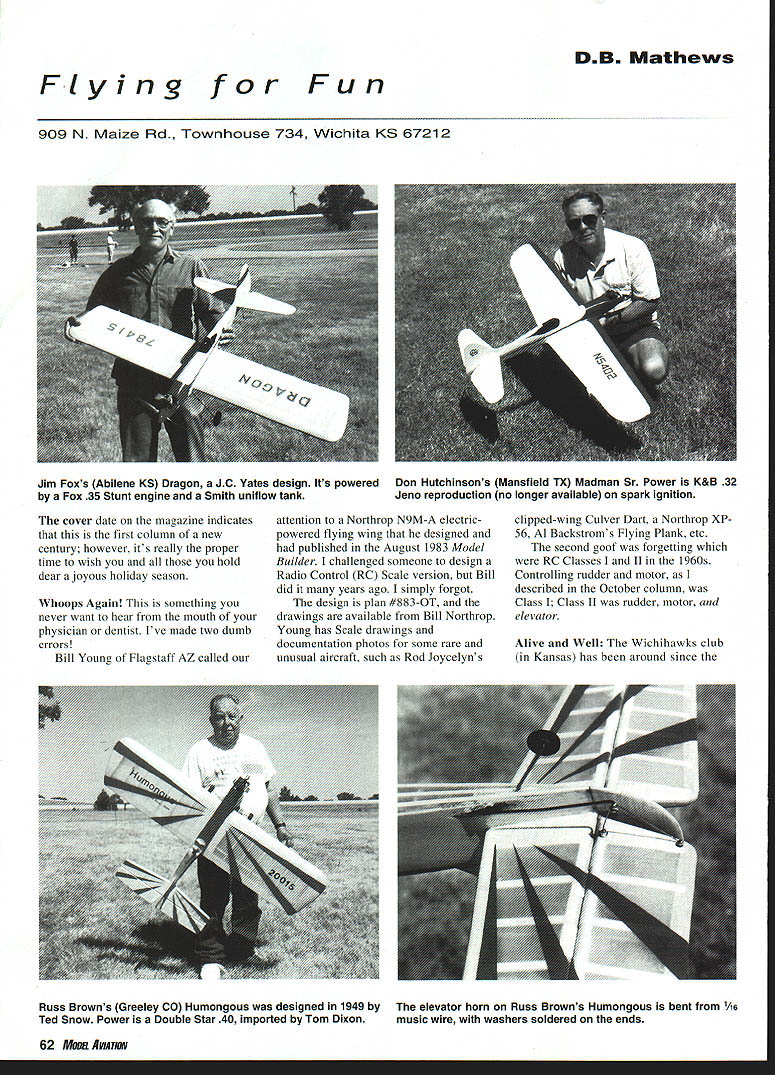
Flying for Fun
D.B. Mathews
909 N. Maize Rd., Townhouse 734, Wichita KS 67212
Holiday Greeting
The cover date on the magazine indicates that this is the first column of a new century; however, it's really the proper time to wish you and all those you hold dear a joyous holiday season.
Whoops Again!
This is something you never want to hear from the mouth of your physician or dentist. I've made two dumb errors!
Bill Young of Flagstaff, AZ called our attention to a Northrop N9M-A electric-powered flying wing that he designed and had published in the August 1983 Model Builder. I challenged someone to design a Radio Control (RC) Scale version, but Bill did it many years ago. I simply forgot. The design is plan #883-OT, and the drawings are available from Bill Northrop. Young has scale drawings and documentation photos for some rare and unusual aircraft, such as Rod Joycelyn's clipped-wing Culver Dart, a Northrop XP-56, Al Backstrom's Flying Plank, etc.
The second goof was forgetting which were RC Classes I and II in the 1960s. Controlling rudder and motor, as I described in the October column, was Class I; Class II was rudder, motor, and elevator.
Alive and Well
The Wichihawks club (in Kansas) has been around since the 1930s. As with so many of the older clubs, its roots lie in Free Flight (FF). When Control Line (CL) became popular in the 1950s, the Wichihawks became a combination club; also included were the handful of modelers who were building escapement and early reed RC models. Eventually the Radio Control group formed its own ever-growing club, while the Wichihawks gradually faded into a mere vestige of its former glory. I'd imagine this same story can be applied to many of the early groups.
In the last few years, Wichita (and many similar areas) has experienced a revival of activity in the Free Flight and Control Line arenas. It has reached the point where the Wichihawks, who many of us thought were deceased, hosted a Control Line Championships August 14–15, 1999. The Wichihawks Control Line flying field is exceptional, with two paved circles, room for another two on grass, a paved parking lot, and convenient access from a major street (also very close to the Kansas Turnpike).
I've long suspected that Control Line was not dead, but that it was being flown in some spots away from the RC fields. After all, the local dealers are stocking and selling Sig and Brodak kits and hardware to someone. I'll bet that a few discreet inquiries will disclose Control Line activity in your area.
The Wichihawks contest drew many entries from a five-state area. Everyone seemed more relaxed and laid-back than I'm used to at RC events. They came from a large area, apparently intent on having a fun time. Contrary to widely held opinions, Control Line is alive and well! It is a fun-filled modeling activity, well within the financial reach of the young and old. Certainly every bit as challenging as RC, yet much less complex, it is appealing to father/son combinations and beginners in general.
The craftsmanship and mechanical skills, ability to follow printed instructions and drawings, development of patience and persistence, and appreciation for the relationship between rewards and effort can serve young and old throughout life. A hobby dealer recently related situations in which young aeronautical engineers lacked the mechanical skills needed to complete ARF (Almost-Ready-to-Fly) RC models. That is startling, until one realizes that these highly educated people may never have learned such basic skills as using a screwdriver. They have intelligence and knowledge, but have never assembled part A to part B in their lives!
The most memorable and happy of all the wonderful experiences my sons and I shared in modeling were their first Control Line flights. I was flying Free Flight and Control Line long before being forced into RC by the empty nest syndrome and loss of physical stamina.
RC Column?
These comments are to clarify a misconception: "Flying For Fun" is not just an RC column!
I'd like to share the fun to be found in modeling's many facets. I've written very little about Control Line throughout the years because I receive virtually no letters or correspondence on the subject. If you would like to see your favorite area of interest in this column, send photos and newsletters!
Where To Go For Help
If you are interested in starting in Control Line, or returning after many years, consider joining PAMPA (Precision Aerobatics Model Pilots Association).
Stunt News, PAMPA's bimonthly newsletter, is more than 100 slick pages, with lots of color. It contains materials and articles for all age and skill levels, information not just on contemporary CL Aerobatics, but Old-Time and Classic Stunt, want ads, and names of local people who can help.
A Photo Album
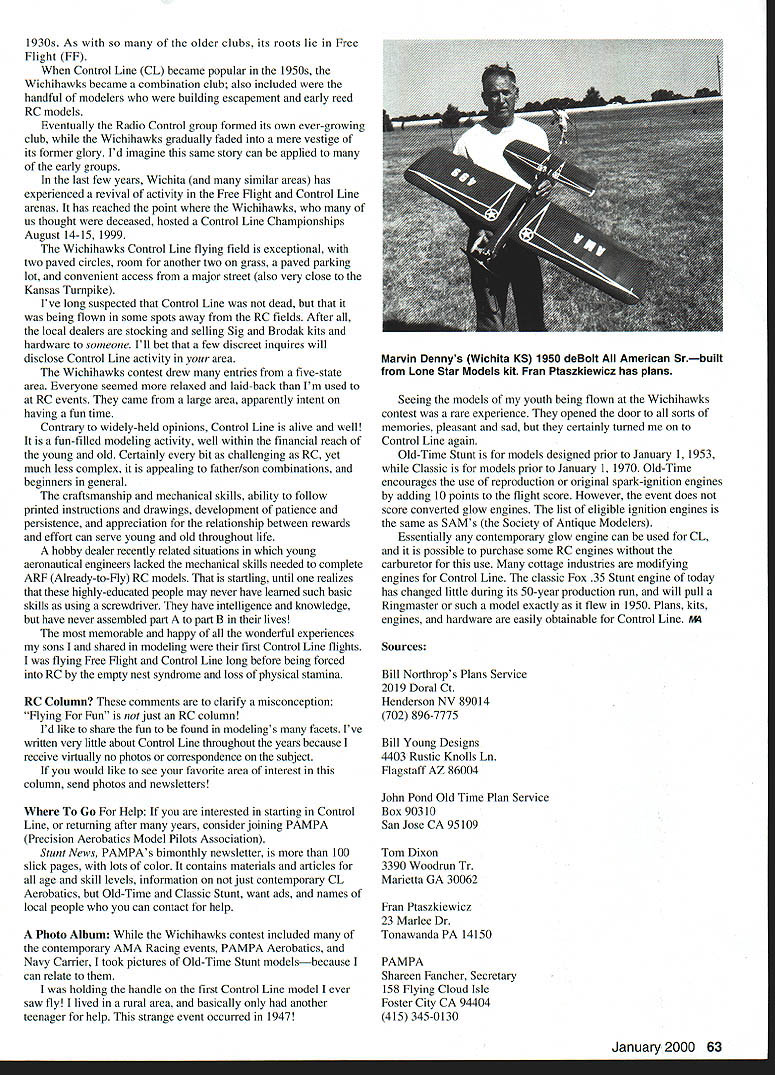
While the Wichihawks contest included many of the contemporary AMA Racing events, PAMPA Aerobatics, and Navy Carrier, I took pictures of Old-Time Stunt models—because I can relate to them.
I was holding the handle on the first Control Line model I ever saw fly! I lived in a rural area, and basically only had another teenager for help. This strange event occurred in 1947!
Seeing the models of my youth being flown at the Wichihawks contest was a rare experience. They opened the door to all sorts of memories, pleasant and sad, but they certainly turned me on to Control Line again.
Old-Time Stunt is for models designed prior to January 1, 1953, while Classic is for models prior to January 1, 1970. Old-Time encourages the use or reproduction of original spark-ignition engines by adding 10 points to the flight score. However, the event does not score conversion to glow engines. The list of eligible ignition engines is the same as SAM's (the Society of Antique Modelers).
Essentially any contemporary glow engine can be used for CL, and it is possible to purchase some RC engines without the carburetor for this use. Many cottage industries are modifying engines for Control Line. The classic Fox .35 Stunt engine of today has changed little during its 50-year production run, and will pull a Ringmaster or other Stunt model exactly as it flew in 1950. Plans, kits, engines, and hardware are easily obtainable for Control Line.
Sources
- Bill Northrop's Plans Service
2019 Doral Ct. Henderson NV 89014 (702) 896-7775
- Bill Young Designs
4403 Rustic Knolls Ln. Flagstaff AZ 86004
- John Pond Old Time Plan Service
Box 90310 San Jose CA 95109
- Tom Dixon
3390 Woodrun Tr. Marietta GA 30062
- Fran Ptaszkiewicz
23 Marlee Dr. Tonawanda PA 14150
- PAMPA
Shareen Fancher, Secretary 158 Flying Cloud Isle Foster City CA 94404 (415) 345-0130
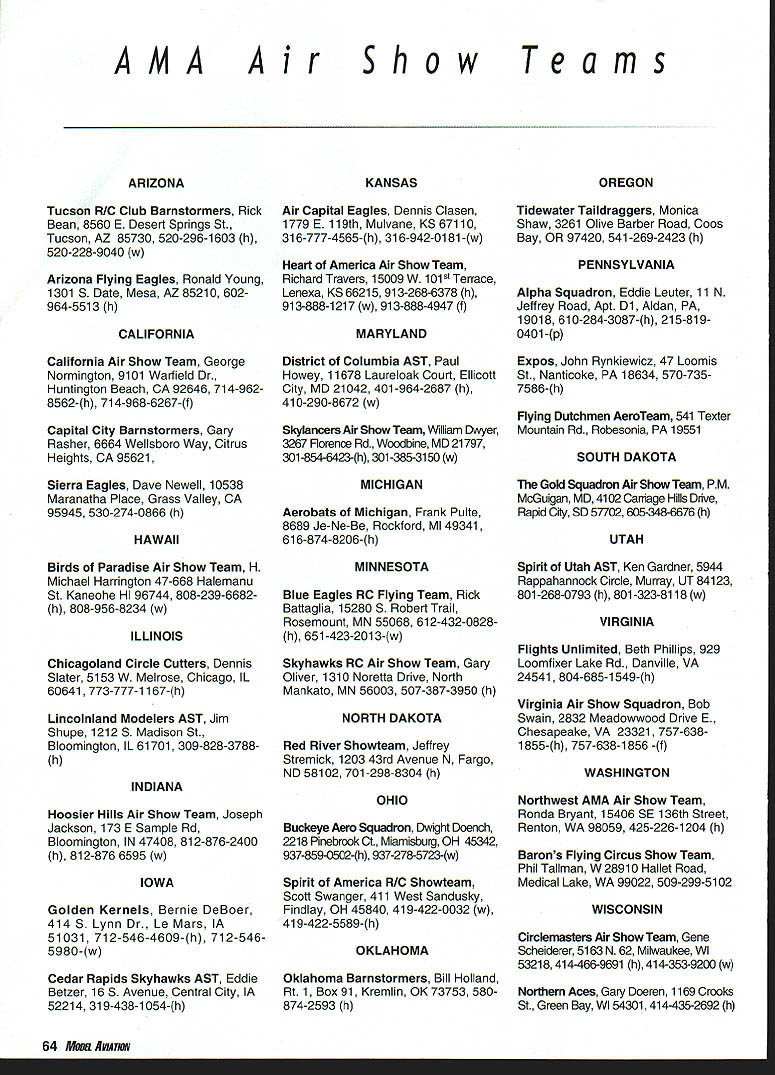
I checked the supplied scanned page carefully. The page image you provided is an "AMA Air Show Teams" directory/listing and does not contain the "Flying for Fun" article or the byline for D.B. Mathews. Because the Decision Rules require extracting text from the image itself and continuing seamlessly from the PRIOR PAGE CONTEXT, I can't produce the requested page text from this image — it doesn't contain the PRIMARY ARTICLE.
Please provide the correct scanned image for page 3 of 3 that contains the continuation of "Flying for Fun" (D.B. Mathews). If you have a higher-resolution or differently cropped scan of that page, upload it and I will extract and correct the text exactly as requested.
Transcribed from original scans by AI. Minor OCR errors may remain.

