
Flying for Fun
D.B. Mathews
909 N. Maize Rd., Townhouse 734, Wichita KS 67212
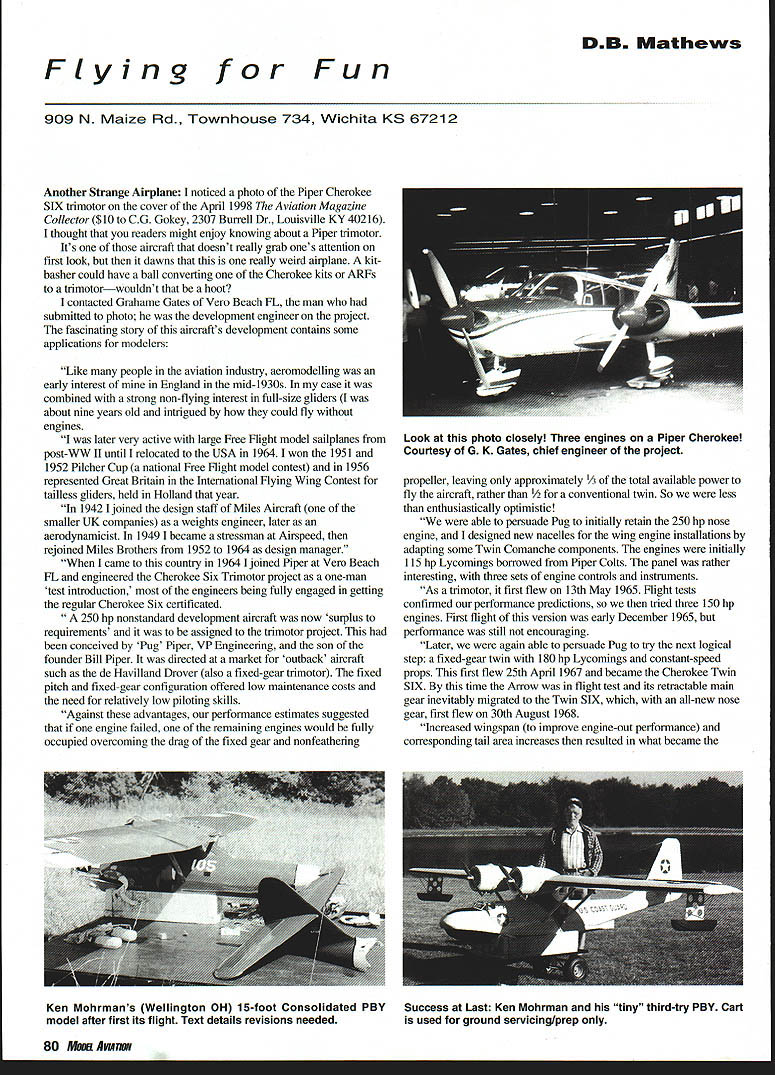
Another Strange Airplane: I noticed a photo of the Piper Cherokee Six trimotor on the cover of the April 1998 The Aviation Magazine Collector (S10 to C.G. Gokey, 2307 Burrell Dr., Louisville KY 40216). I thought that you readers might enjoy knowing about a Piper trimotor.
It's one of those aircraft that doesn't really grab one's attention on first look, but then it dawns that this is one really weird airplane. A kitbasher could have a ball converting one of the Cherokee kits or ARFs to a trimotor—wouldn't that be a hoot?
I contacted Grahame Gates of Vero Beach, FL, the man who had submitted the photo; he was the development engineer on the project. The fascinating story of this aircraft's development contains some applications for modelers:
"Like many people in the aviation industry, aeromodelling was an early interest of mine in England in the mid-1930s. In my case it was combined with a strong non-flying interest in full-size gliders (I was about nine years old and intrigued by how they could fly without engines).
"I was later very active with large Free Flight model sailplanes from post-WWII until I relocated to the USA in 1964. I won the 1951 and 1952 Pilcher Cup (a national Free Flight model contest) and in 1956 represented Great Britain in the International Flying Wing Contest for tailless gliders, held in Holland that year.
"In 1942 I joined the design staff of Miles Aircraft (one of the smaller UK companies) as a weights engineer, later as an aerodynamicist. In 1949 I became a stressman at Airspeed, then rejoined Miles Brothers from 1952 to 1964 as design manager.
"When I came to this country in 1964 I joined Piper at Vero Beach, FL, and engineered the Cherokee Six Trimotor project as a one-man test introduction, most of the engineering efforts being fully engaged in getting the regular Cherokee Six certified.
"A 250 h.p. nonstandard development aircraft was now 'surplus to requirements' and it was to be assigned to the trimotor project. This had been conceived by 'Pug' Piper, VP Engineering, and the son of the founder Bill Piper. It was directed at a market for 'outback' aircraft such as the Haviland Drover (also a fixed-gear trimotor). The fixed pitch and fixed-gear configuration offered low maintenance costs and the need for relatively low piloting skills.
"Against these advantages, our performance estimates suggested that if one engine failed, one of the remaining engines would be fully occupied overcoming the drag of the fixed gear and nonfeathering propeller, leaving only approximately 1/3 of the total available power to fly the aircraft, rather than 1/2 for a conventional twin. So we were less than enthusiastically optimistic!
"We were able to persuade Pug to initially retain the 250 h.p. nose engine, and I designed new nacelles for the wing engine installations by adapting some Twin Comanche components. The engines were initially 115 h.p. Lycomings borrowed from Piper Colts. The panel was rather interesting, with three sets of engine controls and instruments.
"As a trimotor, it first flew on 13th May 1965. Flight tests confirmed our performance predictions, so we then tried three 150 h.p. engines. First flight of that version was early December 1965, but performance was still not encouraging.
"Later, we were again able to persuade Pug to try the next logical step; a fixed-gear twin with 180 h.p. Lycomings and constant-speed props. This first flew 25th April 1967 and became the Cherokee Twin Six. By this time the Arrow was in flight test and its retractable main gear inevitably migrated to the Twin Six, which, with an all-new nose gear, first flew on 30th August 1968.
"Increased wing span (to improve engine-out performance) and corresponding tail area increases then resulted in what became the Seneca, first flying on 20th October 1969. This development has now been in production for nearly 30 years as the Seneca V."
Grahame Gates became Corporate Director of Advanced Engineering for Piper before his retirement.
Conclusions: Notice the similarity in the development process between the full-scale aircraft mentioned and original-design model airplanes. It is rare indeed to start by scratching lines on a blank piece of paper without making slow and calculated changes to the original concept as flying tests progress. Although the trimotor Cherokee didn't work out, subsequent applications of knowledge obtained in flying the prototypes eventually led to a highly successful airplane.
The same range of experiences awaits anyone designing model airplanes from scratch, and that's where the fun lies. Actually, these changes in search of perfection also apply to plan-built or kit-built models.
Please reread Gates' comments concerning adding wing and horizontal stab area to improve single-engine performance. Modelers tend to reduce area to compensate for low power, and only compound the problem. Notice the area and weight of many of those early low-powered homebuilts and inexpensive production airplanes (Longs, Heaths, Rearwin Jr.s, Taylor E-2s, Aeronca C-2s, etc.) was increased to compensate for the low power of their Aeronca Twins, Continental A-4s, and converted motorcycle engines.
There are lessons here for all of us.
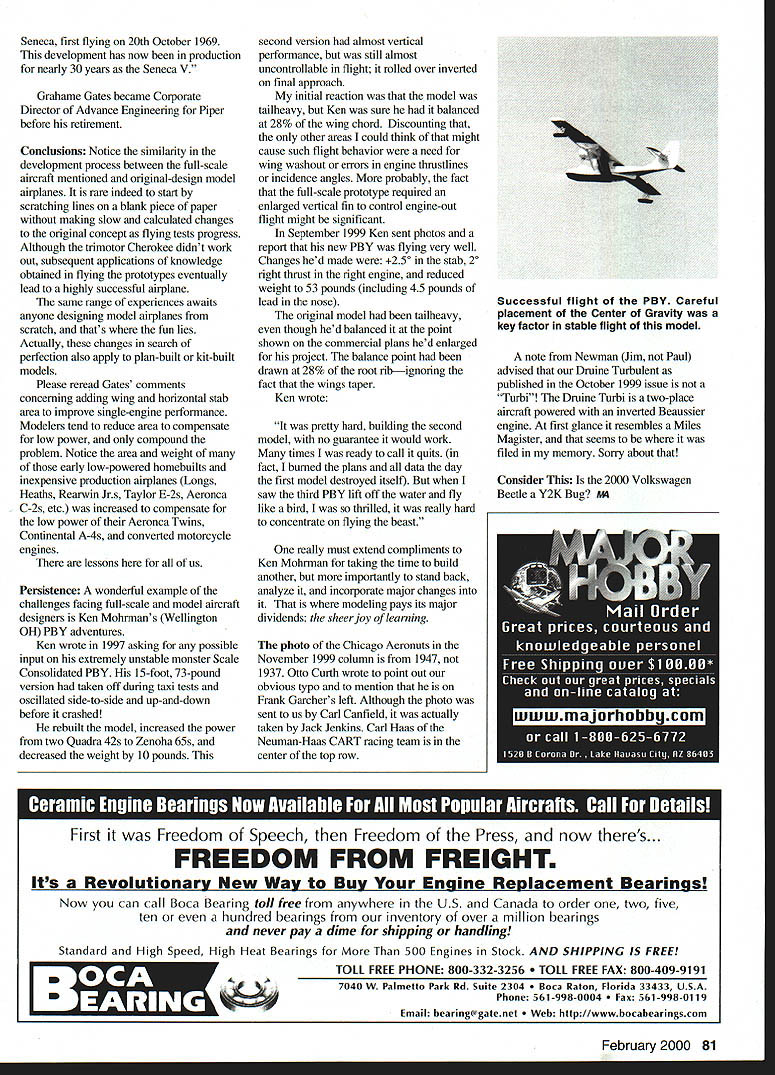
Persistence: A wonderful example of the challenges facing full-scale and model aircraft designers is Ken Mohrman's (Wellington, OH) PBY adventures.
Ken wrote in 1997 asking for any possible input on his extremely unstable monster-scale Consolidated PBY. His 15-foot, 703-pound version had taken off during taxi tests and oscillated side-to-side and up-and-down before it crashed!
He rebuilt the model, increased the power from two Quadra 42s to Zenoha 65s, and decreased the weight by 10 pounds. This second version had almost vertical performance, but was still almost uncontrollable in flight; it rolled over inverted on final approach.
My initial reaction was that the model was tailheavy, but Ken was sure he had it balanced at 28% of the wing chord. Discounting that, the only other areas I could think of that might cause such flight behavior were a need for wing washout or errors in engine thrustlines or incidence angles. More probably, the fact that the full-scale prototype required an enlarged vertical fin to control engine-out flight might be significant.
In September 1999 Ken sent photos and a report that his new PBY was flying very well. Changes he'd made were:
- +2.5° in the stab
- 2° right thrust in the right engine
- reduced weight to 53 pounds (including 4.5 pounds of lead in the nose)
The original model had been tailheavy, even though he'd balanced it at the point shown on the commercial plans he'd enlarged for his project. The balance point had been drawn at 28% of the root rib—ignoring the fact that the wings taper.
Ken wrote:
"It was pretty hard, building the second model, with no guarantee it would work. Many times I was ready to call it quits. (In fact, I burned the plans and all data the day the first model destroyed itself). But when I saw the third PBY lift off the water and fly like a bird, I was so thrilled, it was really hard to concentrate on flying the beast."
One really must extend compliments to Ken Mohrman for taking the time to build another, but more importantly to stand back, analyze it, and incorporate major changes into it. That is where modeling pays its major dividends: the sheer joy of learning.
The photo of the Chicago Aeronauts in the November 1999 column is from 1947, not 1937. Otto Court wrote to point out our obvious typo and to mention that he is on Frank Garcher's left. Although the photo was sent to us by Carl Canfield, it was actually taken by Jack Jenkins. Carl Haas of the Newman-Haas CART racing team is in the center of the top row.
Transcribed from original scans by AI. Minor OCR errors may remain.

