
Flying for Fun
D.B. Mathews
909 N. Maize Rd., Townhouse 734, Wichita KS 67212
As I prepared to write this month's column, a question kept nagging me: why did aviation, and more specifically, model aviation, so excite the American public in the 1930s?
What happened to that excitement? Why did so many organizations, companies, parents, and educators put so much effort into guiding and encouraging youngsters in modeling back then, and so few do so now?
Those of us who have found a lifetime of enjoyment with modeling want to share that joy with others, and find frustration in the public's seeming indifference to our efforts. Undeniably, more and more new faces are coming into modeling, not as creators or craftsmen, but as fliers. Like it or not, the hobby is becoming more a sport and less a craft.
Let me share my rationalization for this change in national attitude.
Think back through the history of the Industrial Revolution. The "hot" technologies and the fields with greatest promise for jobs and wealth have changed dramatically during the last two centuries.
Young people were encouraged, and had a natural interest, in pursuing careers in a series of new technologies as they came on the scene: steamboats, trains, telegraph, telephone, radio, automobiles, aviation, television, computers, rocketry, space, and currently the Internet have all been the "latest and greatest" developments and the hot fields for young people.
The driving force behind all of this has been the promise of a new and exciting career: "get in on the ground floor."
The industrialized world saw great potential in aviation in the 1920s and 1930s. Consider the explosion in municipal airport construction during that era, the news media's positive and upbeat coverage of aviation, or the fact that the most overpriced stocks were aircraft manufacturers of the late 1920s. (You investors can certainly think of contemporary examples of that.) The Kansas Aviation Museum has a display of worthless stock certificates from startup aircraft manufacturers, most of whom no one remembers.
It's little wonder that civic clubs, schools, government, and parents offered youngsters so much encouragement when it came to model airplanes; they were pointing young people in the direction of a "sky's the limit" vocation.
Following this puny line of thought, perhaps we should again place emphasis on modeling, not so much as a method of entertaining youngsters but as a good citizen's, as a career development path.
At least here in Wichita, there is a severe shortage of skilled workers at the major aircraft manufacturers, the "job component" shops, Coleman, and the building trades.
The model airplane hobby has historically been a positive influence on many lives. People such as Neil Armstrong, Burt Rutan, Dr. Paul MacCready, and Max Blekc, not to mention the thousands of unnamed people who have made careers in aviation, have led fulfilling lives and contributed greatly to the nation.
Unfortunately, time is gradually leaving a void in the industries that needs to be addressed, and model aviation may be one of the solutions.
For fun, let's take a look at the incredible interest in modeling found in every hamlet and metropolis in the late 1920s through the 1940s.
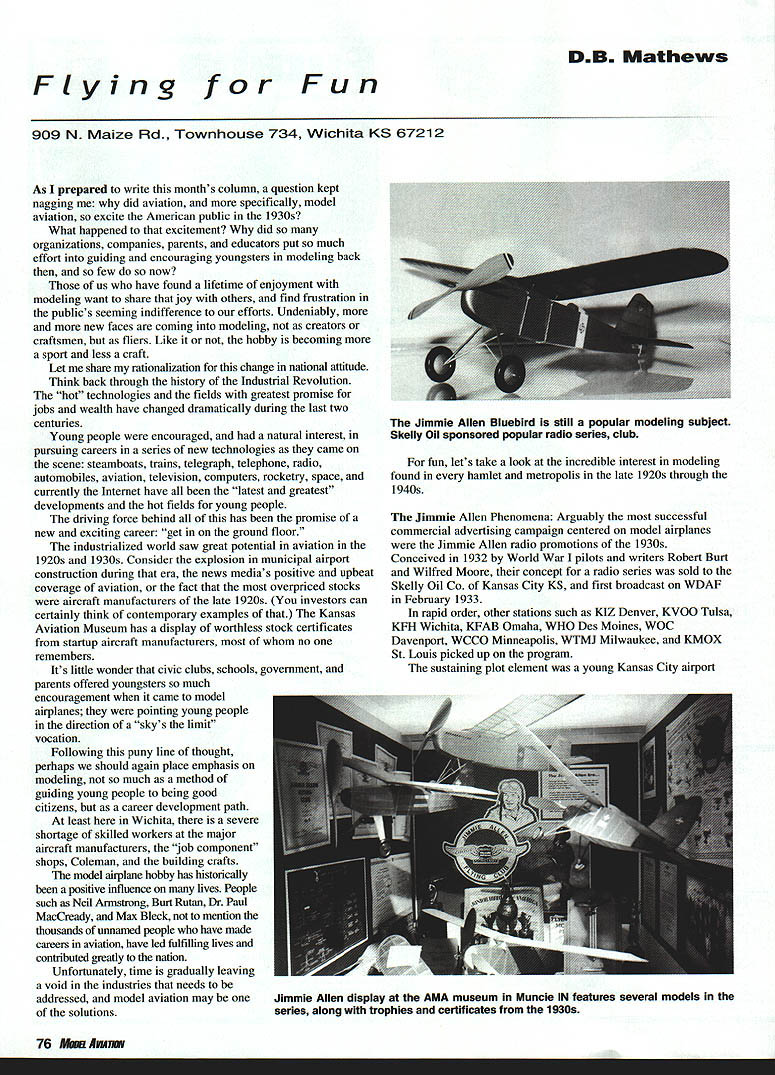
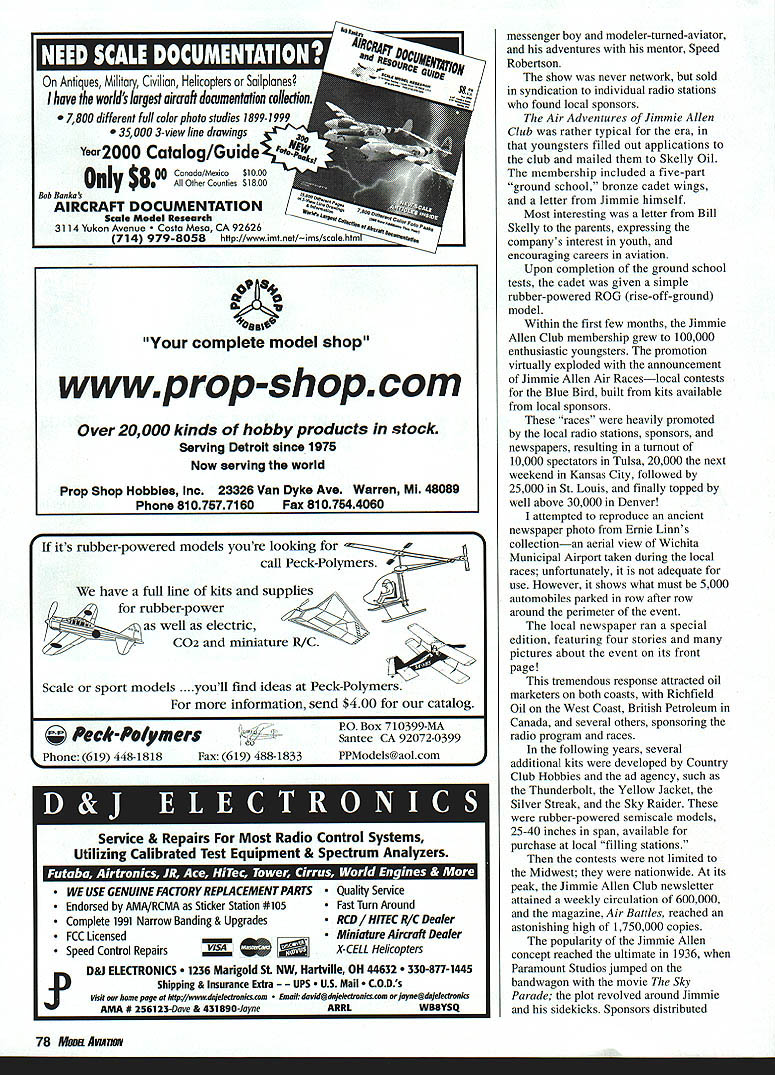
The Jimmie Allen Phenomenon: Arguably the most successful commercial advertising campaign centered on model airplanes were the Jimmie Allen radio promotions of the 1930s. Conceived in 1932 by World War I pilots and writers Robert Burt and Wilfred Moore, their concept for a radio series was sold to the Skelly Oil Co. of Kansas City KS, and first broadcast on WDAF in February 1933.
In rapid order, other stations such as KIZ Denver, KVOO Tulsa, KFH Wichita, KFAB Omaha, WHO Des Moines, WOC Davenport, WCCO Minneapolis, WTMJ Milwaukee, and KMOX St. Louis picked up on the program.
The sustaining plot element was a young Kansas City airport agent, along with trophies and certificates from the 1930s. messenger boy and modeler-turned-aviator, and his adventures with his mentor, Speed Robertson.
The show was never network, but sold in syndication to individual radio stations who found local sponsors.
The Air Adventures of Jimmie Allen Club was rather typical for the era, in that youngsters filled out applications to the club and mailed them to Skelly Oil. The membership included a five-part "ground school," bronze cadet wings, and a letter from Jimmie himself.
Most interesting was a letter from Bill Skelly to the parents, expressing the company's interest in youth, and encouraging careers in aviation.
Upon completion of the ground school tests, the cadet was given a simple rubber-powered ROG (rise-off-ground) model.
Within the first few months, the Jimmie Allen Club membership grew to 100,000 enthusiastic youngsters. The promotion virtually exploded with the announcement of Jimmie Allen Air Races—local contests for the Blue Bird, built from kits available from local sponsors.
These "races" were heavily promoted by the local radio stations, sponsors, and newspapers, resulting in a turnout of 10,000 spectators in Tulsa, 20,000 the next weekend in Kansas City, followed by 25,000 in St. Louis, and finally topped by well above 30,000 in Denver!
I attempted to reproduce an ancient newspaper photo from Ernie Linn's collection—an aerial view of Wichita Municipal Airport taken during the local races; unfortunately, it is not adequate for use. However, it shows what must be 5,000 automobiles parked in row after row around the perimeter of the field.
The local newspaper ran a special edition, featuring four stories and many pictures about the event on its front page!
This tremendous response attracted oil marketers on both coasts, with Richfield Oil on the West Coast, British Petroleum in Canada, and several others, sponsoring the radio program and races.
In the following years, several additional kits were developed by Country Club Hobbies and the ad agency, such as the Thunderbolt, the Yellow Jacket, the Silver Streak, and the Sky Raider. These were rubber-powered semiscale models, 25–40 inches in span, available for purchase at local "flying stations."
Then the contests were not limited to the Midwest; they were nationwide. At its peak, the Jimmie Allen Club newsletter attained a weekly circulation of 600,000, and the magazine, Air Battles, reached an astonishing high of 1,750,000 copies.
The popularity of the Jimmie Allen concept reached the ultimate in 1936, when Paramount Studios jumped on the bandwagon with the movie The Sky Parade; the plot revolved around Jimmie and his sidekicks. Sponsors distributed 600,000 promotional posters to customers for this movie.
To put a perspective on numbers like those, the population of the United States in 1932 was roughly one-half of what it is today!
In 1937, Skelly Oil withdrew its sponsorship and commissioned Burt and Moore to develop a new show. This evolved into another classic aviation-centered radio series, Captain Midnight.
However, The Air Adventures of Jimmie Allen did continue, dependent on local sponsors well into the mid-1940s.
One can only speculate how many young men and women were directed to aviation careers as a result of the Jimmie Allen phenomena, but its impact surely ranks as one of the most successful aviation-based promotions of all time.
This brief overview is based on material written by Walter House of Wichita for the November 1980 and December 1980 Model Builder magazines. Walter's comprehensive and well-researched article and photos are a very good read. I will send you photocopies of the article if you include a large (#10) self-addressed stamped envelope.
The Rest of The Story (Paul Harvey style): The following material is from Claude McCullough.
"Fifty years ago, even if they ate their Wheaties™, young modelers didn't tune in
Jack Armstrong the All American Boy on the Atwater-Kent in the living room when they got home from school. They listened, instead, to The Adventures of Jimmie Allen and his pilot friend Speed Robertson. Jimmie was a model builder who hung around the airport and got involved in situations in which he and Speed defeated various bad guys.
"In our area, the Jimmie Allen program was sponsored by Skelly Oil and broadcast over WHO, the 50,000 watt clear channel 'Voice of the Midwest' in Des Moines. One day, Jimmie designed and built a good-flying new rubber job. Speed suggested they put on a contest during the summer for the design. At the end of the episode, the announcer filled in the information on where to get the kit and entry blanks. The local Skelly gas station didn't know what I was talking about when I arrived there minutes later, but they checked into the situation and got me a kit and the paperwork.
"'Up to that time, I and the other model builders in Ottawa had only built rubber-powered scale models. These were stick-and-former construction, so we didn't have a lot of trouble building the new ships. After some trial glides off the chicken house, I wound mine up and was elated at how much better it flew than anything I had built or seen before. Clearly, I was Iowa's answer to Gordon Light (modeling pioneer).
"Then the combined clout of WHO and Skelly was sufficient to shut down the" Des Moines Municipal Airport for full-scale aviation for the day of competition. As my family was parking next to the big hangar, my optimistic outlook was swiftly deflated. A dozen "Bluebirds" were in the air in near-dead-calm perfect weather, all of them flying higher and longer than my crude effort had ever imagined. Chastened, but even more interested, I spent most of the time looking over the flying shoulders of the best fliers trying to figure out their workmanship and flying secrets, and did little flying myself. I quickly picked up valuable techniques and ideas that our isolated group had never heard of.
"The highlight of the meet was the demonstration flight of a Brown Jr.-powered Kovel-Grant. The K-G I rose to a good altitude and glided down to a landing not far from where it took off.
"Another feature was the spirited public address commentary and 'remote' broadcast from the site by WHO's well-known sportscaster. I watched him perform as he sat in the shade of an awning on the PA truck. He was famous for 'recreating' baseball games off the teletype. He could cast a scene which came more from his imagination than what was actually going on in a big league ball park. While a rubber-powered contest is interesting to model builders like myself, he was able to make it sound exciting to the numerous spectators and listeners.
"Not long after the Jimmie Allen contest, this sportscaster from WHO made a trip, on a sports assignment, to California. While there, he visited a friend, Joy Hodges, a Des Moines starlet who steered him to an agent, who in turn arranged a screen test. He subsequently moved to Hollywood, took off his glasses, dropped his nickname 'Dutch,' and signed with Warner Brothers."
The sportscaster who did the public-address system at the 1936 Jimmie Allen contest in Des Moines was Ronald Reagan! MA
Transcribed from original scans by AI. Minor OCR errors may remain.

