
Flying for Fun
D.B. Mathews
909 N. Maize Rd., Townhouse 734, Wichita KS 67212
More Way Back
When a bull session with a group of modelers of a wide age range reached the conclusion that unlike most areas of modeling, Control Line (CL) flying has changed very little since its beginning, that may well be true from a technological standpoint when compared to the incredible changes in miniaturization, reliability, prices of radio equipment, and the proliferation of gadgetry in Free Flight. However, CL models have evolved considerably from the immediate post-World-War-II boom period.
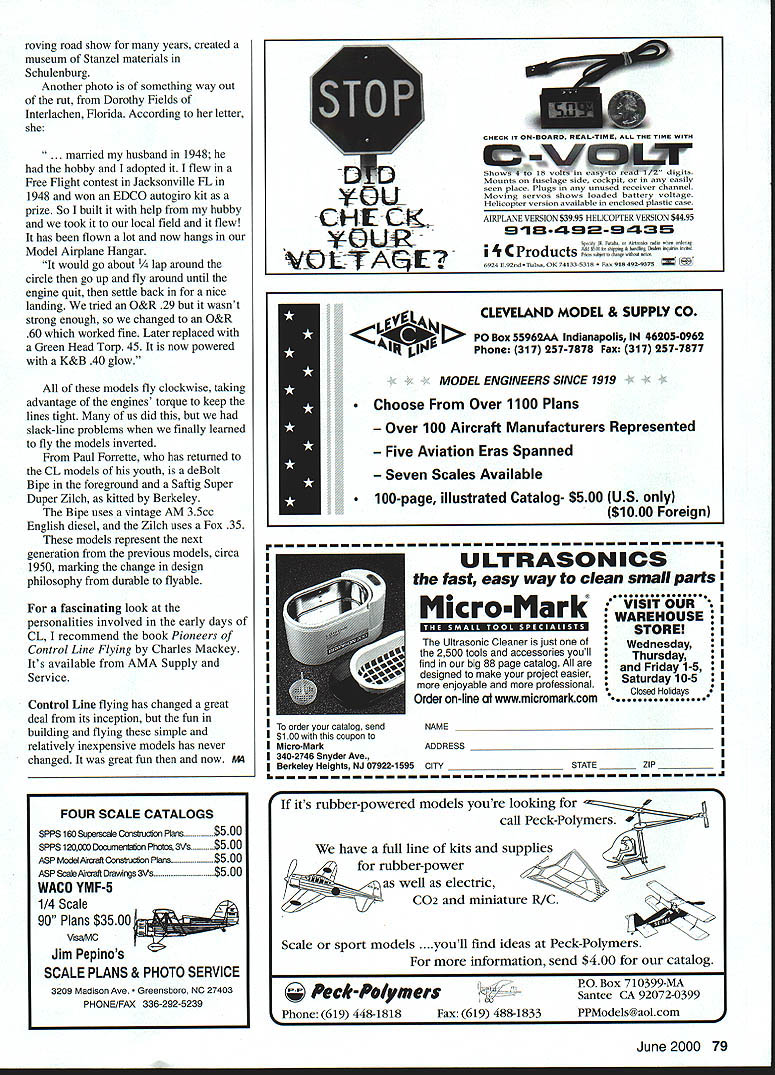
To illustrate the huge evolutionary changes in CL models, I have included photos that readers have sent me from their scrapbooks throughout the years. If you hold the opinion that little has changed in CL, perhaps the photos will alter your perception.
On the other hand, the basic CL control principles (two-line and monoline) have remained essentially unchanged. This speaks well of the genius of Jim Walker and the Stanzel Brothers; 60 years ago they perfected fundamentally sound and ultrasimple devices that really can't be improved upon.
Fortunately (or perhaps unfortunately), I can relate to this historical subject firsthand.
In the first few years following Japan's surrender, the US experienced a glorious economic boom from the pent-up demand for consumer goods that had not been available during the grim war years. The returning soldiers had pockets full of unspent dollars from their war-bond savings and separation bonuses. They had dreams for businesses to start and ideas to market that had been growing in their minds for all those years.
Tremendous optimism was centered on the aviation industry; "everyman's" airplanes and glowing forecasts of an explosion of private flying prevailed.
Most significant from the modeling perspective, the soldiers had a consuming desire to relax and recreate as payback for the years of drudgery and boredom they experienced away from home and in harm's way.
This postwar period was arguably the "golden years" of modeling. The activity had previously been basically limited to large, open areas suitable to Free Flight, and the costs relative to income for engine-powered models had been prohibitive.
Now there were models that could be flown in parks, parking lots, baseball diamonds, and even indoors. We modelers had a great deal of spare money, and a desire to reward ourselves with fun activities.
It's little wonder that CL exploded into big participation, with many people starting kitting businesses, and engine manufacturers springing up everywhere. Almost all of the companies were profitable, but perhaps the most successful was Ohlsson and Rice (O&R); its engines sold so fast there were often waiting lists at hobby shops. O&R even had a company DC-3 to take West-Coast fliers to the 1947 Nationals in Wichita. That's impressive, even now!
There were CL fliers in every village, hamlet, park, and city. Community leaders constructed circles with park funds, and with little need for organized pleading. Local contests and promotional events were everywhere; even in rural western Kansas, an event was on the calendar nearly each summer weekend.
Some returning soldiers saw opportunities in the retail hobby shop business, and shops sprang up. Some mail-order firms were notoriously dishonest, so modelers faithfully stuck to the local shops for materials and for the priceless social interchanges they fostered. Some kit manufacturers' ads actually had the phrase "no mail order" in their copy.
Modelers devoured magazines for any tidbits of information, and to check out the overwhelming number of new kits introduced every month. We'd also check out what was new at the local hobby shop.
The Mechanical Side
I've mentioned the control systems, but one item of interest was the patent situation. Walker's and Stanzel's systems were patented and copyrighted, and the licensing of their use was strictly enforced.
Kits of the era left the control system blank on the drawing, with a label that read, "use the control system of your choice," or listed the patent number and paid a royalty on each kit. The same was true in the case of hardware manufacturers.
A third way around the royalty payments was to use some other proprietary system, which were usually far inferior but were without cost. (These often-rather-strange Rube Goldberg-ish alternate systems will be the subject of an article, if I ever complete it.)
The control lines were originally fairly thin single-strand music wire. In the hands of neophytes such as myself, the lines were very difficult to reel in and out without fatal kinks on our homemade reels. Modelers were thrilled when stranded cable lines and commercial reels became available.
The power plants were primarily spark ignition prior to 1948, requiring make-and-break points on the engine, and carrying coil, condenser, and batteries inside the model. Fuel was white gasoline (essentially unleaded) and SAE 70. A few diesels were used—most notably Leon Shulman's Drone.
In its own way, the introduction of the glow plug by Ray Arden led designers onto a new path, toward much-lighter models and the large and slow "Bob Palmer" revolution, with its large and lightly-loaded aerobatic designs.
The Models
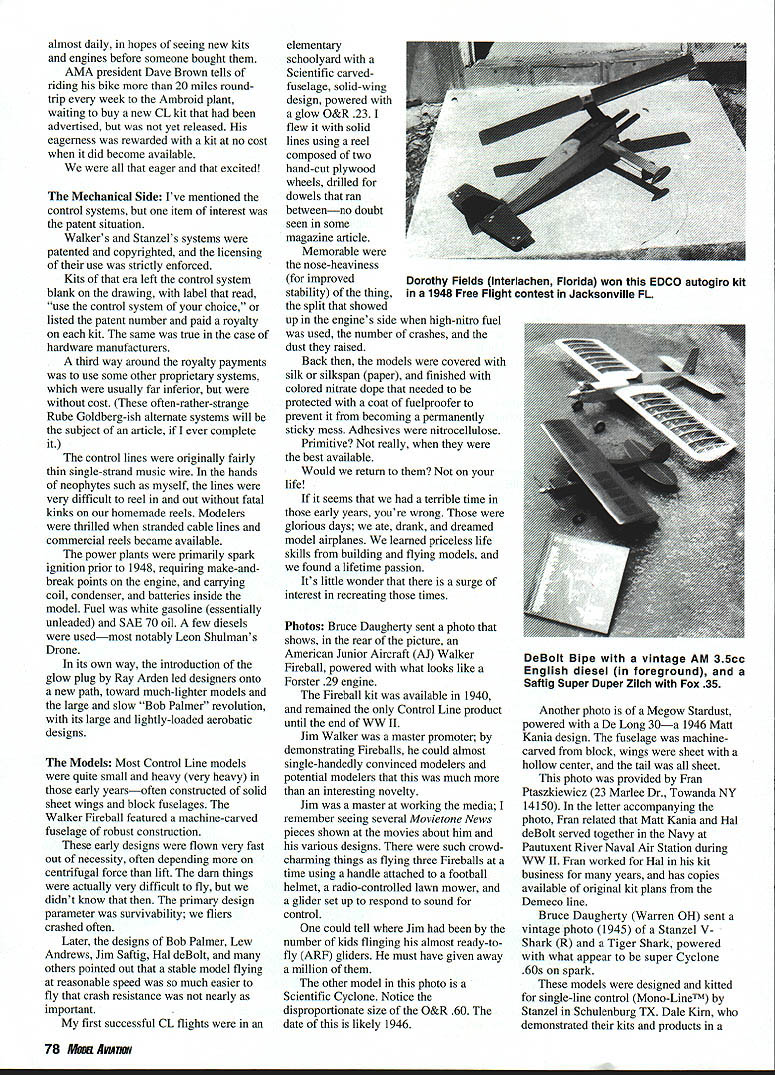
Most Control Line models were quite small and heavy (very heavy) in those early years—often constructed of solid sheet wings and block fuselages. The Walker Fireball featured a machine-carved fuselage of robust construction.
These early designs were flown very fast out of necessity, often depending more on centrifugal force than lift. The darn things were actually very difficult to fly, but we didn't know that then. The primary design parameter was survivability; we fliers crashed often.
Later, the designs of Bob Palmer, Lew Andrews, Jim Sattig, Hal DeBolt, and many others pointed out that a stable model flying at reasonable speed was so much easier to fly that crash resistance was not nearly as important.
My first successful CL flights were in an elementary schoolyard with a Scientific carved-fuselage, solid-wing design, powered with a glow O&R .23. I flew it with solid lines using a reel composed of two hand-cut plywood wheels, drilled for dowels that ran between—no doubt seen in some magazine article.
Memorable were the nose-heaviness (for improved stability) of the thing, the split that showed up in the engine's side when high-nitro fuel was used, the number of crashes, and the dust they raised.
Back then, the models were covered with silk or silkspan (paper), and finished with colored nitrate dope that needed to be protected with a coat of fuelproofer to prevent it from becoming a permanently sticky mess. Adhesives were nitrocellulose.
Primitive? Not really, when they were the best available. Would we return to them? Not on your life!
If it seems that we had a terrible time in those early years, you're wrong. Those were glorious days; we ate, drank, and dreamed model airplanes. We learned priceless life skills from building and flying models, and we found a lifetime passion. It's little wonder that there is a surge of interest in recreating those times.
Photos
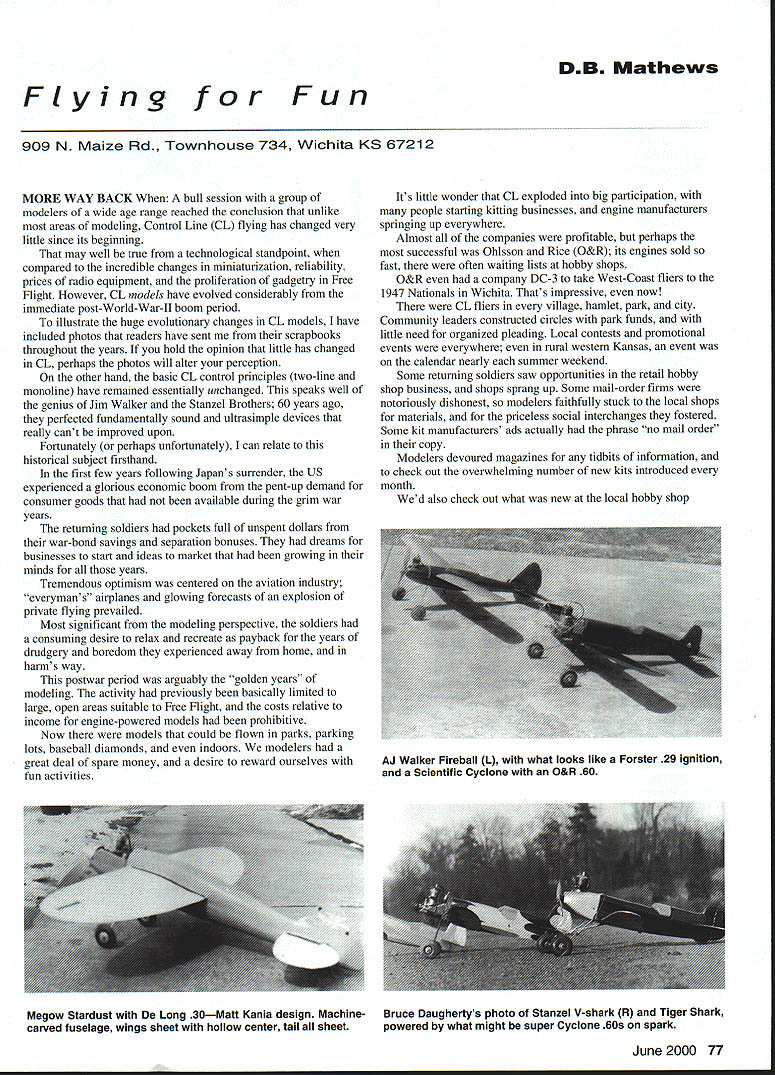
Bruce Daugherty sent a photo that shows, in the rear of the picture, an American Junior Aircraft (AJ) Walker Fireball, powered with what looks like a Forster .29 engine.
The Fireball kit was available in 1940, and remained the only Control Line product until the end of WWII. Jim Walker was a master promoter; by demonstrating Fireballs, he could almost single-handedly convince modelers and potential modelers that this was much more than an interesting novelty.
Jim was a master at working the media; I remember seeing several Movietone News pieces about him and his various designs. There were such crowd-pleasing things as flying three Fireballs at a time using a handle attached to a football helmet, a radio-controlled lawn mower, and a glider set up to respond to sound for control.
One could tell where Jim had been by the number of kids joining his almost ready-to-fly (ARF) gliders. He must have given away a million of them.
The other model in this photo is a Scientific Cyclone. Notice the disproportionate size of the O&R .60. The date of this is likely 1946. All of these models fly clockwise, taking advantage of the engines' torque to keep the lines tight. Many of us did this, but we had slack-line problems when we finally learned to fly the models inverted.
From Paul Forrette, who has returned to the C/L models of his youth, is a DeBolt Bipe in the foreground and a Sattig Super Duper Zilch, as kitted by Berkeley.
- The Bipe uses a vintage .35 cc English diesel.
- The Zilch uses a Fox .35.
These models represent the next generation from the previous models, circa 1950, marking the change in design philosophy from durable to flyable.
For a fascinating look at the personalities involved in the early days of C/L, I recommend the book Pioneers of Control Line Flying by Charles Mackey. It's available from AMA Supply and Service.
Control Line flying has changed a great deal from its inception, but the fun in building and flying these simple and relatively inexpensive models has never changed. It was great fun then and now.
MA
Transcribed from original scans by AI. Minor OCR errors may remain.

