
Flying for Fun
D.B. Mathews
909 N. Maize Rd., Townhouse 734, Wichita KS 67212
Power Plants
For fun, let's take a look at the chicken-and-egg relationship between the development of power plants and full-scale and model aircraft.
Throughout the history of flight, development of more-powerful, lighter, or more-reliable engines has been followed by better airplanes. That same rule of thumb applies to model aircraft.
By reading, research, trial-and-error, and the use of a primitive wind tunnel, the Wright brothers designed successful manned gliders. However, they were not able to convert those gliders into aircraft capable of powered flight—until they invented an internal-combustion engine of sufficient reliability and power relative to weight.
I started to write "the aircraft followed the engine," until it occurred to me that the Wright Flyer was a pusher. Anyhow, you see where I'm coming from.
Those who have had the opportunity to closely examine the Wright engine are impressed by its primitive simplicity and the quality of workmanship. The drive mechanism between the engine and the propellers clearly reveals the Wrights' business background in bicycles.
The early designs of Taylor, Piper, American Eaglet, Rearwin, Aeronca, and many other light airplanes were adequate, but not commercially viable because the available power plants were expensive and unreliable.
These airplanes were not practical until the horizontally-opposed multicylinder Continental, Lycoming, and Franklin engines were introduced, and light airplanes were designed to match them. The engines made the airplanes practical.
The "70" series of World War II fighters were designed around engines that were still in the development stages, such as the Continental X-24 cylinder, etc. When these power plants didn't work out, the designs never went farther than prototypes.
The Bell P-59—America's first jet fighter—was designed around the parameters of the first US license-built British jet engines, which could not be coaxed into producing the "advertised" power output. Therefore, the P-59 was an underpowered, overweight dog.
When better jet engines were developed, the P-59 was quickly replaced by the P-80/T-33, which became a wonderful airplane—not because of a vastly improved design, but because of much better engines.
The P-59 might have become successful if it had been engineered to allow its engines to be changed to the newer power plants, as was done with the Me 262, etc.
The same generalizations can be made about the development of model engines.
In 1930, Bill Brown developed a small gasoline engine for use in model aircraft. By 1932, he had evolved it into a practical .60 cubic-inch unit that could be manufactured for sale.
The modeling world has not been the same since.
Maxwell Bassett, a close neighbor of Bill's, developed flyable models to match the engines. Maxwell flew stick and cabin models in the Rubber events at the 1932 and 1933 Nationals. He swept the rubber-power events those years, and the rules were hastily changed.
Maxwell's models were the "Best of his Philadelphia," kitted by Scientific. To match the power-to-weight ratio of Bill's engines, they were eight-foot-span models of rather robust construction.
As the years went by, improved spark-ignition engines were developed and sold. As the engines' power and size changed, models were developed to match them. In a 10-year period, Free Flight models evolved from huge cabin models, such as the KG-1, to pylon designs, such as the Zipper.
Model design underwent a monstrous change when Ray Arden introduced the glow plug in 1948; it became possible to eliminate the weight of coil, condenser, and batteries required by spark-ignition systems. I illustrated some of those changes in Control Line last month, but Free Flight, and even the rudimentary Radio Control models, suddenly changed as well.
Then the revolution of the tiny glow-plug engine hit.
Led by the 1947 K&B Infant, and quickly followed by numerous other 1/2A units, small, compact models were no longer novelties, but practical, everyday designs.
In contemporary times, there is a wide range of purpose-designed power plants in our hobby, ranging from tiny electric units in Indoor Free Flight and Radio Control, to gas turbines.
In each instance, the development of the power plants has led to development of suitable model designs. And isn't that fun?
Of Monocoupes and Engines
The full-scale Monocoupe aircraft series' design evolution is directly related to the development of suitable power plants.
The following material is condensed from what many consider the definitive work about an aircraft manufacturer: Of Monocoupes and Men by John Underwood. Although this highly prized rare book has been out of print for many years, you might be able to locate a copy in your local library.
Clayton Folkerts was a Bristow, IA, farmboy with no formal engineering education, but he had a burning desire to design and build airplanes. He had developed four different aircraft, and had taught himself to fly them by 1926.
Recognized throughout the Corn Belt as an innovative and knowledgeable designer, Folkerts designed the early Monocoupe series and a later series of highly successful racers, some of which outperformed the military's frontline fighters using a fraction of the power.
Donald Luscombe operated a small advertising agency in Davenport, IA, after he graduated from Iowa State with a degree in merchandising. His interest in aviation was sparked by begging "joyrides" in France, where he served as an ambulance driver during World War I.
Donald purchased a new crated Jenny in 1924, and he learned to fly. Unhappy with the helmet and goggles required in the open-cockpit aircraft of the day, he dreamed of an enclosed-cabin design.
Donald sold his idea to a group of Davenport investors who formed Central States Aviation in 1926. The group hired Clayton Folkerts to design and build a two-place enclosed-cabin airplane to meet Donald's dream.
A small two-place side-by-side design was evolved, but locating a suitable engine was a difficult problem; most aircraft engines of that era were terribly heavy relative to their power.
A Curtiss OX-5 weighed 400 pounds, yet was capable of only 90 horsepower. The French Anzani air-cooled radial was light and powerful, but was terrifically expensive. Other suitable power plants were either unreliable or in the very early stages of development.
The situation was resolved with the introduction of the five-cylinder air-cooled Detroit Air Cat engine, which was being produced by a firm headed by Eddie Rickenbacker.
A race-car driver before WW I, America's leading ace returned to civilian life to briefly own the Indianapolis Speedway. Eddie's other business ventures included an automobile (produced by Studebaker) bearing his name. He is likely best remembered as the longtime head of Eastern Airlines.
The first Monocoupe was completed in March 1927, and it became an immediate success. Production was moved to Bettendorf, IA, into an abandoned clapboard "temple," where Billy Sunday had begun his "crusade."
Sales boomed following Lindbergh's epoch flight and the national explosion of aviation interest that followed. Lindbergh even purchased one of the early Monocoupes for personal use.
Delivery and quality control of the Air Cat engine deteriorated as the financial woes of Rickenbacker's enterprise worsened. The firm was placed into bankruptcy by its creditors late in 1927.
That prompted Luscombe to convince auto manufacturer Willard Velie to assume engine production.
Willard had been a successful buggy manufacturer before switching to automobiles. Willard's grandfather had been successful in the farm-implement business: John Deere.
Production of the Monocoupe was soon combined with production of the engines at Velie's works in Moline, IL, which led to renaming the firm Monocoupe Aircraft, Inc.
The Air Cat was reworked to utilize aluminum cylinders and sodium-tipped pushrods, and it became a much-revved unit. Sales continued to grow, and a nationwide distribution network was established.
When Willard Velie and his son died of natural causes in 1928, the engine business was sold to the Lambert family in St. Louis, MO, and the aircraft division was sold to Allied Aviation, also in St. Louis.
By the end of 1929, more than half of the light single-engine aircraft sold in the U.S. were Monocoupes.
Donald R. Luscombe eventually left the firm to establish his own company in Kansas City in 1933. That firm developed a stretch-formed all-metal fuselage design that became the Luscombe Phantom and evolved into the Silvaire and the Model 8.
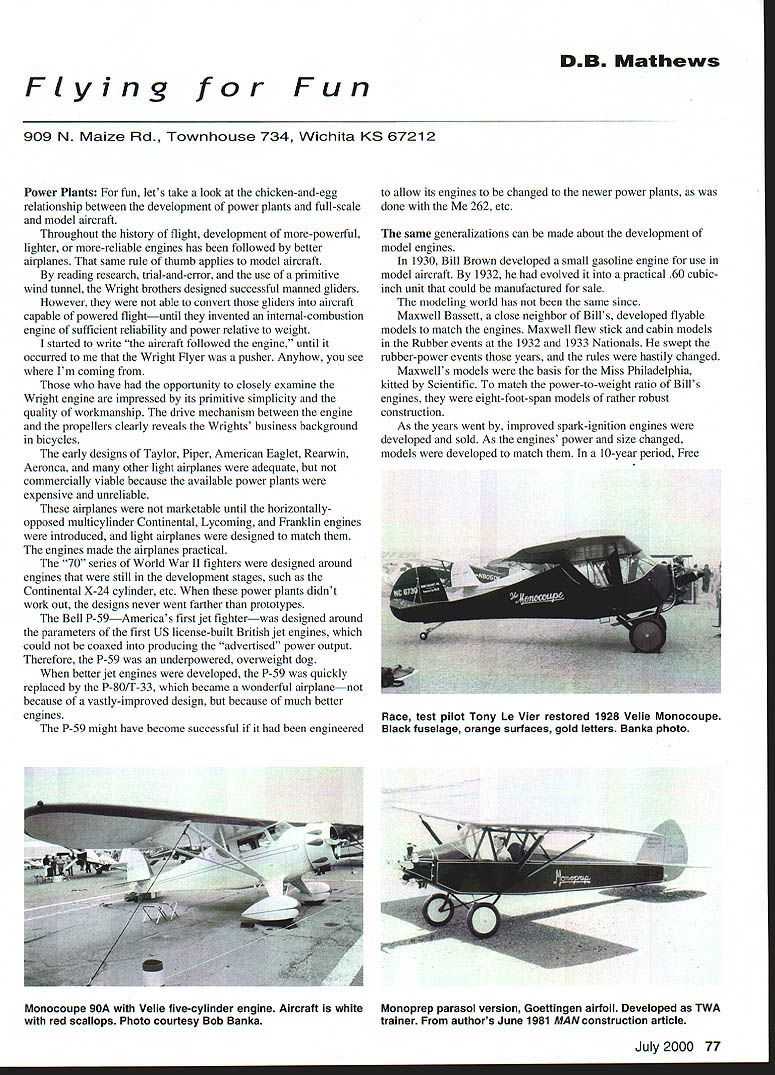
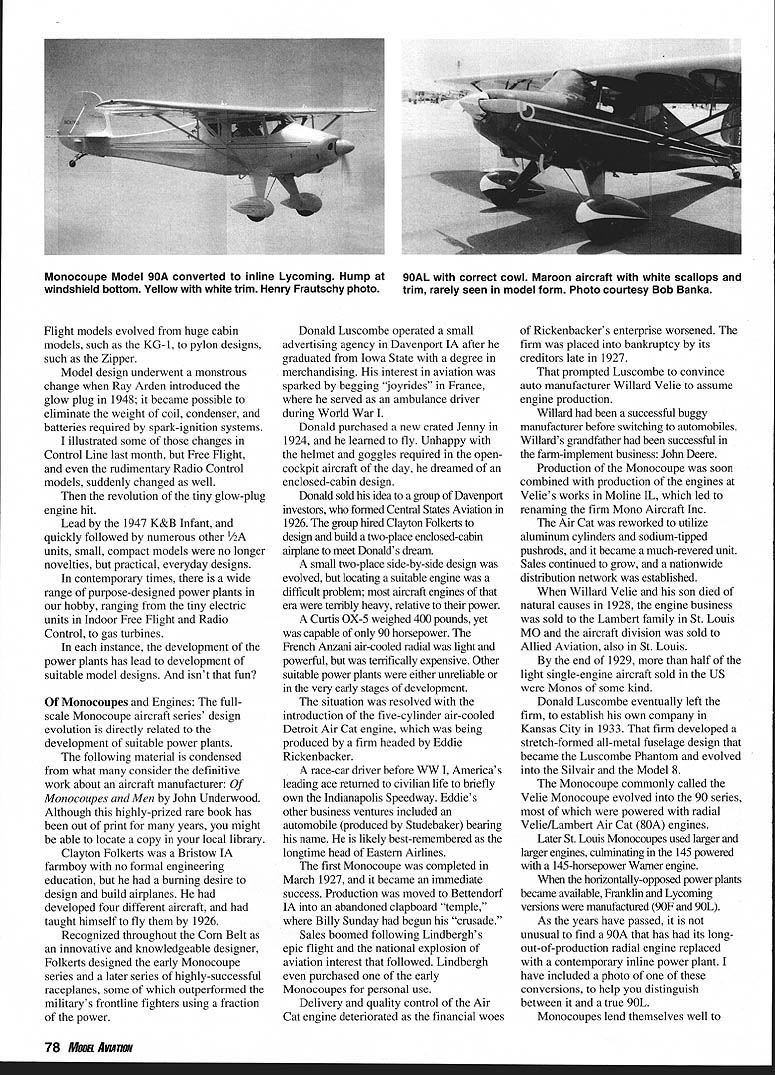
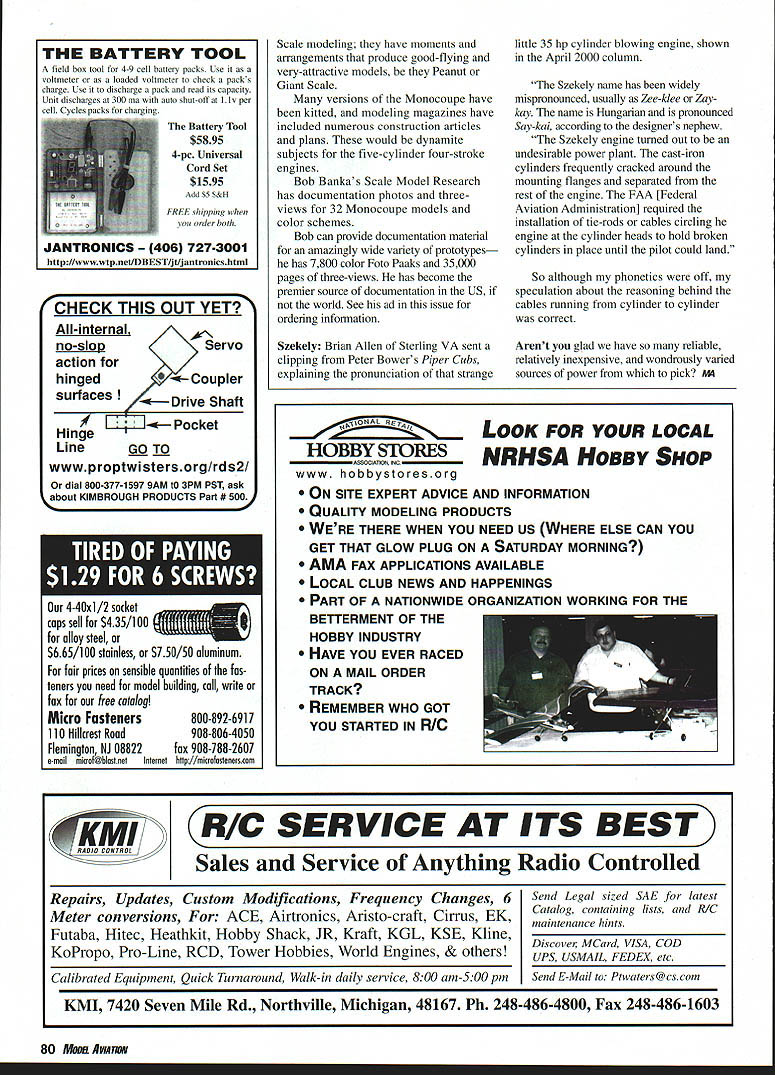
The Monocoupe commonly called the Velie Monocoupe evolved into the 90 series; most of which were powered with radial Velie/Lambert Air Cat 80A engines.
Later St. Louis Monocoupes used larger and larger engines, culminating in the 145 powered with a 145-horsepower Warner engine.
When the horizontally-opposed power plants became available, Franklin and Lycoming engines were produced (90F and 90L).
As the years have passed, many variations of the Monocoupe have been built, and a number are still flying. With the unusual production run and long out-of-production radical engine replacements, the Monocoupe has become a favorite with restorers and modelers alike.
Monocoupes lend themselves well to scale modeling; they have moments and arrangements that produce good-flying and very attractive models, be they Peanut or Giant Scale.
Many versions of the Monocoupe have been kitted, and modeling magazines have included numerous construction articles and plans. These would be dynamite subjects for the five-cylinder four-stroke engines.
Bob Banka’s Scale Model Research has documentation photos and three-views for 32 Monocoupe models and color schemes.
Bob can provide documentation material for an amazingly wide variety of prototypes — he has 7,800 color Foto Paks and 35,000 pages of three-views. He has become the premier source of documentation in the U.S., if not the world. See his ad in this issue for ordering information.
Szekely
Brian Allen of Sterling, VA, sent a clipping from Peter Bower’s Piper Cubs, explaining the pronunciation of that strange little 35 hp cylinder-blowing engine, shown in the April 2000 column.
“The Szekely name has been widely mispronounced, usually as Zee-kel or Zay-kay. The name is Hungarian and is pronounced Sze-kely, according to the designer’s nephew.
“The Szekely engine turned out to be an undesirable power plant. The cast-iron cylinders frequently cracked around the mounting flanges and separated from the rest of the engine. The FAA (Federal Aviation Administration) required the installation of tie-rods or cables circling the engine at the cylinder heads to hold broken cylinders in place until the pilot could land.”
So although my phonetics were off, my speculation about the reasoning behind the cables running from cylinder to cylinder was correct.
Aren’t you glad we have so many reliable, relatively inexpensive, and wondrously varied sources of power from which to pick?
MA
Transcribed from original scans by AI. Minor OCR errors may remain.

