
Flying for Fun
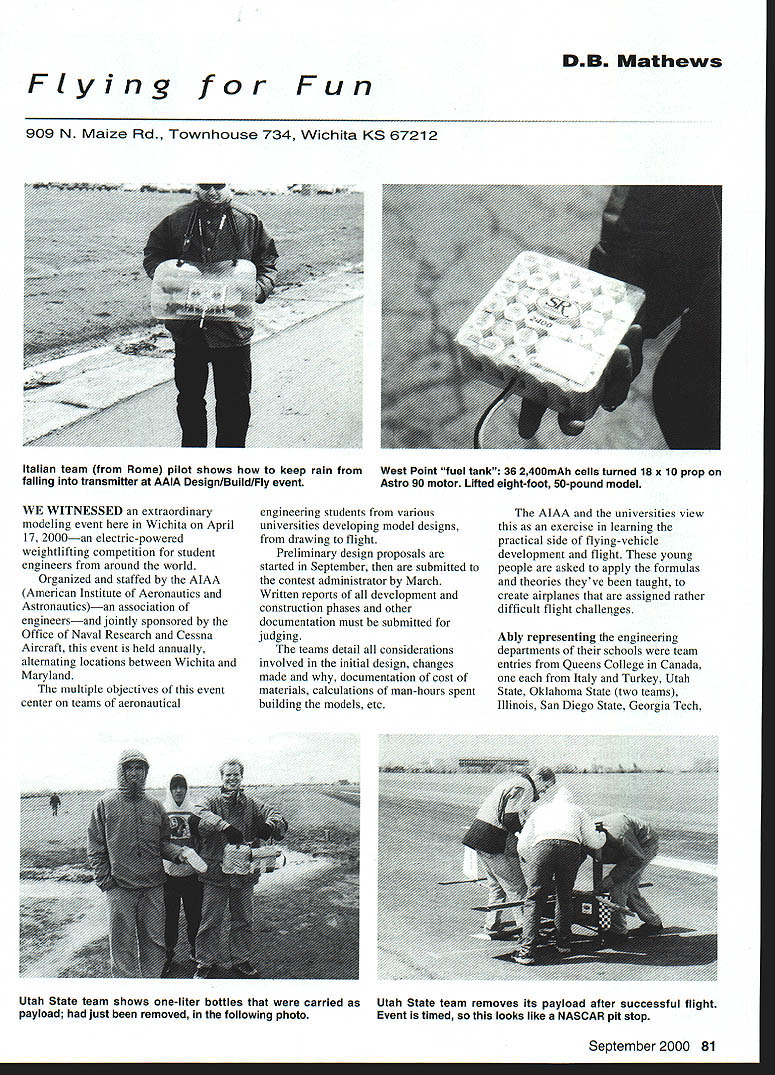
WE WITNESSED an extraordinary modeling event here in Wichita on April 17, 2000—an electric-powered weightlifting competition for student engineers from around the world.
Organized and staffed by the AIAA (American Institute of Aeronautics and Astronautics)—an association of engineers—and jointly sponsored by the Office of Naval Research and Cessna Aircraft, this event is held annually, alternating locations between Wichita and Maryland.
The multiple objectives of this event center on teams of aeronautical engineering students from various universities developing model designs, from drawing to flight.
Preliminary design proposals are started in September, then are submitted to the contest administrator by March. Written reports of all development and construction phases and other documentation must be submitted for judging.
The teams detail all considerations involved in the initial design, changes made and why, documentation of cost of materials, calculations of man-hours spent building the models, and so on.
The AIAA and the universities view this as an exercise in learning the practical side of flying-vehicle development and flight. These young people are asked to apply the formulas and theories they've been taught to create airplanes that are assigned rather difficult flight challenges.
Ably representing the engineering departments of their schools were team entries from:
- Queens College (Canada)
- Italy
- Turkey
- Utah State
- Oklahoma State (two teams)
- Illinois
- San Diego State
- Georgia Tech
- University of Southern California
- California Polytechnic at San Luis Obispo
- West Virginia
- Virginia Tech
- East Stroudsburg
- West Point
- New Mexico
- Massachusetts Institute of Technology
- Texas at Austin
- Miami University
- Central Florida
- Arizona
- Syracuse
- Cleveland State
- Wichita State
- Clarkson
- New York at Buffalo
Not all team members were male; several very bright and charming young women were on the various teams.
In most instances, these teams were selected by the faculty of the school. The rules require at least one-third of the team to be underclassmen.
Some students received class credit for their projects, and some received limited financial support. Most teams had sponsorship from industry, local businesses, and alumni; others raised funds through activities such as raffles. The pilots could be nonuniversity members, but they had to be from the team's local area, preapproved by the contest officials, and members of AMA. As one of the officials observed, "we're trying to develop engineers, not pilots."
Several participants were world-class radio-control aerobatics pilots, and as things turned out, they needed to be.
Aircraft Requirements
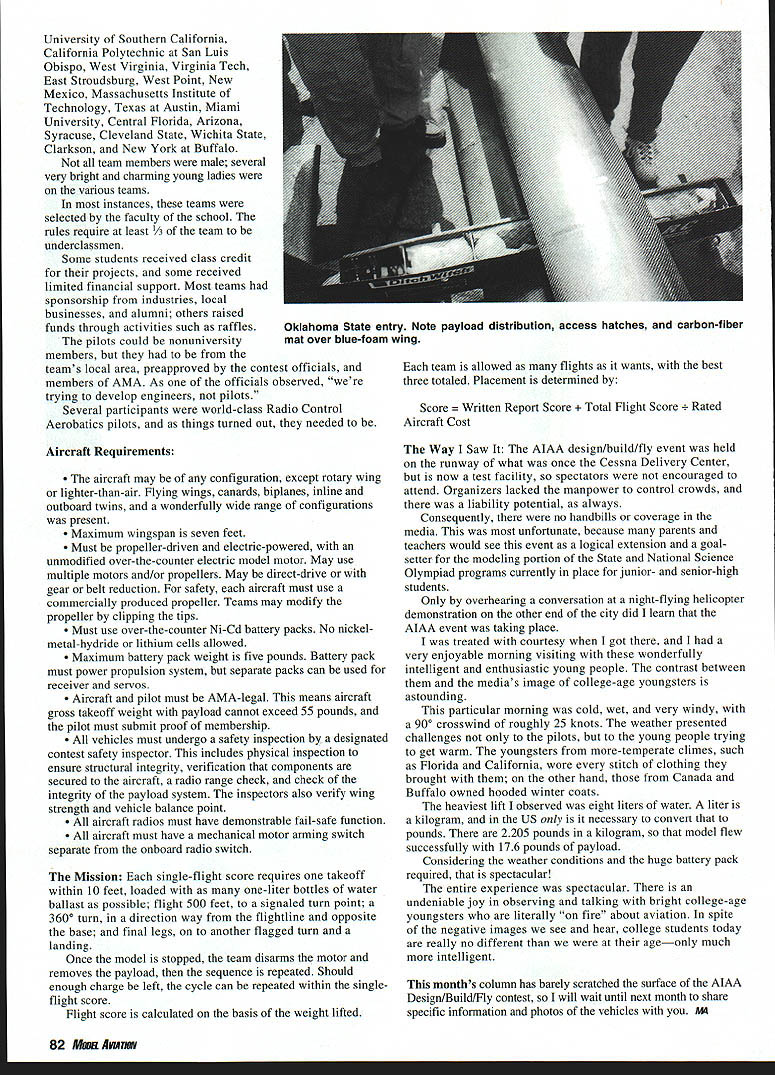
- The aircraft may be of any configuration, except rotary wing or lighter-than-air. Flying wings, canards, biplanes, inline and outboard twins, and a wonderfully wide range of configurations were present.
- Maximum wingspan is seven feet.
- Must be propeller-driven and electric-powered, with an unmodified over-the-counter electric motor. May use multiple motors and/or propellers. May be direct-drive or use gear or belt reduction. For safety, each aircraft must use a commercially produced propeller. Teams may modify the propeller by clipping the tips.
- Must use over-the-counter Ni-Cd battery packs. No nickel-metal-hydride or lithium cells allowed.
- Maximum battery pack weight is five pounds. Battery pack must power the propulsion system, but separate packs can be used for receiver and servos.
- Aircraft and pilot must be AMA-legal. This means aircraft gross takeoff weight with payload cannot exceed 55 pounds, and the pilot must submit proof of membership.
- All vehicles must undergo a safety inspection by a designated contest safety inspector. This includes physical inspection to ensure structural integrity, verification that components are secured to the airframe, a radio range check, and check of the integrity of the payload system. The inspectors also verify wing strength and vehicle balance point.
- All aircraft radios must have demonstrable fail-safe function.
- All aircraft must have a mechanical motor-arming switch separate from the onboard radio switch.
The Mission
Each single-flight score requires:
- One takeoff within 10 feet, loaded with as many one-liter bottles of water ballast as possible.
- Flight 500 feet to a signaled turn point.
- A 360° turn, in a direction away from the flightline and opposite the base.
- Final legs on to another flagged turn and a landing.
Once the model is stopped, the team disarms the motor and removes the payload, then the sequence is repeated. Should enough charge be left, the cycle can be repeated within the single-flight score.
Flight score is calculated on the basis of the weight lifted.
Each team is allowed as many flights as it wants, with the best three totaled. Placement is determined by:
Score = Written Report Score + (Total Flight Score ÷ Rated Aircraft Cost)
The Way I Saw It
The AIAA Design/Build/Fly event was held on the runway of what was once the Cessna Delivery Center, but is now a test facility, so spectators were not encouraged to attend. Organizers lacked the manpower to control crowds, and there was a liability potential, as always.
Consequently, there were no handbills or coverage in the media. This was most unfortunate, because many parents and teachers would see this event as a logical extension and a goal-setter for the modeling portion of the State and National Science Olympiad programs currently in place for junior- and senior-high students.
Only by overhearing a conversation at a night-flying helicopter demonstration on the other end of the city did I learn that the AIAA event was taking place.
I was treated with courtesy when I got there, and I had a very enjoyable morning visiting with these wonderfully intelligent and enthusiastic young people. The contrast between them and the media's image of college-age youngsters is astounding.
This particular morning was cold, wet, and very windy, with a 90° crosswind of roughly 25 knots. The weather presented challenges not only to the pilots, but to the young people trying to get warm. The youngsters from more-temperate climes, such as Florida and California, wore every stitch of clothing they brought with them; on the other hand, those from Canada and Buffalo owned hooded winter coats.
The heaviest lift I observed was eight liters of water. A liter is a kilogram, and in the U.S. it is sometimes necessary to convert that to pounds. There are 2.205 pounds in a kilogram, so that model flew successfully with 17.6 pounds of payload.
Considering the weather conditions and the huge battery pack required, that is spectacular!
The entire experience was spectacular. There is an undeniable joy in observing and talking with bright college-age youngsters who are literally "on fire" about aviation. In spite of the negative images we see and hear, college students today are really no different than we were at their age—only much more intelligent.
This month's column has barely scratched the surface of the AIAA Design/Build/Fly contest, so I will wait until next month to share specific information and photos of the vehicles with you. MA
Transcribed from original scans by AI. Minor OCR errors may remain.

