
Flying for Fun
909 N. Maize Rd., Townhouse 734, Wichita KS 67212
Errata
Bob Clemens of Rochester, NY called my attention to an error: the first postwar Nationals (Nats) was held at Wichita in 1946—not 1947. Bob wrote:
"My brother, my dad, and members of our F.F. club in Naperville, Ill., made the journey west to attend the contest. I was 14 at the time, and it was my first Nats. The 1947 Nationals, which I also attended, were in Minneapolis, sponsored by the American Legion."
Bob and I share that same experience. Although it was 54 years ago, those moments remain vividly etched in our minds and they had a large impact on our lives.
Those "headquarters hotel" and Navy Nats provided glorious memories, primarily from observing activities in the hangars and the incredible social mix of modelers from the entire spectrum of our hobby.
Many attended those old Nats, not to compete, but to be part of the happening.
Unfortunately, those times will never be duplicated, if for no other reason than the overwhelming logistics problems of sites and manpower. Those Nats were made possible by organizations outside the AMA, and are no longer available.
Those certainly were the "glory years" for many of us.
Help
Gene Wallock is appealing for any information about Ted Klauser's low-wing Free Flight model of 1937.
Ted was one of the young men who flew with H.A. Thomas and J.T. Sadler in Little Rock, AR before World War II.
The original model has been found and restored, but there is very little available to document its history. Search your memory banks and scrapbooks to see if you can help.
Write to Gene at:
- 13 NW Sandy Trail Ln., Lawton OK 73505
The Twilight Zone
While on that sort of quest, I would appreciate anything involving Chas. Sigfried (Wichita, KS) and his pioneer Radio Control (RC) models.
I located and restored his 10-footer, and now it hangs in the Kansas Aviation Museum.
Sigfried's model is so interesting because it was flown in the RC event at the Nationals from 1937 to 1952!
An overwhelming flood of memories hit me while I was working on the model.
I had an Austin Craft metal battery box fastened onto the firewall, which held the dry cells for the Forster .99's ignition system. Since the batteries were badly corroded after 46 years, I removed them, only to learn that a section of newspaper had been used to increase the tension on the batteries.
When I removed and carefully unfolded the piece of newspaper, imagine my shock to learn that it was a section of the Los Angeles Times dated July 1952. I read the same edition of that newspaper on the same day!
I attended the 1952 Los Alamitos, CA Nats and watched Charles attempt to fly the airplane, as I had at the Olathe, KS Nats in 1948 and the Wichita Nats in 1946.
I'd like to write a piece on this significant man and his aircraft, but I have only magazine photos, which are not usable. Check through those scrapbooks; this story needs to be told.
More Old Stuff
We've all heard legendary rumors about large quantities of antique cars and model airplane kits or engines being found in dusty old warehouses, but Dale Kim has actually done it!
While putting items together to display in the Stanzel Museum that I mentioned previously, Dale stumbled onto a bunch of ancient Victor Stanzel kits in their original shipping cartons.
Somehow they had been pushed into a dark corner of the raw-materials storage area, and were completely forgotten. They are in pristine condition! The mother lode!
Classic prewar kits such as the Tiger-Shark, the Free Flight Interceptor, the twin-line Shark G-5, and the two-line Sharkdlet, plans for many others, and a line of solid models are for sale.
Contact:
- Victor Stanzel Co., Box 28, Schulenburg TX 78956
- Tel.: (800) 422-6823
- Fax: (979) 743-4870
More about Electric Lifters
Last month I wrote about the international design/build/fly weightlifting event sponsored by the American Institute of Aeronautics and Astronautics (AIAA).
The event is for university student teams who design, develop, and fly electric-powered models, documenting their development and construction via engineering-style papers.
The event requires taking off within 100 feet, flying upwind 500 feet to a flagman, turning 90°, executing a 360° turn in front of the takeoff spot, proceeding downwind to another flagman, turning, and landing.
The cargo is removed, then flight is repeated. If enough "fuel" and time remain in the allotted 10-minute window, additional cycles can be repeated.
It was delightful to observe the bright young minds churning out plans to maximize the amount lifted against the time element. Strategy was knee-deep out there.
Scoring is based on the number of liters of water cargo lifted, a written report score, and the craftsmanship score.
Pilots do not have to be university students, but they must be AMA members. As one of the sponsors said, "we want to develop engineers, not pilots."
Power plants, hardware, and Ni-Cd packs must be off-the-shelf items. From there, the innovative minds of these young people are allowed to run wild. And what fun that is!
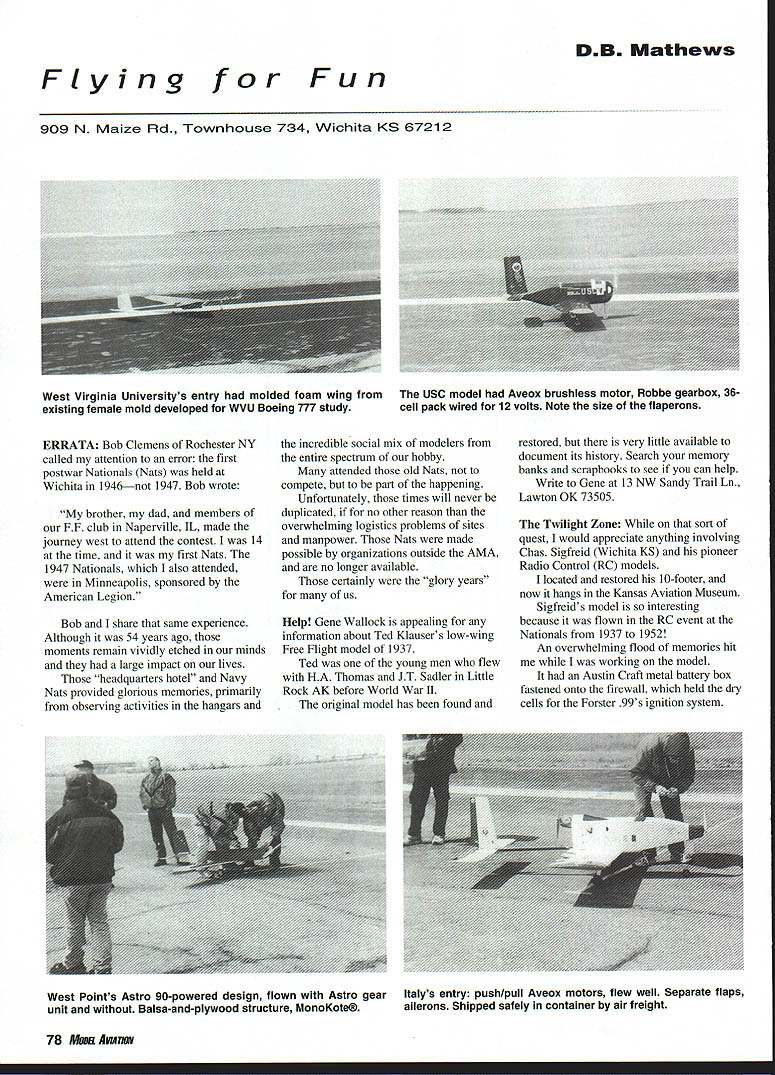
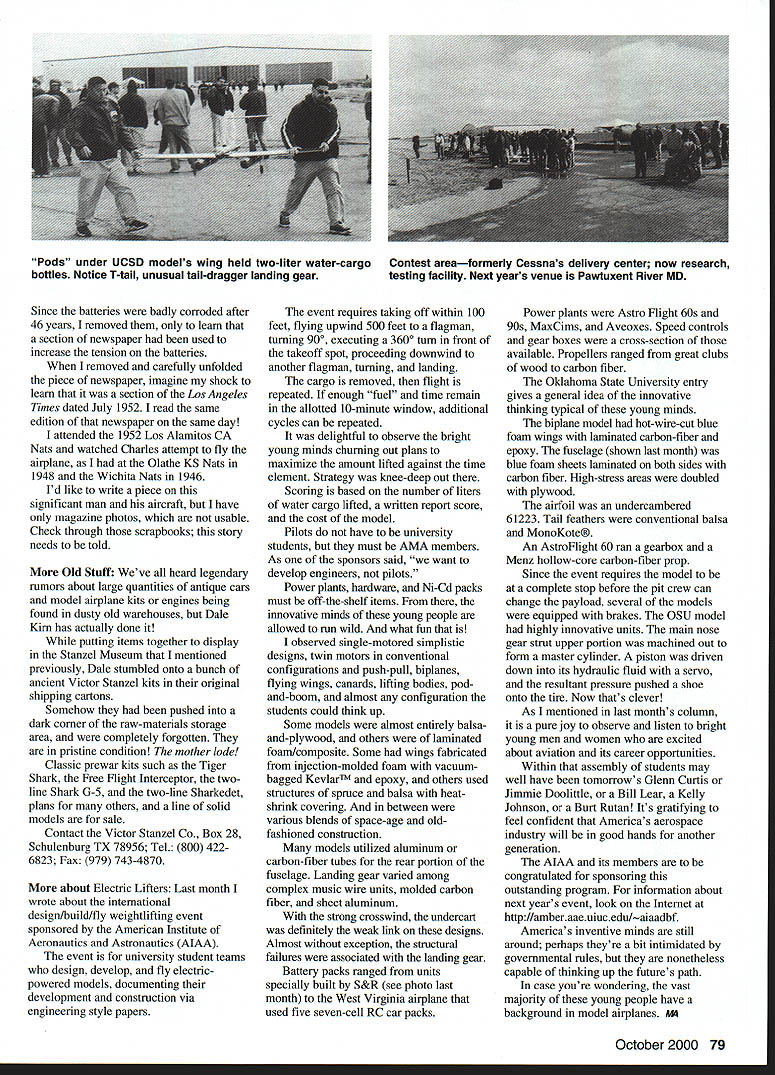
I observed single-motored simplistic designs, twin motors in conventional configurations and push-pull, biplanes, flying wings, canards, lifting bodies, pod-and-boom, and almost any configuration the students could think up.
Some models were almost entirely balsa-and-plywood, and others were of laminated foam/composite. Some had wings fabricated from injection-molded foam with vacuum-bagged Kevlar and epoxy, and others were structures of spruce and bass with heat-shrink covering. And in between were various blends of space-age and old-fashioned construction.
Many models utilized aluminum or carbon-fiber tubes for the rear portion of the fuselage. Landing gear varied among complex music wire units, molded carbon fiber, and sheet aluminum.
With the strong crosswind, the undercarriage was definitely the weak link on these designs. Almost without exception, the structural failures were associated with the landing gear.
Battery packs ranged from units specially built by S&R to the West Virginia airplane that used five seven-cell RC car packs.
Power plants were Astro Flight 60s and 90s, MaxCims, and Aveoxes. Speed controls and gearboxes were a cross-section of those available. Propellers ranged from great clubs of wood to carbon fiber.
The Oklahoma State University entry was a general idea of the innovative thinking typical of these young minds.
The biplane model had hot-wire-cut blue foam wings with laminated carbon-fiber and epoxy. The fuselage was blue foam sheets laminated on both sides with carbon fiber. High-stress areas were doubled with plywood.
The airfoil was an undercambered 61223. Tail feathers were conventional balsa and MonoKote®.
An AstroFlight 60 ran a gearbox and a Menz hollow-core carbon-fiber prop.
Since the event required the model to be a complete stop before the pit crew can change the payload, several of the models were equipped with brakes. The OSU model had highly innovative units. The main nose gear strut upper portion was machined out from a master cylinder. A piston was driven down into its hydraulic fluid with a servo, and the resultant pressure pushed a shoe onto the tire. Now that's clever!
As I mentioned in last month's column, it is a pure joy to observe and listen to bright young men and women who are excited about aviation and its career opportunities.
Within that assembly of students may well have been tomorrow's Glenn Curtiss or Jimmie Doolittle, or a Bill Lear, a Kelly Johnson, or a Burt Rutan! It's gratifying to feel confident that America's aerospace industry will be in good hands for another generation.
The AIAA and its members are to be congratulated for sponsoring this outstanding program. For information about next year's event, look on the Internet at http://www.aiaa.org.
America's inventive minds are still around; perhaps they're a bit intimidated by governmental rules, but they are nonetheless capable of thinking up the future's path.
In case you're wondering, the vast majority of these young people have a background in model airplanes.
MA
Transcribed from original scans by AI. Minor OCR errors may remain.

