
Flying for Fun
909 N. Maize Rd., Townhouse 734, Wichita KS 67212
Flying for Fun
ONE CHALLENGE a columnist faces is measuring what interests his or her readers. Although the method is less than scientific, subjects that generate a great deal of mail and photos deserve the most attention.
Based on that, the topic of building and flying model airplanes during the 1940–1946 wartime years ranks near the top.
Several "Flying for Fun" columns have had themes built around those modeling experiences, and have produced some informative material that I would like to share.
An Historical Perspective
Although the United States did not actively enter World War II until late in 1941, much of the world had been at war since 1939. Most of Europe and large parts of Africa had been overrun and occupied by the Nazis, and huge chunks of the Far East were under Japanese control.
America's political mood and most of its media bias were dominated by isolationism—"it's not our problem; let's stay out of it."
By 1940, it was apparent that if England and Australia were to avoid invasion, the US would have to re-examine its attitude and provide them with the machines of war.
One of the many ingenious ways around our neutrality involved rolling unmarked aircraft just short of the border that separates the US and Canada, tossing a rope across the boundary, and allowing the British to tow the airplanes across the line.
The US also swapped destroyers with Britain, for the right to construct and use airfields in Bermuda.
And what ranks near the top of all-time silliness was lend-lease; the US provided tools of war by renting them, with a return date built into the contract.
Germany became less and less impressed with the United States' supposed neutrality, and it began to torpedo any merchant vessels inside British territorial waters—regardless of the flag that was flown.
All pretenses of noninvolvement were removed with the events of the morning of December 7, 1941 (Pearl Harbor), and the US was immediately mobilized for war. We were incredibly poorly equipped and understaffed—mostly because of the isolationism.
The US lost each battle and each encounter with the Japanese and Germans in those early months. We didn't experience victories until the naval Battle of Midway, the invasion of North Africa, and when the Russians turned back the Germans from the gates of Moscow.
The German U-boats ran nearly uncontested from Canada to the tip of South America in those early years. The US had such woefully inadequate submarine defenses that the U-boats often surfaced and sank merchant vessels within sight of land with artillery.
I've talked to old-timers along Cape Hatteras, North Carolina, who reported standing on the beach and watching torpedoed ships explode and burn in broad daylight.
As a consequence of this "blockade," goods not produced in the US were rationed; civilians had stamps to obtain items such as coffee, tea, sugar, gasoline, rubber, and cocoa.
Raw materials required by the immense buildup of the US military were in equally short supply for civilian use.
Since all the nylon was needed for parachutes, ladies painted their legs and created fake seams to represent stockings. Shoes and clothing were rationed; there were no Hershey "S" M or other candy bars on store shelves; scrap metal and paper drives were held as a patriotic duty; and we even saved and turned in empty toothpaste and cement tubes!
Balsa was a non-native wood that could only be imported from Ecuador by boat. For most of my life, I've felt a primordial elation each time I walk into a hobby shop: I know I can buy all the balsa I want.
Conventional wisdom was that the United States' meager supply of balsa made its way past the U-boats because it was used in life rafts. Although that is true, consider how much balsa was used in aircraft structures during that wartime era.
The de Havilland Mosquito was constructed of balsa cores sandwiched between plywood skins. One can only wonder how many carloads of wood were sorted through to find balsa with the proper density and grain for the Havilland's project.
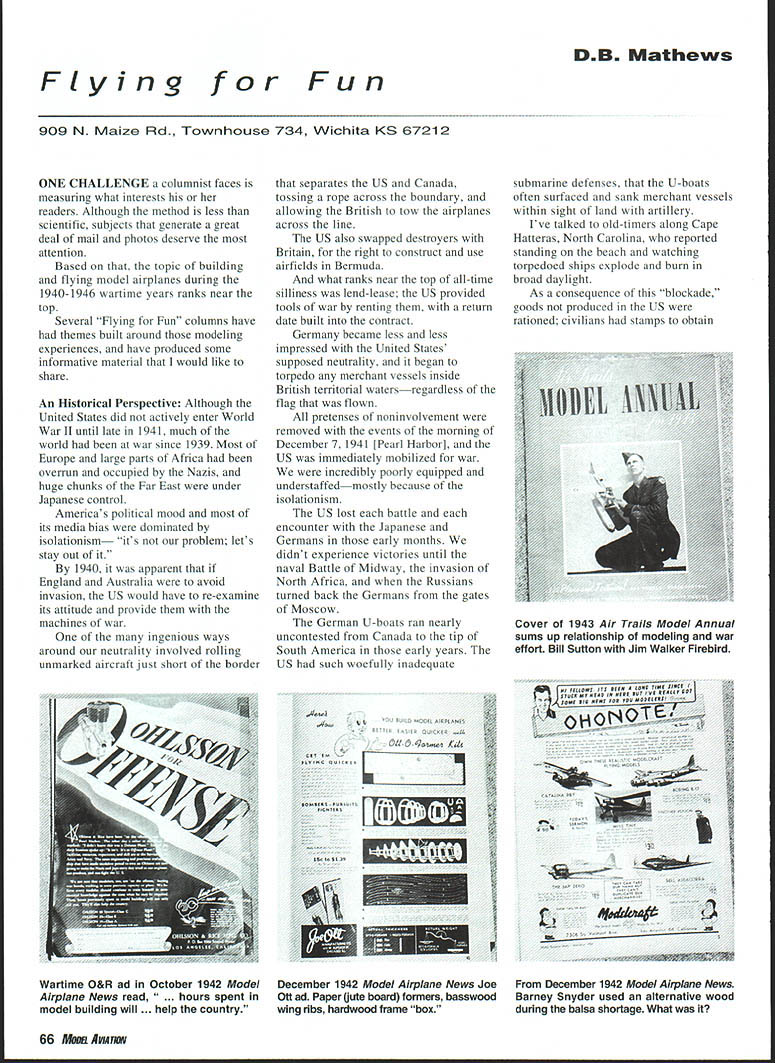
A quote from a JASCO ad in the June 1942 Model Airplane News read, "No more balsa after May 15th. Special brown rubber out of stock since April 10th. Cause? Not enough balsa or rubber to meet the needs of the arming industry!"
The US made a miraculous transition from a depression economy to producing goods for war. Automobile and appliance sales were poor in 1940, and aircraft sales were nearly nonexistent.
The US had to utilize existing production capacity, and make immense expansions for facilities. This was done at the Willow Run plant in Michigan and Boeing Plant 2, on the old Stearman site in Wichita.
Model-aircraft engine manufacturers were included in the conversion to wartime production. Some even mentioned their contributions in magazine ads.
Virtually the only engines available to hobbyists were used ones, put up for sale by guys who had to report for military duty. Some very poor engines were available new by mail-order throughout the war years, but they were probably unsold inventory.
Ignition coils were also hard to get; they were used by the thousands as ignitors in flame throwers.
What about batteries? Between military flashlights and those issued to civil defense air-raid wardens, there were few to be had.
A Deprived Bunch of Kids?
I hope I haven't implied great personal bitterness or a sense of being cheated. Neither I, nor my contemporaries, nor their families felt inconvenienced. In our small way, we were doing our part to win a terrible war.
Terms such as "poor" and "disadvantaged" are relative; if everyone around you is enduring the same hardships, who's poor?
We young modelers merrily hacked out solid models from pine, folded our paper warplanes from the famous "H" boxes, and built kits with paper formers and hardwood strips. We had a wonderful time doing it.
Our models didn't look like much, and they flew little, if at all, but they were works of art to our eyes because we had created them.
My friends and I were totally immersed in airplanes. We read everything we could get our hands on, and tried to identify each airplane that flew overhead. We argued endlessly among ourselves about the merits of one aircraft type compared to another, and we gloried in any movie or newsreel with airplanes in it.
We were probably not very "cool" by the standards of kids today (we were actually nerds, weren't we?), but it sure was fun!
Ecuadorian Gold
Following are some letters about balsa and the ingenious ways that some modelers found their supplies.
#### From Murray Brandenburg, Cedar Park TX
"When World War II started it was hard to get balsa. Somewhere in Brooklyn NY there was a factory that made life jackets and other flotation materials for lifeboats and rafts. I would go down to the East River and walk along the shore and pick up scrap blocks of balsa of all shapes.
"I had to make a model of something related to aviation for an aviation theory class at Haaren High School of Aviation Trades, so I bought a Joe Ott kit of the Brewster Buffalo. The hardest part was to attach the wing to the fuselage."
#### From Bob Northcutt of Grove OK
"In Wichita there was an excellent source of balsa blocks. The curved, almost stinger-like back of the Cessna Bobcat (aka 'Bamboo Bomber') was made of light balsa. Scraps were available very reasonably. Trouble was that most blocks were the size of a fourteen-inch lunch box, for some reason. Sometimes larger blocks were available. We had only a hacksaw with the blade turned or Mom's kitchen knife to cut the sheets with. Only one side of a block could be used as the other was very rough."
#### From Claude McCullough
"After several years at various duty stations, I ended up as a signal man in Italy at the H of the 49th Heavy Bomber Wing, 15th AF. When the Germans surrendered we presumed we would be sent to the Pacific Theater and all our units' gear was to be packaged into Ocean Going Packaging kits for shipment through the Panama Canal.
"Included in the kits were wood for building crates, rolls of reinforced waterproof Kraft paper, and 2½ gallons of glue to seal the paper around the communications gear. I took the lid off one and sniffed, it was good old Duro-type model cement.
"I made sure the cement was not wasted, and strangely, when the packaging job was finished there was a gallon of it left.
"Meanwhile the atomic bomb was dropped and the war ended. Go home? Sorry fellas, we will go to Marseilles [France] to coordinate the return of 'high point' vets back to the US in B-24s and B-17s.
"With the continuing support of Bill Winter, I started construction of the Charger FF (Free Flight) and the Seabee but a strong shortage of sheet balsa complicated the project.
"As part of the communications and a daily Jeep® courier run was made into Marseilles. One day the driver came back with his hand behind his back and said, 'Hey, my builder; did you ever see one of these?' He held out a pretty good sheet of metric equivalent 3/32 balsa from a German model shop he'd come upon.
"I went along the next trip and despite the language difficulties, made out that the shop owner had discovered that the rafts and floats on the beaches in the wake of the invasion of Southern France were full of balsa. He scrounged all he could and went into the business. I wish I had found out his name. He may now be running a major hobby distributor or kit business."
Claude's letter gives yet another insight into the legend of Bill Winter; he had a positive impact on blossoming magazine writers.
Claude tried to enlist in the Army Air Corps shortly after Pearl Harbor, but he was rejected because of his vision.
When Claude's draft number came up, he reported with copies of his modeling magazine articles and a strong letter of recommendation from Air Trails editor Bill Winter. The letter indicated that Claude should be in the Air Corps.
He wrote several articles for Air Trails while he was on active duty. The Bunch Tiger-powered Charger was published as a construction article in the November 1946 Air World, and the Seabee was published in Bill Winter's Plan Book.
Transcribed from original scans by AI. Minor OCR errors may remain.

