
Flying for Fun
D.B. Mathews 909 N. Maize Rd., Townhouse 734, Wichita KS 67212
Paper Airplanes
Specific to the World War II years were model airplanes developed by cutting out precolored printed paper patterns, folding them as directed, and using built-in tabs to hold them together.
Most units were included inside cereal boxes, or available by coupon from the cereal manufacturer. However, these little fold-up plans became so popular that books of them could be purchased.
Some paper airplanes were well-designed, and it was possible to create three-dimensional aircraft. Considering the times, they were exclusively models of the warplanes of that era.
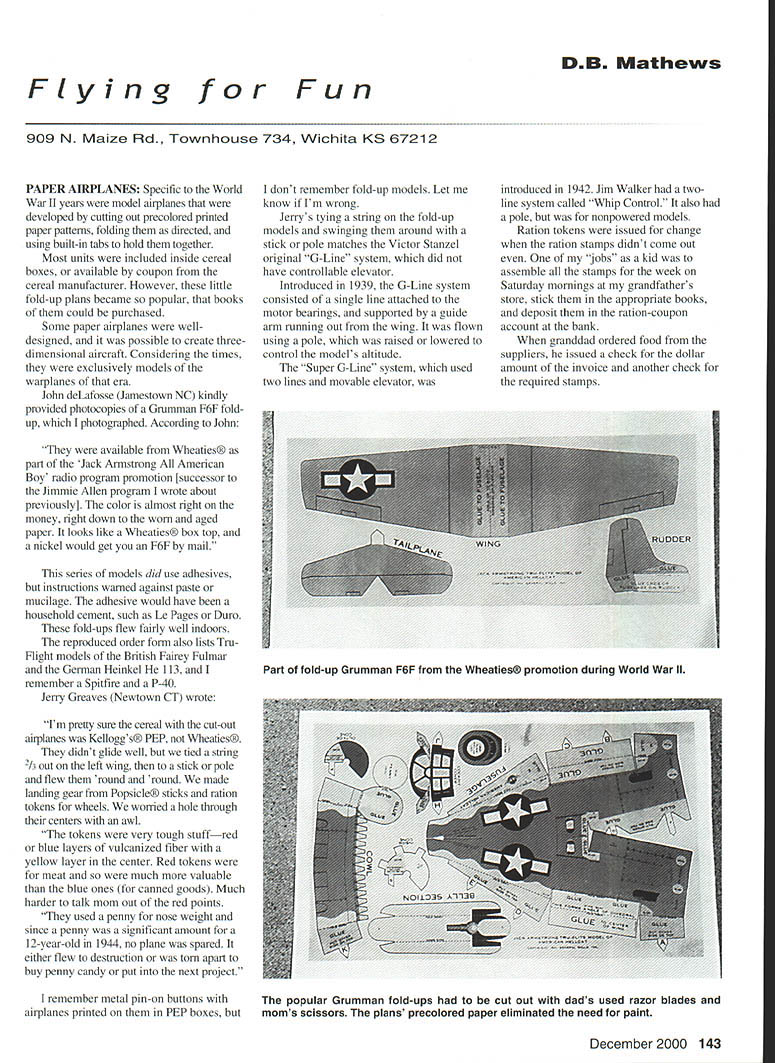
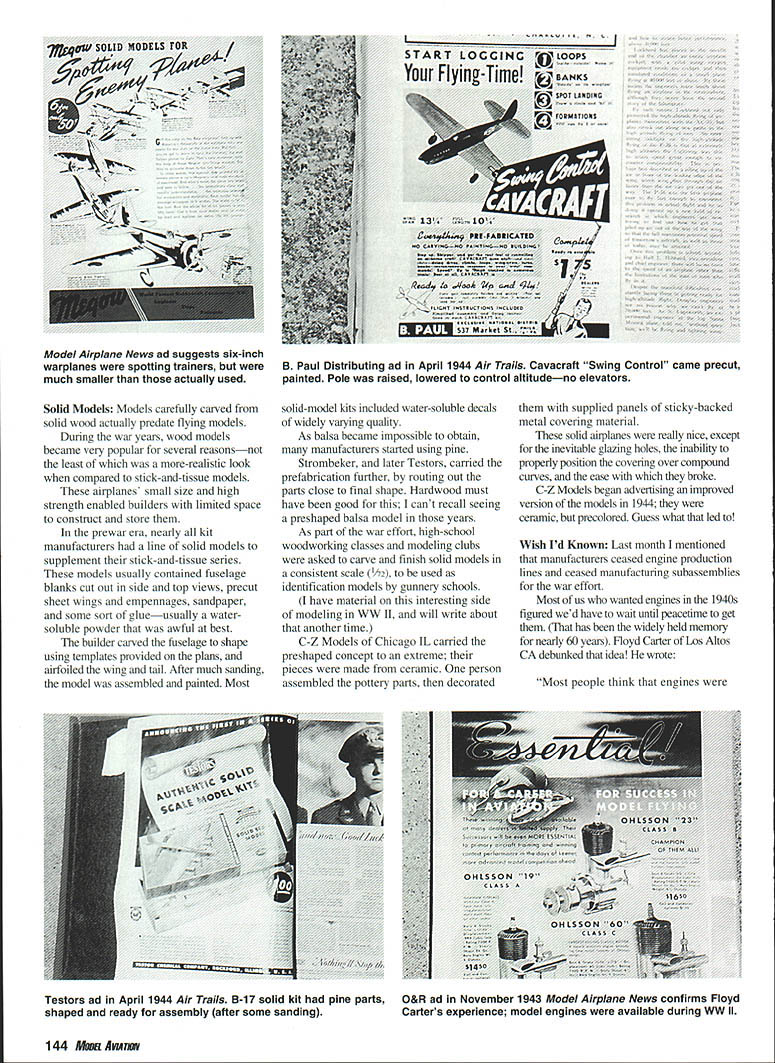
John deLafosse (Jamestown NC) kindly provided photocopies of a Grumman F6F foldup, which I photographed. According to John:
"They were available from Wheaties© as part of the 'Jack Armstrong All American Boy' radio program promotion (successor to the Jimmie Allen program I wrote about previously). The color is almost right on the money, right down to the worn and aged paper. It looks like a Wheaties© box top, and a nickel would get you an F6F by mail."
This series of models did use adhesives, but instructions warned against paste or mucilage. The adhesive would have been a household cement, such as LePage's or Duro.
These fold-ups flew fairly well indoors. The reproduced order form also lists Tru-Flight models of the British Fairey Fulmar and the German Heinkel He 113, and I remember a Spitfire and a P-40.
Jerry Greaves (Newtown CT) wrote:
"I'm pretty sure the cereal with the cut-out airplanes was Kellogg's PEP, not Wheaties©. They didn't glide well, but we tied a string 2' out on the left wing, then to a stick or pole and flew them 'round and 'round. We made landing gear from Popsicle© sticks and ration tokens for wheels. We worried a hole through their centers with an awl.
"The tokens were very tough stuff—red or blue layers of vulcanized fiber with a yellow layer in the center. Red tokens were for meat and so were much more valuable than the blue ones for canned goods. Much harder to talk mom out of the red points.
"They used a penny for nose weight and since a penny was a significant amount for a 12-year-old in 1944, no plane was spared. It either flew to destruction or was torn apart to buy penny candy or put into the next project."
I remember metal pin-on buttons with airplanes printed on them in PEP boxes, but I don't remember fold-up models. Let me know if I'm wrong.
Jerry's tying a string on the fold-up models and swinging them around with a stick or pole matches the Victor Stanzel original "G-Line" system, which did not have a controllable elevator.
I introduced in 1939 the G-Line system, which consisted of a single line attached to the motor bearings and supported by a guide arm running out from the wing. It was flown using a pole, which was raised or lowered to control the model's altitude.
The "Super G-Line" system, which used two lines and a movable elevator, was introduced in 1942. Jim Walker had a two-line system called "Whip Control." It also had a pole, but was for unpowered models.
Ration tokens were issued for change when the ration stamps didn't come or were uneven. One of my 'jobs' as a kid was to assemble all the stamps for the week on Saturday mornings at my grandfather's store, stick them in the appropriate books, and deposit them in the ration-coupon account at the bank.
When granddad ordered food from the suppliers, he issued a check for the dollar amount of the invoice and another check for the required stamps.
Solid Models
Models carefully carved from solid wood actually predate flying models.
During the war years, wood models became very popular for several reasons—not the least of which was a more realistic look when compared to stick-and-tissue models.
These airplanes' small size and high strength enabled builders with limited space to construct and store them.
In the prewar era, nearly all kit manufacturers had a line of solid models to supplement their stick-and-tissue series. These models usually contained few parts—blanks cut out in side and top views, precut sheet wings and empennages, sandpaper, and some sort of glue—usually a water-soluble powder that was awful at best.
The builder carved the fuselage to shape using templates provided on the plans, and airfoiled the wing and tail. After much sanding, the model was assembled and painted. Most solid-model kits included water-soluble decals of widely varying quality.
As balsa became impossible to obtain, many manufacturers started using pine. Strombecker, and later Testors, carried the prefabrication further by routing out the parts close to final shape. Hardwood must have been good for this; I can't recall seeing a preshaped balsa model in those years.
As part of the war effort, high-school woodworking classes and modeling clubs were asked to carve and finish solid models in their own scale (1/2), to be used as identification models by gunnery schools.
(I have material on this interesting side of modeling in WWII, and will write about that another time.)
C-Z Models of Chicago IL carried the preshaped concept to an extreme; their pieces were made from ceramic. One person assembled the pottery parts, then decorated them with supplied panels of sticky-backed metal covering material.
These solid airplanes were really nice, except for the inevitable glazing holes, the inability to properly position the covering over compound curves, and the ease with which they broke.
C-Z Models began advertising an improved version of the models in 1944; they were ceramic, but precolored. Guess what that led to!
Wish I'd Known
Last month I mentioned that manufacturers ceased engine production lines and ceased manufacturing subassemblies for the war effort.
Most of us who wanted engines in the 1940s figured we'd have to wait until peacetime to get them. (That has been widely held memory for nearly 60 years). Floyd Carter of Los Altos CA debunked that idea! He wrote:
"Most people think that engines were not available during the war. Actually, Ohlsson & Rice continued producing the .23 side-port pretty much all during the war. The War Department gave them permission to supply some engines to model plane clubs and to those individuals who submitted a letter saying that they planned to become aircraft designers when they grew up.
"That is what our local hobby shop owner told me. So I wrote the necessary letter and after two or three months, O&R delivered a .23 engine to the hobby shop with my name on the box. That was in late 1943, and I was 11 years old. It was tough for my parents to come up with the $18.50, but they were both employed by Douglas, building Dauntless dive bombers.
"Recently, someone who worked at O&R during the war told me that these engines were made after-hours, using existing prewar parts, and the employees did not charge to the government contracts, but their overtime work was paid by O&R."
I hope this and last month's columns have stirred some pleasant memories for readers who lived through those dark days of WWII. Hopefully those readers who came along later can detect the abundant wellspring of joy we share in our mutual hobby.
Whether these words represent memories or history, the common bond among us all is flying for fun!
MA
Transcribed from original scans by AI. Minor OCR errors may remain.

