
Flying for Fun
D.B. Mathews
909 N. Maize Rd., Townhouse 734, Wichita KS 67212
In the last year or so, I have mentioned the paper models that the "breakfast food" (cereal) companies offered as promotional items in the 1940s.
The mail response to this subject has been incredible, ranging from reminiscent letters to voluminous packets of photos and copies of the original premiums.
Paper/Card Models
When I first mentioned this subject, I recalled three-dimensional cut-and-fold airplanes available as part of a promotion by General Mills' Wheaties®, which was tied to its sponsorship of Jack Armstrong, the All-American Boy on the radio.
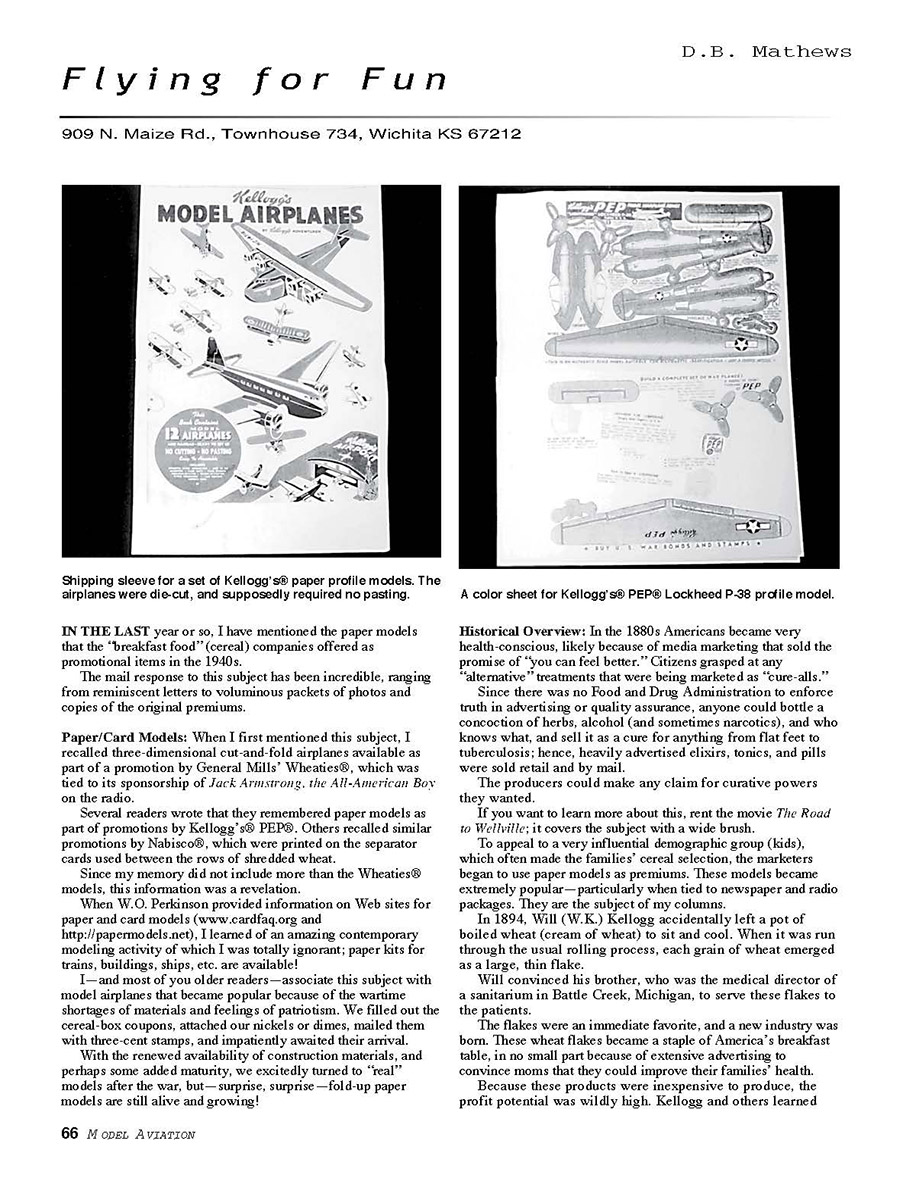
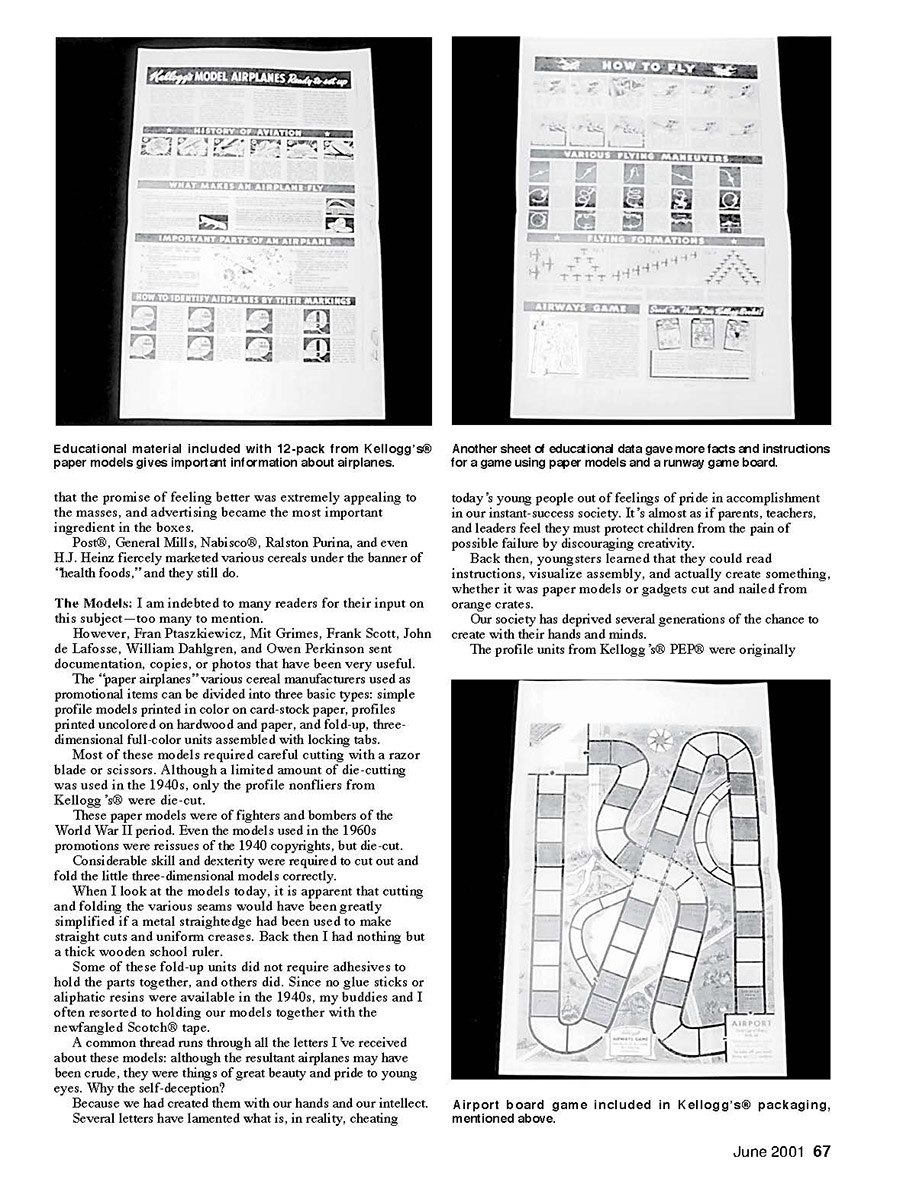
Several readers wrote that they remembered paper models as part of promotions by Kellogg's® PEP®. Others recalled similar promotions by Nabisco®, which were printed on the separator cards used between the rows of shredded wheat.
Since my memory did not include more than the Wheaties® models, this information was a revelation.
When W. O. Perkinson provided information on Web sites for paper and card models (www.cardfaq.org and http://papermodels.net), I learned of an amazing contemporary modeling activity of which I was totally ignorant; paper kits for trains, buildings, ships, etc. are available!
I — and most of you older readers — associate this subject with model airplanes that became popular because of the wartime shortages of materials and feelings of patriotism. We filled out the cereal-box coupons, attached our nickels or dimes, mailed them with three-cent stamps, and impatiently awaited their arrival.
With the renewed availability of construction materials, and perhaps some added maturity, we excitedly turned to "real" models after the war, but—surprise, surprise—fold-up paper models are still alive and growing!
Historical Overview
In the 1880s Americans became very health-conscious, likely because of media marketing that sold the promise of "you can feel better." Citizens grasped at any "alternative" treatments that were being marketed as "cure-alls."
Since there was no Food and Drug Administration to enforce truth in advertising or quality assurance, anyone could bottle a concoction of herbs, alcohol (and sometimes narcotics), and who knows what, and sell it as a cure for anything from flat feet to tuberculosis; hence, heavily advertised elixirs, tonics, and pills were sold retail and by mail.
The producers could make any claim for curative powers they wanted.
If you want to learn more about this, rent the movie The Road to Wellville; it covers the subject with a wide brush.
To appeal to a very influential demographic group (kids), who often made the families' cereal selection, the marketers began to use paper models as premiums. These models became extremely popular—particularly when tied to newspaper and radio packages. They are the subject of my columns.
In 1894, Will (W. K.) Kellogg accidentally left a pot of boiled wheat (cream of wheat) to cool and become hard. When it was run through the usual rolling process, each grain of wheat emerged as a large, thin flake.
Will convinced his brother, who was the medical director of a sanitarium in Battle Creek, Michigan, to serve these flakes to the patients.
The flakes were an immediate favorite, and a new industry was born. These wheat flakes became a staple of America's breakfast table, in no small part because of extensive advertising to convince moms that they could improve their families' health.
Because these products were inexpensive to produce, the profit potential was wildly high. Kellogg and others learned that the promise of feeling better was extremely appealing to the masses, and advertising became the most important ingredient in the boxes.
Post®, General Mills, Nabisco®, Ralston Purina, and even H. J. Heinz fiercely marketed various cereals under the banner of "health foods," and they still do.
The Models
I am indebted to many readers for their input on this subject—too many to mention.
However, Fran Ptaszkiewicz, Mit Grimes, Frank Scott, John de Lafosse, William Dahlgren, and Owen Perkinson sent documentation, copies, or photos that have been very useful.
The "paper airplanes" various cereal manufacturers used as promotional items can be divided into three basic types:
- Simple profile models printed in color on card-stock paper.
- Profiles printed uncolored on hardwood and paper.
- Fold-up, three-dimensional full-color units assembled with locking tabs.
Most of these models required careful cutting with a razor blade or scissors. Although a limited amount of die-cutting was used in the 1940s, only the profile nonfliers from Kellogg's® were die-cut.
These paper models were of fighters and bombers of the World War II period. Even the models used in the 1960s promotions were reissues of the 1940 copyrights, but die-cut.
Considerable skill and dexterity were required to cut out and fold the little three-dimensional models correctly.
When I look at the models today, it is apparent that cutting and folding the various seams would have been greatly simplified if a metal straightedge had been used to make straight cuts and uniform creases. Back then I had nothing but a thick wooden school ruler.
Some of these fold-up units did not require adhesives to hold the parts together, and others did. Since no glue sticks or aliphatic resins were available in the 1940s, my buddies and I often resorted to holding our models together with the newfangled Scotch® tape.
A common thread runs through all the letters I've received about these models: although the resultant airplanes may have been crude, they were things of great beauty and pride to young eyes. Why the self-deception?
Because we had created them with our hands and our intellect. Several letters have lamented what is, in reality, cheating today's young people out of feelings of pride in accomplishment in our instant-success society. It's almost as if parents, teachers, and leaders feel they must protect children from the pain of possible failure by discouraging creativity.
Back then, youngsters learned that they could read instructions, visualize assembly, and actually create something, whether it was paper models or gadgets cut and nailed from orange crates.
Our society has deprived several generations of the chance to create with their hands and minds.
Transcribed from original scans by AI. Minor OCR errors may remain.

