
Flying for Fun
909 N. Maize Rd., Townhouse 734, Wichita KS 67212
FUN FOR NEWCOMERS: For this special issue I thought a brief overview of the incredibly diverse, yet interconnected, world of model airplanes would be in order.
For most of us, building and/or flying model aircraft is an avocation—not a vocation. Did you ever notice how much alike vocation and vacation are in spelling and pronunciation, yet are the opposite of each other?
To us modelers, our hobby is a vacation, or avocation. Model airplanes are for fun; they allow us an escape from the routines and stresses of our work (vocation); we are on vacation when modeling.
As a result, when two or more modelers assemble to discuss, build, or fly, laughter, fellowship, and joy surround them. Modelers are happy people because they are pursuing their hobby.
The happiness, joy, and friendliness are contagious. As a newcomer, you are entering a nonexclusive fraternity of happy people.
Even if you live somewhere that is isolated from the mainstream, the modeling magazines and the Internet will connect you with these people.
The diversity of venues that is so fundamental to this hobby provides a bond among all of us, whether our interests are in simple rubber-powered models or incredibly detailed Scale Radio Control (RC) models.
Though a certain degree of bigotry could develop between such diverse groups, they are joined by a common interest in things that fly and the fun others derive from them.
Let's take a look at those different, yet unifying, areas of interest, and the fun to be found in them.
Free Flight (FF)
I have a tip for you newcomers who are actually returnees who built models in earlier times: kits, hardware, covering materials, and adhesives have totally changed and are vastly improved.
Many kits are die- or laser-cut, providing much better parts fit. Many rubber-powered kits use commercially molded plastic or precarved balsa propellers, which eliminates the need to carve them from those odd-shaped blanks. Great wheels and pre-bent wire parts are provided.
Excellent-quality rubber strip is now available. Inexpensive and very practical winders are stock items in many hobby shops or by mail.
Although most of the smaller rubber-powered models are still covered with tissue, its quality has improved greatly and some excellent new techniques for applying it are available.
An excellent instructional video is Covering Models with Japanese Tissue with Larry Kruze (from Robin's View Productions, Box 68, Stockton PA 18083).
Slightly larger models can be covered with heat-shrinkable polyester tissue, such as LiteSpan (from Hobby Lobby). This material is much the same weight as tissue, but is infinitely more puncture-resistant and is available in a wide variety of colors.
The book Rubber Powered Model Airplanes by Don Ross is an excellent reference source, and it may be available in your local library or from Carstens Publications (Box 700, Newton NJ 07860-0700). I highly recommend the tape and the book to newcomers.
FF models are not only flown with rubber power; tiny electric power plants and units using compressed CO2 are available for models intended for indoor or outdoor flying.
Check out the ads in Model Aviation and Flying Models; you'll be amazed at the diversity of power plants and kits available.
Some glow- and gas-powered FF is still flown, but in competition for the most part, and that is outside the scope of this overview for newcomers.
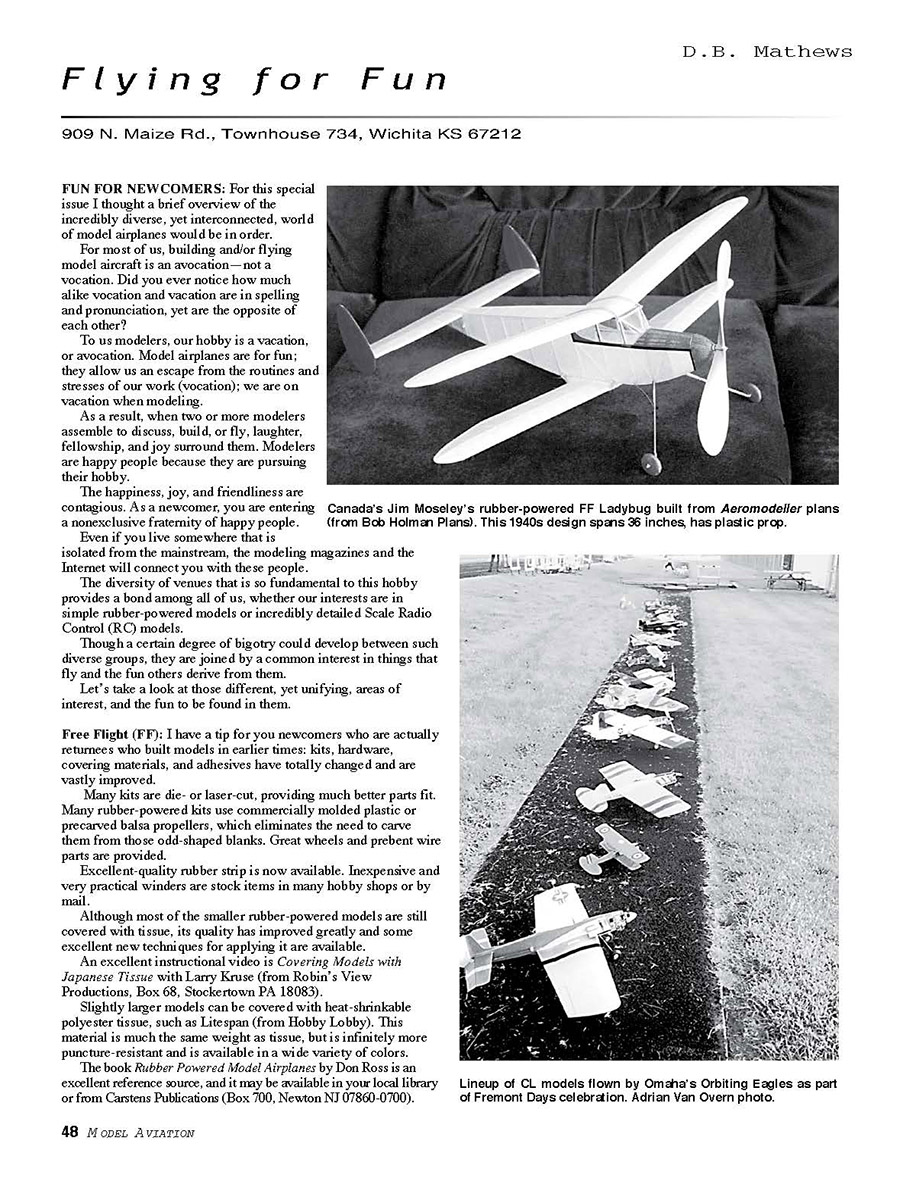
An astonishing number of quality kits for sport FF are available from a large group of manufacturers. These range from tiny 13-inch-span "Peanuts" to 30-inch-span "Jumbos," and are available in Scale and non-Scale versions.
I recommend that newcomers initially stick with the non-Scale subjects; they are usually easier to build and much easier to trim for satisfactory flights.
Once the fundamentals of building and trimming have been learned, there is a nearly unlimited choice of subjects from which to choose.
Many splendid designs are available from the aforementioned magazines and from individuals. These plan-built models are only a bit more challenging to build, and they add the fun of creating a model from the drawings up.
As you gather skill and knowledge, scratch-building from your original plans can be a great source of pride and fun. This also applies to the categories of models that follow.
Of no small significance to the attraction of sport FF models is the relatively low expense. On a dollar-per-hour-of-fun basis, this category is a true bargain.
I have been building and flying model airplanes for more than 60 years. There is nothing more beautiful to see than an FF model climb out, then glide with the sun shining through its semitransparent covering. That is pure artistry, and a joy to behold.
Control Line (CL)
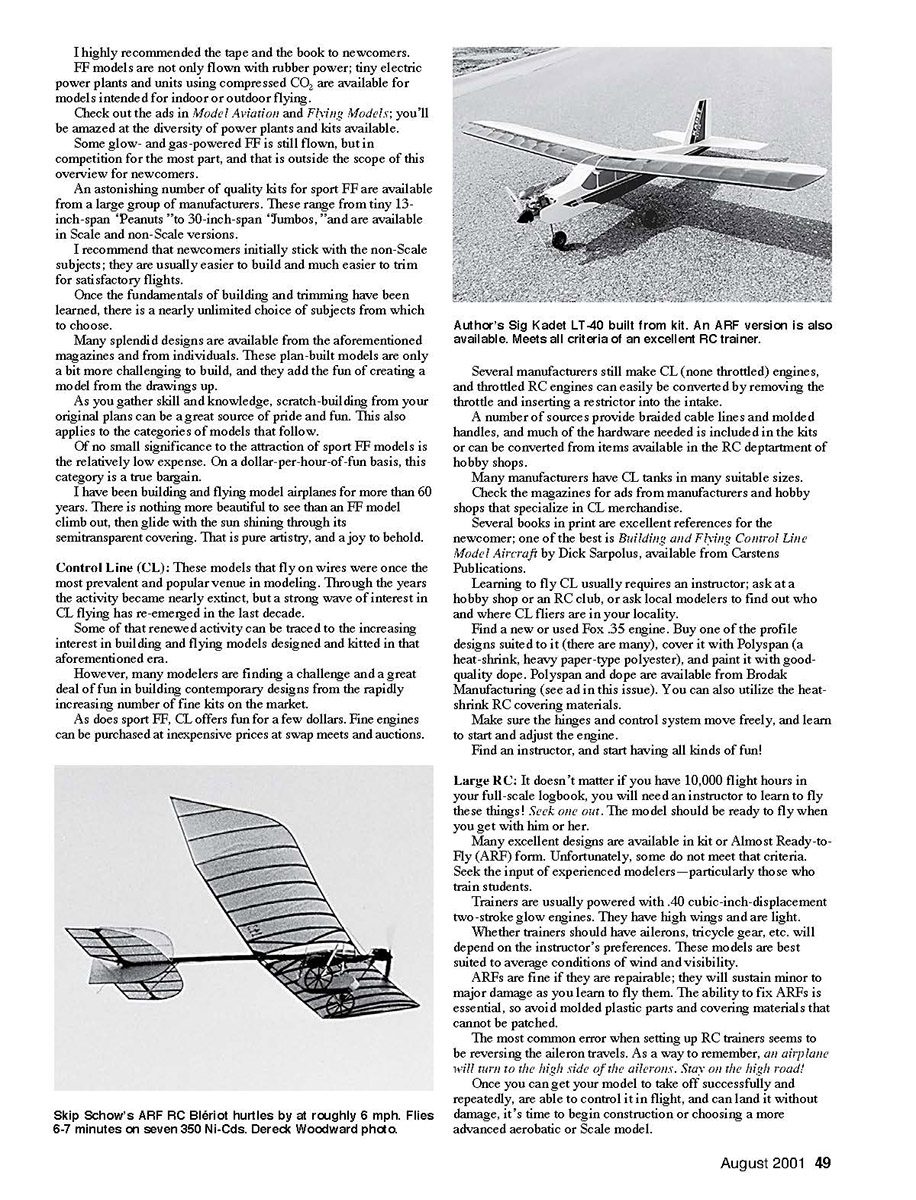
These models that fly on wires were once the most prevalent and popular venue in modeling. Through the years the activity became nearly extinct, but a strong wave of interest in CL flying has re-emerged in the last decade.
Some of that renewed activity can be traced to the increasing interest in building and flying models designed and kitted in that aforementioned era.
However, many modelers are finding a challenge and a great deal of fun in building contemporary designs from the rapidly increasing number of fine kits on the market.
As does sport FF, CL offers fun for a few dollars. Fine engines can be purchased at inexpensive prices at swap meets and auctions.
Several manufacturers still make CL (none throttled) engines, and throttled RC engines can easily be converted by removing the throttle and inserting a restrictor into the intake.
A number of sources provide braided cable lines and molded handles, and much of the hardware needed is included in the kits or can be converted from items available in the RC department of hobby shops.
Many manufacturers have CL tanks in many suitable sizes. Check the magazines for ads from manufacturers and hobby shops that specialize in CL merchandise.
Several books in print are excellent references for the newcomer; one of the best is Building and Flying Control Line Model Aircraft by Dick Saporolus, available from Carstens Publications.
Learning to fly CL usually requires an instructor; ask at a hobby shop or an RC club, or ask local modelers to find out who and where CL fliers are in your locality.
Find a new or used Fox .35 engine. Buy one of the profile designs suited to it (there are many), cover it with Polyspan (a heat-shrink, heavy paper-type polyester), and paint it with good-quality dope. Polyspan and dope are available from Brodak Manufacturing (see ad in this issue). You can also utilize the heat-shrink RC covering materials.
Make sure the hinges and control system move freely, and learn to start and adjust the engine.
Find an instructor, and start having all kinds of fun!
Large RC
It doesn't matter if you have 10,000 flight hours in your full-scale logbook, you will need an instructor to learn to fly these things! Seek one out. The model should be ready to fly when you get with him or her.
Many excellent designs are available in kit or Almost Ready-to-Fly (ARF) form. Unfortunately, some do not meet that criteria. Seek the input of experienced modelers—particularly those who train students.
Trainers are usually powered with .40 cubic-inch-displacement two-stroke glow engines. They have high wings and are light.
Whether trainers should have ailerons, tricycle gear, etc. will depend on the instructor's preferences. These models are best suited to average conditions of wind and visibility.
ARFs are fine if they are repairable; they will sustain minor to major damage as you learn to fly them. The ability to fix ARFs is essential, so avoid molded plastic parts and covering materials that cannot be patched.
The most common error when setting up RC trainers seems to be reversing the aileron travels. As a way to remember, an airplane will turn to the high side of the aileron. Stay on the right road!
Once you can get your model to take off successfully and repeatedly, are able to control it in flight, and can land it without damage, it's time to begin construction or choosing a more advanced aerobatic or Scale model.
The radio gear, engine, tank and other hardware from a trainer will be fine for more advanced projects.
The model of increasing complexity are where the fabulous variety of RC becomes apparent. Gliders, helicopters, autogiros, biplanes, triplanes, flying wings, floatplanes, amphibians, ski planes, aerobatic Combat, multiengine, Scale, sport, huge, tiny, antique, classic, and contemporary are just a few segments.
There are several excellent reference texts on the subject.
Small RC
This area is relatively new and most exciting.
These electric-powered models come in three categories: park flyers, which require the space of a football or soccer field to be flown safely; yard flyers, which can be flown in relatively tight outdoor spaces, such as vacant lots or wide residential streets; and indoor, which opens up most basketball courts and gym-size sites to fun flying.
The most important thing about these small electric models is the absolute need for quality components. Cheap motors, speed controls, and batteries are actually very expensive, because they don't work well or long. Whenever possible, try to buy a matched equipment package from the model's manufacturer. You can also use the equipment later, in subsequent models with equivalent specifications.
Although the vast majority of these small RC models are sold as ARFs, we are beginning to see kits and magazine plans for them.
The potential for fun with these little models is limited only by how strong the wind is blowing (when outdoors, of course). I anticipate an absolute explosion of people flying small models in areas never available to them before—not only because of the small space requirements, but because of the low noise these aircraft generate.
These models combine the virtues of rubber power with the advances of RC; this is a true definition of fun!
"Truths I learned the hard way"
- Tail-heavy models are looking for a place to crash! Models must balance at the points shown on the construction drawings; there's no room for compromises. Add the required weight and/or shift the components around in the model until it hangs level with the floor when lifted at the balance point. Don't allow yourself or anyone else to fool you into thinking it is possible to compensate for tail-heaviness with the radio system.
- Never attempt to adjust the needle valve or shut off or remove the glow-plug clip by reaching around the arc of the spinning propeller from the model's front! Move to the back of the model before placing your hands anywhere near the engine. A spinning propeller is just waiting for a chance to eat your fingers, or worse! Please don't feed the propellers!
- Internal-combustion model engines make a lot of noise when running. Respect the sensitivities of others; be a good neighbor.
- Regardless of the power plant or model's size, consider the safety of those around you.
- When flying RC, never turn on your transmitter without making absolutely sure no one else is already using that frequency.
As the late Johnny Clemens put on his hobby shop van, "Drive yourself sane, fly model airplanes."
Transcribed from original scans by AI. Minor OCR errors may remain.

