
Flying for Fun
I was astonished at the sheer scope and huge crowds. How huge? I commented that I felt as if I’d been bent, folded, stapled, and mutilated.
My primary reason for attending was to “touch the flesh” with a lot of people I’d corresponded with for many years, but had never actually met. Those contacts were a pure delight, even if longtime friend Dick Kidd thought I was “much bigger than I was supposed to be.” A very special thank you to those who walked up to flatter me with kind words about my designing and writing.
My secondary purpose was to try to get a feel for what modelers are thinking and doing. Other columnists in this and in other magazines will more-than-adequately report on the products and innovations introduced at Toledo. I’ll report on what I learned from visiting with a large number of modelers outside the exhibition hall.
Small electric models
There is an incredible surge of interest and activity in the area of small electric-powered models. We bounce about, hunting for a name for these little models, using “yard,” “park,” “street,” “slow,” and “mini” as descriptions.
Whatever they are called, the excitement is increasing by the day; nearly everyone I talked to was already flying them or was getting ready to. This is the most dynamic surge in modeling since the early days of Control Line (CL).
Much like CL was in its heyday, these little models can be flown in areas to which the general public has easy access. And much like CL (without the noise), these models attract curious adults and kids in droves.
Let’s face it: the majority of the public’s exposure to modeling is at special events held miles away from where they live. The public-address emphasis at these shows always seems to be on cost, time spent building the models, and wild performance. Consequently, the spectators leave impressed, perhaps, but hardly captivated.
On the layman’s side of this experience, the little models are inexpensive, available as Almost Ready to Flys (ARFs), and simply look easy to fly safely in small spaces. Fly one of the small aircraft in a park or on a playground, and the onlookers will be mesmerized. Questions of “Where do I get one of those?” will follow shortly.
After flying a mini-Electric for a while and discovering how much fun it is to fly Radio Control (RC), it is likely that they will develop an understanding and really become captivated by the type of models they see at special events. Although I’m hardly in the prediction business, I fully expect to see an absolute explosion of new modelers entering our hobby! We could well see a doubling of participation in the next few years.
I hope AMA will encourage the small-model manufacturers and/or importers to include information about joining the Academy. They need to provide very clear and concise warnings about the danger of shooting someone else down if two models on the same frequency are flown at the same time too close to each other.
I also hope to see transmitters introduced with limited range, to help prevent this “unseen filter” problem. These little models certainly don’t require transmitters with the output we have in current equipment.
My “snooping” at Toledo also confirmed (once again) how friendly modelers of all ages are. That bond of common interest I’ve mentioned repeatedly really glows at an event such as Toledo.
Want to start a conversation with strangers? Say “model airplane”!
Innovation: Is necessity really the mother of invention?
Consider the modeler who derives great pleasure from adapting materials or techniques from nonmodeling items to his or her building. Is this inventiveness motivated by a lack of funds or frugality? Not usually. The reward is the pure joy of devising a new way of doing things—not the money saved!
There might be a touch of snobbery floating about on this subject; some modelers presume that innovators and those who fly simple models are poor. Comparing net-worth statements with those who buy everything ready to use would be very revealing.
Innovative modelers love to find simple and inexpensive solutions to complex problems. They are the ones who build from scratch (drawings up) or from plans. They are the ones who derive as much pleasure from simple rubber-powered Free Flights as others do from incredibly complex Scale RC models. These people are not motivated by saving dollars, but by being creative and having fun.
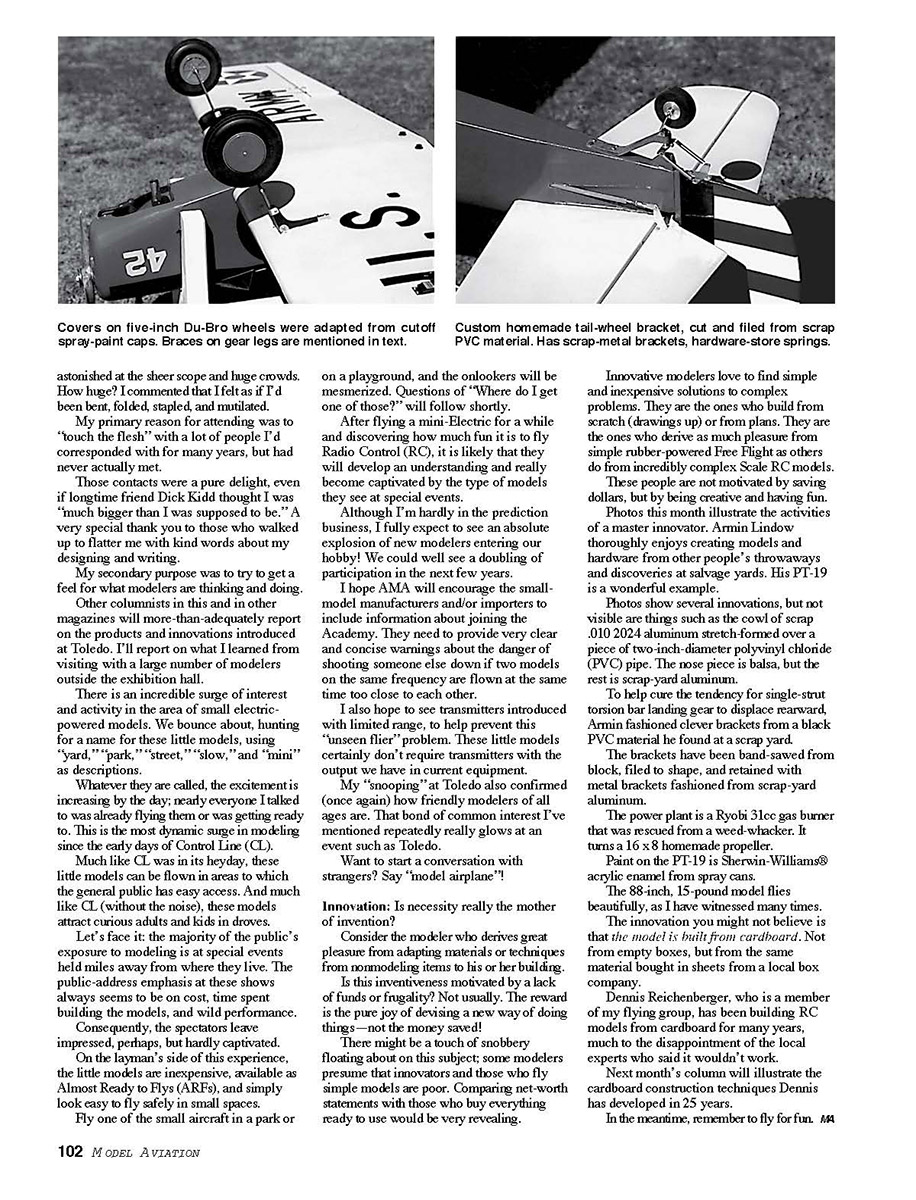
Photos this month illustrate the activities of a master innovator, Armin Lindow, thoroughly enjoying creating models and hardware from other people’s throwaways and discoveries at salvage yards. His PT-19 is a wonderful example.
Photos show several innovations, but not visible are things such as the cowl of scrap .010 2024 aluminum stretched over a piece of two-inch-diameter polyvinyl chloride (PVC) pipe. The nose piece is balsa, but the rest is scrap-yard aluminum.
To help cure the tendency for single-strut torsion bar landing gear to displace rearward, Armin fashioned clever brackets from a black PVC material he found at a scrap-yard. The brackets have been band-sawed from block, filed to shape, and retained with metal brackets fashioned from scrap-yard aluminum.
The power plant is a Royla 31cc gas burner that was rescued from a weed-wacker. It turns a 16 x 8 homemade propeller. Paint on the PT-19 is Sherwin-Williams acrylic enamel from spray cans. The 88-inch, 15-pound model flies beautifully, as I have witnessed many times.
The innovation you might not believe is that the model is built from cardboard. Not from empty boxes, but from the same material bought in sheets from a local box company.
Alen Reichenberger, who is a member of my flying group, has been building RC models from cardboard for many years, much to the disappointment of the local experts who said it wouldn’t work. Next month’s column will illustrate the cardboard-construction techniques Dennis has developed in 25 years.
In the meantime, remember to fly for fun.
M.A.
Transcribed from original scans by AI. Minor OCR errors may remain.

