
Flying for Fun
909 N. Maize Rd., Townhouse 734, Wichita KS 67212
WHERE THERE Is a Will ...:
The September and October columns were based on many modelers' exemplary ability to adapt inexpensive materials to modeling use. This month I'll look at a circumstance in which no materials were available.
A letter from John T. Bishop of Hoffman Estates IL illustrates an approach to that situation. He wrote:
"I spent most of WW II in China, providing communications for the Air Corps. I was at most of the bomber and fighter bases in China. The B-29 base near Chengtu was the biggest activity. A place that big always had an airplane graveyard on-site with lots of hulks to pour over—both American and Japanese.
"I discovered the aft fuselage tank in the P-51D had a support of beautiful grained balsa. Having been a prewar competitor in rubber power, I found a whole new way to somewhat enjoy my hobby while in China.
"My last and best-flying prewar Rubber model was a Dick Korda Record Holder, so I made another of them from the wood out of the P-51Ds and some thin plywood from Japanese rear control surfaces. Dope, glue, and power tools were available from the base aviation maintenance shops, and I discovered some good rubber in landing-gear bungee cord.
"For almost six months I enjoyed flying my Korda in this land where the population was still in the middle ages, mechanically.
"A modeler will always find a way to enjoy this wonderful hobby."
Those "N" Numbers:
Jim Deckert of St. Donatus IA sent material and comments that hopefully will clarify the "What font?" question I posed in the May 2001 column. He wrote:
"Things are often less organized and formal than they seem. Type and/or lettering fonts as we know them now were quite unknown outside of the printing industry before personal computers, and the CAA/FAA (Civil Aviation Authority/Federal Aircraft Administration) requirements for lettering were (and still are) rather loose.
"So while researching aircraft, it is not unusual to find registration numbers in a variety of sizes and styles.
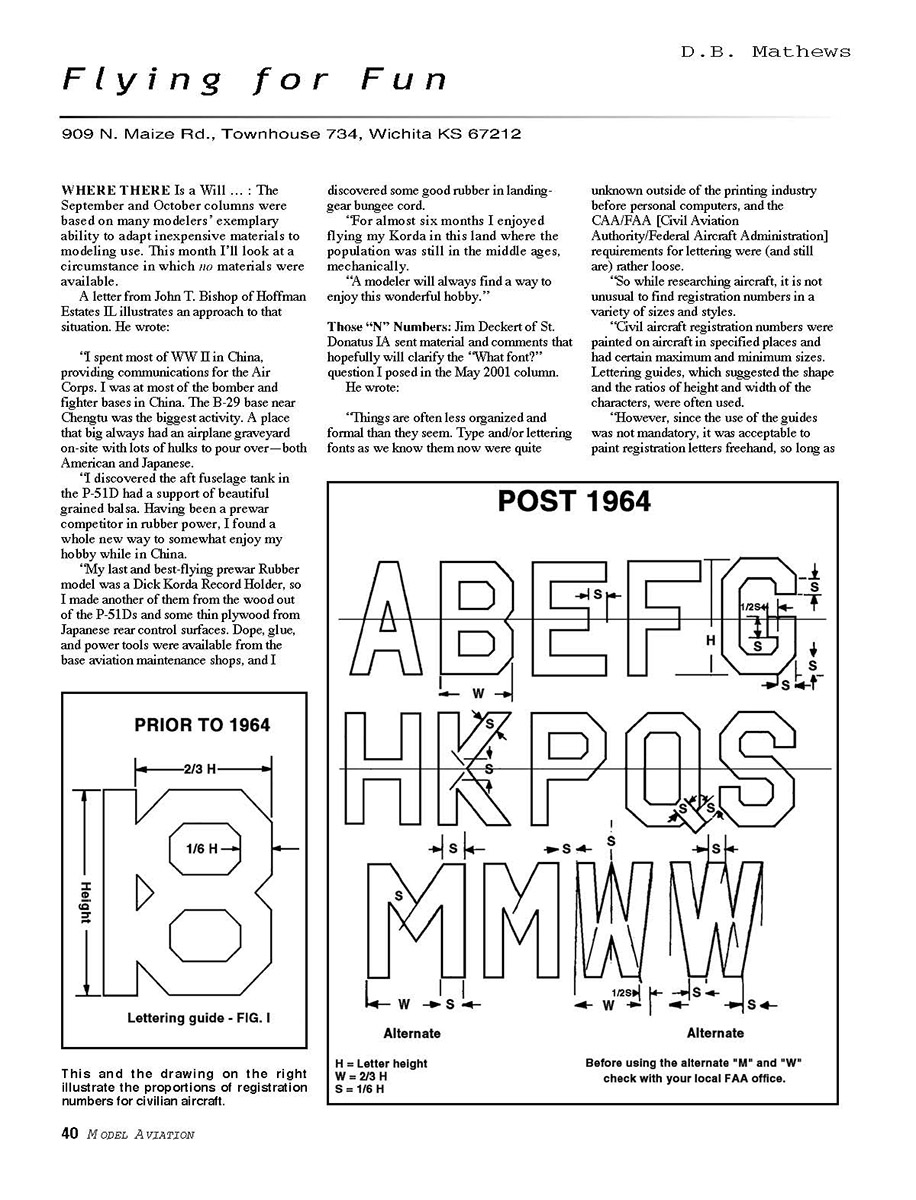
"Civil aircraft registration numbers were painted on aircraft in specified places and had certain maximum and minimum sizes. Lettering guides, which suggested the shape and the ratios of height and width of the characters, were often used.
"However, since the use of the guides was not mandatory, it was acceptable to paint registration letters freehand, so long as they were legible and the aircraft could be thus identified.
"The text Aircraft Maintenance for the Aircraft Mechanic (Brimm, Daniel J. and Bogges, H. Edward, Pitman Publishing Co. New York: 1940) is the standard reference guide for aircraft. Using this guide, any registration number could be laid out.
"For years the system used 'N' (US registry) followed by 'C' for certified aircraft or 'X' for experimental and 'R' for restricted; i.e., racing, agricultural, forest service, and aerobatic aircraft. Thus two letters followed by five digits or four digits and a letter at the end.
"Exceptions to this format were occasionally allowed for some experimental aircraft (NX 211 for Lindbergh's NYP) and for some racing aircraft (such as NR2102 on a Gee Bee R-1).
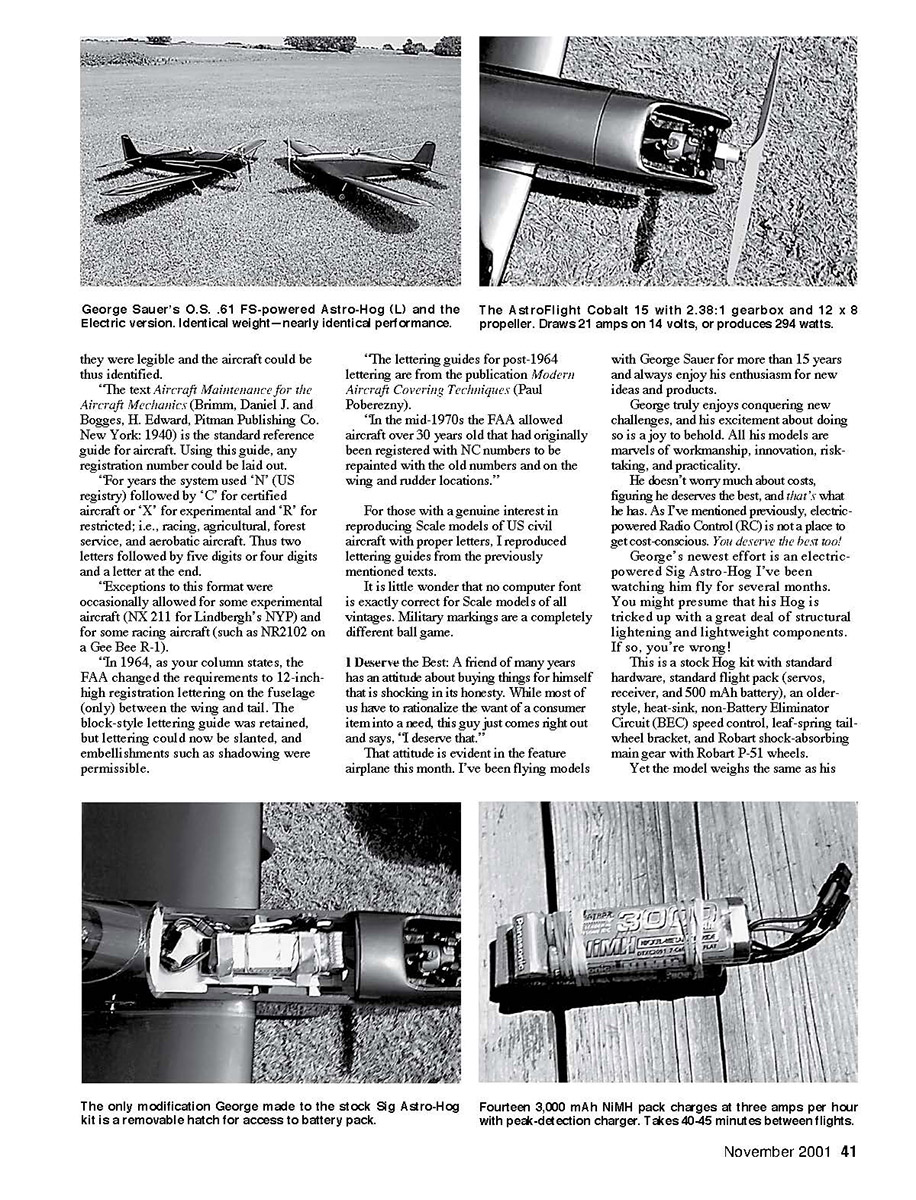
"In 1964, as your column states, the FAA changed the requirements to 12-inch-high registration lettering on the fuselage (only) between the wing and tail. The block-style lettering guide was retained, but lettering could now be slanted, and embellishments such as shadowing were permissible.
"'The lettering guides for post-1964 lettering are from the publication Modern Aircraft Covering Techniques (Paul Poberezny).
"In the mid-1970s the FAA allowed aircraft over 30 years old that had originally been registered with NC numbers to be repainted with the old numbers and on the wing and rudder locations.'
For those with a genuine interest in reproducing scale models of US civil aircraft with proper letters, I reproduced lettering guides from the previously mentioned texts.
It is little wonder that no computer font is exactly correct for Scale models of all vintages. Military markings are a completely different ball game.
I Deserve the Best:
A friend of many years has an attitude about buying things for himself that is shocking in its honesty. While most of us have to rationalize the want of a consumer item into a need, this guy just comes right out and says, "I deserve that."
That attitude is evident in the feature airplane this month. I've been flying models with George Sauer for more than 15 years and always enjoy his enthusiasm for new ideas and products.
George truly enjoys conquering new challenges, and his excitement about doing so is a joy to behold. All his models are marvels of workmanship, innovation, risk-taking, and practicality.
He doesn't worry much about costs, figuring he deserves the best, and that's what he has. As I've mentioned previously, electric-powered Radio Control (RC) is not a place to get cost-conscious. You deserve the best too!
George's newest effort is an electric-powered Sig Astro-Hog I've been watching him fly for several months. You might presume that his Hog is tricked up with a great deal of structural lightening and lightweight components. If so, you're wrong!
This is a stock Hog kit with standard hardware, standard flight pack (servos, receiver, and 500 mAh battery), an older-style, heat-sink, non-Battery Eliminator Circuit (BEC) speed control, leaf-spring tailwheel bracket, and Robart shock-absorbing main gear with Robart P-51 wheels.
Yet the model weighs the same as his O.S. .61 FS-powered model when they are fully fueled and ready for takeoff (seven pounds, two ounces).
Power is gained as Astro Conti 15 (brushed) motor running off two seven-cell 3,000 mAh Nickel Metal Hydride (NiMH) packs. This setup runs a J & B Master A-screw electric wood propeller at 800 rpm using an Astroflight 23.8:1 gearbox.
That's roughly what you would expect from a .61 FS glow engine. As a result, the takeoff, run and flying speeds are nearly identical. George's electric- and glow-powered Hogs are indistinguishable in the air.
It's astonishing! I've observed numerous flights of the AstroHog, and I assure you I am not stretching the facts.
What astonishes me even more is that the Electric version could be built many ounces lighter by using a lighter speed control with a built-in BEC to eliminate the flight pack (six ounces), using a lighter receiver and servos (at least four ounces), using a lighter set of wheels and axles for the mains and the tailwheel (two ounces), and adding lightening holes in the wing ribs and fuselage doublers and hollowing the nose blocks (two to three ounces).
Trimming off 13–17 ounces of weight would likely drop an Electric Astro-Hog that would outperform the glow version.
The fact that this Hog flies so well without any effort at lowering its weight is strong testimony to how electric-powered models have come in the last few years.
As I've mentioned in previous columns, those early Electric "climb and glide" (a little) kits that were hardly more than electric skis have been replaced by components and hardware that leave very little, if any, difference between electric and glow power. That is a testament to those pioneers who stuck with the development of electric power.
George Sauer has proven to those of us who fly with him that the age of quality electric-powered, medium-sized sport RC models is upon us.
Consider those lighter-weight sport aerobatic kits and designs that are successfully and easily converted to fly well on electric power.
What Size Is the Motor?
Somehow electric motors for model use suffer an identity crisis. Consider a "Speed 400"—400 what? Or an Astro "15"—15 cubic inches?
What happens when either is geared? How about the brushless units? Or the increased capacity of NiMH or Lithium cells?
When Astroflight pioneered the electric motor thing, it apparently named them on the basis of comparison to glow engines: the rpm of either with a given propeller. This was long before gearboxes were introduced, so the names are irrelevant.
The experts in the electric power field prefer to classify the motors on the basis of watts: amps multiplied by volts. The wattage depends on efficiency of the power plant, propeller size, and gear ratio. Therefore, even labeling electric motors in watts is a bit shaky.
Apparently the best bet was to name the motors in maximum watts. It's little wonder that the matched system electric kits are gaining popularity.
An alternative would be the rating system Hobby Lobby uses, listing model size, model purpose (glider vs. sport aerobatic), number of cells, and propeller recommendation. It makes sense to me!
Those who want to measure a given motor's performance with varying propellers, gearboxes, and battery packs need a good voltmeter and tachometer. And there is the challenge to one's abilities and an opportunity to add to one's fund of knowledge.
Now doesn't that sound like fun?
Warning:
Two local novice Electric fliers burned out the speed controls of their Almost Ready-to-Fly park flyers. How?
Consider the variables mentioned in the previous section to see if you can figure why and how.
They had no room for a larger battery pack nor could they easily change the gear ratio, so the problem had to be changing the propeller that drew more amps.
Propellers that are larger in diameter, pitch, or both increased the current (amps) drawn, in this case exceeding the capacity or rating of the Electronic Speed Control.
Speed controls are rated at a maximum amperage; do not exceed it, or the thing will fry.
Transcribed from original scans by AI. Minor OCR errors may remain.

