
Flying for Fun
909 N. Maize Rd., Townhouse 734, Wichita KS 67212
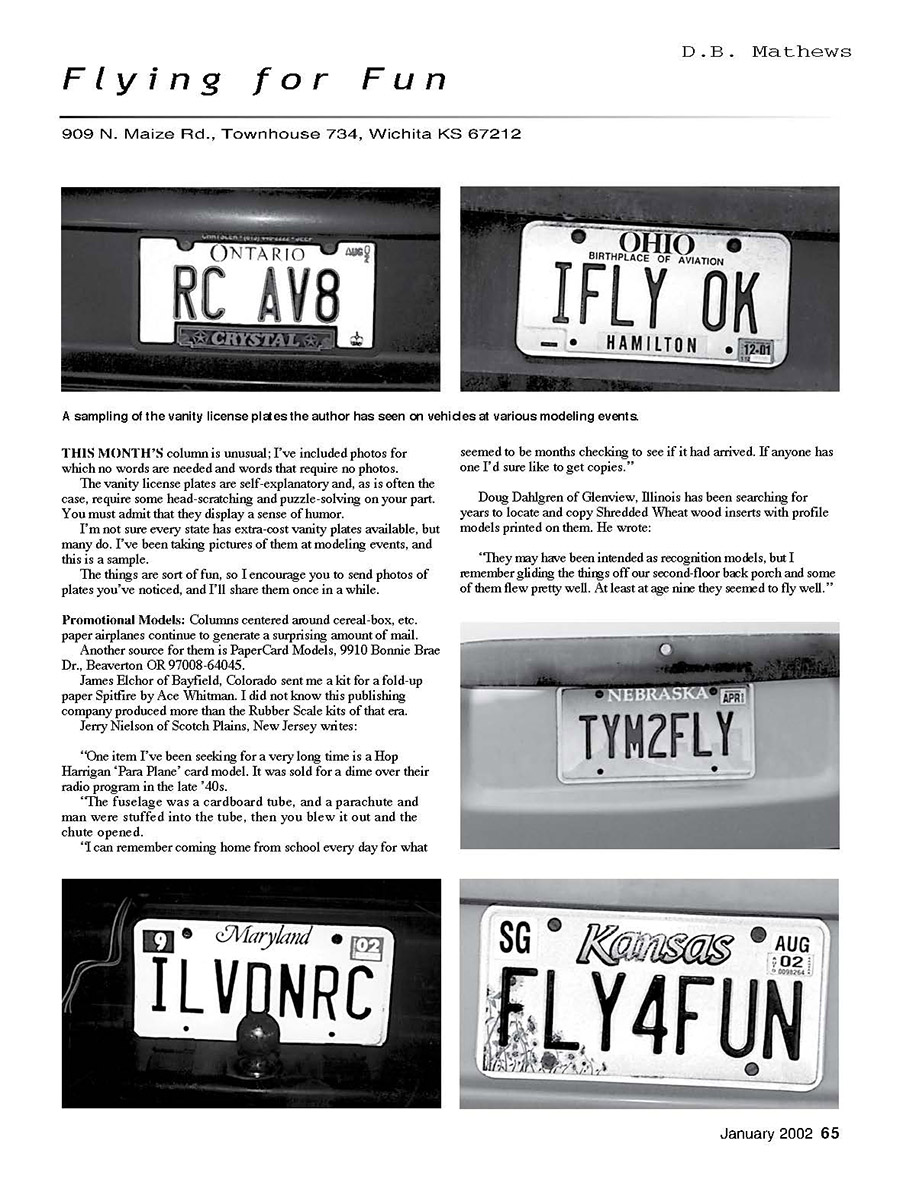
THIS MONTH'S column is unusual; I've included photos for which no words are needed and words that require no photos.
The vanity license plates are self-explanatory and, as is often the case, require some head-scratching and puzzle-solving on your part. You must admit that they display a sense of humor.
I'm not sure every state has extra-cost vanity plates available, but many do. I've been taking pictures of them at modeling events, and this is a sample.
The things are sort of fun, so I encourage you to send photos of plates you've noticed, and I'll share them once in a while.
Promotional Models: Columns centered around cereal-box, etc. paper airplanes continue to generate a surprising amount of mail.
Another source for them is PaperCard Models, 9910 Bonnie Brae Dr., Beaverton OR 97008-6045.
James Elchor of Bayfield, Colorado sent me a kit for a fold-up paper Spitfire by Ace Whitman. I did not know this publishing company produced more than the Rubber Scale kits of that era.
Jerry Nielson of Scotch Plains, New Jersey writes:
"One item I've been seeking for a very long time is a Hop Harrigan 'Para Plane' card model. It was sold for a dime over their radio program in the late '40s.
"The fuselage was a cardboard tube, and a parachute and man were stuffed into the tube, then you blew it out and the chute opened.
"I can remember coming home from school every day for what seemed to be months checking to see if it had arrived. If anyone has one I'd sure like to get copies."
Doug Dahlgren of Glenview, Illinois has been searching for years to locate and copy Shredded Wheat wood inserts with profile models printed on them. He wrote:
"They may have been intended as recognition models, but I remember gliding the things off our second-floor back porch and some of them flew pretty well. At least at age nine they seemed to fly well."
As I've mentioned several times, most of us modelers live rather sedentary, air-conditioned lives, and there is real danger in getting physically active at the flying field in such extreme temperatures.
Most summers, plenty of fluids, shade, and evening or early-morning flying are necessities. This year it has often been dangerous to be outdoors for more than a few moments.
Quarantined: M.D. May of Hill Top Beaverton, England talks of an even more severe restriction on flying than weather: England is in the grip of a nationwide hoof-and-mouth-disease epidemic.
One result is that all parks are closed and there are severe restrictions on outdoor activities. M.D.'s flying field on an old Royal Air Force base has been closed for months. These limitations extend to athletic fields, traditional fairs, and outdoor concerts.
The fear is the spread of the disease to wildlife, such as deer, then their exposure to humans. And we thought we had flying problems!
B-29 Stuff: The restoration of a B-29 here in Wichita to flying status, a television special put together by a public television station, and a reading of Seven Men by General Curtis LeMay and Bill Yenne have dredged up a bunch of memories.
The need for the B-29, with its vastly longer range, lifting capacity, and pressurization, was recognized in the late 1930s. The military had accepted Boeing's design by May 1940. The aircraft was ordered into production before the first prototype was flown.
Since all existing airplane factories were producing night and day, it was necessary to build new plants, housing for the workers, schools for their children, and bases from which to fly the airplanes. This was accomplished in 12 months!
After some wrangling, the Department of Defense built factories for Boeing in Renton, Washington and Wichita, for Bell in Marietta, Georgia, and for Martin in Omaha, Nebraska. From these facilities, 3,628 aircraft were produced.
In 47 months the B-29 progressed from paper sketches to operation bomber, that's incredible considering the advanced design and its complexity.
As a result of the pressure on the airplane's construction, several design defects showed up as they entered service. Such things as hydraulic-seal erosion, engine mounts, the top turret control, etc., required changes.
However, the concept of shutting down the production lines and retraining assemblers didn't make much sense, so the 50 plus needed changes were made postproduction on the handstands. It seems weird but was actually much more efficient.
Bases for combat-crew training were built from scratch in less than 12 months at Pratt, Great Bend, and Walker, Kansas. These three facilities are nearly in a straight line south to north, separated by approximately 30 miles.
Although the runways and some infrastructure, such as electrical power, sewers, and water, were finished as the B-29s flew in off the assembly lines, very little housing for the personnel was consequently built; the crews lived in tents.
General Henry "Hap" Arnold had promised operational units by the spring,
My hometown, La Crosse, Kansas, is roughly 30 miles west of the line that connected Walker, Great Bend, and Pratt, so as you can guess I saw many B-29s flying over. One flight in particular stuck in my memory.
One fall evening, my buddy Don and I were walking north to his dad's Case (agricultural) construction equipment dealership after school. Our brick-paved main street was all of five blocks long and ran north and south.
As we walked toward the dealership, we noticed the sun shining off the sides of a B-29 flying at altitude to our north. Suddenly the giant turned into a huge orange ball, billowed by smoking pieces fluttering to the ground.
That one was survived is an understatement. We dashed the rest of the way to the Case place and begged Don's dad Pete to take us to see what had happened.
Based on my experiences 13 years later as a dental officer in the Air Force, operating body bags to make positive identifications from dental records, Pete's refusal to take us was most fortunate.
At the time, we had no idea what had caused the fatal explosion, but now, some 56 years later, I understand.
One of the persistent problems with the unmodified B-29 was a tendency for the exhaust manifolds to fall apart in flight, causing nacelle fires then ignition of the fuel cells in the wings.
By pure happenstance and in complete ignorance, I witnessed part of what was later known as the Battle of Kansas.
The subcontractors on the B-29 program had to expand but keep the tight security that was held on the program. One subcontractor moved a nacelle-assembly plant into an empty building in my hometown.
Since things were so secretive, all the windows were painted opaque and the alley behind the building was sealed off when completed units were loaded onto trucks.
Wartime shortages were so severe that no telephone service was available to this storefront city for several months. The local operator would call one of us kids to ride our bike there and tell the people when they had long-distance calls.
I remember beating hand on the door to be held over the riveting and so forth. I also recall that the top would bring a check for a quarter from Southwestern Bell.
Because of the sorts of problems I've mentioned and the B-29's complex technical advances, my crew members were apprehensive about flying the airplanes.
The colonel in charge of crew training had pretty five-foot-tall Women's Ferry Command pilots from here to the base in the B-29 to gain indoctrination flights for the doubters.
This ploy was very effective. The colonel who came up with this idea was Paul Tibbets of later fame.
Early photos of the B-29 published in the magazines (including model magazines) and newspapers of the day had the landing gear attributed out as a kid. I wondered if the Japanese didn't already know the airplane had landing gear and wheels.
Thanks to an efficient airfoil and four Wright Cyclone R-3350 engines, the B-29 had three times the wing area of a J-3 Cub but could lift 50 times the weight. The airplane tripled the bomb load of a B-17 and doubled the range.
Transcribed from original scans by AI. Minor OCR errors may remain.

