
Flying for Fun
D.B. Mathews
909 N. Maize Rd., Townhouse 734, Wichita KS 67212
IT'S BEEN quite a while since I wrote about the dynamics involved in changing the appearance of a stock model-airplane kit, commonly called kit "bashing." A letter from Doug Kuyath of La Center WA motivated me to share some observations on the subject.
The desire to create a model that looks different from others or to incorporate your own ideas into a design is admirable and has been done repeatedly by modelers with satisfactory results.
As I've mentioned in the past, a design can be altered cosmetically with reasonable expectations of success, but the project may be a disappointment if the aerodynamics or structural integrity is changed a great deal.
Change the shape of the rudder and/or stabilizer but not their areas or location, and do not change the balance point or the incidence of the wing. Severe changes to thrustline and wing area are not recommended. Change the shape of the wingtips if you like, but not the airfoil. Avoid moving the wheel-axle location or removing a great deal of the structure, and avoid adding weight to the model.
Let's take a look at Doug's question and try to apply some of the principles I've mentioned.
"I'm writing this letter after reading about your SR X250 in the December issue of the magazine. I'm trying to talk myself into getting one, but haven't seen one nor talked to anyone who has one.
"The real reason I haven't bought one yet is I would prefer it to be a top-mounted wing because where I would be flying it there is no runway and a hand launch would be required. Do you think changing the wing mounting to the top of the fuselage would ruin the airplane's good flying characteristics?
"I've looked for a full-house (4-channel) Speed 400 that would be suitable for rough-field flying and haven't been able to satisfy my requirements. I think the SR X250 would be perfect if the wing was on the top with the aileron servo out of the way."
The X250 looks like it would be a gentle flier (suitable to my flying skills), and with NiMH batteries it should have good performance when needed and good duration. What do you think of my idea?
The SR Batteries X250 is a wonderful design and kit, particularly when coupled with the matched motor, gearbox and propeller, speed control, and battery packs that SR Batteries sells with it.
However, it is an aerobatic design capable of ROG (rise-off-ground) takeoffs from mown grass, and it will roll, loop, fly inverted, etc., all at a surprisingly rapid rate of movement. The design is hardly a "gentle" flier, in that one must fly it all the time, exactly as one would a wet-powered acrobatic design.
Flown inside the parameters for which it was designed, the X250 is a wonderful little model that is loaded with fun for those who enjoy sport aerobatics, but it is not a "gentle flier" in the trainer or Old-Timer frame of reference.
When considering and planning for as major a "bash" as Doug is thinking about, one must consider the changes to structure, aerodynamics, and equipment locations. Mounting the kit wing to the fuselage top would work since the flat-bottom airfoil (not Clark Y) is mounted at zero incidence on the bottom of the fuselage and would set on the top the same way. That is, the bottom of the airfoil would be parallel with the datum line of the fuselage.
One would either not remove the laser-cut wing cutouts in the fuselage sides and doubler or trace them out on an outline on a sheet of appropriate thickness then adhere it to fill in the wing saddles.
Sections of scrap balsa could be sanded round to fill in the wing-hold-down-dowel holes and new holes drilled directly above the old ones. Then the fuselage bottom could be sealed with cross-grain balsa sheet.
Wing construction could remain the same as in the kit, but the aileron servo would have to be placed on the wing top—not the bottom—since the compartment below the new high wing is filled with batteries and would provide no room for a servo.
The top-mounted wing would have to be removed after each flight to recharge the batteries, and it could replace the kit's removable hatch. However, a small section of the kit's hatch would have to be rigged to remove with the wing to complete access to the battery compartment.
Aerodynamically, moving the wing to the fuselage top would place it directly in line with the horizontal stabilizer, presenting a potential turbulence or blanketing problem. However, the X250's relatively thick top and flat-bottom airfoil would likely divert most of the turbulent air passing over it downward and below the horizontal stabilizer.
Omitting the landing gear and wheels for hand launching would certainly reduce the model's overall weight, and an ounce saved on a model this small is a great deal in percent.
On the other hand, the weight of the gear below the center of lift adds to a model's stability (which is one of the reasons high-winged models are more stable than low-winged models). So removing the gear is likely more plus than minus.
However, for this and all other "bash" projects, do not change the balance (center of gravity) point.
From this point, everything else, including hardware and wood, should be usable as designed. I strongly recommend fitting the kit canopy to the top of the wing center-section; it adds vertical fin area aerodynamically.
I covered my X250 with UltraCote® Lite with excellent results, and I recommend it for this project with the caveat that it does puncture and tear more easily than regular UltraCote®. That might be something for you to consider when flying from an unmown field.
So, Doug, your concept is likely workable and would produce a very novel-looking X250 that is capable of easy hand launches and suitable for rough-field flying. But (and this is a big but) you are looking at a lot of extra work and some risk of failure.
Therefore, I suggest that you take a good look at SR Batteries' Cutie, which builds just as easily and straight as the X250, has a very clever parasol wing, is a bit larger with more wing area, and has dihedral, all of which produce a true "gentle flier."
If you absolutely have to have ailerons, they could be hinged to the back of the existing trailing edge with servo pushrods set at an angle to the servo and horns.
If you are looking for a geared Speed 400 gentle flier and don't mind lots of building, another alternative is Sig's Rascal. (See my review in the September 2001 Flying Models.) It's a lovely design that flies gently but is a bit less sturdy.
Other Bashes: I have a large file full of photos of bashed-for-whatever biplanes and monoplanes which I designed many years ago for Ace R/C. These kits are no longer in production, but they are frequently listed for sale on eBay® and in the classified sections of the magazines. I picked a couple that illustrate the potential of cosmetic changes to these stock kits in a spectacular way. I'll also share a couple "bashes" of other kits with you.
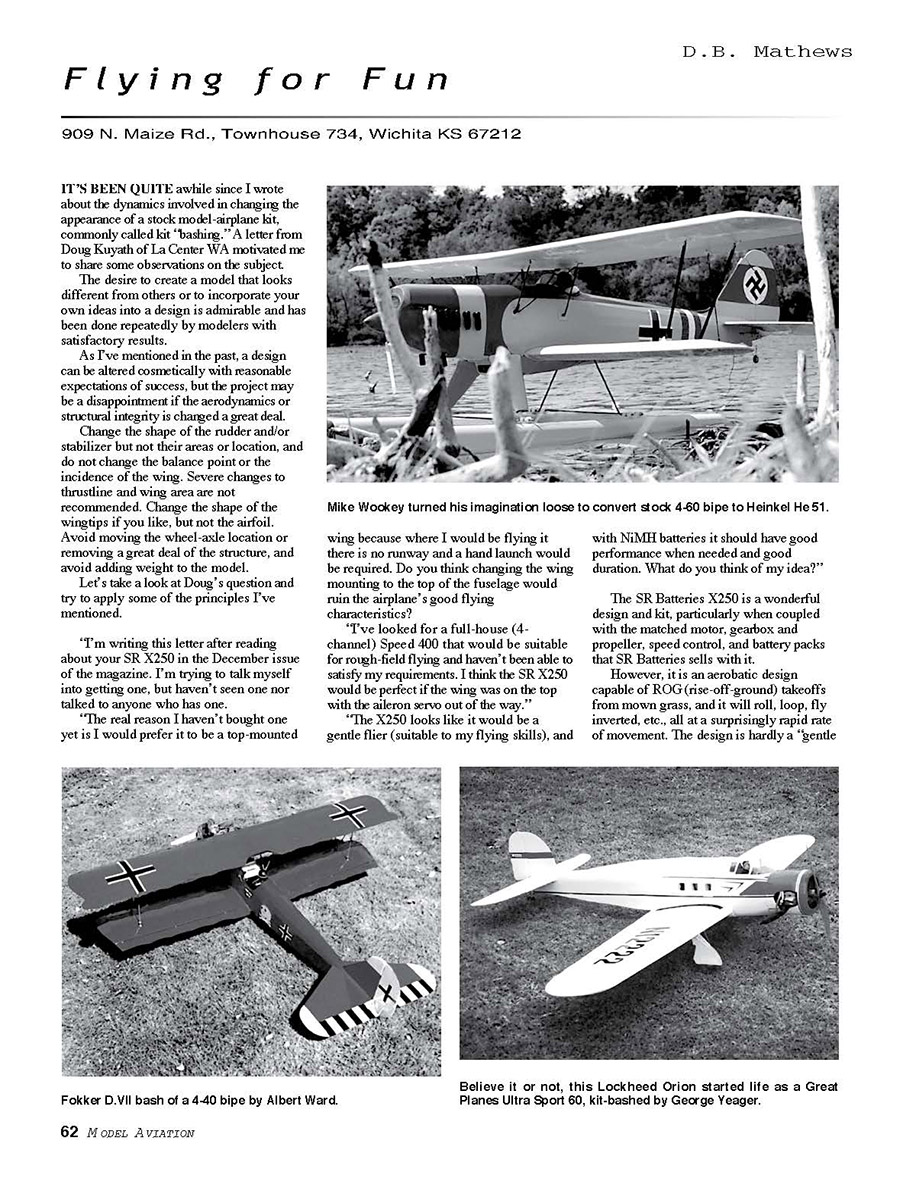
Michael Wookey of Janesville WI cleverly added an upper cowl, rounded wingtips, and changed the fuselage shape of a stock .40-size bipe to create a very attractive Heinkel He 51 on floats. With clever use of color-and-markings, the model is attractive and would pass for scale with the casual observer.
The empennage shape has been changed, but the area of the original has been retained. The thrustline and wing incidence are per the original, and even the kit landing gear has just been flattened. Power is an O.S. .61, and covering is Coverite™ and Perfect Paint. As I've often mentioned, a set of three-views is indispensable for a semi-scale or "looks-like-Scale" bash. Not commonly known is that Bob Basha not only has thousands of photos, but he supplies a huge list of three-views.
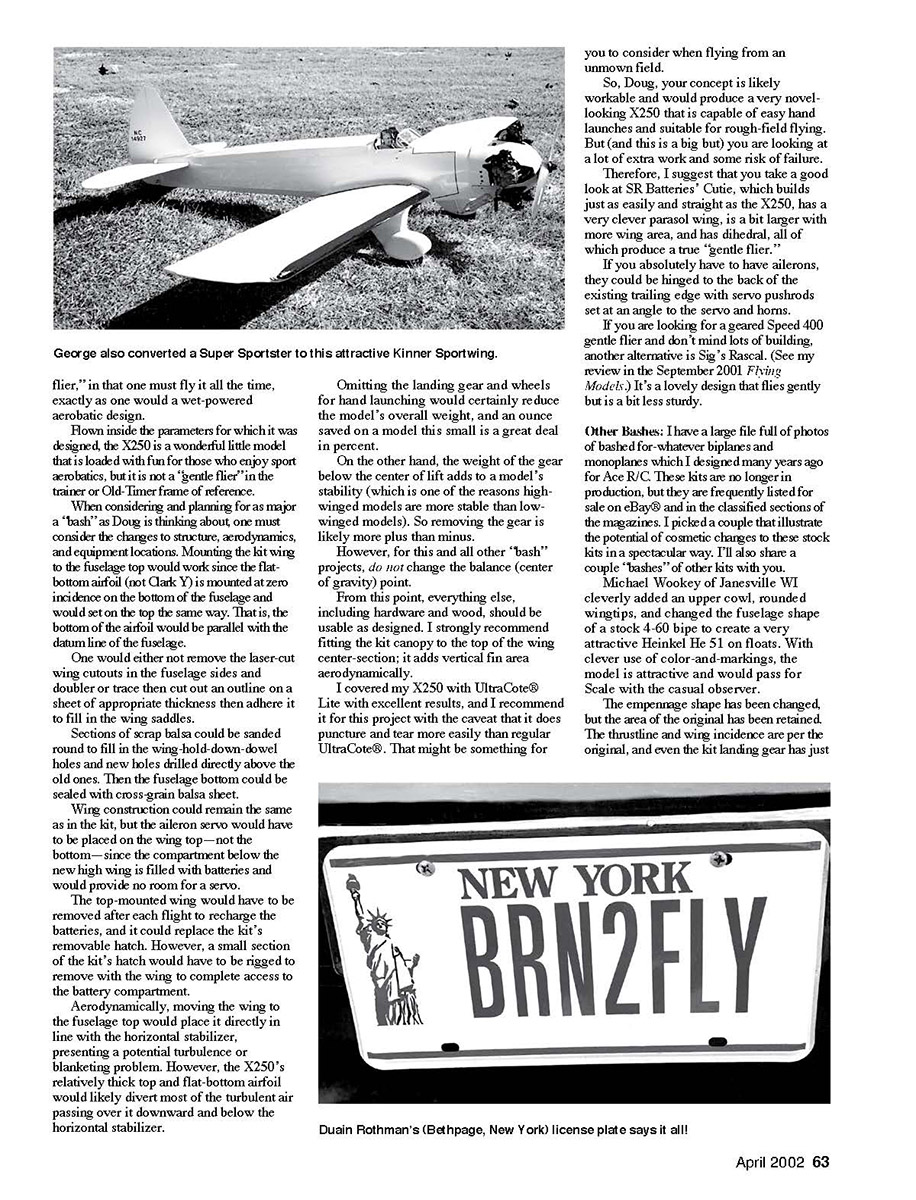
Albert J. Ward of Fremont, CA built and flew a .40 bipe that his dad started for him out of. He decided to build another, but he didn't want to just create a clone of his first model, so he added scallops to the wing trailing edge (ailerons, really), made a wire landing gear and a dummy Mercedes engine, added the classic Fokker elephant ears to the aileron tips, and reshaped the empennage.
The resultant Fokker D.VII turned out to be rather appealing. All covering and markings are UltraCote®, and the power is an O.S. 40 four-stroke. As Albert says, "If this isn't flying for fun, I don't know what is."
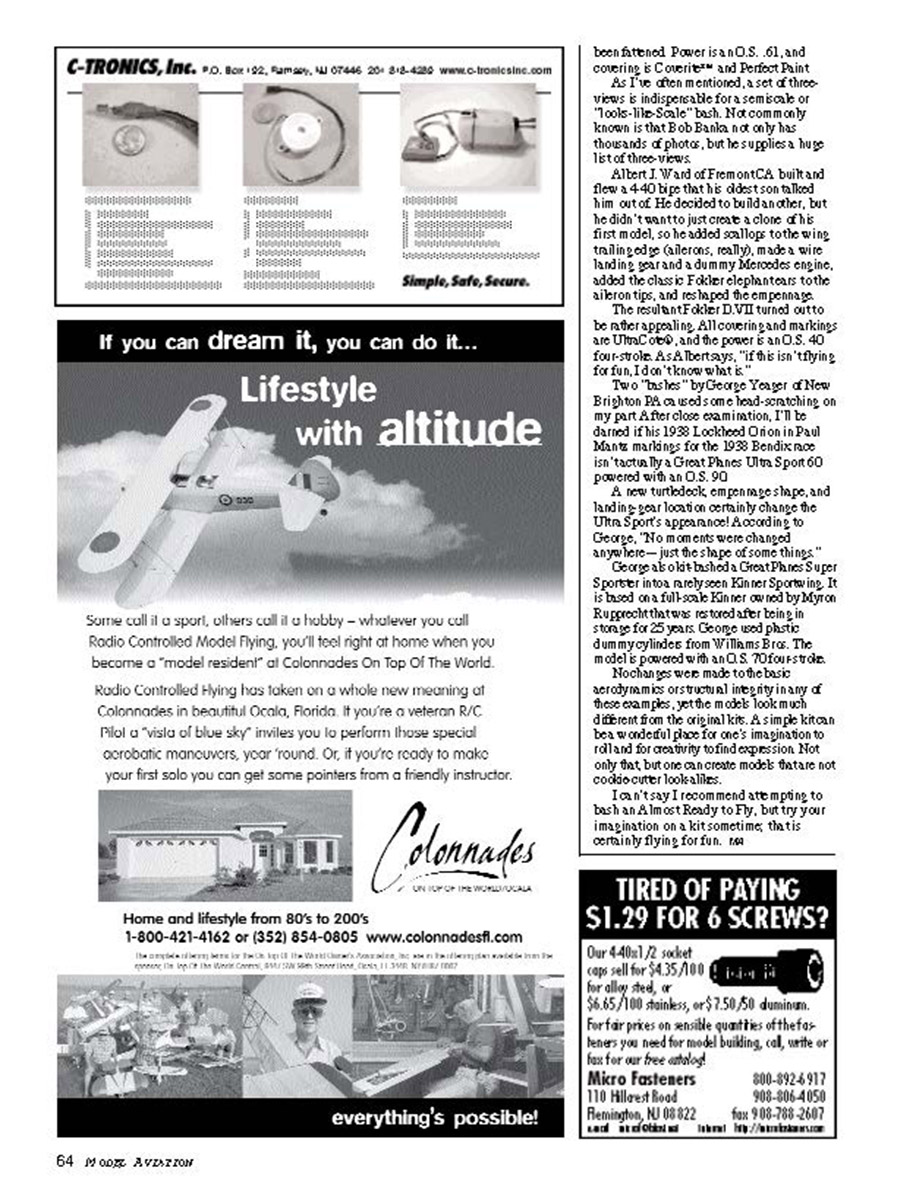
Two "bashes" by George Yeager of New Brighton, PA used some head-scratching on my part. After close examination, I'll be darned if his 1938 Lockheed Orion in Paul Mantz markings for the 1938 Bendix races isn't actually a Great Planes Ultra Sport 60 powered with an O.S. 90.
A new turtledeck, empennage shape, and landing-gear location certainly change the Ultra Sport's appearance! According to George, "No moments were changed anywhere — just the shape of some things."
George's other bash turned a Great Planes Super Sportster into a reissue Kinner Sportwing. It is based on a full-scale Kinner owned by Myron Rupprecht that was restored after being in storage for 25 years. George used plastic dummy cylinders from Williams Bros. The model is powered with an O.S. 70 four-stroke.
No changes were made to the basic aerodynamics or structural integrity in any of those examples, yet the models look much different from the original kits. A simple kit can be a wonderful place for one's imagination to run wild for creativity and expression. Not only that, but one can create models that are not cookie-cutter lookalikes.
I can't say I recommend attempting to bash an Almost Ready to Fly, but try your imagination on a kit sometime; that is certainly flying for fun.
F&M
Transcribed from original scans by AI. Minor OCR errors may remain.

