
Flying for Fun
READERS CONTINUE to send me all sorts of interesting tidbits for which I am most grateful! However, often the information or photos don't quite fit within the confines of the space available or the theme of a column, and I am forced to wait to use them. This month, let's take a look at some of those sorts of tidbits and forget trying to tie them all into one neat, homogenous package.
The March of Time:
In the last two columns I feebly attempted to capture the efforts and attitudes of the Allies during World War II toward "saving the world for democracy." Unavoidably, some 55-year-old personal feelings toward Germany, Japan, and Italy crept into my text, and in light of current times they are completely outdated.
Jan Svendsen's electric floatplane with the momma duck and her ducklings graced the cover of this magazine several years ago. Jan describes himself as a Norwegian by birth, an American by choice, and a Boeing 747 captain for JAL (Japan Airlines) by occupation.
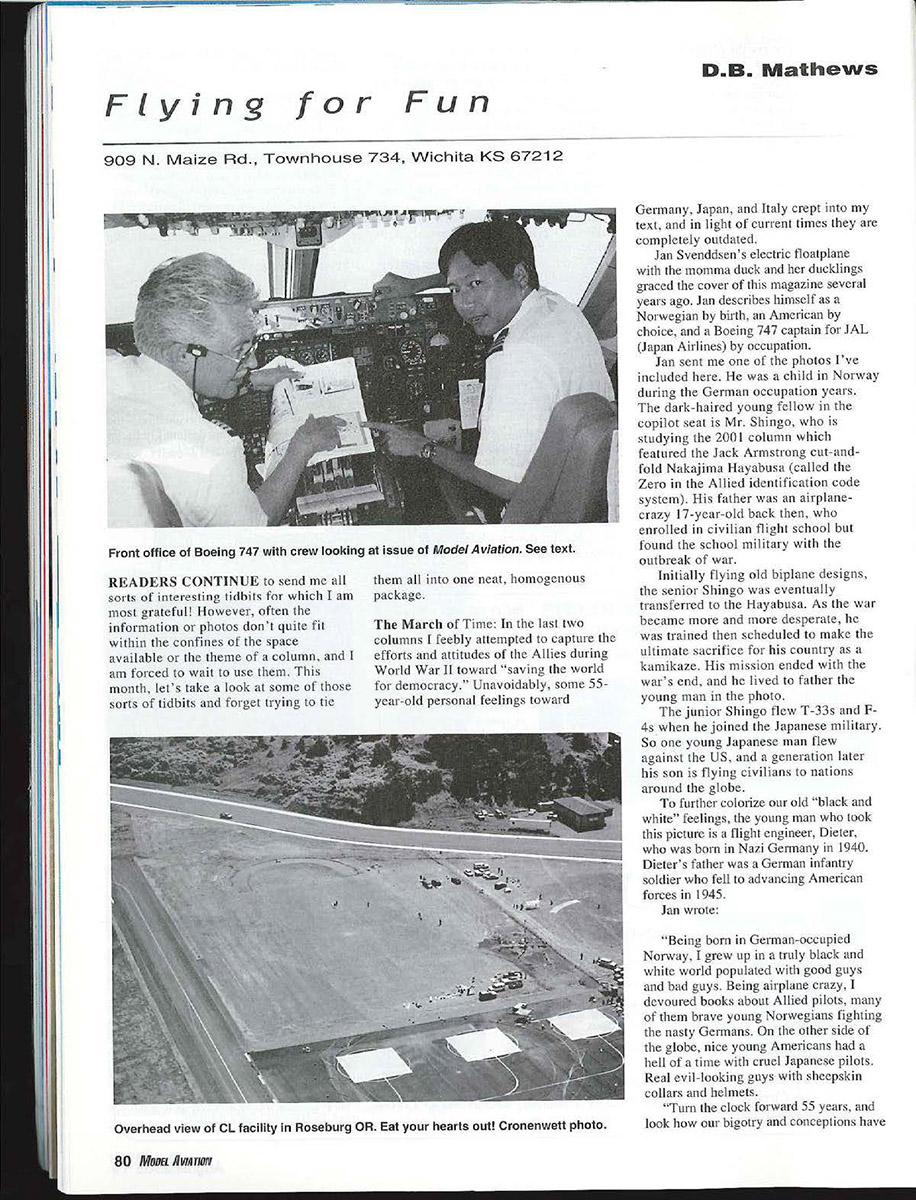
Jan sent me one of the photos I've included here. He was a child in Norway during the German occupation years. The dark-haired young fellow in the copilot seat is Mr. Shingo, who is studying the 2001 column which featured the Jack Armstrong cut-and-fold Nakajima Hayabusa (called the Zero in the Allied identification code system). His father was an airplane-crazy 17-year-old back then, who enrolled in civilian flight school but found the school military with the outbreak of war.
Initially flying old biplane designs, the senior Shingo was eventually transferred to the Hayabusa. As the war became more and more desperate, he was trained then scheduled to make the ultimate sacrifice for his country as a kamikaze. His mission ended with the war's end, and he lived to father the young man in the photo.
The junior Shingo flew T-33s and F-4s when he joined the Japanese military. So one young Japanese man flew against the US, and a generation later his son is flying civilians to nations around the globe.
To further colorize our old "black and white" feelings, the young man who took this picture is a flight engineer, Dieter, who was born in Nazi Germany in 1940. Dieter's father was a German infantry soldier who fell to advancing American forces in 1945.
Jan wrote:
"Being born in German-occupied Norway, I grew up in a truly black and white world populated with good guys and bad guys. Being airplane crazy, I devoured books about Allied pilots, many of them brave young Norwegians fighting the nasty Germans. On the other side of the globe, nice young Americans had a hell of a time with cruel Japanese pilots. Real evil-looking guys with sheepskin collars and helmets.
"Turn the clock forward 55 years, and look how our bigotry and conceptions have changed once we learned those 'evil' ones were just simple people like us."
As Jan says, "Alliances between world powers change but ordinary people really don't. Left to their own wills, three men from widely diverse cultures have come together to complete complex tasks entrusted with the safe travel of people from around the world, while communicating in a language that is native to none of them."
This photo is fascinating not only from its lesson in history, but for the fact that it was taken at 35,000 feet during a flight from Anchorage AK to Atlanta GA. Not only that, but it is written on the back of outdated winds/temperature maps that had been transmitted from World Area Forecast Center Washington and printed in flight. Certainly many firsts for this column.
Paper Airplanes:
Bill Grant of Sunnyvale CA informed me of a source for the original Jack Armstrong series of paper airplanes first available as cereal premiums from General Mills beginning in 1944. Contact Tru-Flite Models, 3720 Hessen Rd., Casco MI 48064, for information.
"Have been playing with them for the last three years and love them dearly," wrote Bill. "Made a lot for my grandson too."
That's a dandy idea; I just ordered some to share with my granddaughters.
While on the subject of fun things to share with youngsters, Dare Hobby Distributing (800) 578-3273 has reproductions of Jim Walker's immortal AJ Interceptor. For those who are too young to have participated in the tons of fun these offered, they are folding-wing, all-balsa gliders launched with the wings folded flat against the fuselage sides, using a rubber band attached to a stick and fitted into a slot in the fuselage. Pull back and release the model, and whoosh.
As kids, we could get these things way up into the air. Then as the glider reached its apogee, a clever mechanism allowed the wings to pop open. Then they would glide and glide. For the adventurous, the surfaces could be adjusted for aerobatics including loops and rolls.
As I remember, the only negative was that they flew so well you needed the space of a baseball diamond or a football field to fly them; they loved to land in trees. Head to your local hobby shop or call Dare Hobby Distributing for information.
These little gliders were used in the hundreds of thousands as gunnery targets during World War II. They were launched behind earthen mounds while beginner gunners fired away at them with machine guns mounted in turrets on Jeeps®.
Considering their small size and the rate at which they moved, these gliders were likely as difficult to hit as an Axis fighter was to be hit by a B-
Transcribed from original scans by AI. Minor OCR errors may remain.

