
Flying for Fun
909 N. Maize Rd., Townhouse 734, Wichita KS 67212
THE JUNE AND July columns featured a brief historical overview of the WACO CG-4 troop-carrying gliders of World War II. That this material hit a responsive chord with readers is evidenced by the large mail response on the subject. Included in that correspondence was an astonishing letter and photocopy from Bill Kincheloe of Magalia, California.
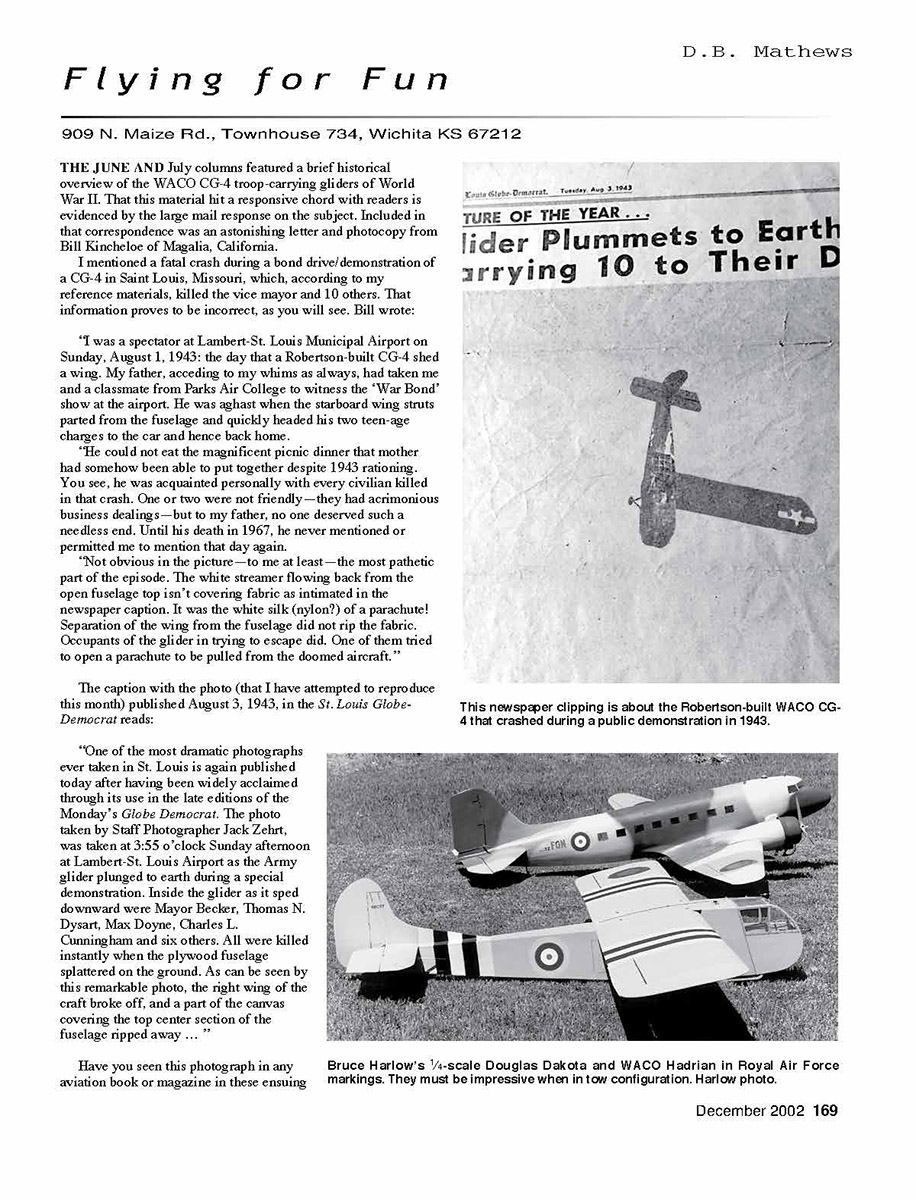
I mentioned a fatal crash during a bond drive/demonstration of a CG-4 in Saint Louis, Missouri, which, according to my reference materials, killed the vice mayor and 10 others. That information proves to be incorrect, as you will see. Bill wrote:
"I was a spectator at Lambert-St. Louis Municipal Airport on Sunday, August 1, 1943; the day that a Robertson-built CG-4 shed a wing. My father, acceding to my whims as always, had taken me and a classmate from Parks Air College to witness the 'War Bond' show at the airport. He was aghast when the starboard wing struts parted from the fuselage and quickly headed his two teen-age charges to the car and hence back home.
"He could not eat the magnificent picnic dinner that mother had somehow been able to put together despite 1943 rationing. You see, he was acquainted personally with every civilian killed in that crash. One or two were not friendly—they had acrimonious business dealings—but to my father, no one deserved such a needless end. Until his death in 1967, he never mentioned or permitted me to mention that day again.
"Not obvious in the picture—to me at least—the most pathetic part of the episode. The white streamer flowing back from the open fuselage top isn't covering fabric as intimated in the newspaper caption. It was the white silk (nylon?) of a parachute! Separation of the wing from the fuselage did not rip the fabric. Occupants of the glider in trying to escape did. One of them tried to open a parachute to be pulled from the doomed aircraft."
The caption with the photo (that I have attempted to reproduce this month) published August 3, 1943, in the St. Louis Globe-Democrat reads:
"One of the most dramatic photographs ever taken in St. Louis is again published today after having been widely acclaimed through its use in the late editions of the Monday's Globe-Democrat. The photo taken by Staff Photographer Jack Zehrt, was taken at 3:55 o'clock Sunday afternoon at Lambert-St. Louis Airport as the Army glider plunged to earth during a special demonstration. Inside the glider as it sped downward were Mayor Becker, Thomas N. Dysart, Max Doyne, Charles L. Cunningham and six others. All were killed instantly when the plywood fuselage splattered on the ground. As can be seen by this remarkable photo, the right wing of the craft broke off, and a part of the canvas covering the top center section of the fuselage ripped away ..."
Have you seen this photograph in any aviation book or magazine in these ensuing 59 years? I have not, which raises the possibility that the War Department may have classified that negative and destroyed it.
The photo would hardly raise the morale of the civilian or military population in the summer of 1943! Imagine the impact of this photo on those whose loved ones were assigned to the airborne units using gliders or, for that matter, on the crews. Remember that this was 10 months before the glider assaults on D-Day.
The photo I've used with this column is below minimum standards, and I apologize. However, the image is of such great interest that I resorted to photographing the newspaper photo. What you see has not likely been published anywhere in 59 years.
Construction Plans: A surprising number of readers wrote in requesting help locating drawings from which they could construct WACO CG-4 models in various sizes. In the July column I mentioned drawings for a PG-2 (powered version) in 1/10 scale in the February 1972 Model Airplane News and vaguely recalled a 1/2A version I was unable to reference.
Merle Miller of Hemet, California, has a better memory than mine; he located the model design I vaguely recalled as Radio Control Modeler plan 1201: a 63-inch-span semiscale PG-2 by Stu Richmond. It is designed around a pair of Astro 05 electric motors.
Merle also advises of a video, apparently excerpted from old Air Corps footage, illustrating towed takeoffs, landings, combat footage, and many other interesting activities of CG gliders. Contact Kenneth Vogeliheim, 300 W. Michigan Ave., Rogers City MI 49779, for more information.
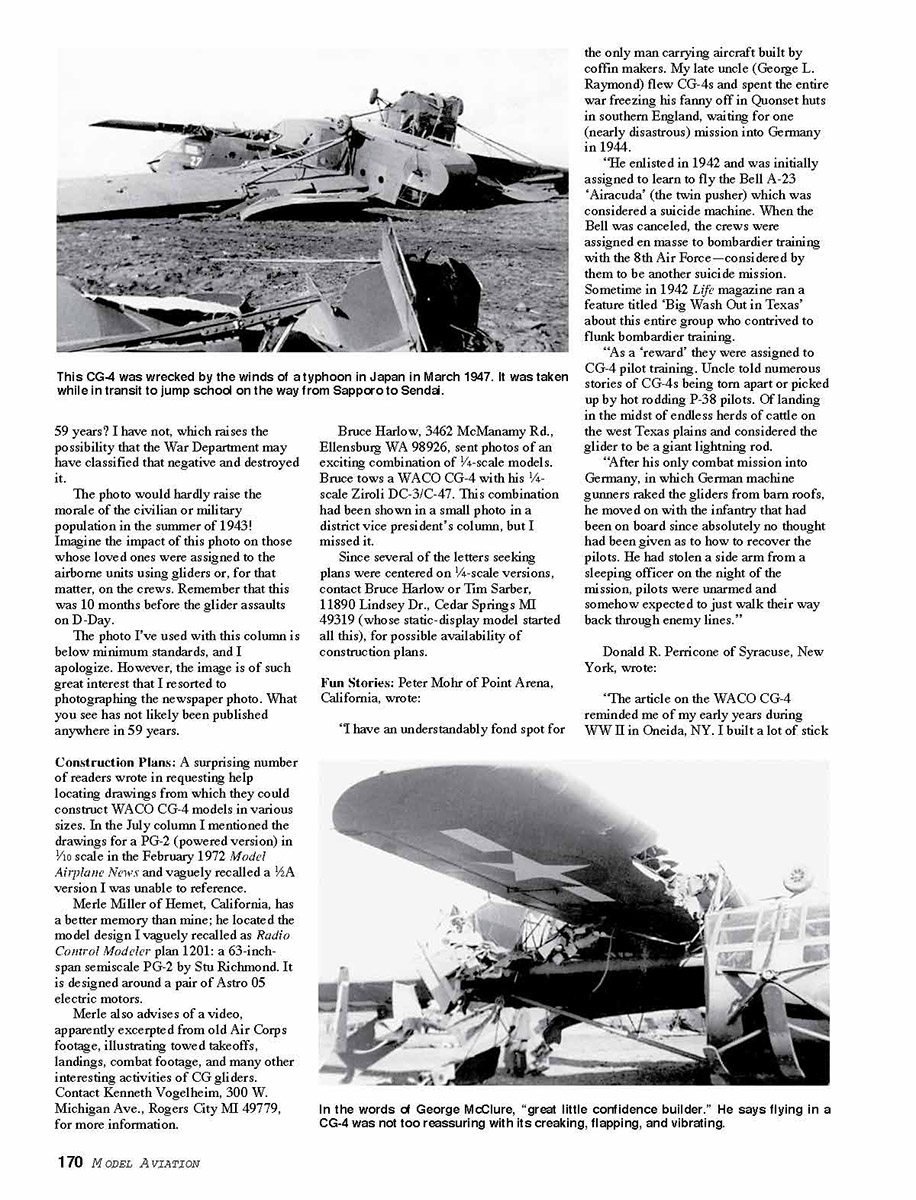
Bruce Harlow, 3462 McManamy Rd., Ellensburg WA 98926, sent photos of an exciting combination of 1/4-scale models. Bruce tows a WACO CG-4 with his 1/4-scale Ziroli DC-3/C-47. This combination had been shown in a small photo in a district vice president's column, but I missed it.
Since several of the letters seeking plans were centered on 1/4-scale versions, contact Bruce Harlow or Tim Sarber, 11890 Lindsey Dr., Cedar Springs MI 49319 (whose static-display model started all this), for possible availability of construction plans.
Fun Stories: Peter Mohr of Point Arena, California, wrote:
"I have an understandably fond spot for the only man carrying aircraft built by coffin makers. My late uncle (George L. Raymond) flew CG-4s and spent the entire war freezing his fanny off in Quonset huts in southern England, waiting for one (nearly disastrous) mission into Germany in 1944.
"He enlisted in 1942 and was initially assigned to learn to fly the Bell A-23 'Airacuda' (the twin pusher) which was considered a suicide machine. When the Bell was canceled, the crews were assigned en masse to bombardier training with the 8th Air Force—considered by them to be another suicide mission. Sometime in 1942 Life magazine ran a feature titled 'Big Wash Out in Texas' about this entire group who contrived to flunk bombardier training.
"As a 'reward' they were assigned to CG-4 pilot training. Uncle told numerous stories of CG-4s being torn apart or picked up by hot rodding P-38 pilots. Of landing in the midst of endless herds of cattle on the west Texas plains and considered the glider to be a giant lightening rod.
"After his only combat mission into Germany, in which German machine gunners raked the gliders from barn roofs, he moved on with the infantry that had been on board since once absolutely no thought had been given as to how to recover the pilots. He had stolen a side arm from a sleeping officer on the night of the mission; pilots were unarmed and somehow expected to just walk their way back through enemy lines."
Donald R. Perricone of Syracuse, New York, wrote:
"The article on the WACO CG-4 reminded me of my early years during WW II in Oneida, NY. I built a lot of stick and tissue models and we could not get dope for our models because it was all being used in the war effort.
"As the man said 'where there is a will there is a way' so we got small milk (glass back then) bottles of clear dope from people who worked at the Mastercraft Furniture Manufacturing Co. in Oneida. The company had a contract to produce the WACO CG-4 glider for the Army. A small milk bottle of clear dope would last a long time in building model airplanes.
"As you pointed out in your column, the shipping crates and even the wing panels were seen around town for years. The crates were used as sheds, etc. and the wing panels were often used as shade coverings for roadside produce stands. I only wish I had photos to send you."
There was a great deal of informative material in a letter from Norm Harris of Saint Clair Shores, Michigan. In 1945 Norm was a military police officer in the 787 Battalion Company D assigned to a former German airstrip a couple hours outside of Paris. His unit was assigned to guard a group of 101st Airborne troopers inside a barbed-wire enclosure. (What should we make of that?)
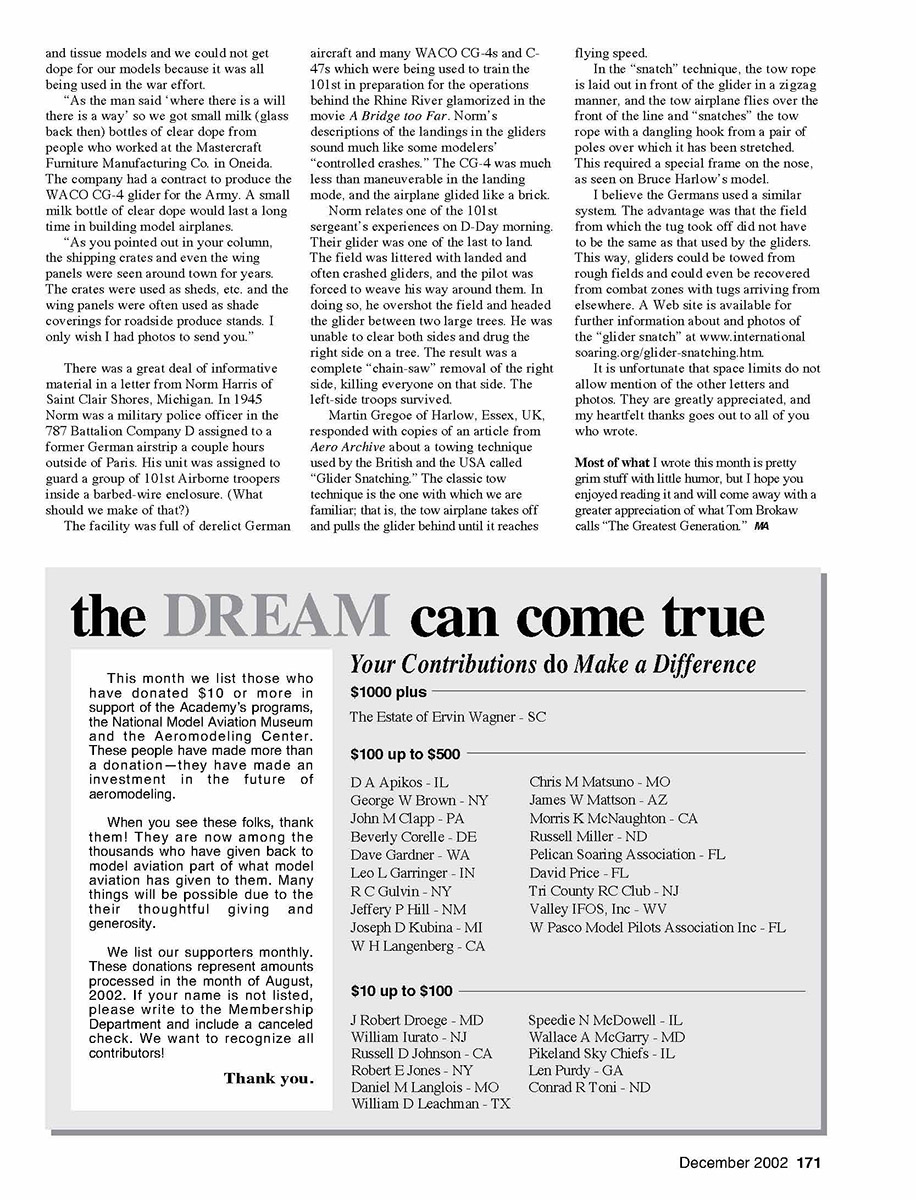
The facility was full of derelict German aircraft and many WACO CG-4s and C-47s which were being used to train the 101st in preparation for the operations behind the Rhine River glamorized in the movie A Bridge too Far. Norm's descriptions of the landings in the gliders sound much like some modelers' "controlled crashes." The CG-4 was much less than maneuverable in the landing mode, and the airplane glided like a brick.
Norm relates one of the 101st sergeant's experiences on D-Day morning. Their glider was one of the last to land. The field was littered with landed and often crashed gliders, and the pilot was forced to weave his way around them. In doing so, he overshot the field and headed the glider between two large trees. He was unable to clear both sides and drug the right side on a tree. The result was a complete "chain-saw" removal of the right side, killing everyone on that side. The left-side troops survived.
Martin Gregoe of Harlow, Essex, UK, responded with copies of an article from Aero Archive about a towing technique used by the British and the USA called "Glider Snatching." The classic tow technique is the one with which we are familiar; that is, the tow airplane takes off and pulls the glider behind until it reaches flying speed.
In the "snatch" technique, the tow rope is laid out in front of the glider in a zigzag manner, and the tow airplane flies over the front of the line and "snatches" the tow rope with a dangling hook from a pair of poles over which it has been stretched. This required a special frame on the nose, as seen on Bruce Harlow's model.
I believe the Germans used a similar system. The advantage was that the field from which the tug took off did not have to be the same as that used by the gliders. This way, gliders could be towed from rough fields and could even be recovered from combat zones with tugs arriving from elsewhere. A web site is available for further information about and photos of the "glider snatch" at www.internationalsoaring.org/glider-snatching.htm.
It is unfortunate that space limits do not allow mention of the other letters and photos. They are greatly appreciated, and my heartfelt thanks goes out to all of you who wrote.
Most of what I wrote this month is pretty grim stuff with little humor, but I hope you enjoyed reading it and will come away with a greater appreciation of what Tom Brokaw calls "The Greatest Generation." MA
Transcribed from original scans by AI. Minor OCR errors may remain.

