
Flying for Fun
D.B. Mathews
909 N. Maize Rd., Townhouse 734, Wichita KS 67212
JOHN POND PLANS: According to Scott Cheslik at AMA Headquarters, the AMA plans service ([765] 287-1256, extension 507) has cataloged and is shipping copies of the huge collection of Old-Time FF (gas and rubber power), CL, and RC plans that John Pond sold for many years. This includes many plans from kits and published designs that are much newer than the December 1941 cutoff date for Society of Antique Modelers-type aircraft.
AMA also has plans for all the designs published in this magazine from its inception. You can find a complete list of what is available, along with order blanks and ordering instructions, on the AMA Web site.
Incredible! The surge in interest in electric-powered RC models in the last few years is so strong and still growing at such a rate that I would term it a phenomenon. I have been building model airplanes for 65 years and have never witnessed anything even close to the ever-increasing power systems, kits, ARFs, hardware, press coverage, and, most important, activity that this exciting new facet of modeling has produced.
The monstrous surge in CL flying in the immediate post-World War II "golden" era is often recalled in glowing terms, but that can't hold a candle to what is occurring in contemporary electric-powered RC! The reasons for this are multiple, diverse, and, frankly, immaterial. What is important is the huge number of new modelers this facet of the sport is attracting and the fun they are having.
A letter from Ed Dupaquier, a hobby-shop proprietor in Houston, Texas, called my attention to a thread on RC Universe. Go to www.rcuniverse.com, click on "Forums," click on "Planes," click on "AMA Discussions," and search "Why AMA is Not Growing."
There are some well-thought-out discussions there concerning the low-tech $120-$190 RTF electric park flyers and their relation, if any, to AMA. In his editorials, Dave Brown has frequently referred to these non-AMA members and what the Academy should do about them.
I have nothing to add except an observation from long ago. Although it was on a much smaller scale relative to numbers of potential members, the plastic ready-to-fly glow-powered CL models from Cox and others that were sold in toy stores in the 1960s and 1970s might provide a lesson.
I helped quite a few youngsters get these CL ARFs flying back then and cannot recall a single one who ever became interested enough to stay with the hobby beyond that first experience. Most were certainly not interested long enough to consider joining AMA.
This electric-powered RC park flyer ARF phenomenon may be a different situation, but I doubt it. Perhaps it's a waste of time and effort to be concerned about these fliers as members unless they progress out of their inexpensive and simple park flyers and get into brushless motors and Li-Poly batteries. If they were to "get serious" about the hobby/sport, at that point they should be recruited.
Guillow’s Kit Conversions: In the February 2005 column I used a photo and words to describe Shawn Strunk’s conversion of a Guillow’s Fokker triplane T-series kit to four-channel electric RC. Much to the amazement of most of us at the flying field, this (considerably lightened) version flies remarkably well.
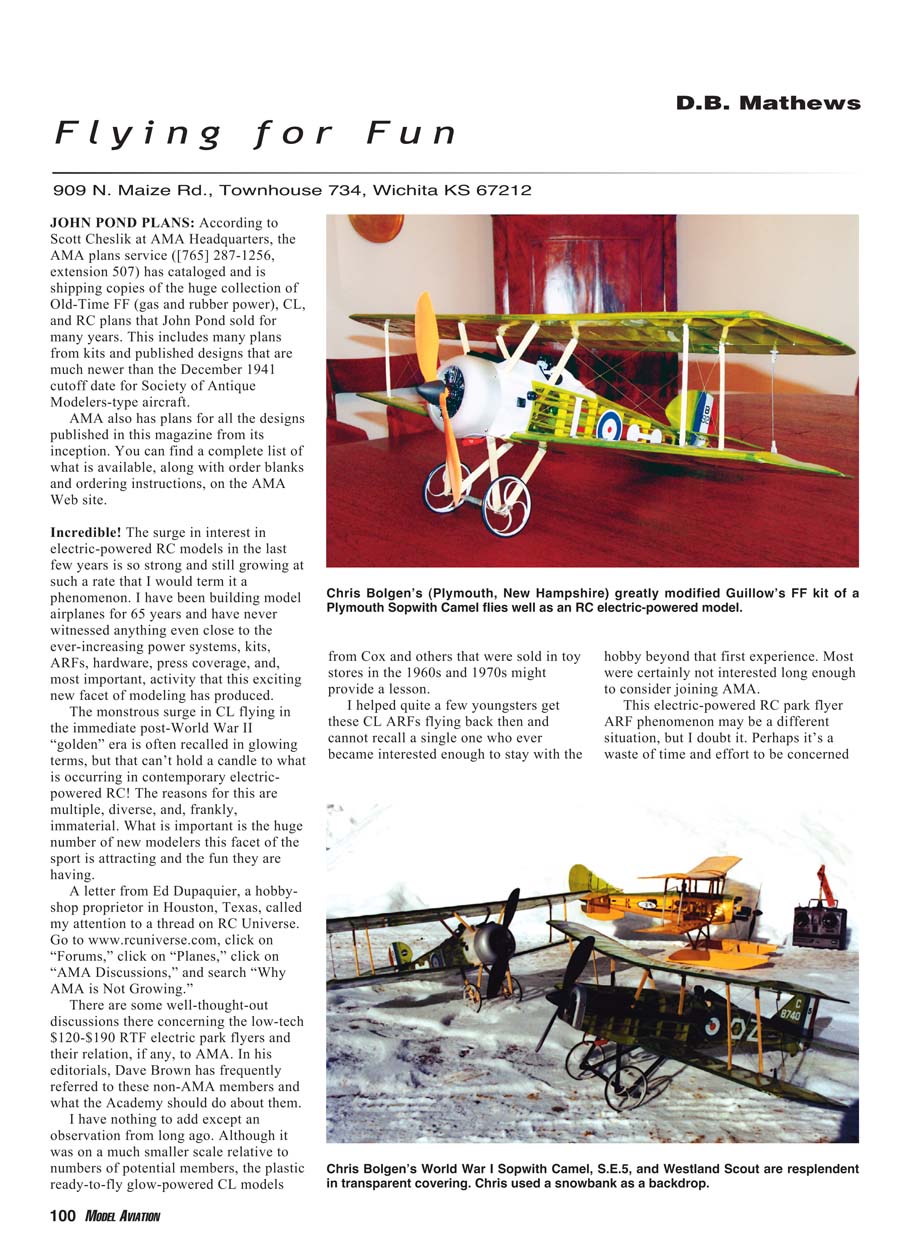
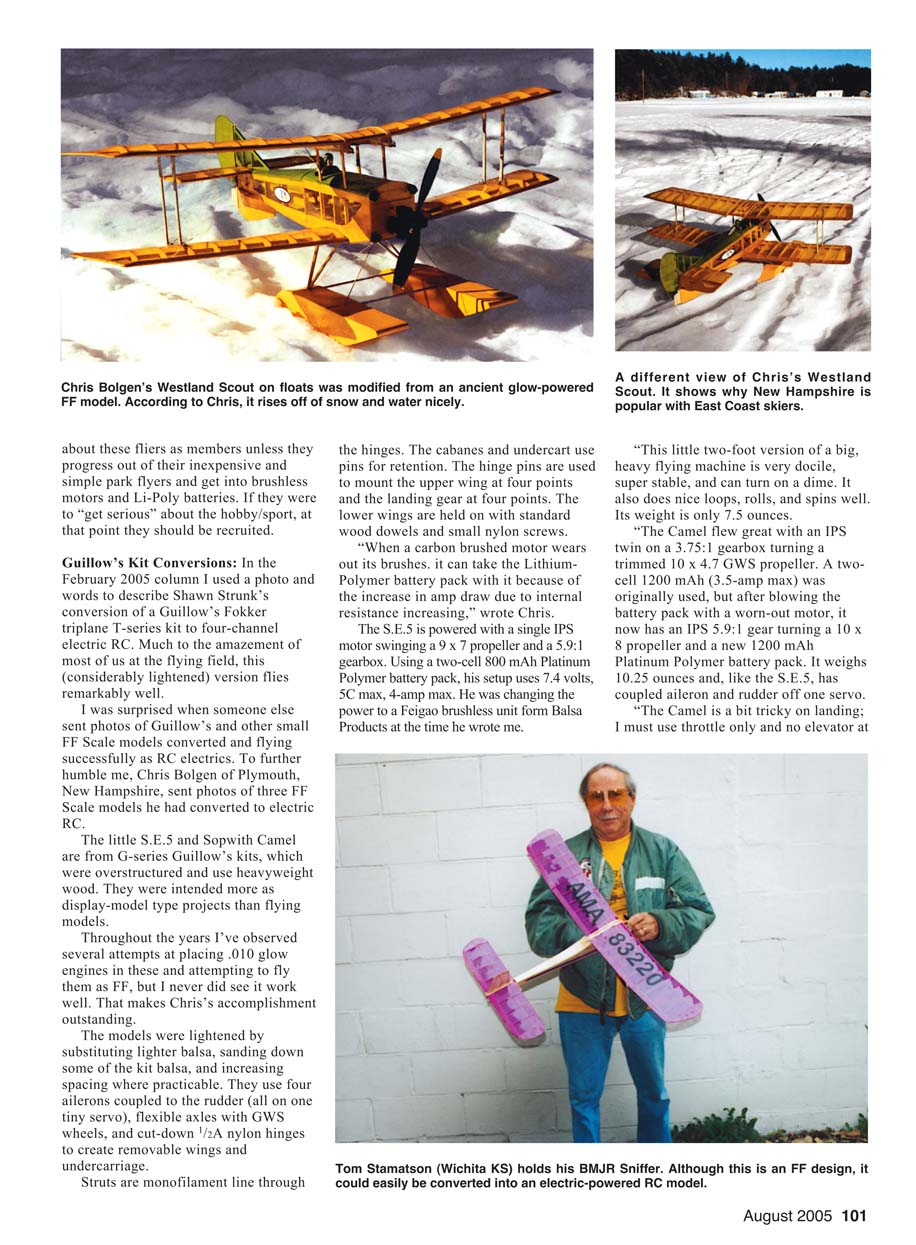
I was surprised when someone else sent photos of Guillow’s and other small FF Scale models converted and flying successfully as RC electrics. To further humble me, Chris Bolgen of Plymouth, New Hampshire, sent photos of three FF Scale models he had converted to electric RC.
The little S.E.5 and Sopwith Camel are from G-series Guillow's kits, which were overstructured and use heavyweight wood. They were intended more as display-model type projects than flying models.
Throughout the years I’ve observed several attempts at placing .010 glow engines in these and attempting to fly them as FF, but I never did see it work well. That makes Chris’s accomplishment outstanding.
The models were lightened by substituting lighter balsa, sanding down some of the kit balsa, and increasing spacing where practicable. They use four ailerons coupled to the rudder (all on one tiny servo), flexible axles with GWS wheels, and cut-down 1/2A nylon hinges to create removable wings and undercarriage.
Struts are monofilament line through the hinges. The cabanes and undercart use pins for retention. The hinge pins are used to mount the upper wing at four points and the landing gear at four points. The lower wings are held on with standard wood dowels and small nylon screws.
"When a carbon brushed motor wears out its brushes, it can take the Lithium-Polymer battery pack with it because of the increase in amp draw due to internal resistance increasing," wrote Chris. The S.E.5 is powered with a single IPS motor swinging a 9 x 7 propeller and a 5.9:1 gearbox. Using a two-cell 800 mAh Platinum Polymer battery pack, his setup uses 7.4 volts, 5C max, 4-amp max. He was changing the power to a Feigao brushless unit from Balsa Products at the time he wrote me.
"This little two-foot version of a big, heavy flying machine is very docile, super stable, and can turn on a dime. It also does nice loops, rolls, and spins well. Its weight is only 7.5 ounces.
"The Camel flew great with an IPS twin on a 3.75:1 gearbox turning a trimmed 10 x 4.7 GWS propeller. A two-cell 1200 mAh (3.5-amp max) was originally used, but after blowing the battery pack with a worn-out motor, it now has an IPS 5.9:1 gear turning a 10 x 8 propeller and a new 1200 mAh Platinum Polymer battery pack. It weighs 10.25 ounces and, like the S.E.5, has coupled aileron and rudder on one servo.
"The Camel is a bit tricky on landing; I must use throttle only and no elevator at all. I have worn out many motors on both these models, they are so much fun to fly. Takeoffs and landings are an absolute kick in the pants."
The Westland Scout was developed from plans published in an old British magazine Chris found in a local library. I looked through all of my old US and English plans catalogs, at my library, etc., and the only thing I found on this aircraft is a photo on page 195 of Fighter Aircraft of the 1914-1918 War by Harleyford Publications. Even that airplane doesn't quite match the model, but the captions mention an earlier version, the N-16, which used Sopwith-type floats, and those more closely match Chris's airplane.
He originally built the Westland in 1985 as an FF model, powering it with a reed-valve .049 engine. He rebuilt it in 2004 with a GWS 350C motor and a four-cell 800 mAh Platinum Polymer battery pack in the floats.
The Scout spans 30 inches, weighs 15.75 ounces, and has an undercambered airfoil. According to Chris, it's stable, has ample power, and is great on water and snow with its flat-bottom floats.
All three models are covered with Nelson LiteFILM transparent iron-on material. Although it's not scale, the covering adds an ethereal look to the models while showing off their delicate structures. They look light.
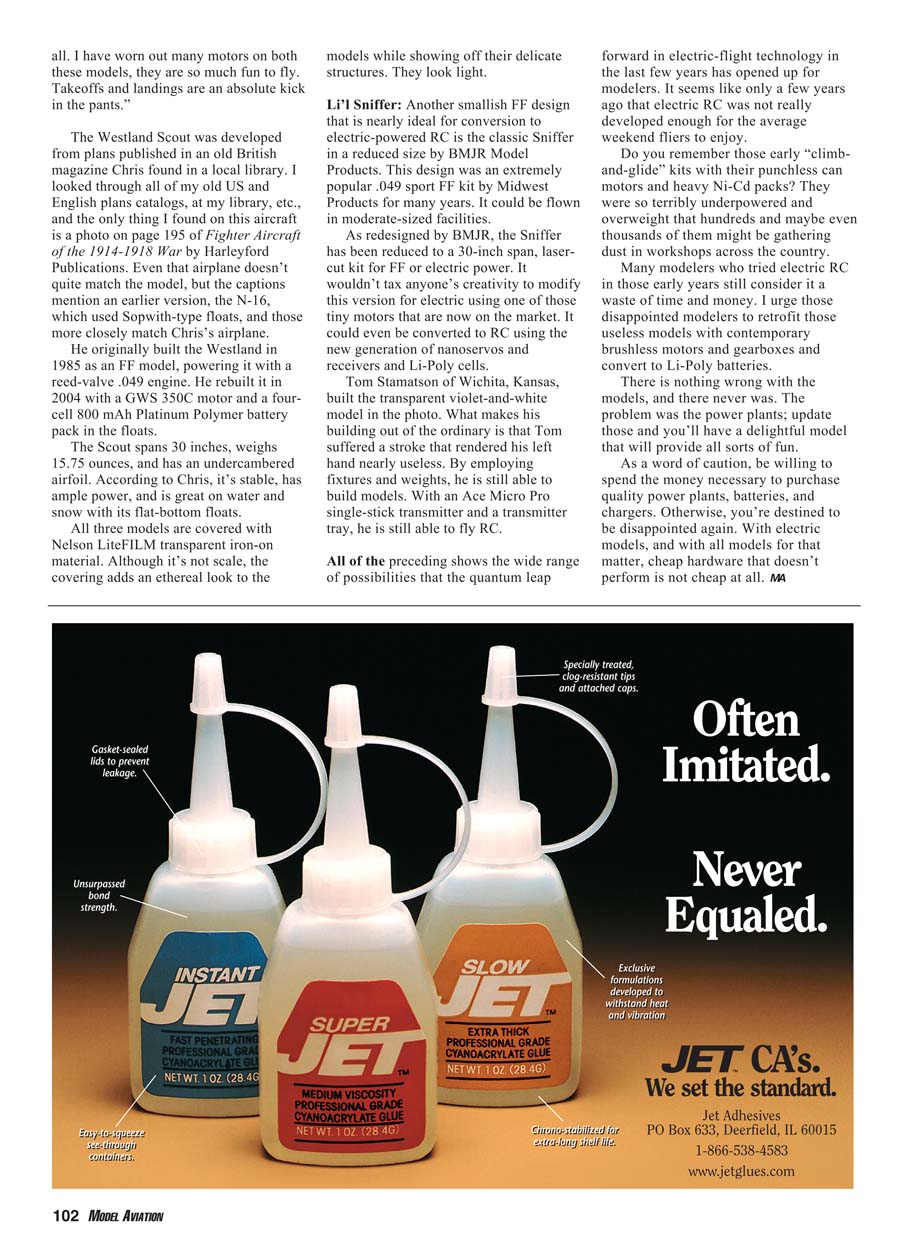
Li'l Sniffer: Another smallish FF design that is nearly ideal for conversion to electric-powered RC is the classic Sniffer in a reduced size by BMJR Model Products. This design was an extremely popular .049 sport FF kit by Midwest Products for many years. It could be flown in moderate-sized facilities.
As redesigned by BMJR, the Sniffer has been reduced to a 30-inch span, laser-cut kit for FF or electric power. It wouldn't tax anyone's creativity to modify this version for electric using one of those tiny motors that are on the market. It could even be converted to RC using the new generation of nanoservos and receivers and Li-Poly cells.
Tom Stamantson of Wichita, Kansas, built the transparent violet-and-white model in the photo. What makes his building out of the ordinary is that Tom suffered a stroke that rendered his left hand nearly useless. By employing fixtures and weights, he is still able to build models. With an Ace Micro Pro single-stick transmitter and a transmitter tray, he is still able to fly RC.
All of the preceding shows the wide range of possibilities that the quantum leap forward in electric-flight technology in the last few years has opened up for modelers. It seems like only a few years ago that electric RC was not really developed enough for the average weekend fliers to enjoy.
Do you remember those early "climb-and-glide" kits with their punchless can motors and heavy Ni-Cd packs? They were so terribly underpowered and overweight that hundreds and maybe even thousands of them might be gathering dust in workshops across the country.
Many modelers who tried electric RC in those early years still consider it a waste of time and money. I urge those disappointed modelers to retrofit those useless models with contemporary brushless motors and gearboxes and convert to Li-Poly batteries.
There is nothing wrong with the models, and there never was. The problem was the power plants; update those and you'll have a delightful model that will provide all sorts of fun.
As a word of caution, be willing to spend the money necessary to purchase quality power plants, batteries, and chargers. Otherwise, you're destined to be disappointed again. With electric models, and with all models for that matter, cheap hardware that doesn't perform is not cheap at all. MA
Flying for Fun
D.B. Mathews
Transcribed from original scans by AI. Minor OCR errors may remain.

