
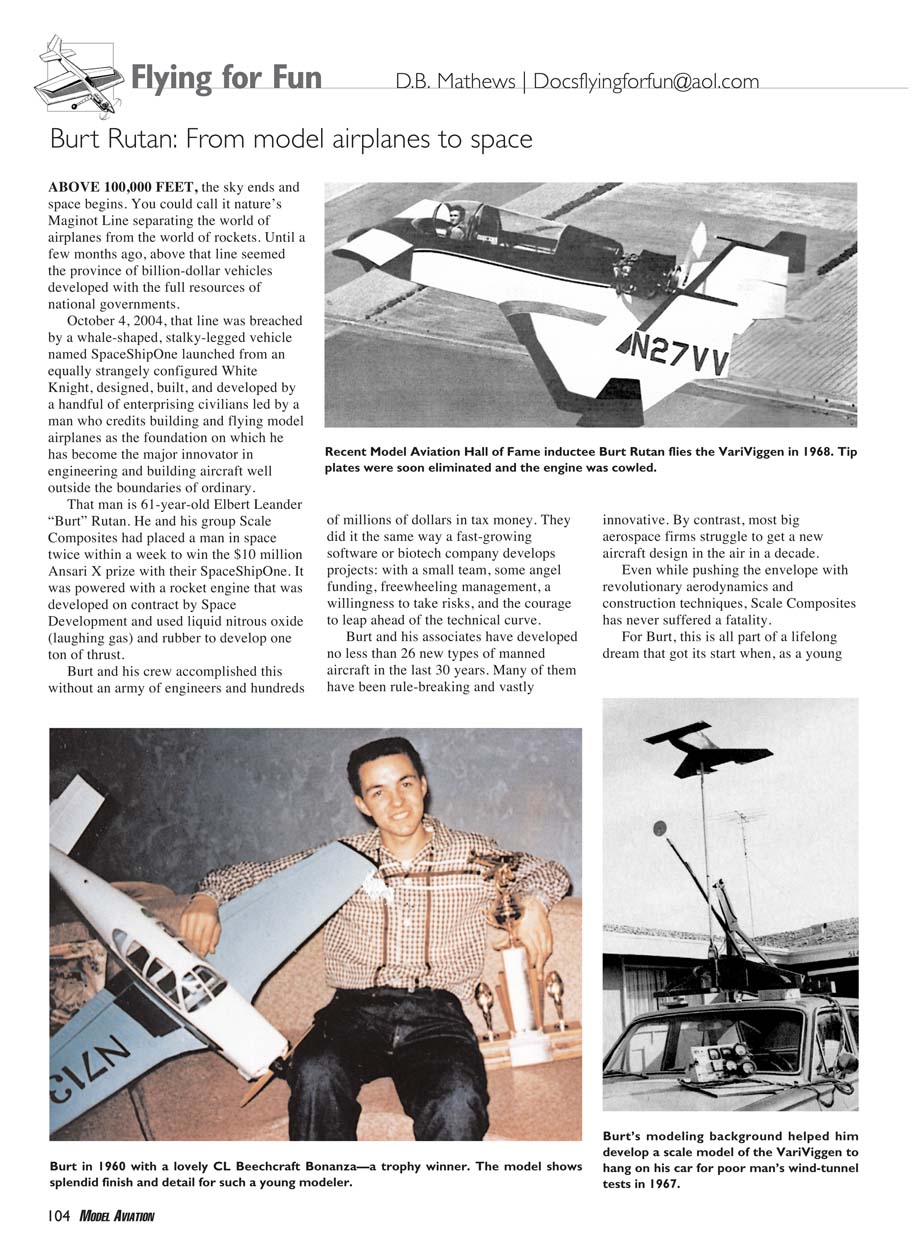
Burt Rutan: From model airplanes to space
D.B. Mathews
Above 100,000 feet, the sky ends and space begins. You could call it nature's Maginot Line separating the world of airplanes from the world of rockets. Until a few months ago, above that line seemed the province of billion-dollar vehicles developed with the full resources of national governments.
On October 4, 2004, that line was breached by a whale-shaped, stalky-legged vehicle named SpaceShipOne launched from an equally strangely configured White Knight, designed, built, and developed by a handful of enterprising civilians led by a man who credits building and flying model airplanes as the foundation on which he has become the major innovator in engineering and building aircraft well outside the boundaries of ordinary.
That man is 61-year-old Elbert Leander “Burt” Rutan. He and his group Scale Composites had placed a man in space twice within a week to win the $10 million Ansari X prize with their SpaceShipOne. It was powered with a rocket engine that was developed on contract by Space Development and used liquid nitrous oxide (laughing gas) and rubber to develop one ton of thrust.
Burt and his crew accomplished this without an army of engineers and hundreds of millions of dollars in tax money. They did it the same way a fast-growing software or biotech company develops projects: with a small team, some angel funding, freewheeling management, a willingness to take risks, and the courage to leap ahead of the technical curve.
Burt and his associates have developed no less than 26 new types of manned aircraft in the last 30 years. Many of them have been rule-breaking and vastly innovative. By contrast, most big aerospace firms struggle to get a new aircraft design in the air in a decade.
Even while pushing the envelope with revolutionary aerodynamics and construction techniques, Scale Composites has never suffered a fatality.
For Burt, this is all part of a lifelong dream that got its start when, as a young son of a dentist growing up in 1940s Dinuba, California, he developed an obsession for designing, building, and flying all sorts of model airplanes.
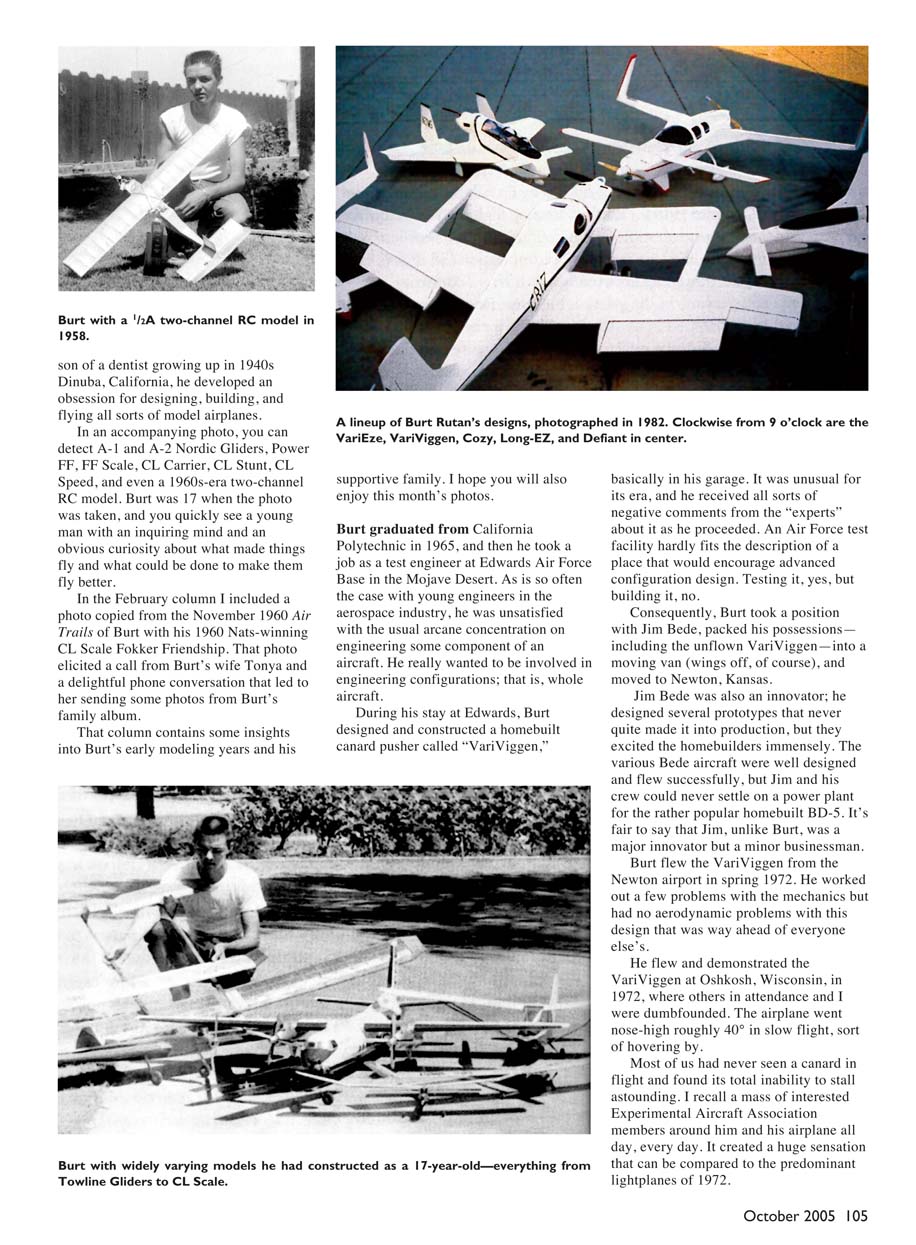
In an accompanying photo, you can detect A-1 and A-2 Nordic Gliders, Power FF, FF Scale, CL Carrier, CL Stunt, CL Speed, and even a 1960s-era two-channel RC model. Burt was 17 when the photo was taken, and you quickly see a young man with an inquiring mind and an obvious curiosity about what made things fly and what could be done to make them fly better.
In the February column I included a photo copied from the November 1960 Air Trails of Burt with his 1960 Nats-winning CL Scale Fokker Friendship. That photo elicited a call from Burt’s wife Tonya and a delightful phone conversation that led to her sending some photos from Burt’s family album.
That column contains some insights into Burt’s early modeling years and his supportive family. I hope you will also enjoy this month’s photos.
Burt graduated from California Polytechnic in 1965, and then he took a job as a test engineer at Edwards Air Force Base in the Mojave Desert. As is so often the case with young engineers in the aerospace industry, he was unsatisfied with the usual arcane concentration on engineering some component of an aircraft. He really wanted to be involved in engineering configurations; that is, whole aircraft.
During his stay at Edwards, Burt designed and constructed a homebuilt canard pusher called “VariViggen,” basically in his garage. It was unusual for its era, and he received all sorts of negative comments from the “experts” about it as he proceeded. An Air Force test facility hardly fits the description of a place that would encourage advanced configuration design. Testing it, yes, but building it, no.
Consequently, Burt took a position with Jim Bede, packed his possessions—including the unflown VariViggen—into a moving van (wings off, of course), and moved to Newton, Kansas.
Jim Bede was also an innovator; he designed several prototypes that never quite made it into production, but they excited the homebuilders immensely. The various Bede aircraft were well designed and flew successfully, but Jim and his crew could never settle on a power plant for the rather popular homebuilt BD-5. It’s fair to say that Jim, unlike Burt, was a major innovator but a minor businessman.
Burt flew the VariViggen from the Newton airport in spring 1972. He worked out a few problems with the mechanics but had no aerodynamic problems with this design that was way ahead of everyone else’s.
He flew and demonstrated the VariViggen at Oshkosh, Wisconsin, in 1972, where others in attendance and I were dumbfounded. The airplane went nose-high roughly 40° in slow flight, sort of hovering by.
Most of us had never seen a canard in flight and found its total inability to stall astounding. I recall a mass of interested Experimental Aircraft Association members around him and his airplane all day, every day. It created a huge sensation that can be compared to the predominant lightplanes of 1972.
Transcribed from original scans by AI. Minor OCR errors may remain.

