
Flying for Fun
D.B. Mathews | [email protected]
Redefining a "serious" electric flier
IN THE AUGUST 2005 column I mistakenly equated serious electric-power fliers to the use of Li-Poly batteries and brushless motors. That is not what I meant.
My comments attempting to measure a modeler's seriousness and potential membership in AMA were directed at the rank newcomer who buys a foam RTF electric at a Wal‑Mart or other retailer, assembles it, and flies it on a playground or vacant lot with no connection to organized modeling. Once the novelty wears off, these people seldom advance in the hobby.
Not all serious electric modelers use Li‑Poly cells and brushless motors, and many of these fliers belong to local clubs and AMA. If they are serious about the electric models and not just buying another toy, they certainly are potential members.
A Lasting Gift: What I'm about to write has little, if any, direct association with modeling; however, it is an important message. Since this is the December issue, writing about gift‑giving seems appropriate.
I have someone else's cornea in my left eye. It was transplanted from a tissue donor who had expired and was harvested via a donor card or with the family's permission. One of my flying buddies has donated a kidney.
These donors have given us gifts for which we can never thank them since they are anonymous. I indirectly thank them by urging all of you who have healthy tissue to arrange for its donation upon your death, either by signing the back of your driver's license (in some states) or making arrangements with your family.
My transplant is 20 months old and is successful. This has provided me with vastly improved vision, to the point where I can fly models using depth perception again. It's a wonderful gift!
What's the Opposite of Outrunner? At the risk of making this column look all electric, I have some models to share. Apparently you readers like to see electric power units with all the hardware named.
Although this month's models use the described products successfully, there are many equally satisfactory substitutes available. It's just that I know these work well, and I hope I can save those who are relatively new to the wonders of electric flight a bunch of question asking or catalog searching.
Never in the 65‑plus years I have been building and flying model aircraft have I seen such an explosion of interest and advancing technology. Currently, at least locally, the outrunner motors are getting rave comments from users. Outrunners have several advantages over geared brushless motors, not the least of which is reduced noise levels. In flight the outrunner-powered models make roughly as much racket as the average floor fan.
The earliest motors used in model aircraft were converted small industrial power plants with encased magnets. AstroFlight and others improved these with replaceable rare earth magnets. Then the brushless motors really made electric‑powered models come to life with their much improved power and lowered battery drain.
Now we have a generation of motors that spin the armature wires around magnets inside the wire coil. The shaft is fixed with the propeller attached to the rotating case, much like those old rotary engines of World War I. In essence these outrunners are built backward from a conventional motor.
The outrunner method provides marked improvement in torque, removes a need for gearing, and allows the use of larger propellers than those employed on a regular brushless direct‑drive motor. It would seem that the bulk of the sound with a geared motor, although minimal, comes from the gears themselves.
Eliminating the gearbox lowers the model’s overall weight and greatly reduces frictional drag and complexity. The outrunner motors are available in sizes ranging from those that are suitable for indoor models to those that produce power to match a gas‑burner.
Outrunners can be produced in large sizes, yet be run without huge battery packs. This allows the electrification of some big models. Some pilots are now flying fully aerobatic jumbo‑scale electric‑powered models using outrunners from various manufacturers.
Outrunner motors have been available for several years, but they suddenly seem to be catching on. It looks as though they are another advancing step in the evolution of electric flight, and a notable one at that.
Considering the advances in batteries, motors, electronics, model designs, and radio systems I’ve seen in the last few years, one can only wonder where the next advance may lie. Servos are reaching the point where they are smaller and lighter than their connectors. Perhaps the term “micro” will soon mean you’ll need a microscope to work on them.
Hinges:
With the advent of the foam 3‑D electric‑powered models, I resorted to using clear packing tape for the hinges since the moving surfaces are huge, and conventional “hot hinges” were too stiff. Recently I have begun using Electric Flyer Hinge Tape from Du‑Bro (item 916). It adheres to Depron better, is much more flexible, and seems to be extremely durable when compared to packaging tape.
This product is actually a surgical/medical tape—a use for which its adhesion and flexibility are helpful. Du‑Bro has it available in useful sizes rather than in 100‑foot rolls.
Cutie:
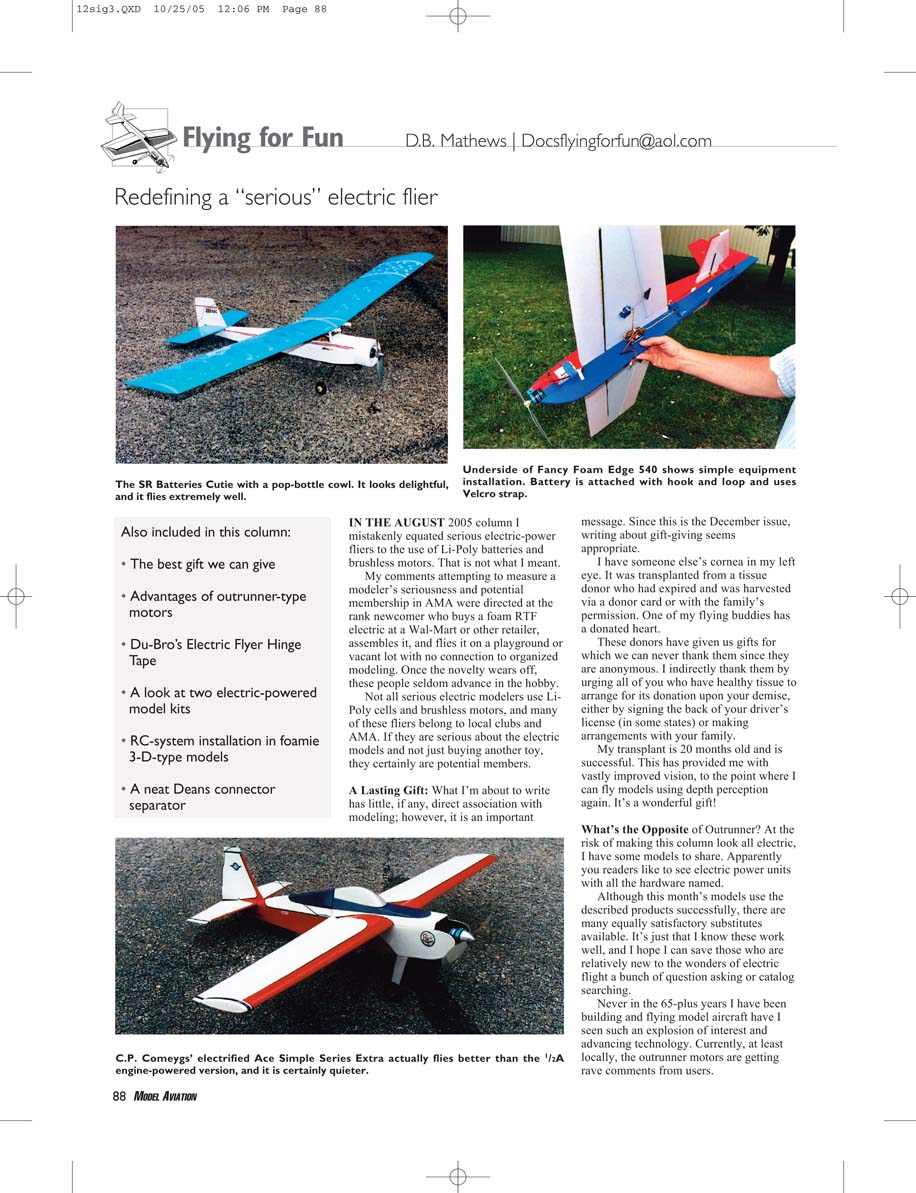
One of my all‑time favorite kits was the Airtronics QT—an attractive little parasol model for 1/2A power and two channels. SR Batteries has used that old concept as the basis for one of the most cleverly designed and engineered kits I have ever built: the Cutie.
Originally designed for a geared Speed 400 motor using 1/6 600 mAh Ni‑Cd cells, mine flies well and is a pure delight. The model shown incorporates a Himax 2808‑1130 outrunner motor and three 1500 mAh Li‑Poly cells.
Speed control is a Phoenix‑25 from Castle Creations, the radio is a Hitec Electron 6 with two Hitec HS‑55 servos, the propeller is an 8 x 4E APC, and the cowl is the bottom of a plastic soft‑drink bottle. The total weight is only 19 ounces with Solarfilm covering. This little model will execute turns so tight and stable that it can be flown in a small parking lot, although that is not recommended. There is far more power available than needed, to the point where this airplane can be flown at half throttle most of the time. This really is a Cutie!
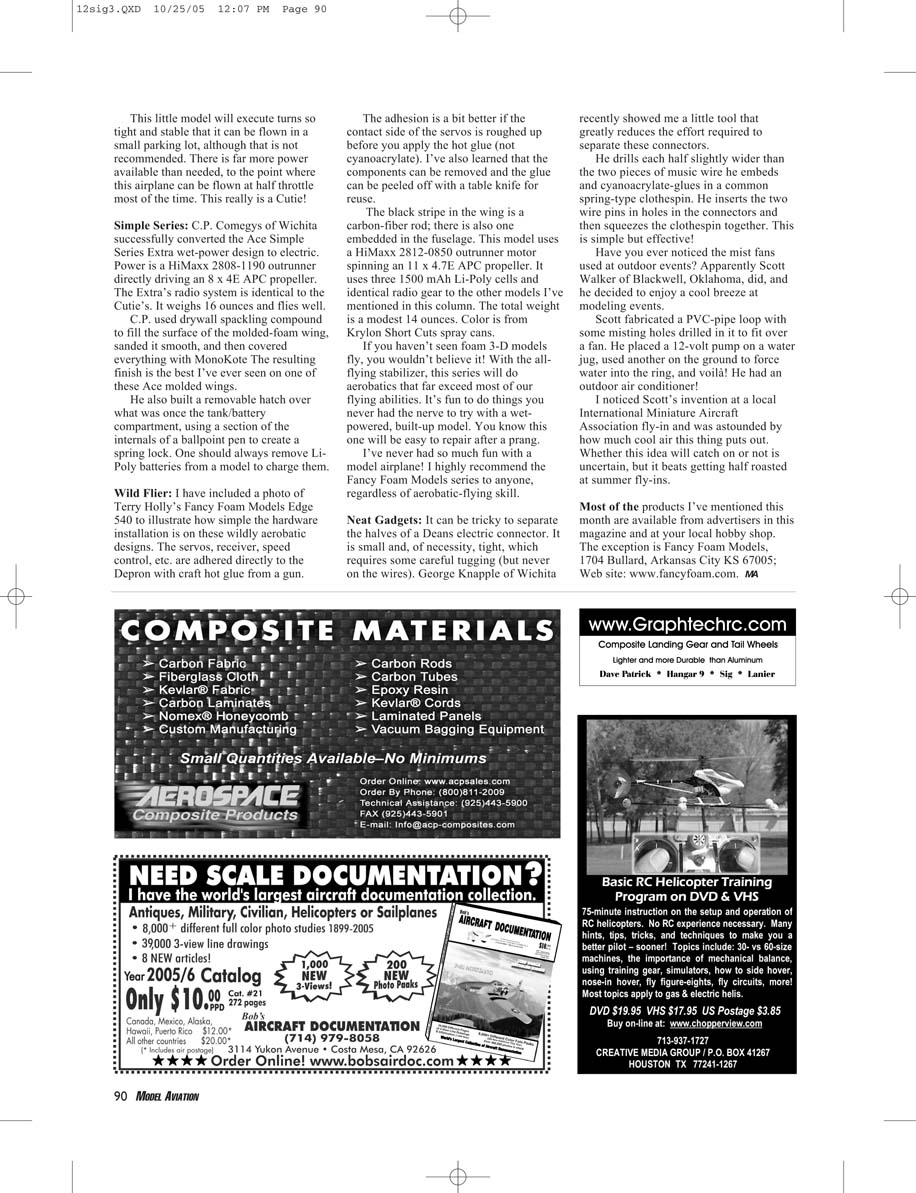
Simple Series: C.P. Comegys of Wichita successfully converted the Ace Simple Series Extra wet‑power design to electric. Power is a HiMaxx 2808‑1190 outrunner directly driving an 8 x 4E APC propeller. The Extra's radio system is identical to the Cutie's. It weighs 16 ounces and flies well.
C.P. used drywall spackling compound to fill the surface of the molded‑foam wing, sanded it smooth, and then covered everything with MonoKote. The resulting finish is the best I've ever seen on one of these Ace molded wings.
He also built a removable hatch over what was once the tank/battery compartment, using a section of the internals of a ballpoint pen to create a spring lock. One should always remove Li‑Poly batteries from a model to charge them.
Wild Flier:
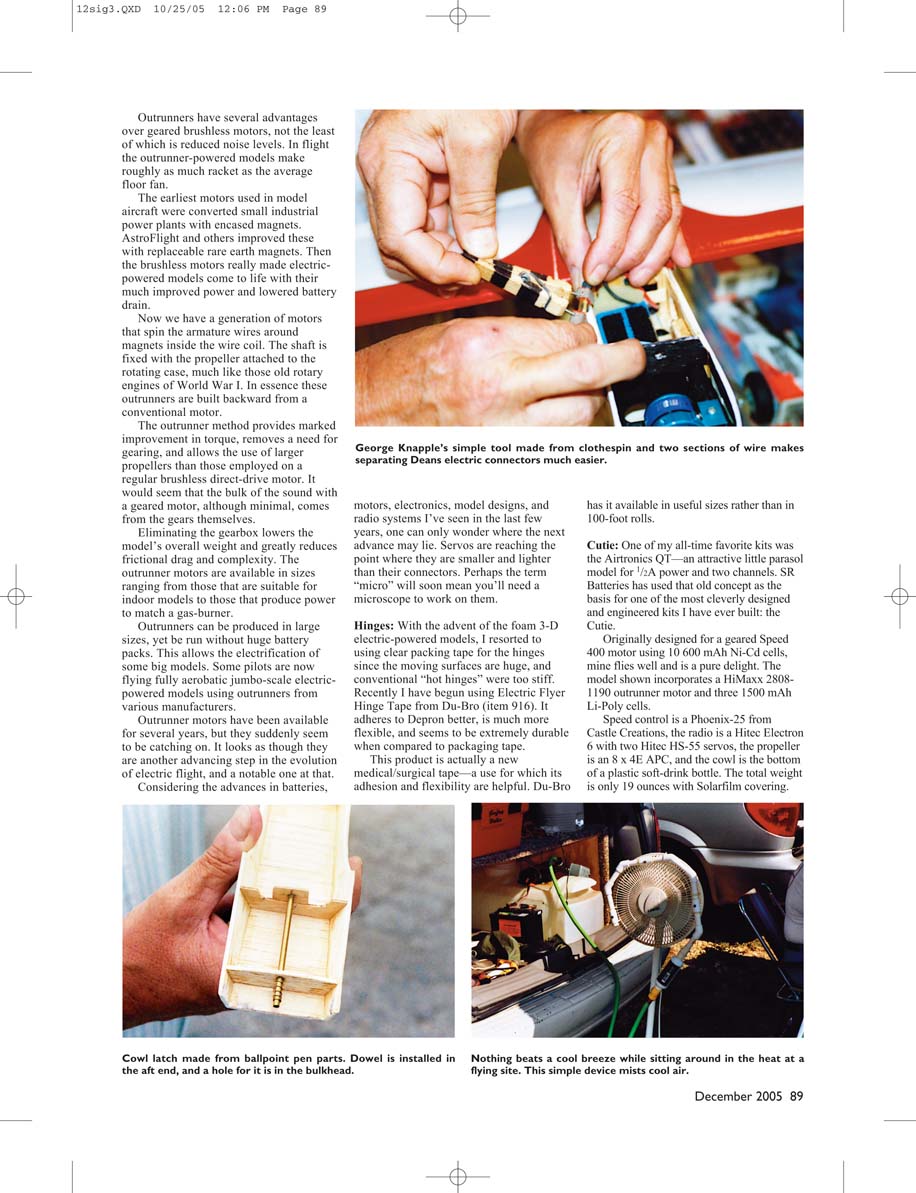
I have included a photo of Terry Holly's Fancy Foam Models Edge 540 to illustrate how simple the hardware installation is on these wildly aerobatic designs. The servos, receiver, speed control, etc. are adhered directly to the Depron with craft hot glue from a gun.
The adhesion is a bit better if the contact side of the servos is roughed up before you apply the hot glue (not cyanoacrylate). I've also learned that the components can be removed and the glue can be peeled off with a table knife for reuse.
The black stripe in the wing is a carbon‑fiber rod; there is also one embedded in the fuselage. This model uses a HiMaxx 2812‑0850 outrunner motor spinning an 11 x 4.7E APC propeller. It uses three 1500 mAh Li‑Poly cells and standard radio gear to the other models I've mentioned in this column. The total weight is a modest 14 ounces. Color is from Krylon Short Cuts spray cans.
If you haven't seen foam 3‑D models fly, you wouldn't believe it! With the all‑flying stabilizer, this series will do aerobatics that far exceed most of our flying abilities. It's fun to do things you never had the nerve to try with a powered, built‑up model. You know this one will be easy to repair after a prang.
I've never had so much fun with a model airplane! I highly recommend the Fancy Foam Models series to anyone, regardless of aerobatic‑flying skill.
Neat Gadgets:
It can be tricky to separate the halves of a Deans electric connector. It is small and, of necessity, tight, which requires some careful tugging (but never on the wires). George Knapple of Wichita recently showed me a little tool that greatly reduces the effort required to separate these connectors.
He drills each half slightly wider than the two pieces of music wire he embeds and cyanoacrylate‑glues in a common spring‑type clothespin. He inserts the two wire pins in holes in the connectors and then squeezes the clothespin together. This is simple but effective.
Have you ever noticed the mist fans used at outdoor events? Apparently Scott Walker of Blackwell, Oklahoma, did, and he decided to enjoy a cool breeze at modeling events. Scott fabricated a PVC‑pipe loop with some misting holes drilled in it to fit over a fan. He placed a 12‑volt pump on a water jug, used another one on the ground to force water into the ring, and voila! He had an outdoor air conditioner!
I noticed Scott's invention at a local International Miniature Aircraft Association fly‑in and was amazed by how much cool air this thing puts out. Whether this idea will catch on or not is uncertain, but it beats getting half roasted at summer fly‑ins.
Most of the products I've mentioned this month are available from advertisers in this magazine and at your local hobby shop. The exception is Fancy Foam Models, 1704 Bullard, Arkansas City KS 67005; Web site: www.fancyfoam.com.
Transcribed from original scans by AI. Minor OCR errors may remain.

