
Flying Site Assistance - 2003/04
Coordinators
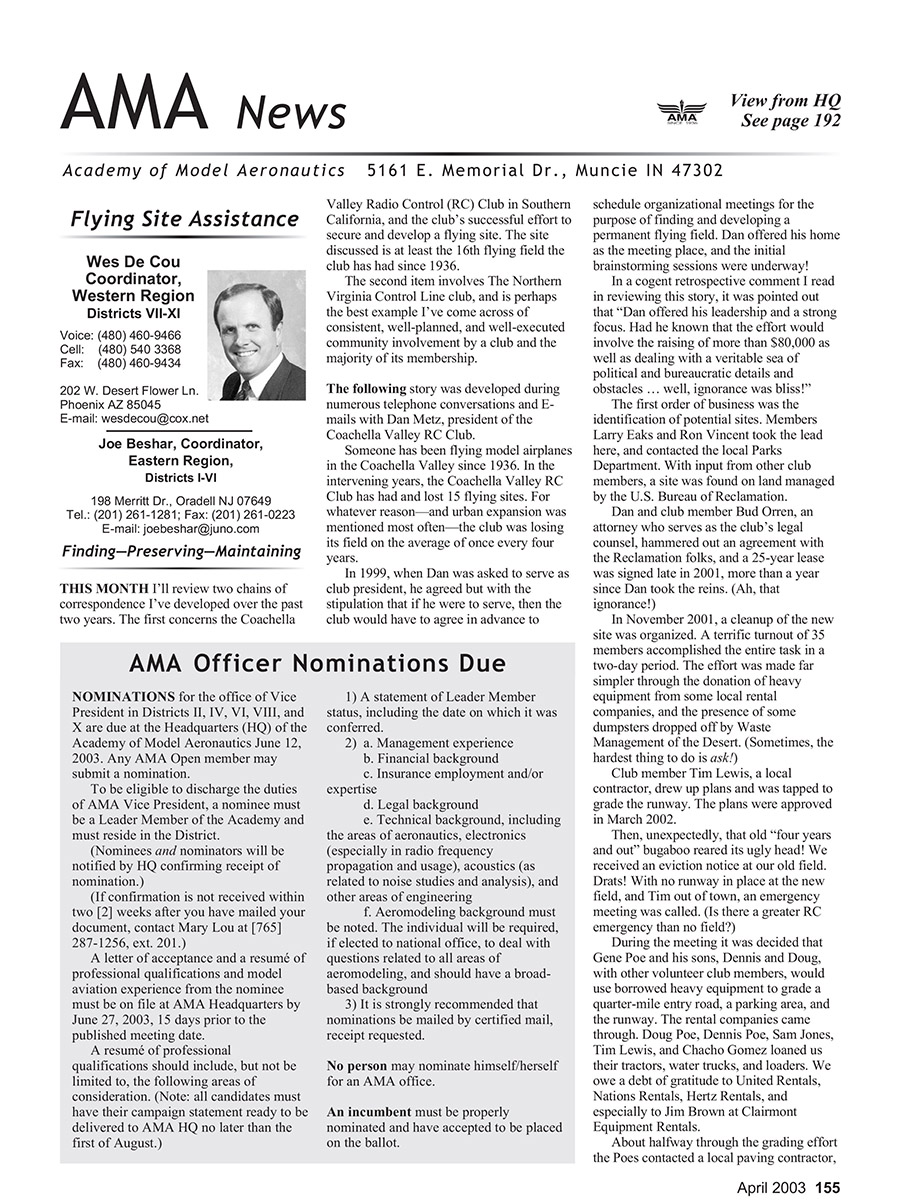
Wes De Cou Coordinator, Western Region, Districts VII–XI Voice: (480) 460-9466 Cell: (480) 540-3368 Fax: (480) 460-9434 202 W. Desert Flower Ln. Phoenix, AZ 85045 E-mail: [email protected]
Joe Beshar Coordinator, Eastern Region, Districts I–VI 198 Merritt Dr., Oradell, NJ 07649 Tel.: (201) 261-1281 Fax: (201) 261-0223 E-mail: [email protected]
Finding—Preserving—Maintaining
This month I review two chains of correspondence developed over the past two years. The first concerns the Coachella Valley Radio Control (RC) Club in Southern California and the club’s successful effort to secure and develop a flying site (at least the club’s 16th flying field since 1936). The second item involves the Northern Virginia Control Line Club and is a strong example of well-planned, consistent community involvement by a club and its membership.
The Coachella Valley story was developed from numerous telephone conversations and e-mails with Dan Metz, president of the Coachella Valley RC Club.
Coachella Valley RC Club — securing a permanent field
Someone has been flying model airplanes in the Coachella Valley since 1936. In the intervening years the Coachella Valley RC Club had had and lost 15 flying sites—on average losing a field about once every four years, most often due to urban expansion.
In 1999 Dan Metz agreed to serve as club president on the condition that the club schedule organizational meetings to find and develop a permanent flying field. Dan offered his home as a meeting place and the initial brainstorming sessions began.
Dan’s leadership and focus proved essential. The effort ultimately involved raising more than $80,000 and dealing with many political and bureaucratic details. The first order of business was identifying potential sites. Members Larry Eaks and Ron Vincent took the lead and contacted the local Parks Department. With input from other club members a site was found on land managed by the U.S. Bureau of Reclamation. Dan and club member Bud Orren (the club’s legal counsel) negotiated an agreement with the Reclamation officials and a 25-year lease was signed late in 2001.
In November 2001 a cleanup of the new site was organized. A turnout of 35 members completed the task in two days, aided by donated heavy equipment from local rental companies and dumpsters provided by Waste Management of the Desert.
Club member Tim Lewis, a local contractor, drew up plans and was selected to grade the runway; plans were approved in March 2002. Then the club received an eviction notice at its old field. With no runway yet in place at the new field and Tim out of town, an emergency meeting was called. It was decided that Gene Poe and his sons, Dennis and Doug, along with other volunteers, would use borrowed heavy equipment to grade a quarter-mile entry road, a parking area, and the runway. Rental companies and individual members loaned tractors, water trucks, and loaders; the club acknowledges United Rentals, Nations Rentals, Hertz Rentals, and Jim Brown at Clairmont Equipment Rentals.
Paving contractor Larry Gaylor, a full-scale pilot, inspected the project and provided a quote well below other offers for a smaller runway. By that point an entry road, a 70-foot by 600-foot runway, a pit area, and a parking lot had been graded. Approximately 10,000 cubic yards of soil were moved, requiring roughly 750,000 gallons of water donated by Howard Keck.
Members who worked long days in 100-degree heat included Bob Taylor, Gene Poe, Larry Eaks, Dan Metz, Richard Boyd, Bill Conlin, Steve Fornelius, Susie Fornelius, Richard Knapp, Bill Sorenson, and Randy Martin—many of whom are over 65 and showed remarkable dedication.
Paving was completed 30 days after breaking ground. Daniel Martinez and a crew from Date Land Construction poured 11,000 square feet of concrete for the pits, shade structure, and storage building. The remaining 5,800 square feet of shade structure and storage building were expected to be built in January 2003.
Throughout the project volunteers pitched in with timely donations of fuel and materials. Larry Eaks was active in site acquisition, plan approval, fundraising, material donations, youth aviation, and even sculpted a statue for the club’s thank-you garden. Gene Poe, a relatively new member, used his community contacts to benefit the club many times.
Memorable moments included Bob Taylor’s visible joy when he realized the runway quote meant the club had the money to proceed, and Larry Eaks (normally in a wheelchair) finding great satisfaction driving the water truck during grading—“for the moment it was truly his.”
Lessons and suggestions from Coachella Valley
- Be hospitable to newcomers; they may prove invaluable.
- Get to know your local media and invite them to events; publicity is invaluable.
- Ask for help—many people and companies are willing to donate if you ask.
- Develop a youth flight training program; it inspires young people and gives donors a tangible reason to support you.
- Dream big and start now; a combination of sweat, cash, and donations can make the field of your dreams a reality.
Northern Virginia Control Line Club — community outreach
The remainder of this column contains excerpts and paraphrases from correspondence to, from, and about the Northern Virginia Control Line Club. Scott Richlen, the club president, generously included me as a “cc” on many club e-mails. The excerpts show a clear club commitment to being a visible part of the community; most group activities are public and involve introducing model aviation to young and old.
From Scott Richlen (newsletter), April 23, 2002:
- April was busy: two training sessions with kids (and some adults) introducing them to control line flying; committee work at the monthly meeting; and preparations for participating in the Manassas EAA fly-in (May 4–5).
- The first training session was at Rachel Carson Middle School (the club’s officially adopted school) on April 10. New member Margy Nance, a teacher and sponsor of the school aviation club, enlisted the club’s help. That afternoon nine students received flight instruction.
- On April 13 the club scouted Manassas airport for demonstration and training areas for the EAA show.
- On April 21 the club participated in Tarara Vineyard’s Winds and Wines Festival; despite modest turnout due to weather, they flew about a dozen children and a few adults.
From Dick Houser, Activities/Contest Committee Chair, to Jerry Raimo, Youth Committee Chair, September 21, 2002 (evening of the Dulles Days event):
- “Thanks to all who came out and helped! Could not have trained all those ‘little’ fliers without your help and knowledge. Some kind of tired when I got home, but a good kind tired, if you know what I mean. Thanks again. ‘Rubber Legs’ Dick.”
Jerry Raimo’s response the same evening:
- “We had 48 of them fill out our questionnaire and fly. And a few more at the end after we ran out of questionnaires. We made a lot of new friends today. Maybe a few of our new friends will show up at a building session and we plan to invite them to Henry’s. Time will tell.
I drank about eight bottles of water out there and can barely walk right now, but you’re right, it’s a good kind of tired.”
From Scott Richlen to Barry Smith, Dulles Plane Pull for Special Olympics staff, October 5, 2002:
- “On behalf of the Northern Virginia Control Line Club, thank you for the opportunity to fly at the Dulles Plane Pull for Special Olympics. We had a wonderful time, and put up more than 40 children on our trainer airplanes.
We are now planning to offer a special builders class for all our new ‘pilots’ ages 8 to 15. We will be organizing a club commuter service of sorts to transport interested kids to the club field. On March 15 we participated in the Town of Leesburg’s ‘Kids’ Day.’ Our club had a booth with static displays and several trainers available for supervised young people. We introduced about 60 young people to the basics of model aviation.”
The Northern Virginia Control Line Club demonstrates that with organization and a willingness to serve the community, a club can significantly increase membership, improve its public image, and gain support for future programs.
Closing
I hear stories of success and failure nearly every day. Those who succeed generally make it happen; those who fail often watch it happen. If you have a story about your club’s flying site efforts or community outreach activities, please drop me a line.
Transcribed from original scans by AI. Minor OCR errors may remain.

