
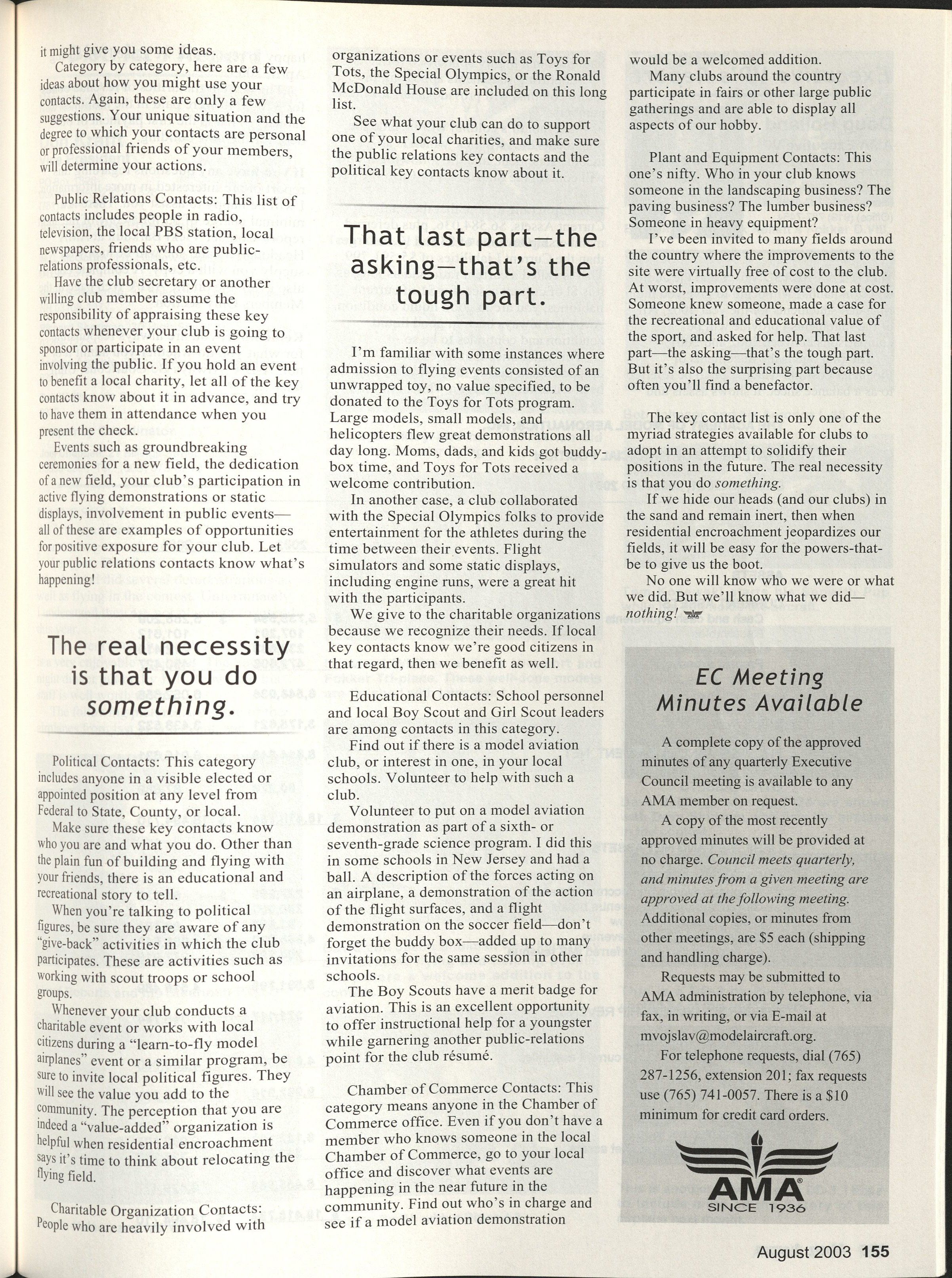
Flying Site Assistance
Here is a reminder to all who might be attending AirVenture 2003 in Oshkosh, Wisconsin, July 29–August 4, 2003. Control Line (CL) flying will again be offered as a hands-on activity for youngsters who attend the KidVenture area of the AirVenture show. As always, CL Chairman Jim Krueger is looking for AMA members who would like to volunteer an hour or two to help run this active venue.
Jim can use your talents as a member of the pit crew, as a registration table assistant, as part of the crowd-control effort, or as a member of the circle-support group. The jobs are easy, they're fun, and the smiles of a thousand kids are your reward. If you plan to attend the AirVenture show and can spare some time in the morning or early afternoon (you'll have plenty of time to get to the daily air show), call Jim at (262) 786-9463 or send him an email at [email protected].
So, how are you doing on that list of "key contacts" I wrote about in my last column? Not done yet? Keep the pressure on your membership to submit some names. The list will prove to be a valuable asset as you continue to take an active interest in your own field-preservation effort. Once your initial list is completed (remember, the list has the potential to grow with each new member who joins your club), you will want to divide it into major key-contact categories. For example, you might want to establish the categories of:
- Public-relations contacts
- Political contacts
- Charitable-organization contacts
- Educational contacts
- Plant-and-equipment contacts
- Chamber of Commerce contacts
This isn't an all-inclusive list, but it might give you some ideas.
Category by category, here are a few ideas about how you might use your contacts. Again, these are only suggestions. Your unique situation and the degree to which your contacts are personal or professional friends of your members will determine your actions.
Public Relations Contacts
This list includes people in radio, television, the local PBS station, local newspapers, and friends who are public-relations professionals.
Have the club secretary or another willing club member assume responsibility for apprising these key contacts whenever your club is going to sponsor or participate in an event involving the public. If you hold an event to benefit a local charity, let all of the key contacts know about it in advance, and try to have them in attendance when you present the check.
Events such as groundbreaking ceremonies for a new field, the dedication of a new field, your club's participation in flying demonstrations or static displays, and involvement in public events are all opportunities for positive exposure. Let your public-relations contacts know what's happening.
The real necessity is that you do something.
Political Contacts
This category includes anyone in a visible elected or appointed position at any level—from federal to state, county, or local.
Make sure these key contacts know who you are and what you do. Other than the plain fun of building and flying with your friends, there is an educational and recreational story to tell.
When you're talking to political figures, be sure they are aware of any "give-back" activities in which the club participates—activities such as working with scout troops or school groups. Whenever your club conducts a charitable event or works with local citizens during a "learn-to-fly model airplanes" event or a similar program, be sure to invite local political figures. They will see the value you add to the community.
The perception that you are a "value-added" organization is helpful when residential encroachment says it's time to think about relocating the flying field.
Charitable Organization Contacts
This includes people involved with organizations or events such as Toys for Tots, the Special Olympics, or the Ronald McDonald House.
See what your club can do to support a local charity, and make sure the public-relations and political key contacts know about it.
That last part—the asking—that's the tough part.
Examples:
- Admission to flying events could be an unwrapped toy for Toys for Tots. Large models, small models, and helicopters can fly demonstrations all day. Parents and kids can get buddy-box time, and Toys for Tots receives a welcome contribution.
- A club collaborating with Special Olympics can provide entertainment for athletes between events. Flight simulators and static displays, including engine runs, are a great hit.
We give to charitable organizations because we recognize their needs. If local key contacts know we're good citizens in that regard, then we benefit as well.
Educational Contacts
School personnel and local Boy Scout and Girl Scout leaders are contacts in this category.
Find out if there is a model aviation club, or interest in one, in your local schools. Volunteer to help with such a club. Volunteer to put on a model aviation demonstration as part of a sixth- or seventh-grade science program. A description of the forces acting on an airplane, a demonstration of the action of the flight surfaces, and a flight demonstration on the soccer field—don't forget the buddy box—can lead to many invitations for repeat sessions.
The Boy Scouts have an aviation merit badge. This is an excellent opportunity to offer instructional help for a youngster while earning another public-relations point for the club résumé.
Chamber of Commerce Contacts
This means anyone in the Chamber of Commerce office. Even if you don't have a member who knows someone in the local Chamber, go to your local office and discover what events are happening in the community. Find out who's in charge and see if a model aviation demonstration would be a welcomed addition.
Many clubs around the country participate in fairs or other large public gatherings and are able to display all aspects of the hobby.
Plant and Equipment Contacts
Who in your club knows someone in the landscaping business? The paving business? The lumber business? Someone in heavy equipment?
I've been invited to many fields where improvements to the site were virtually free of cost to the club. At worst, improvements were done at cost. Someone knew someone, made a case for the recreational and educational value of the sport, and asked for help. That last part—the asking—that's the tough part. But it's also the surprising part, because often you'll find a benefactor.
The key-contact list is only one of the myriad strategies available for clubs to adopt to solidify their positions in the future. The real necessity is that you do something.
If we hide our heads (and our clubs) in the sand and remain inert, then when residential encroachment jeopardizes our fields it will be easy for the powers-that-be to give us the boot.
No one will know who we were or what we did. But we'll know what we did—nothing!
Transcribed from original scans by AI. Minor OCR errors may remain.

