
Flying Site Assistance - 2003/11
After two years of hopeful waiting, the provisional use was withdrawn and the club was back to ground zero. Lawsuits had fortunately delayed the construction of the septic lagoons at Embreeville, so the club had six to nine months to find a new field.
Our pursuit of the nearby county land for a new field was the proper thing to do; however, we had naively wasted two years hoping that this one prospect would be our savior. As the club formed a new group to pursue field acquisition, it was clear that we had to take a different approach to the field‑acquisition task.
New Acquisition Approach Summary
A committee was formed to pursue field acquisition. Although there were a number of volunteers for the task, the working committee ended up being four members out of a 60‑member club. At our first committee meeting, besides coming up with a list of quick‑hit prospects, we discussed our overall managing process and knowledge acquisition.
The lesson we had learned from the past was that we needed:
- a multiple‑pronged approach to generate more prospective locations,
- more knowledge from AMA about successful field‑acquisition approaches, and
- an actionable plan and process to get results within our six‑ to nine‑month time horizon.
Within two months we had done our homework with AMA, had run through the quick‑hit list (which helped us test some of our approaches), and had presented and gotten approval for the overall field‑acquisition plan from the membership. Three months later we had generated more than 150 prospects and, through our managing process, ended up with two excellent final candidates.
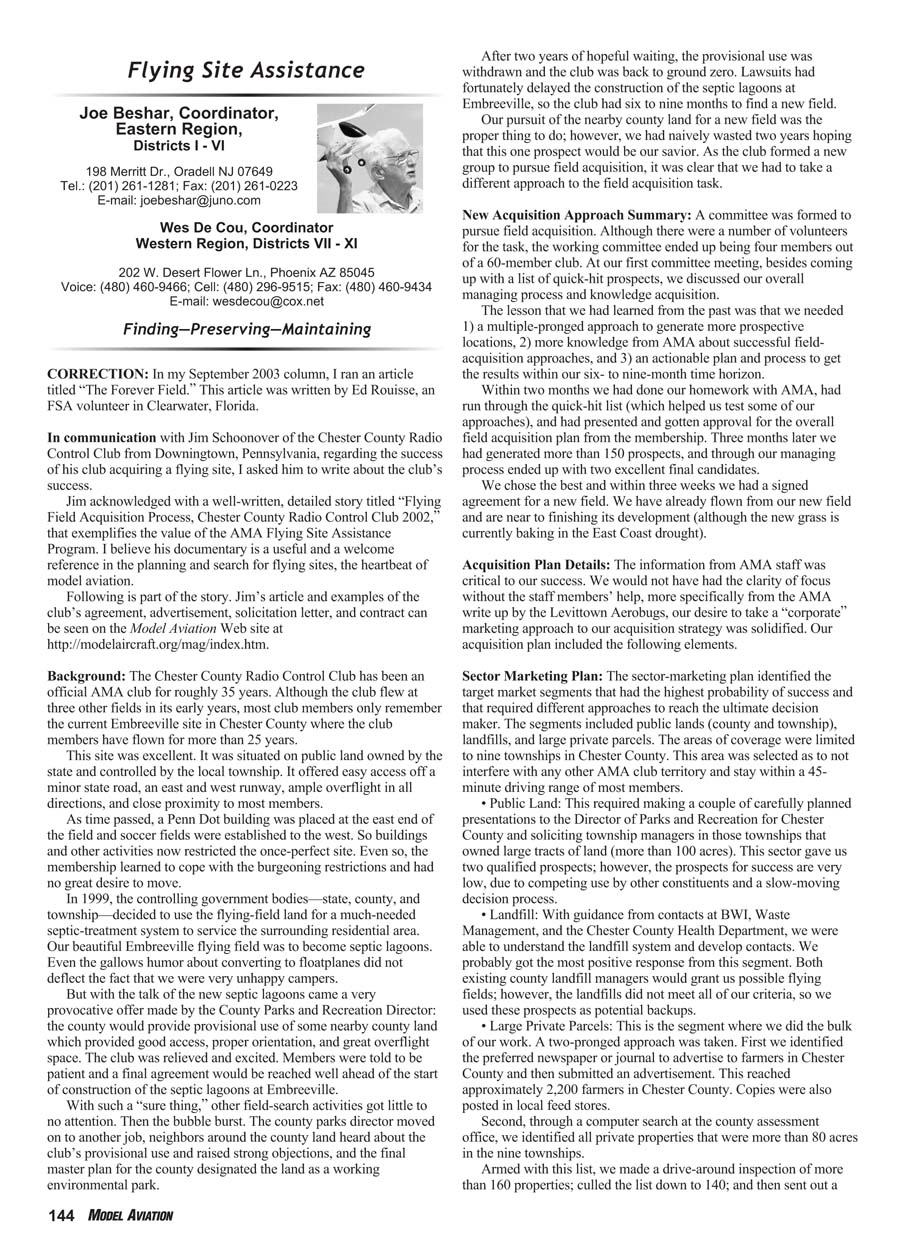
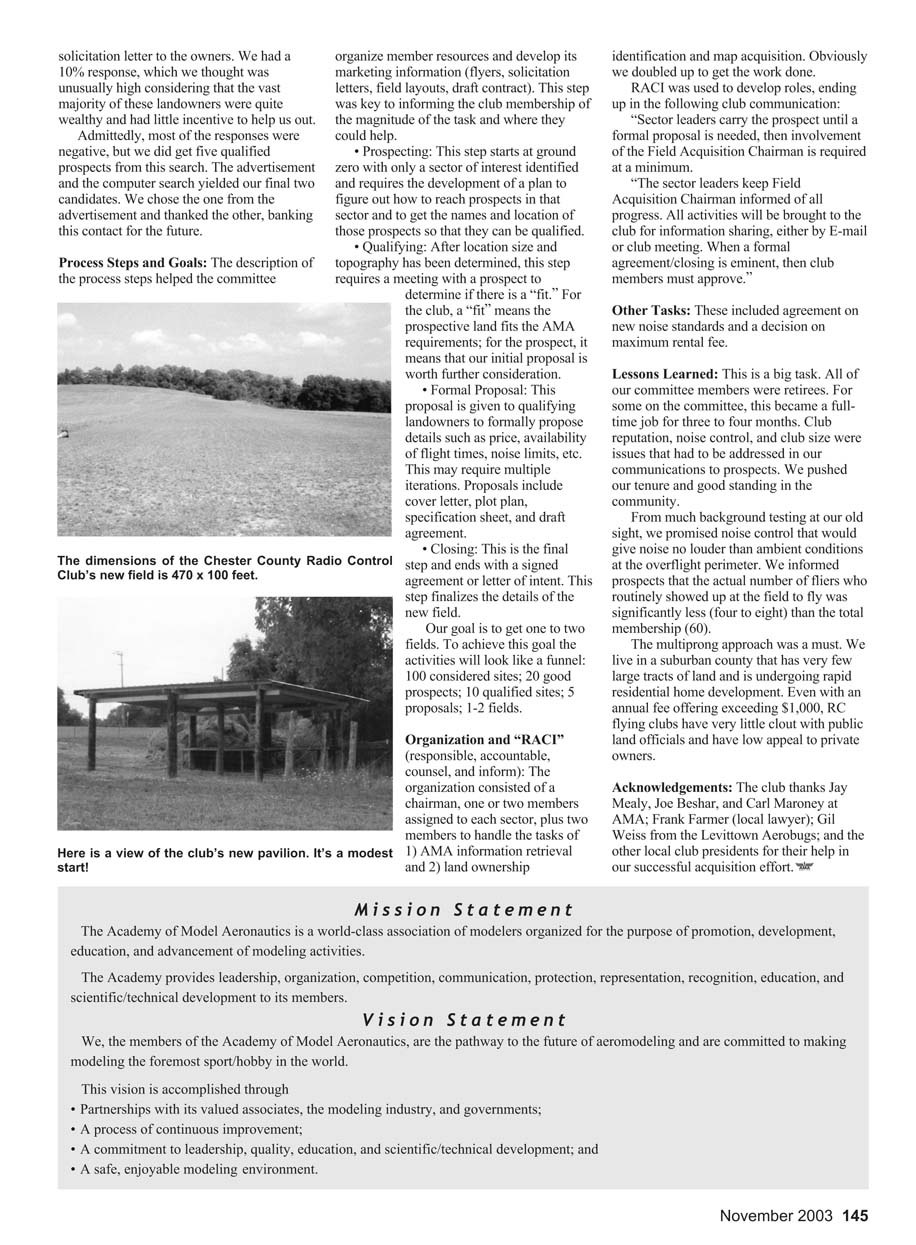
We chose the best and within three weeks we had a signed agreement for a new field. We have already flown from our new field and are near to finishing its development (although the new grass is currently baking in the East Coast drought).
Acquisition Plan Details
The information from AMA staff was critical to our success. We would not have had the clarity of focus without the staff members' help. More specifically, from the AMA write‑up by the Levittown Aerobugs, our desire to take a "corporate" marketing approach to our acquisition strategy was solidified. Our acquisition plan included the following elements.
Sector Marketing Plan
The sector‑marketing plan identified the target market segments that had the highest probability of success and that required different approaches to reach the ultimate decision maker. The segments included public lands (county and township), landfills, and large private parcels. The areas of coverage were limited to nine townships in Chester County. This area was selected so as to not interfere with any other AMA club territory and to stay within a 45‑minute driving range of most members.
- Public Land:
- This required making a couple of carefully planned presentations to the Director of Parks and Recreation for Chester County and soliciting township managers in those townships that owned large tracts of land (more than 100 acres).
- This sector gave us two qualified prospects; however, the prospects for success were very low due to competing use by other constituents and a slow‑moving decision process.
- Landfill:
- With guidance from contacts at BWI, Waste Management, and the Chester County Health Department, we were able to understand the landfill system and develop contacts.
- We probably got the most positive response from this segment. Both existing county landfill managers would grant us possible flying fields; however, the landfills did not meet all of our criteria, so we used these prospects as potential backups.
- Large Private Parcels:
- This is the segment where we did the bulk of our work. A two‑pronged approach was taken.
- First, we identified the preferred newspaper or journal to advertise to farmers in Chester County and then submitted an advertisement. This reached approximately 2,200 farmers in Chester County. Copies were also posted in local feed stores.
- Second, through a computer search at the county assessment office, we identified all private properties that were more than 80 acres in the nine townships.
- Armed with this list, we made a drive‑around inspection of more than 160 properties; culled the list down to 140; and then sent out a solicitation letter to the owners. We had a 10% response rate, which we thought was unusually high considering that the vast majority of these landowners were quite wealthy and had little incentive to help us out.
- Admittedly, most of the responses were negative, but we did get five qualified prospects from this search. The advertisement and the computer search yielded our final two candidates. We chose the one from the advertisement and thanked the other, banking this contact for the future.
Process Steps and Goals
The description of the process steps helped the committee organize member resources and develop its marketing information (flyers, solicitation letters, field layouts, draft contract). This step was key to informing the club membership of the magnitude of the task and where they could help.
- Prospecting:
- This step starts at ground zero with only a sector of interest identified and requires the development of a plan to figure out how to reach prospects in that sector and to get the names and locations of those prospects so that they can be qualified.
- Qualifying:
- After location size and topography have been determined, this step requires a meeting with a prospect to determine if there is a "fit." For the club, a "fit" means the prospective land fits the AMA requirements; for the prospect, it means that our initial proposal is worth further consideration.
- Formal Proposal:
- This proposal is given to qualifying landowners to formally propose details such as price, availability of flight times, noise limits, etc. This may require multiple iterations.
- Proposals include a cover letter, plot plan, specification sheet, and draft agreement.
- Closing:
- This is the final step and ends with a signed agreement or letter of intent. This step finalizes the details of the new field.
Our goal is to get one to two fields. To achieve this goal the activities will look like a funnel:
- 100 considered sites
- 20 good prospects
- 10 qualified sites
- 5 proposals
- 1–2 fields
Organization and "RACI" (responsible, accountable, consulted, and informed)
The organization consisted of a chairman, one or two members assigned to each sector, plus two members to handle the tasks of 1) AMA information retrieval and 2) land ownership identification and map acquisition. Obviously we doubled up to get the work done.
RACI was used to develop roles, ending up in the following club communication:
"Sector leaders carry the prospect until a formal proposal is needed, then involvement of the Field Acquisition Chairman is required at a minimum.
"The sector leaders keep the Field Acquisition Chairman informed of all progress. All activities will be brought to the club for information sharing, either by e‑mail or club meeting. When a formal agreement/closing is imminent, then club members must approve."
Other Tasks
These included agreement on new noise standards and a decision on maximum rental fee.
Lessons Learned
This is a big task. All of our committee members were retirees. For some on the committee, this became a full‑time job for three to four months. Club reputation, noise control, and club size were issues that had to be addressed in our communications to prospects. We emphasized our tenure and good standing in the community.
From much background testing at our old site, we promised noise control that would keep noise no louder than ambient conditions at the overflight perimeter. We informed prospects that the actual number of fliers who routinely showed up at the field to fly was significantly less (four to eight) than the total membership (60).
The multipronged approach was a must. We live in a suburban county that has very few large tracts of land and is undergoing rapid residential development. Even with an annual fee offering exceeding $1,000, RC flying clubs have very little clout with public land officials and have low appeal to private owners.
Acknowledgments
The club thanks Jay Mealy, Joe Beshar, and Carl Maroney at AMA; Frank Farmer (local lawyer); Gil Weiss from the Levittown Aerobugs; and the other local club presidents for their help in our successful acquisition effort.
Transcribed from original scans by AI. Minor OCR errors may remain.

