
Flying Site Assistance
Wesley De Cou | [email protected]
Every good ocean fisherman knows that luck can change with the tide.
During a visit to Southern California, I was reminded that we can often win approval for a new flying site if we can show that the site will provide a direct benefit to far more people than just the local modelers.
Conejo Valley Flyers and the SDA
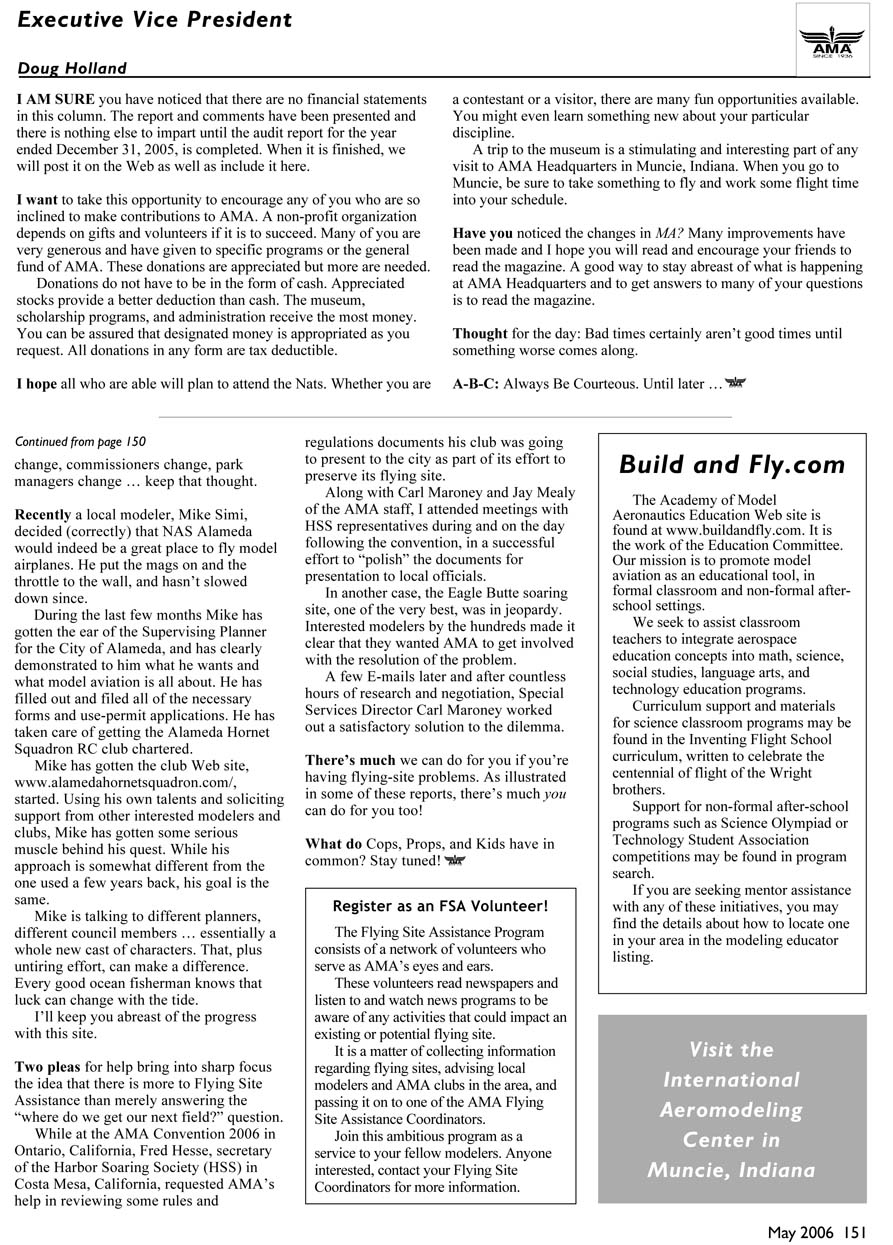
Such was the case with the new site procured by the Conejo Valley Flyers in Ventura County, California. I detailed the seven-year effort of the Conejo Valley people in a recent article. While I was in Burbank, California, to present a Certificate of Appreciation to the site owner, the Southern California Conference of the Seventh Day Adventist Church (SDA), I was talking to the church’s president, Larry Caviness, and attorney Bob Peterson about the development of the flying field on a large portion of its land.
As it turns out, the SDA members have secondary school academies in Southern California and a college in Northern California. The college has a strong aviation-related curriculum, and attendance there is the goal of many of the academy students.
The existence of the new model-aviation site will give those students an opportunity to study and experience aviation science “in miniature,” avoiding the expense involved with learning and experiencing the same principles at a full-scale aviation facility.
Marvelous, isn’t it, how the fundamental laws of aerodynamics that apply to large aircraft—lift, weight, thrust, drag, power-to-weight ratio, etc.—apply in precisely the same manner to aircraft you can hold in your hand?
Through the untiring efforts of Joe Martin and the clear foresight of the SDA leaders, there will soon be a great new flying site in the Los Angeles area.
“Persistence pays” is a quote we’ve all heard. The Conejo Valley Flyers’ seven-year effort is an excellent example of that old adage.
Alameda Naval Air Station effort
In Alameda, California, we have a somewhat similar situation. A few years ago I was asked to visit the old Alameda Naval Air Station, which had been closed during the first round of military base closures, in an effort to get permission to use one of the then-unused runways as a flying site.
After a few meetings with local modelers and some of the new tenants, it became clear that the plan wasn’t going to “fly.” Additionally, the local modelers were not overly enthusiastic about putting much “sweat equity” into the effort.
I returned to Phoenix, Arizona, and the Alameda Naval Air Station (NAS) effort became quiet. Quiet—not dead!
Mayors change, city council members change, commissioners change, park managers change … keep that thought.
Recently a local modeler, Mike Simi, decided (correctly) that NAS Alameda would indeed be a great place to fly model airplanes. He put the mags on and the throttle to the wall, and hasn’t slowed down since.
During the last few months Mike has gotten the ear of the Supervising Planner for the City of Alameda, and has clearly demonstrated to him what he wants and what model aviation is all about. He has filled out and filed all of the necessary forms and use-permit applications. He has taken care of getting the Alameda Hornet Squadron RC club chartered.
Mike has gotten the club website, www.alamedahornetsquadron.com, started. Using his own talents and soliciting support from other interested modelers and clubs, Mike has gotten some serious muscle behind his quest. While his approach is somewhat different from the one used a few years back, his goal is the same.
Mike is talking to different planners, different council members ... essentially a whole new cast of characters. That, plus untiring effort, can make a difference. Every good ocean fisherman knows that luck can change with the tide.
I'll keep you abreast of the progress with this site.
Helping clubs preserve sites
Two pleas for help bring into sharp focus the idea that there is more to Flying Site Assistance than merely answering the "where do we get our next field?" question.
While at the AMA Convention 2006 in Ontario, California, Fred Hesse, secretary of the Harbor Soaring Society (HSS) in Costa Mesa, California, requested AMA's help in reviewing some rules and regulations documents his club was going to present to the city as part of its effort to preserve its flying site.
Along with Carl Maroney and Jay Mealy of the AMA staff, I attended meetings with HSS representatives during and on the day following the convention, in a successful effort to polish the documents for presentation to local officials.
In another case, the Eagle Butte soaring site, one of the very best, was in jeopardy. Interested modelers by the hundreds made it clear that they wanted AMA to get involved with the resolution of the problem.
A few emails later and after countless hours of research and negotiation, Special Services Director Carl Maroney worked out a satisfactory solution to the dilemma.
There's much we can do for you if you're having flying-site problems. As illustrated in these reports, there's much you can do for yourself, too.
What do Cops, Props, and Kids have in common?
Stay tuned!
Register as an FSA Volunteer!
The Flying Site Assistance (FSA) Program consists of a network of volunteers who serve as AMA's eyes and ears.
These volunteers read newspapers and listen to and watch news programs to be aware of any activities that could impact an existing or potential flying site.
It is a matter of collecting information regarding flying sites, advising local modelers and AMA clubs in the area, and passing it on to one of the AMA Flying Site Assistance Coordinators.
Join this ambitious program as a service to your fellow modelers. Anyone interested, contact your Flying Site Coordinators for more information.
Transcribed from original scans by AI. Minor OCR errors may remain.

