
Flying Site Assistance
We Win Some and Some Go to Extra Innings
It's the second week of the Cactus League baseball season here in the Phoenix area. Major League stars and future stars are getting ready for the regular season, which kicks off in April. The sports section is talking wins and losses as spring training rolls on.
In the Flying Site Assistance arena, I like to talk of wins and extra-inning efforts, rather than wins and losses.
In January I got a call from Reeves Lippincott of the Alaska RC Society (ARCS) in which he described an onerous new law that would essentially outlaw model aviation within the Matanuska-Susitna Borough (MSB). The MSB comprises roughly 24,700 square miles and contains approximately 10% of the population of Alaska. Anchorage is within the MSB area.
The new law restricted noise levels created by certain sources—such as model aircraft engines—to 3–5 dB above ambient noise levels measured at the affected property line. The mayor had vetoed the measure at a prior meeting, but the MSB Assembly was getting ready to have an override vote.
ARCS and the AMA mounted a furious informational campaign to educate the assembly members regarding the benefits of model aviation, both to individuals and to communities. At the override hearing, many modelers stood to decry the new ordinance and to defend their recreational activity.
The veto was overridden; however, because of the significant input from the modelers at the hearing (more than an hour of comments), the assembly asked that a committee be formed to try to come to an agreement whereby the modelers would indeed be able to continue their flying activities. Instead of the flat denial and a loss of flying activities, we got some “extra innings.” Three modelers will be part of the six-person committee.
In retrospect, Tom Simes, president of the ARCS, and Reeves Lippincott pointed to two learning points they took from the events leading to the override:
- The initial ordinance revision had been advertised in local newspapers as required by law, but the sound ordinance’s impact on modelers had been missed. The initial ordinance had been voted on without any input from us. We need to skim public notices to see whether or not they have an impact on us.
- Rather than offering a series of comments praising the benefits of model aviation and describing the burdensome nature of the new ordinance, we should have approached the assembly with a workable alternative plan. By attending the meeting with nothing other than passionate comments, we left the assembly members with nothing more than an up-or-down choice.
In the “win” column, I have a great follow-up to my article in the March issue of MA. Near the end of that article I mentioned that construction of the new model airpark in Florence, Arizona, would get underway before that issue would hit your mailbox.
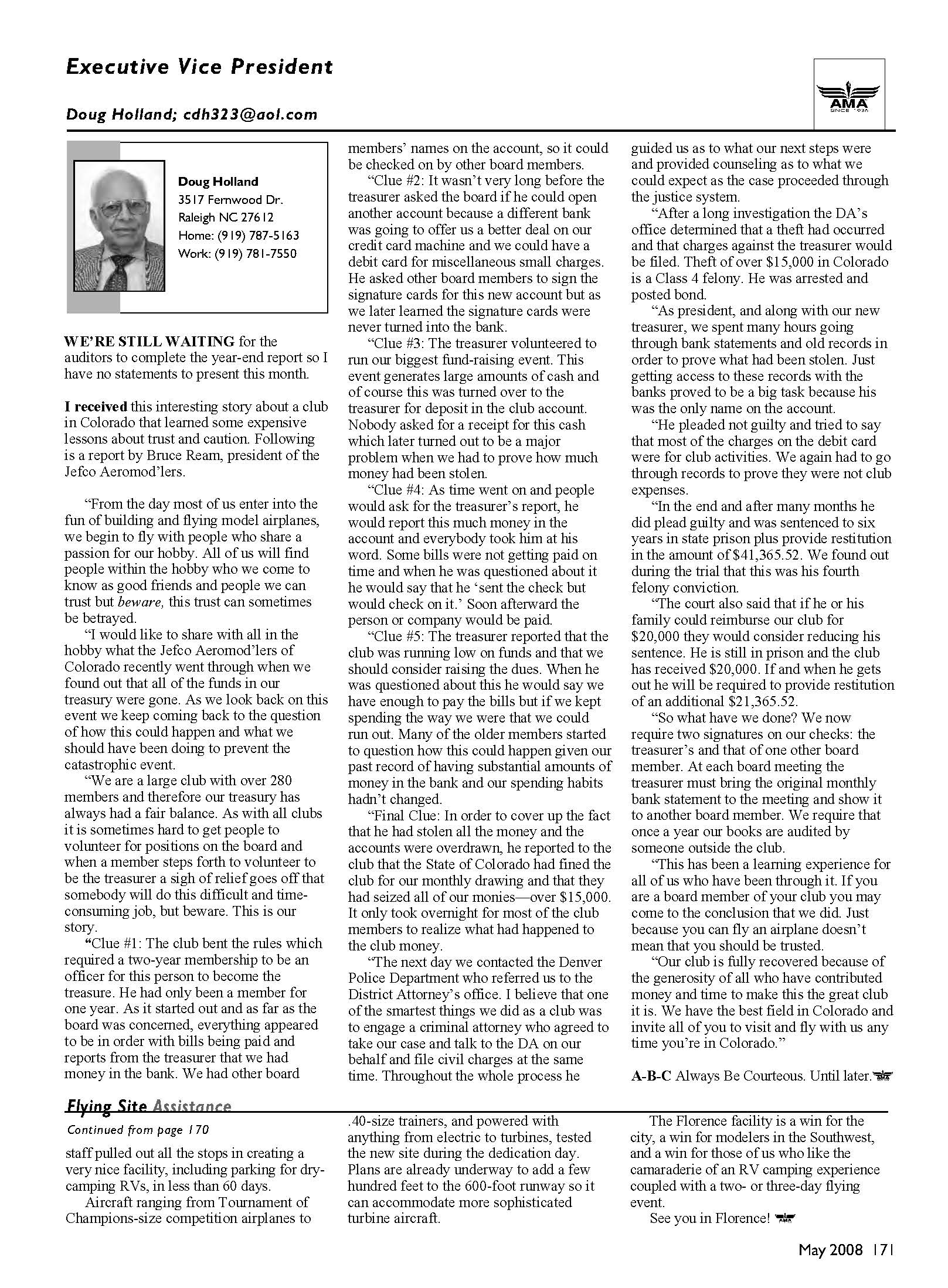
On March 1, the day the March issue arrived at my house, the new airpark was dedicated! Take a look at the picture in the March issue and the pictures I have included. A motivated and dedicated city staff pulled out all the stops in creating a very nice facility, including parking for dry-camping RVs, in less than 60 days.
Aircraft ranging from Tournament of Champions–size competition airplanes to .40-size trainers, and powered by anything from electric to turbines, tested the new site during the dedication day. Plans are already underway to add a few hundred feet to the 600-foot runway so it can accommodate more sophisticated turbine aircraft.
The Florence facility is a win for the city, a win for modelers in the Southwest, and a win for those of us who like the camaraderie of an RV camping experience coupled with a two- or three-day flying event.
See you in Florence!
A-B-C — Always Be Courteous. Until later.
Transcribed from original scans by AI. Minor OCR errors may remain.

