
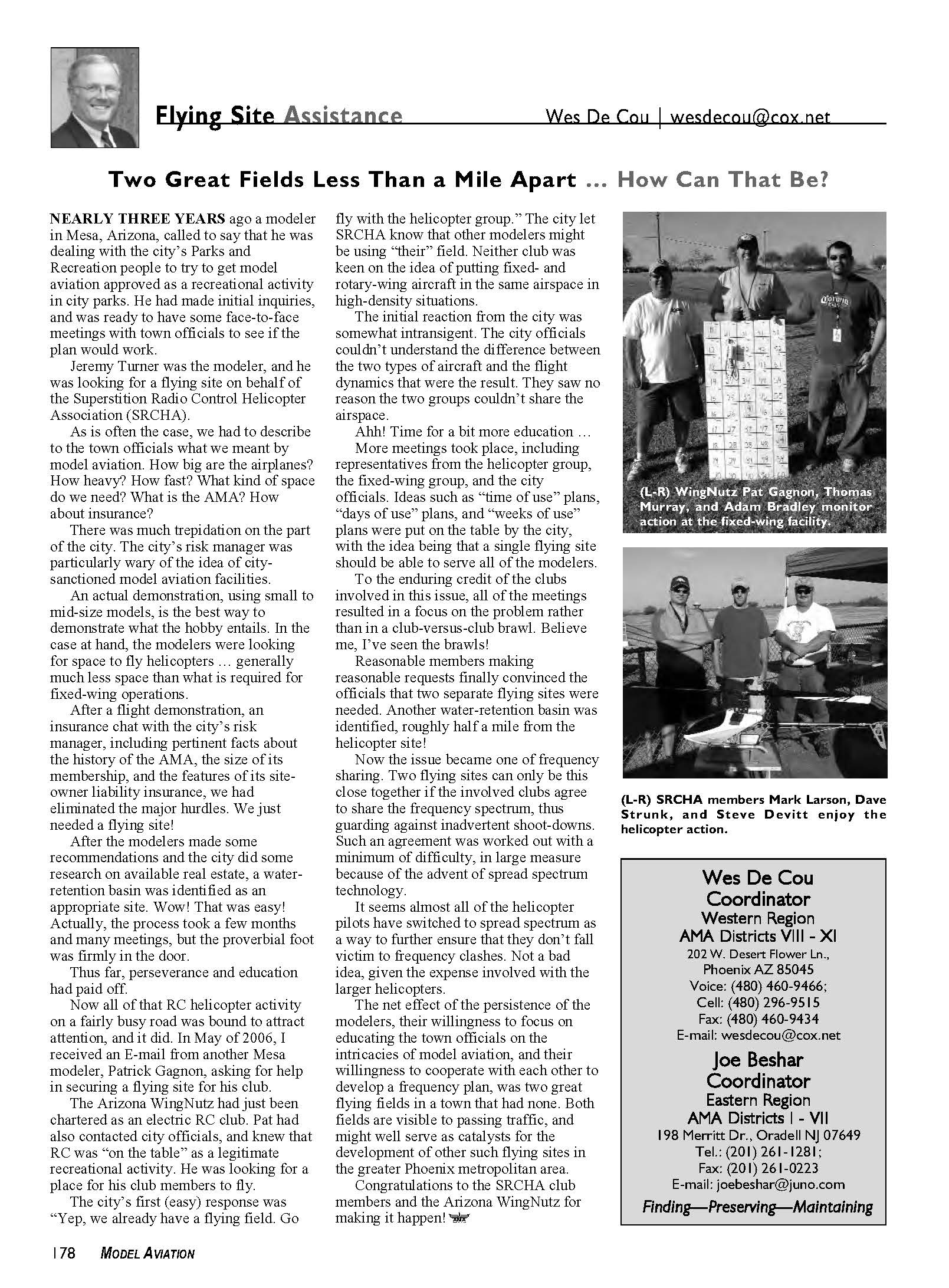
Two Great Fields Less Than a Mile Apart ... How Can That Be?
Nearly three years ago a modeler in Mesa, Arizona, called to say that he was dealing with the city's Parks and Recreation people to try to get model aviation approved as a recreational activity in city parks. He had made initial inquiries and was ready to have some face-to-face meetings with town officials to see if the plan would work.
Jeremy Turner was the modeler, and he was looking for a flying site on behalf of the Superstition Radio Control Helicopter Association (SRCHA).
As is often the case, we had to describe to the town officials what we meant by model aviation. How big are the airplanes? How heavy? How fast? What kind of space do we need? What is the AMA? How about insurance?
There was much trepidation on the part of the city. The city's risk manager was particularly wary of the idea of city-sanctioned model aviation facilities.
An actual demonstration, using small- to mid-size models, is the best way to show what the hobby entails. In this case the modelers were looking for space to fly helicopters — generally much less space than is required for fixed-wing operations.
After a flight demonstration and an insurance chat with the city's risk manager, including pertinent facts about the history of the AMA, the size of its membership, and the features of its site-owner liability insurance, we had eliminated the major hurdles. We just needed a flying site.
After the modelers made some recommendations and the city did some research on available real estate, a water-retention basin was identified as an appropriate site. Wow! That was easy! Actually, the process took a few months and many meetings, but the proverbial foot was firmly in the door.
Thus far, perseverance and education had paid off.
Now all of that RC helicopter activity on a fairly busy road was bound to attract attention, and it did. In May of 2006 I received an email from another Mesa modeler, Patrick Gagnon, asking for help in securing a flying site for his club.
The Arizona WingNutz had just been chartered as an electric RC club. Pat had also contacted city officials, and knew that RC was "on the table" as a legitimate recreational activity. He was looking for a place for his club members to fly.
The city's first (easy) response was, "Yep, we already have a flying field. Go fly with the helicopter group." The city let SRCHA know that other modelers might be using "their" field. Neither club was keen on the idea of putting fixed- and rotary-wing aircraft in the same airspace in high-density situations.
The initial reaction from the city was somewhat intransigent. The city officials couldn't understand the difference between the two types of aircraft and the flight dynamics that resulted. They saw no reason the two groups couldn't share the airspace.
Ah! Time for a bit more education.
More meetings took place, including representatives from the helicopter group, the fixed-wing group, and the city officials. Ideas such as "time of use" plans, "days of use" plans, and "weeks of use" plans were put on the table by the city, with the idea being that a single flying site should be able to serve all of the modelers.
To the enduring credit of the clubs involved, all of the meetings resulted in a focus on the problem rather than in a club-versus-club brawl. Reasonable members making reasonable requests finally convinced the officials that two separate flying sites were needed. Another water-retention basin was identified, roughly half a mile from the helicopter site.
Now the issue became one of frequency sharing. Two flying sites can only be this close together if the involved clubs agree to share the frequency spectrum, thus guarding against inadvertent shoot-downs. Such an agreement was worked out with a minimum of difficulty, in large measure because of the advent of spread-spectrum technology.
It seems almost all of the helicopter pilots have switched to spread spectrum as a way to further ensure that they don't fall victim to frequency clashes. Not a bad idea, given the expense involved with the larger helicopters.
The net effect of the persistence of the modelers, their willingness to educate the town officials on the intricacies of model aviation, and their cooperation in developing a frequency plan was two great flying fields in a town that had none. Both fields are visible to passing traffic, and might well serve as catalysts for the development of other such flying sites in the greater Phoenix metropolitan area.
Congratulations to the SRCHA club members and the Arizona WingNutz for making it happen!
Transcribed from original scans by AI. Minor OCR errors may remain.

