
Flying Site Assistance - 2009/11
Wes De Cou | [email protected]
Putting model aviation in the public eye
Daily I receive new, current information that I can use in the ongoing effort to create or save flying sites.
We have a Flying Site Assistance Kit available for clubs to use in their efforts to persuade site owners to let their land be used for model aviation activities. Those site owners might be city or county parks and recreation representatives, city councils, state or federal officials, or simply people with a little extra land available.
The kit contains much information about the history of model aviation, the history, mission, and purpose of the Academy of Model Aeronautics, and myriad documents attesting to the great recreational and educational value of our hobby. There are also documents intended to help you, the local club member, make a good presentation to those site owners in support of your efforts to get a new flying site.
We’ve had the kit for many years. Some of the available information is dated, but it is still germane to the effort to tell people who we are and what we do. The material I receive each day via e-mail, news wires, and web-based news journals has the potential to add significant impact to any presentation you make in your effort to convince site owners of the “value added” impact of a local flying facility.
Some examples, you ask? Read on. I received an e-mail from Noel Eberhardt, president of the South Bay Soaring Society (SBSS), whose club has gotten involved in its local community in a big way.
“Thank you very much for the packet of material on flying site assistance you arranged to be sent from Muncie [Indiana]. I started going through it and there’s a lot history can teach.
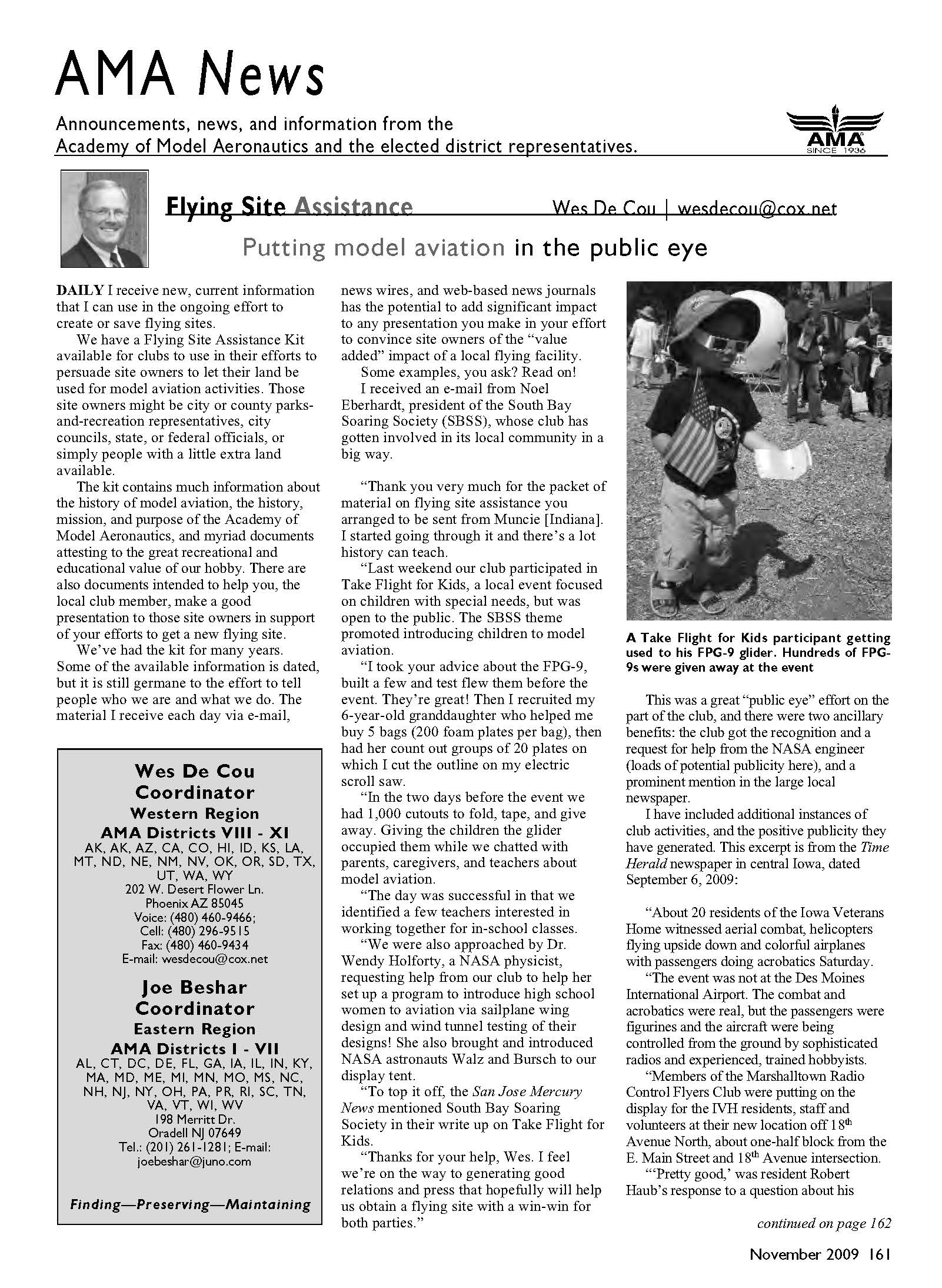
“Last weekend our club participated in Take Flight for Kids, a local event focused on children with special needs, but was open to the public. The SBSS theme promoted introducing children to model aviation.
“I took your advice about the FPG-9, built a few and test flew them before the event. They’re great! Then I recruited my 6-year-old granddaughter who helped me buy 5 bags (200 foam plates per bag), then had her count out groups of 20 plates on which I cut the outline on my electric scroll saw.
“In the two days before the event we had 1,000 cutouts to fold, tape, and give away. Giving the children the glider occupied them while we chatted with parents, caregivers, and teachers about model aviation.
“The day was successful in that we identified a few teachers interested in working together for in-school classes.
“We were also approached by Dr. Wendy Holforty, a NASA physicist, requesting help from our club to help her set up a program to introduce high school women to aviation via sailplane wing design and wind tunnel testing of their designs! She also brought and introduced NASA astronauts Walz and Bursch to our display tent.
“To top it off, the San Jose Mercury News mentioned South Bay Soaring Society in their write up on Take Flight for Kids.
“Thanks for your help, Wes. I feel we’re on the way to generating good relations and press that hopefully will help us obtain a flying site with a win-win for both parties.”
This was a great “public eye” effort on the part of the club, and there were two ancillary benefits: the club got recognition and a request for help from the NASA engineer (loads of potential publicity here), and a prominent mention in the large local newspaper.
I have included additional instances of club activities, and the positive publicity they have generated. This excerpt is from the Time Herald newspaper in central Iowa, dated September 6, 2009:
“About 20 residents of the Iowa Veterans Home witnessed aerial combat, helicopters flying upside down, and colorful airplanes doing acrobatics Saturday.
“The event was not at the Des Moines International Airport. The combat and acrobatics were real, but the passengers were figurines and the aircraft were models. Residents watched the activities and the model airplanes from the pit area.
“‘It's a dandy,’ he replied, when asked about the sunny and warm conditions.
“The pit area held a variety of aircraft of all colors, shapes, and sizes. Several were modeled after conventional aircraft while others were designed to resemble fighter planes. The club of 41 central Iowa members had planned a busy day for the residents, who were also treated to lunch, beverages and plenty of shade.
“Secretary Jim Zimmerman of Marshalltown said they wanted to entertain the residents and show off their new location. For many years, club members flew their aircraft at the old landfill north of town. Then the site was purchased by another organization.
“'The local hunt club bought it,' club member Ed Boehm of Marshalltown said. 'We worked with the city to get this property. It used to be a field for crops. We leveled the high points down and rolled it about three times.' Boehm pointed to a large silver roller parked nearby.
“Zimmerman said, 'The city had been very helpful and good to work with,' in allowing the club to use the flood plain area. 'The new location gives us more room and more visibility. Since we've moved here, we've added about eight new members.'”
This is great 'public eye' stuff. The club got some good recognition, gave kudos to the city for its help in getting a new flying site, and can claim a 'give-back' to the community through this effort with the local Veterans' Home.
I saw this excerpted article by staff writer Ed Richter of the Journal News in Butler County, Ohio, on Sunday, August 9, 2009:
“Jordan Hils said he would like to become a pilot someday. The 7-year-old from Erlanger, Ky., was among the nearly 3,000 people who spent Saturday afternoon, August 8, lined up along the taxiway at the Butler County Regional Airport to watch the 49th annual Flying Circus air show put on by the Greater Cincinnati Radio Control Club. 'It's really good,' Jordan said as he watched World War II re-enactments by scale model B-29 bombers. 'I just think flying is fun.'
“His father, Michael Hils, said, 'This is wonderful, absolutely wonderful ... I wouldn't miss it for the world.'
“About 150 planes flown by 50 enthusiasts participated in one of the nation's largest radio control model air shows, said Tom Burdin of West Chester Twp., who has been a member for 41 years.
“Described by Burdin as the 'apex' of the air show, more than two dozen planes built by club members especially for the Flying Circus participate in miniature versions of WWII bombing raids and other fighter attacks on a mini city in the airfield. As the planes fly over their targets, club members set off large firecrackers to knock down the small buildings.
“Burdin said the planes — with price tags from $300 to upwards of $10,000 — are made of fiberglass, carbon fiber, plywood, balsa, foam, plastic, or a mixture of several materials. The planes are powered by methanol, gasoline, electricity and JP4 jet fuel.
“Aircraft ranging from propeller-driven to helicopters to jets zoomed skyward, buzzed the runways, and performed acrobatic maneuvers.
“Terry Jacobs, of Goshen, wowed the crowd with his Starfire jet as it soared through the sky. Jacobs said he got into the hobby as a University of Cincinnati student after he purchased a $300 plane. 'I said it was something I always wanted to do,' he said. 'The next thing I know, I'm walking out with a plane.'
“Jacobs said it took a few weeks to learn how to fly using training aircraft, and he added that he got into jets a year later. 'I love to do shows,' Jacobs said. 'They invite me to fly each year, and it's a lot of fun.'
“The club also gives back to the area community by donating about $5,000 to charities from the proceeds of the event.
“'This is a very organized show,' Burdin said. 'Wait until next year (for the 50th event).'”
This is more "public eye" material — great publicity for the event, which continued on the day of publication, and a wonderful comment about the charitable giving on the part of the club.
My final offering is a tiny item with the potential to deliver a big wallop during your flying site presentation. This is from WTAP-TV, based in Parkersburg, West Virginia, as posted on the WTAP.com website:
“Dozens of airplanes took flight in the Mid-Ohio Valley Saturday, but it's not the kind of plane you took on your last vacation or business trip.
“The Blennerhassett Area Radio Control Club had its annual Airshow Extravaganza, but the organization made this year a little different by making it into a charity event. Food and donations were collected for some local charities.
“One BARCC member described flying model planes as a life-long hobby. 'When I was younger I always went by a shop and they had a big remote control Spitfire in the window, and I just loved to watch that thing, and I never saw it fly or anything, but I just love airplanes,' Rob Maas said.”
This is a small item, but the impact of a charitable donation is never lost on site owners. If your club is having an event, get it noticed in the newspaper, on television, or on a local radio show.
Don't be afraid to put the activity in front of the public. People remain fascinated with all aspects of aviation, and the public can be your greatest ally in front of people who make decisions regarding your plea for a flying site.
There will be detractors, but you can have them outnumbered by a vocal and sympathetic public if you put your club, its events, and its value to the community out there in the "public eye."
Transcribed from original scans by AI. Minor OCR errors may remain.

