
Flying Site Assistance
Wes De Cou | [email protected]
When opportunity comes a knockin' ...
WHOOSH! Whoosh! What was that?
I'm walking down the corridor at Taylor Jr. High School in Mesa, Arizona, looking for the classroom of teacher Karen Rascon, who's involved in something called AWIM.
Whoosh! That was a glider buzzing the hallway! I think I've found the classroom.
A few weeks before this encounter, I had been talking with Jon Moss, a friend of mine and a retired General Motors executive, about a program called "A World In Motion" (AWIM). Developed by SAE International (Society of Automotive Engineers), AWIM is a teacher-administered, volunteer-assisted program that brings science, technology, engineering, and math (STEM) education to life in the classroom for students in kindergarten through grade 12.
Benchmarked to national standards, AWIM incorporates the laws of physics, motion, flight, and electronics into age-appropriate hands-on activities that reinforce classroom STEM curriculum.
With the support of corporations, foundations, volunteers, SAE members, and the SAE Foundation, AWIM opens a window of possibilities for students as they discover the exciting application of science principles and learn about rewarding engineering, science, and technical careers.
The students learn to work as a team with their classmates and apply creative problem solving during the activities.
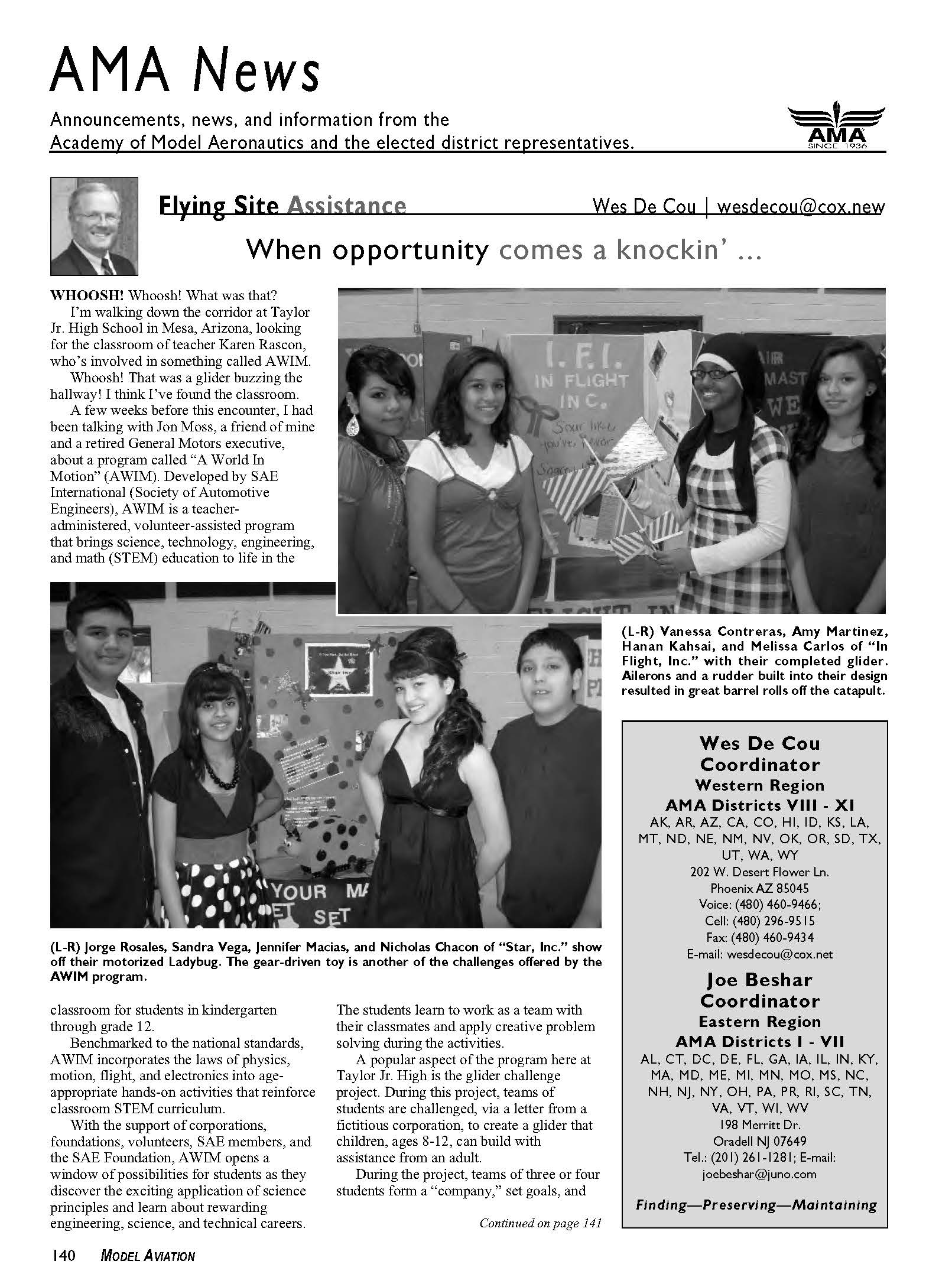
A popular aspect of the program here at Taylor Jr. High is the glider challenge project. During this project, teams of students are challenged, via a letter from a fictitious corporation, to create a glider that children ages 8–12 can build with assistance from an adult.
During the project, teams of three or four students form a "company," set goals, and build their knowledge about flight in general and rubber-band catapult-launched gliders in particular. They design, test, and revise their gliders, agree on a final design that meets their stated goals, build the final product, and present the results of their work to teachers, family, and friends at the end-of-project celebration.
The presentations include actual demonstrations of the glider, display boards depicting the various stages of development, and an oral presentation delivered via a student-produced PowerPoint.
As I write this column, I have just returned from the end-of-project celebration at Taylor Jr. High. The short commitment on my part—one or two hours in eight weeks—is over. The reward came this evening in the form of excited students demonstrating their newly acquired knowledge to their peers, parents, and teachers.
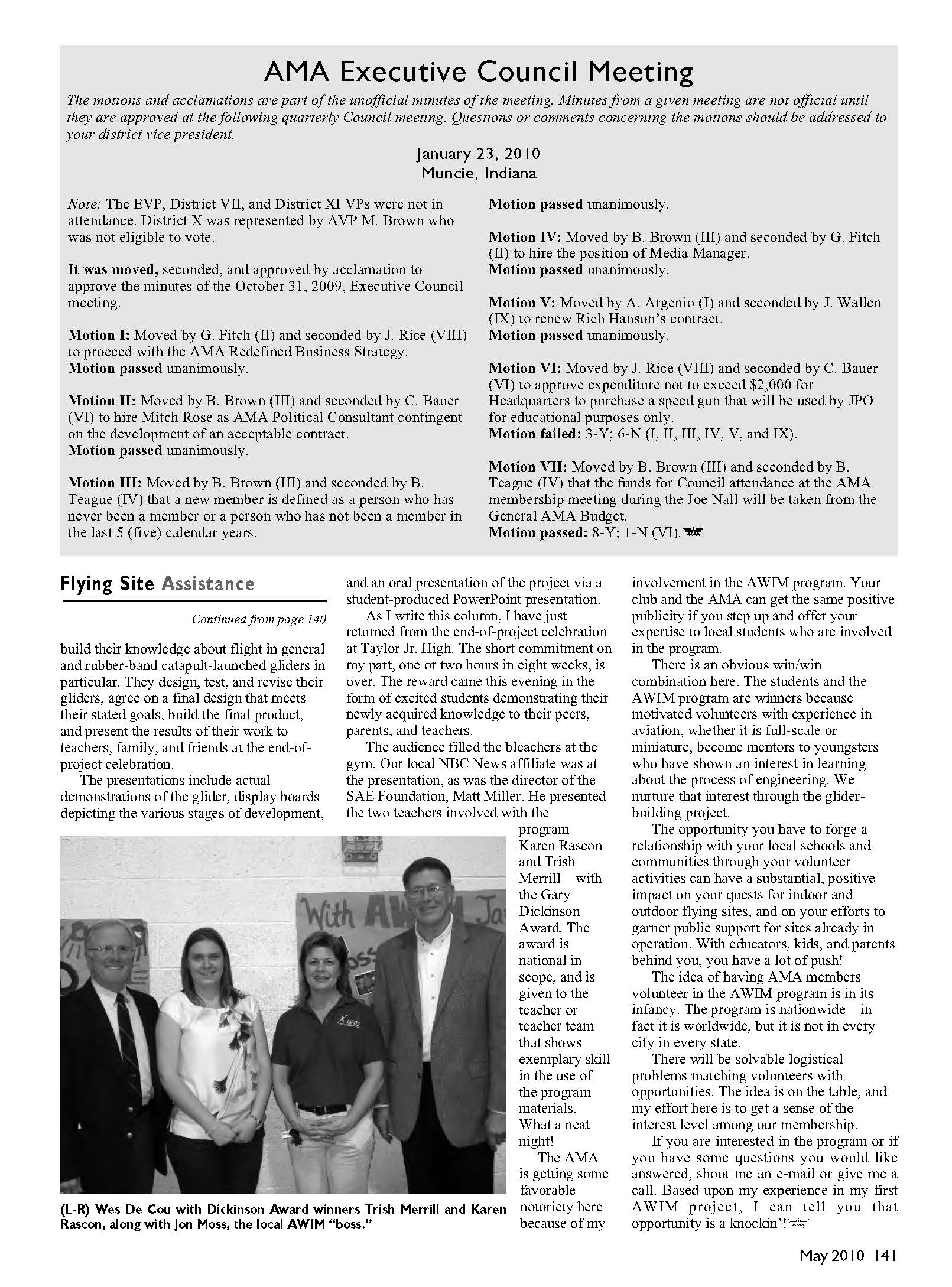
The audience filled the bleachers at the gym. Our local NBC news affiliate was at the presentation, as was the director of the SAE Foundation, Matt Miller. He presented the two teachers involved with the program, Karen Rascon and Trish Merrill, with the Gary Dickinson Award. The award is national in scope and is given to the teacher or teacher team that shows exemplary skill in the use of the program materials. What a neat night!
The AMA is getting some favorable notoriety here because of my involvement in the AWIM program. Your club and the AMA can get the same positive publicity if you step up and offer your expertise to local students who are involved in the program.
There is an obvious win/win combination here. The students and the AWIM program are winners because motivated volunteers with experience in aviation—whether it is full-scale or miniature—become mentors to youngsters who have shown an interest in learning about the process of engineering. We nurture that interest through the glider-building project.
The opportunity you have to forge a relationship with your local schools and communities through your volunteer activities can have a substantial, positive impact on your quests for indoor and outdoor flying sites, and on your efforts to garner public support for sites already in operation. With educators, kids, and parents behind you, you have a lot of push!
The idea of having AMA members volunteer in the AWIM program is in its infancy. The program is nationwide — in fact it is worldwide — but it is not in every city in every state.
There will be solvable logistical problems matching volunteers with opportunities. The idea is on the table, and my effort here is to get a sense of the interest level among our membership.
If you are interested in the program or if you have some questions you would like answered, shoot me an e-mail or give me a call. Based upon my experience in my first AWIM project, I can tell you that opportunity is a knockin'!
— WDC
Transcribed from original scans by AI. Minor OCR errors may remain.

