
Focal Point
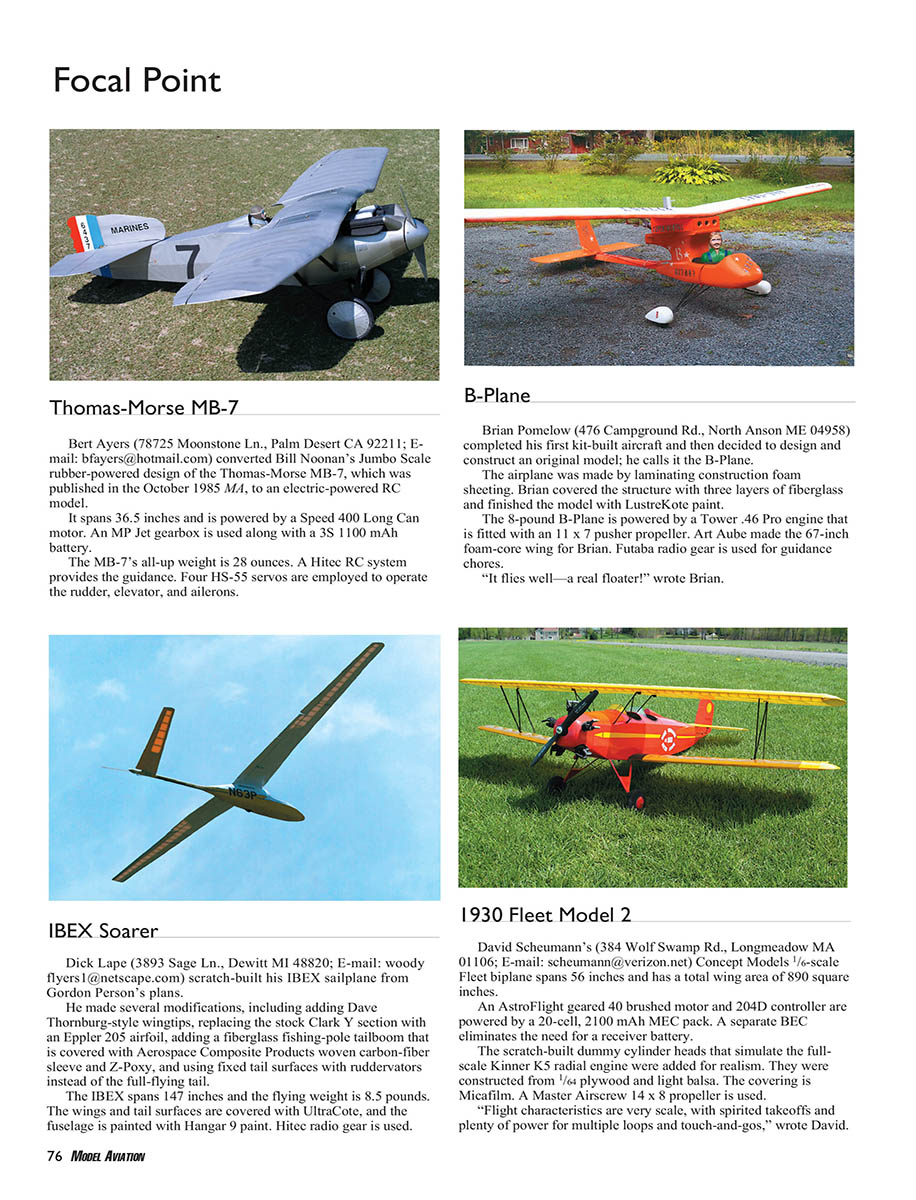
Thomas-Morse MB-7
Bert Ayers (78725 Moonstone Ln., Palm Desert, CA 92211; E-mail: [email protected]) converted Bill Noonan’s Jumbo Scale rubber-powered design of the Thomas-Morse MB-7, which was published in the October 1985 MA, to an electric-powered RC model.
It spans 36.5 inches and is powered by a Speed 400 Long Can motor. An MP Jet gearbox is used along with a 3S 1100 mAh battery.
The MB-7’s all-up weight is 28 ounces. A Hitec RC system provides guidance. Four HS-55 servos are employed to operate the rudder, elevator, and ailerons.
IBEX Soarer
Dick Lape (3893 Sage Ln., Dewitt, MI 48820; E-mail: [email protected]) scratch-built his IBEX sailplane from Gordon Person’s plans.
He made several modifications, including adding Dave Thornburg-style wingtips, replacing the stock Clark Y section with an Eppler 205 airfoil, adding a fiberglass fishing-pole tailboom that is covered with Aerospace Composite Products woven carbon-fiber sleeve and Z-Poxy, and using fixed tail surfaces with ruddervators instead of the full-flying tail.
The IBEX spans 147 inches and the flying weight is 8.5 pounds. The wings and tail surfaces are covered with UltraCote, and the fuselage is painted with Hangar 9 paint. Hitec radio gear is used.
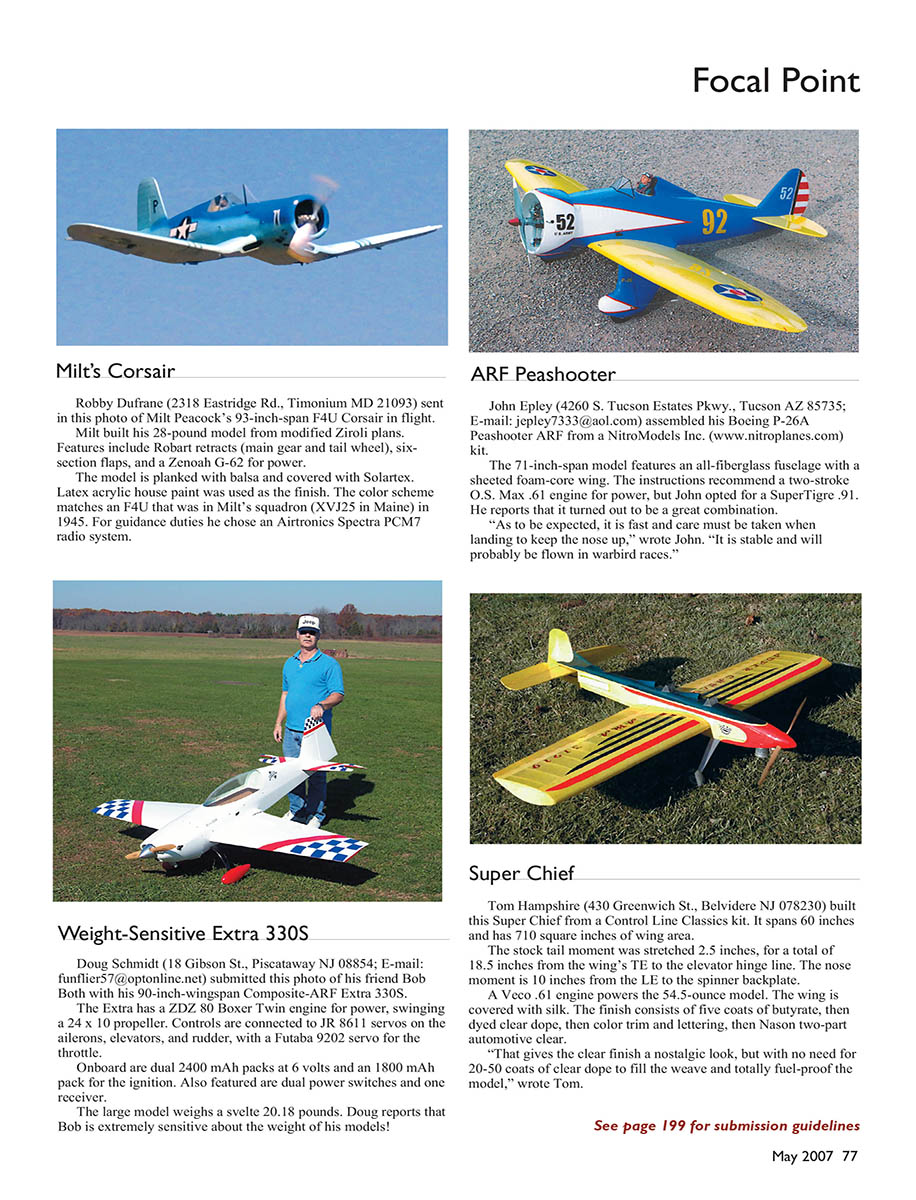
B-Plane
Brian Pomelow (476 Campground Rd., North Anson, ME 04958) completed his first kit-built aircraft and then decided to design and construct an original model; he calls it the B-Plane.
The airplane was made by laminating construction foam sheeting. Brian covered the structure with three layers of fiberglass and finished the model with LustreKote paint.
The 8-pound B-Plane is powered by a Tower .46 Pro engine that is fitted with an 11 x 7 pusher propeller. Art Aube made the 67-inch foam-core wing for Brian. Futaba radio gear is used for guidance chores.
“It flies well—a real floater!” wrote Brian.
1930 Fleet Model 2
David Scheumann (384 Wolf Swamp Rd., Longmeadow, MA 01106; E-mail: [email protected]) built a Concept Models 1/6-scale Fleet biplane that spans 56 inches and has a total wing area of 890 square inches.
An AstroFlight geared 40 brushed motor and 204D controller are powered by a 20-cell, 2100 mAh MEC pack. A separate BEC eliminates the need for a receiver battery.
Scratch-built dummy cylinder heads that simulate the full-scale Kinner K5 radial engine were added for realism. They were constructed from 1/64 plywood and light balsa. The covering is Micafilm. A Master Airscrew 14 x 8 propeller is used.
“Flight characteristics are very scale, with spirited takeoffs and plenty of power for multiple loops and touch-and-gos,” wrote David.
Milt’s Corsair
Robby Dufrane (2318 Eastridge Rd., Timonium, MD 21093) sent in a photo of Milt Peacock’s 93-inch-span F4U Corsair in flight. Milt built his 28-pound model from modified Ziroli plans. Features include Robart retracts (main gear and tail wheel), six-section flaps, and a Zenoah G-62 for power.
The model is planked with balsa and covered with Solartex. Latex acrylic house paint was used as the finish. The color scheme matches an F4U that was in Milt’s squadron (VJ25 in Maine) in 1945. For guidance duties he chose an Airtronics Spectra PCM7 radio system.
ARF Peashooter
John Epley (4260 S. Tucson Estates Pkwy., Tucson, AZ 85735; E-mail: [email protected]) assembled his Boeing P-26A Peashooter ARF from a NitroModels Inc. (www.nitroplanes.com) kit.
The 71-inch-span model features an all-fiberglass fuselage with a sheeted foam-core wing. The instructions recommend a two-stroke O.S. Max .61 engine for power, but John opted for a SuperTigre .91. He reports that it turned out to be a great combination.
“As to be expected, it is fast and care must be taken when landing to keep the nose up,” wrote John. “It is stable and will probably be flown in warbird races.”
Weight-Sensitive Extra 330S
Doug Schmidt (18 Gibson St., Piscataway, NJ 08854; E-mail: [email protected]) submitted a photo of his friend Bob Both with his 90-inch-wingspan Composite-ARF Extra 330S.
The Extra has a ZDZ 80 Boxer Twin engine for power, swinging a 24 x 10 propeller. Controls are connected to JR 8611 servos on the ailerons, elevators, and rudder, with a Futaba 9202 servo for the throttle.
Onboard are dual 2400 mAh packs at 6 volts and an 1800 mAh pack for the ignition. Also featured are dual power switches and one receiver.
The large model weighs a svelte 20.18 pounds. Doug reports that Bob is extremely sensitive about the weight of his models!
Super Chief
Tom Hampshire (430 Greenwich St., Belvidere, NJ 07823) built this Super Chief from a Control Line Classics kit. It spans 60 inches and has 710 square inches of wing area.
The stock tail moment was stretched 2.5 inches, for a total of 18.5 inches from the wing’s trailing edge to the elevator hinge line. The nose moment is 10 inches from the leading edge to the spinner backplate.
A Veco .61 engine powers the 54.5-ounce model. The wing is covered with silk. The finish consists of five coats of butyrate, then dyed clear dope, then color trim and lettering, then Nason two-part automotive clear.
“That gives the clear finish a nostalgic look, but with no need for 20–50 coats of clear dope to fill the weave and totally fuel-proof the model,” wrote Tom.
Transcribed from original scans by AI. Minor OCR errors may remain.

