
Focal Point
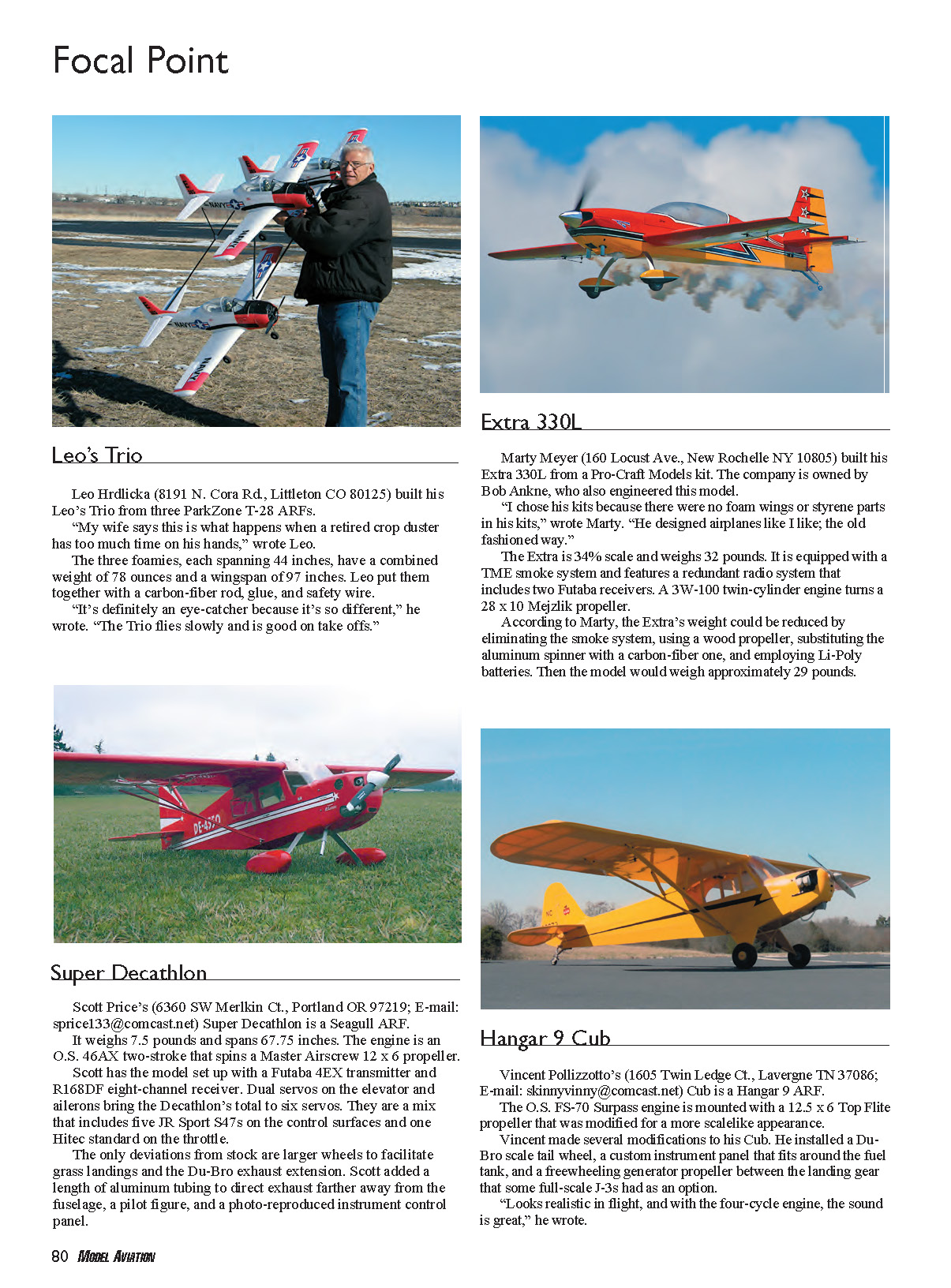
Leo's Trio
Leo Hrdlicka (8191 N. Cora Rd., Littleton, CO 80125) built his Leo's Trio from three ParkZone T-28 ARFs.
"My wife says this is what happens when a retired crop duster has too much time on his hands," wrote Leo.
The three foamies, each spanning 44 inches, have a combined weight of 78 ounces and a wingspan of 97 inches. Leo put them together with a carbon-fiber rod, glue, and safety wire.
"It's definitely an eye-catcher because it's so different," he wrote. "The Trio flies slowly and is good on takeoffs."
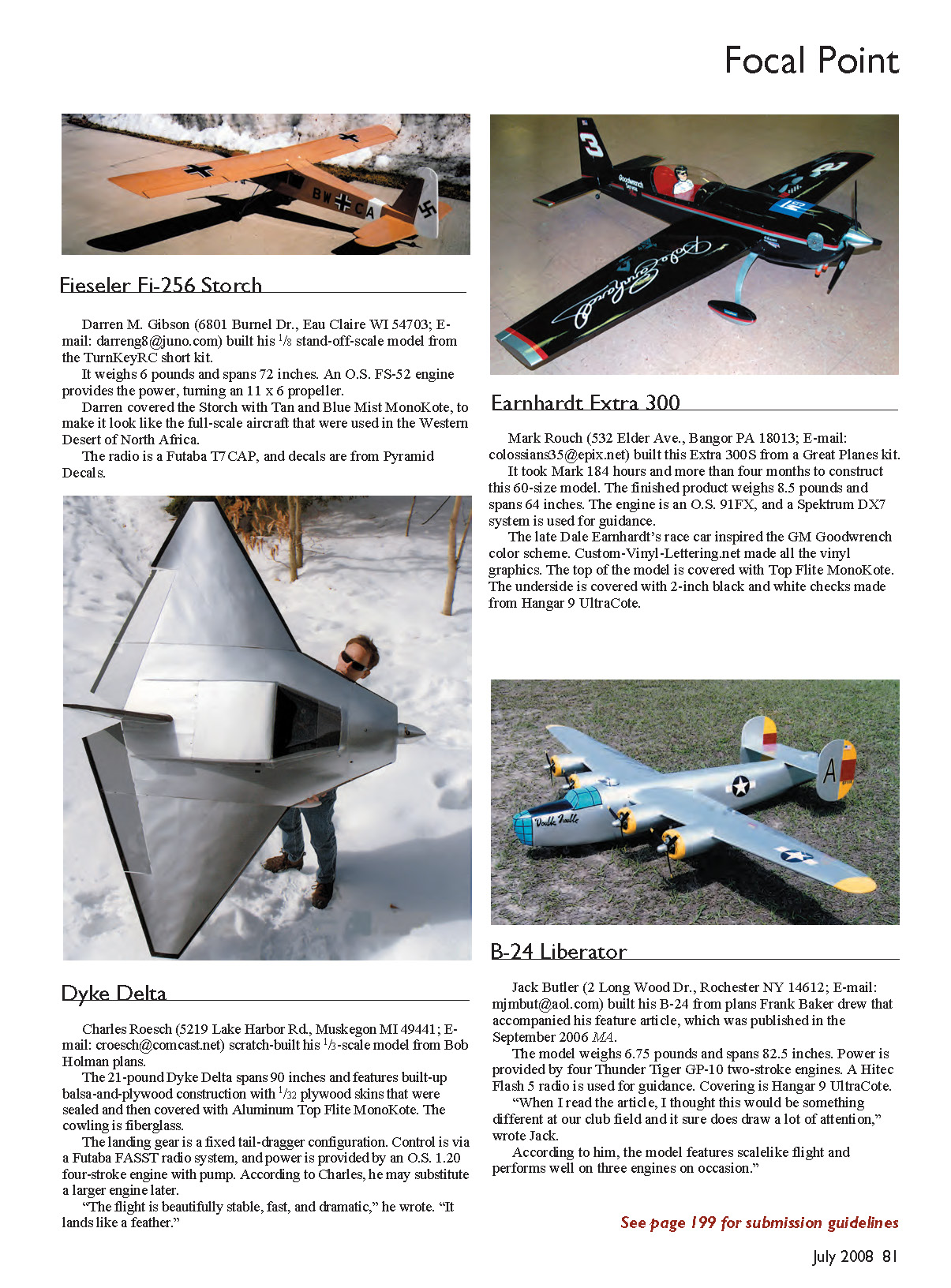
Extra 330L
Marty Meyer (160 Locust Ave., New Rochelle, NY 10805) built his Extra 330L from a Pro-Craft Models kit. The company is owned by Bob Ankne, who also engineered this model.
"I chose his kits because there were no foam wings or styrene parts in his kits," wrote Marty. "He designed airplanes like I like; the old fashioned way."
The Extra is 34% scale and weighs 32 pounds. It is equipped with a TME smoke system and features a redundant radio system that includes two Futaba receivers. A 3W-100 twin-cylinder engine turns a 28 x 10 Mejzlik propeller.
According to Marty, the Extra's weight could be reduced by eliminating the smoke system, using a wood propeller, substituting the aluminum spinner with a carbon-fiber one, and employing Li-Poly batteries. Then the model would weigh approximately 29 pounds.
Super Decathlon
Scott Price (6360 SW Merlkin Ct., Portland, OR 97219; E-mail: [email protected]) flies a Super Decathlon (Seagull ARF).
It weighs 7.5 pounds and spans 67.75 inches. The engine is an O.S. 46AX two-stroke that spins a Master Airscrew 12 x 6 propeller.
Scott has the model set up with a Futaba 4EX transmitter and R168DF eight-channel receiver. Dual servos on the elevator and ailerons bring the Decathlon's total to six servos. They are a mix that includes five JR Sport S47s on the control surfaces and one Hitec standard on the throttle.
The only deviations from stock are larger wheels to facilitate grass landings and a Du-Bro exhaust extension. Scott added a length of aluminum tubing to direct exhaust farther away from the fuselage, a pilot figure, and a photo-reproduced instrument control panel.
Hangar 9 Cub
Vincent Pollizzotto (1605 Twin Ledge Ct., La Vergne, TN 37086; E-mail: [email protected]) flies a Cub (Hangar 9 ARF).
The O.S. FS-70 Surpass engine is mounted with a 12.5 x 6 Top Flite propeller that was modified for a more scale-like appearance.
Vincent made several modifications to his Cub. He installed a Du-Bro scale tail wheel, a custom instrument panel that fits around the fuel tank, and a freewheeling generator propeller mounted between the landing gear that some full-scale J-3s had as an option.
"Looks realistic in flight, and with the four-cycle engine, the sound is great," he wrote.
Fieseler Fi-156 Storch
Darren M. Gibson (6801 Burnel Dr., Eau Claire, WI 54703; E-mail: [email protected]) built his 1/8 stand-off-scale model from the TurnKeyRC short kit.
It weighs 6 pounds and spans 72 inches. An O.S. FS-52 engine provides the power, turning an 11 x 6 propeller.
Darren covered the Storch with Tan and Blue Mist MonoKote to make it look like the full-scale aircraft that were used in the Western Desert of North Africa.
The radio is a Futaba T7CAP, and decals are from Pyramid Decals.
Earnhardt Extra 300
Mark Rouch (532 Elder Ave., Bangor, PA 18013; E-mail: [email protected]) built this Extra 300S from a Great Planes kit.
It took Mark 184 hours and more than four months to construct this 60-size model. The finished product weighs 8.5 pounds and spans 64 inches. The engine is an O.S. 91FX, and a Spektrum DX7 system is used for guidance.
The late Dale Earnhardt’s race car inspired the GM Goodwrench color scheme. Custom-Vinyl-Lettering.net made all the vinyl graphics. The top of the model is covered with Top Flite MonoKote. The underside is covered with 2-inch black-and-white checks made from Hangar 9 UltraCote.
Dyke Delta
Charles Roesch (5219 Lake Harbor Rd., Muskegon, MI 49441; E-mail: [email protected]) scratch-built his 1/3-scale Dyke Delta from Bob Holman plans.
The 21-pound Delta spans 90 inches and features built-up balsa-and-plywood construction with 1/32-inch plywood skins that were sealed and then covered with Aluminum Top Flite MonoKote. The cowling is fiberglass.
The landing gear is a fixed tail-dragger configuration. Control is via a Futaba FASST radio system, and power is provided by an O.S. 1.20 four-stroke engine with pump. According to Charles, he may substitute a larger engine later.
"The flight is beautifully stable, fast, and dramatic," he wrote. "It lands like a feather."
B-24 Liberator
Jack Butler (2 Long Wood Dr., Rochester, NY 14612; E-mail: [email protected]) built his B-24 from plans Frank Baker drew that accompanied his feature article, which was published in the September 2006 MA.
The model weighs 6.75 pounds and spans 82.5 inches. Power is provided by four Thunder Tiger GP-10 two-stroke engines. A Hitec Flash 5 radio is used for guidance. Covering is Hangar 9 UltraCote.
"When I read the article, I thought this would be something different at our club field and it sure does draw a lot of attention," wrote Jack.
According to him, the model features scale-like flight and performs well on three engines on occasion.
Transcribed from original scans by AI. Minor OCR errors may remain.

