
Focal Point
Boeing 314 Clipper
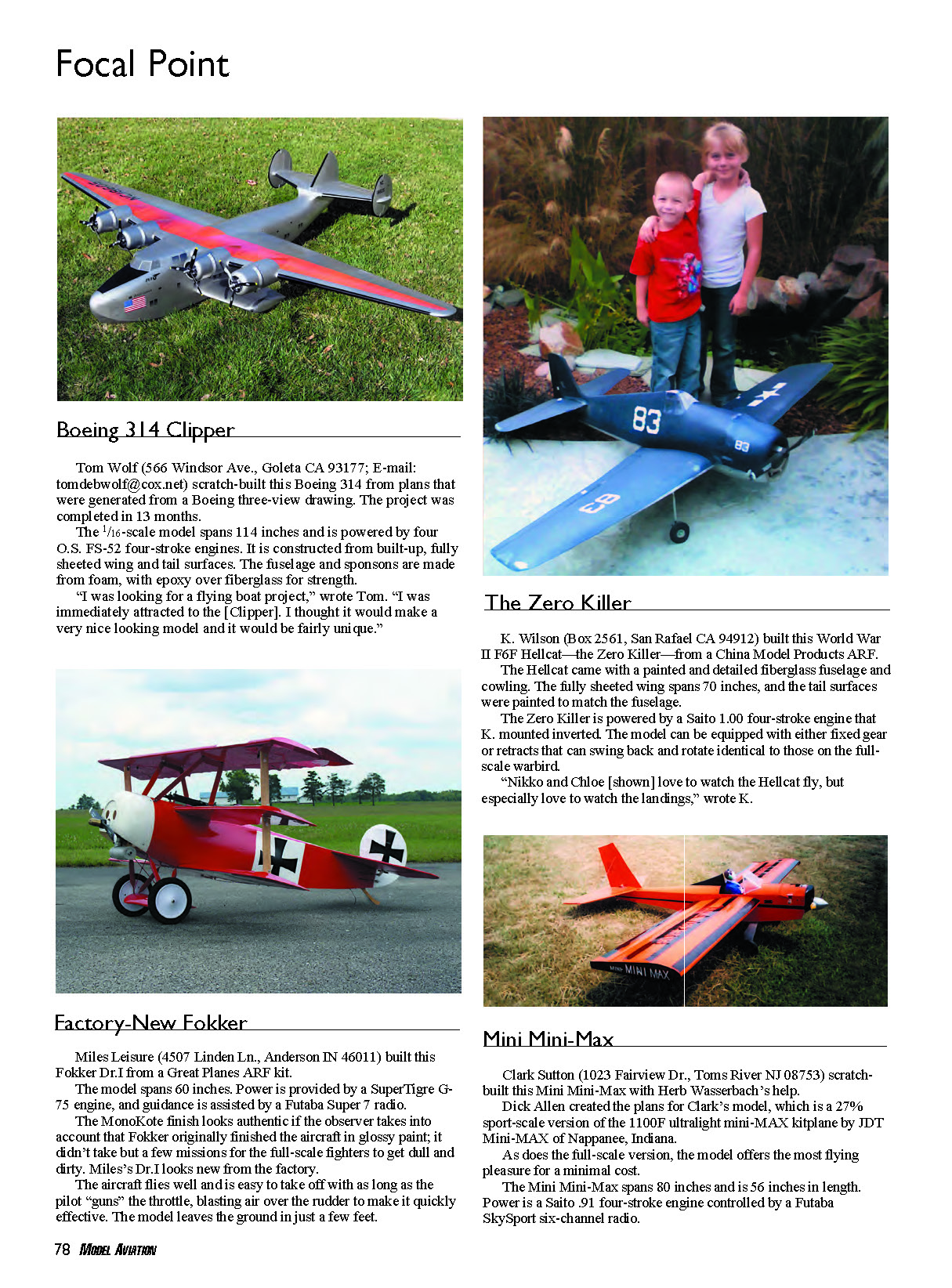
Tom Wolf (566 Windsor Ave., Goleta, CA 93177; E-mail: [email protected]) scratch-built this Boeing 314 from plans generated from a Boeing three-view drawing. The project was completed in 13 months.
The 1/16-scale model spans 114 inches and is powered by four O.S. FS-52 four-stroke engines. It is constructed from built-up, fully sheeted wing and tail surfaces. The fuselage and sponsons are made from foam with epoxy over fiberglass for strength.
“I was looking for a flying boat project,” wrote Tom. “I was immediately attracted to the Clipper. I thought it would make a very nice-looking model and it would be fairly unique.”
The Zero Killer
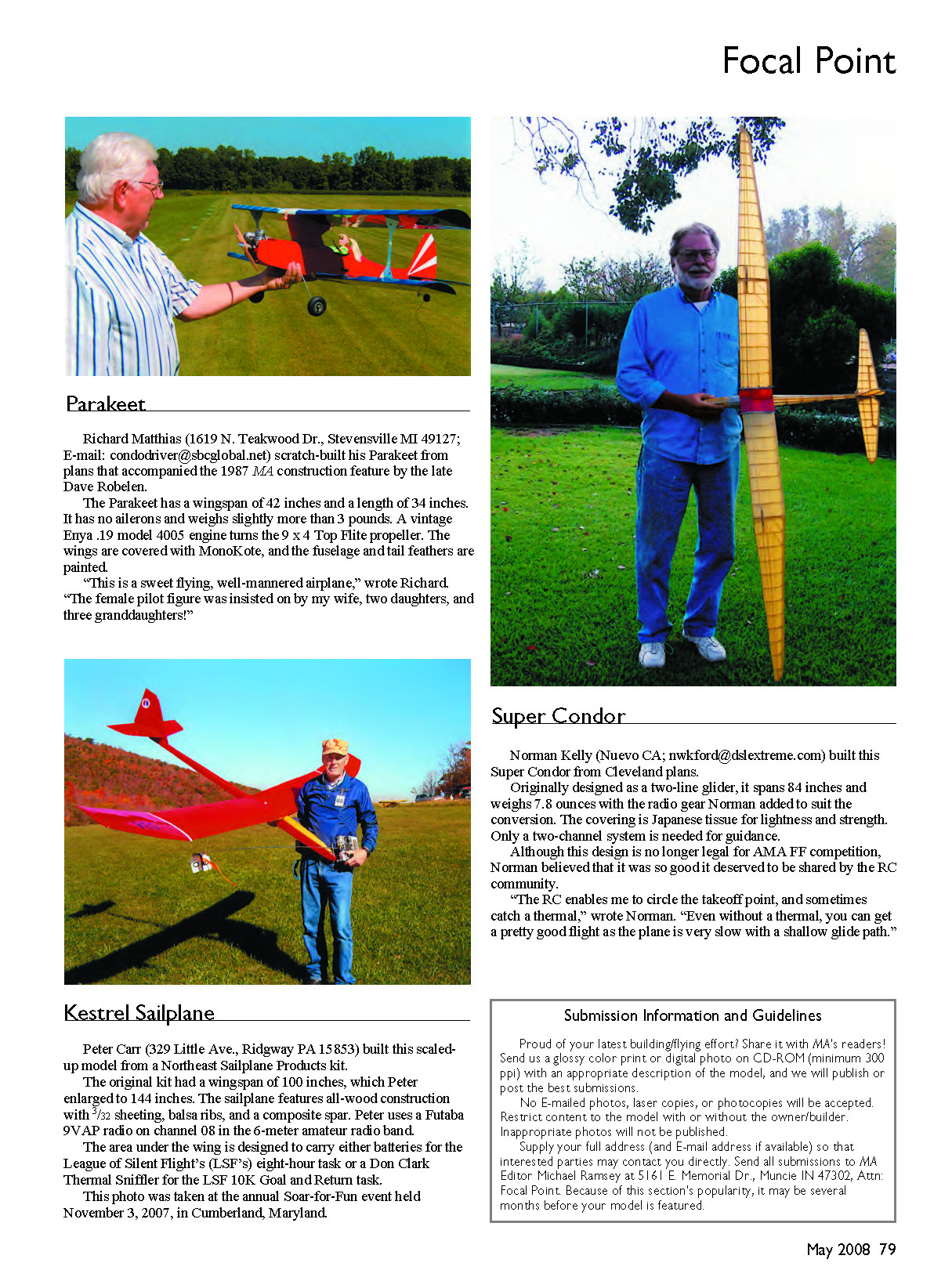
K. Wilson (Box 2561, San Rafael, CA 94912) built this World War II F6F Hellcat—the Zero Killer—from a China Model Products ARF.
The Hellcat came with a painted and detailed fiberglass fuselage and cowling. The fully sheeted wing spans 70 inches, and the tail surfaces were painted to match the fuselage.
The Zero Killer is powered by a Saito 1.00 four-stroke engine that K. Wilson mounted inverted. The model can be equipped with either fixed gear or retracts that swing back and rotate identical to those on the full-scale warbird.
“Nikko and Chloe [shown] love to watch the Hellcat fly, but especially love to watch the landings,” wrote K.
Factory-New Fokker
Miles Leisure (4507 Linden Ln., Anderson, IN 46011) built this Fokker Dr.I from a Great Planes ARF kit.
The model spans 60 inches. Power is provided by a SuperTigre G-75 engine, and guidance is assisted by a Futaba Super 7 radio.
The MonoKote finish looks authentic if the observer takes into account that Fokker originally finished the aircraft in glossy paint; it didn’t take but a few missions for the full-scale fighters to get dull and dirty. Miles’s Dr.I looks new from the factory.
The aircraft flies well and is easy to take off with as long as the pilot “guns” the throttle, blasting air over the rudder to make it quickly effective. The model leaves the ground in just a few feet.
Mini Mini-Max
Clark Sutton (1023 Fairview Dr., Toms River, NJ 08753) scratch-built this Mini Mini-Max with Herb Wasserbach’s help.
Dick Allen created the plans for Clark’s model, which is a 27% sport-scale version of the 1100F ultralight mini-MAX kitplane by JDT Mini-MAX of Nappanee, Indiana.
As does the full-scale version, the model offers the most flying pleasure for a minimal cost.
The Mini Mini-Max spans 80 inches and is 56 inches in length. Power is a Saito .91 four-stroke engine controlled by a Futaba SkySport six-channel radio.
Parakeet
Richard Matthias (1619 N. Teakwood Dr., Stevensville, MI 49127; E-mail: [email protected]) scratch-built his Parakeet from plans that accompanied the 1987 MA construction feature by the late Dave Robelen.
The Parakeet has a wingspan of 42 inches and a length of 34 inches. It has no ailerons and weighs slightly more than 3 pounds. A vintage Enya .19 model 4005 engine turns a 9 x 4 Top Flite propeller. The wings are covered with MonoKote, and the fuselage and tail feathers are painted.
"This is a sweet flying, well-mannered airplane," wrote Richard. "The female pilot figure was insisted on by my wife, two daughters, and three granddaughters!"
Super Condor
Norman Kelly (Nuevo, CA; [email protected]) built this Super Condor from Cleveland plans.
Originally designed as a two-line glider, it spans 84 inches and weighs 7.8 ounces with the radio gear Norman added to suit the conversion. The covering is Japanese tissue for lightness and strength. Only a two-channel system is needed for guidance.
Although this design is no longer legal for AMA FF competition, Norman believed it was so good it deserved to be shared with the RC community.
"The RC enables me to circle the takeoff point, and sometimes catch a thermal," wrote Norman. "Even without a thermal, you can get a pretty good flight as the plane is very slow with a shallow glide path."
Kestrel Sailplane
Peter Carr (329 Little Ave., Ridgway, PA 15853) built this scaled-up model from a Northeast Sailplane Products kit.
The original kit had a wingspan of 100 inches, which Peter enlarged to 144 inches. The sailplane features all-wood construction with 3/32" sheeting, balsa ribs, and a composite spar. Peter uses a Futaba 9VAP radio on channel 08 in the 6-meter amateur radio band.
The area under the wing is designed to carry either batteries for the League of Silent Flight's (LSF) eight-hour task or a Don Clark Thermal Sniffer for the LSF 10K Goal and Return task.
This photo was taken at the annual Soar-for-Fun event held November 3, 2007, in Cumberland, Maryland.
Transcribed from original scans by AI. Minor OCR errors may remain.

