
Focal Point - 2005/02
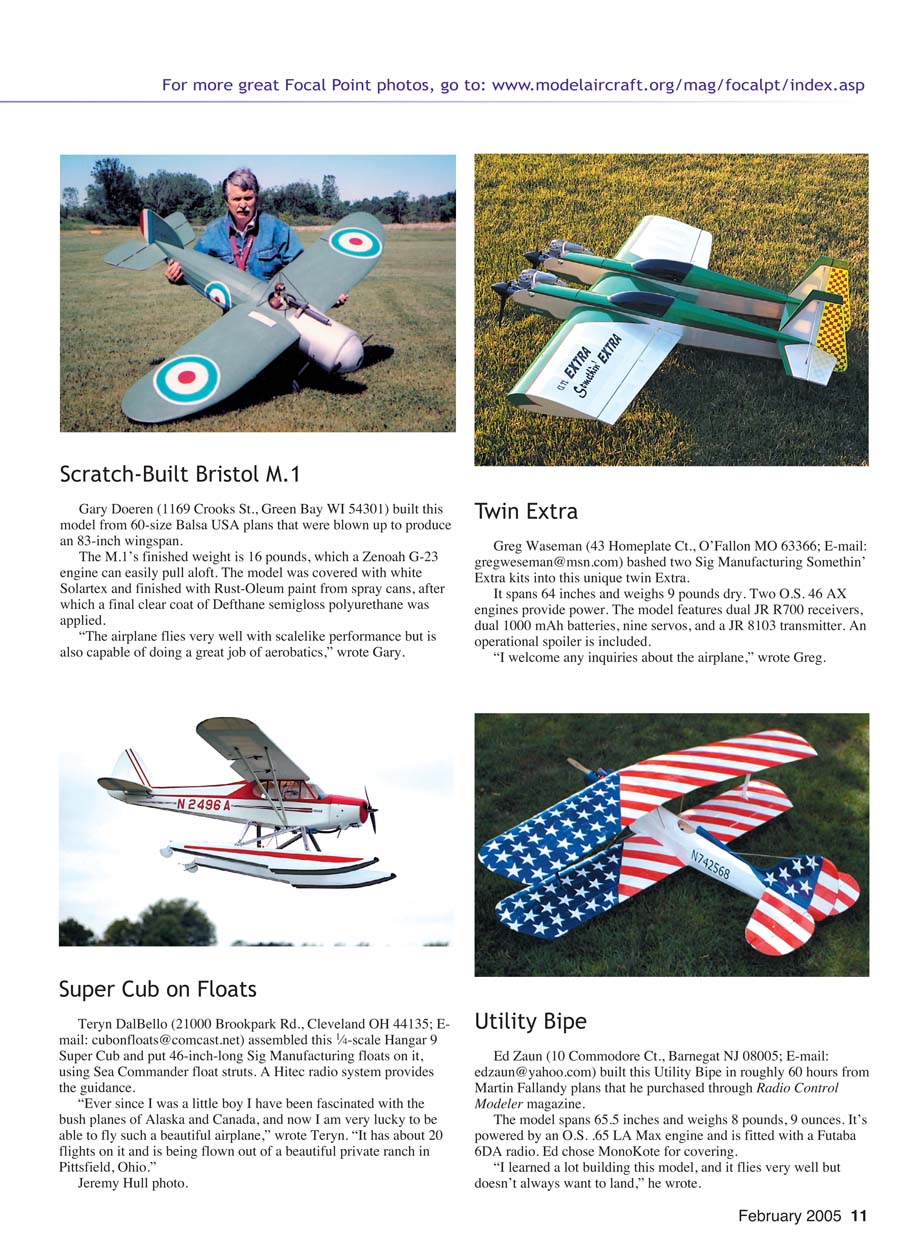
Super Sportster Plus
Scott Durham (1701 Debbie Dr., Plano, TX 75074; E-mail: [email protected]) built this oversized Super Sportster from plans that Bob Stutes enlarged from the 90 to the 120 version.
The model spans 84 inches and is powered by a Brison 2.4 engine. The finished weight is 18.5 pounds. The radio system is a JR transmitter and receiver with six Hitec servos.
The Sportster is covered with MonoKote. The wheel pants and the cowling are painted with LustreKote.
"The aircraft flies just as great as the smaller Super Sportsters; it's just bigger," wrote Scott.
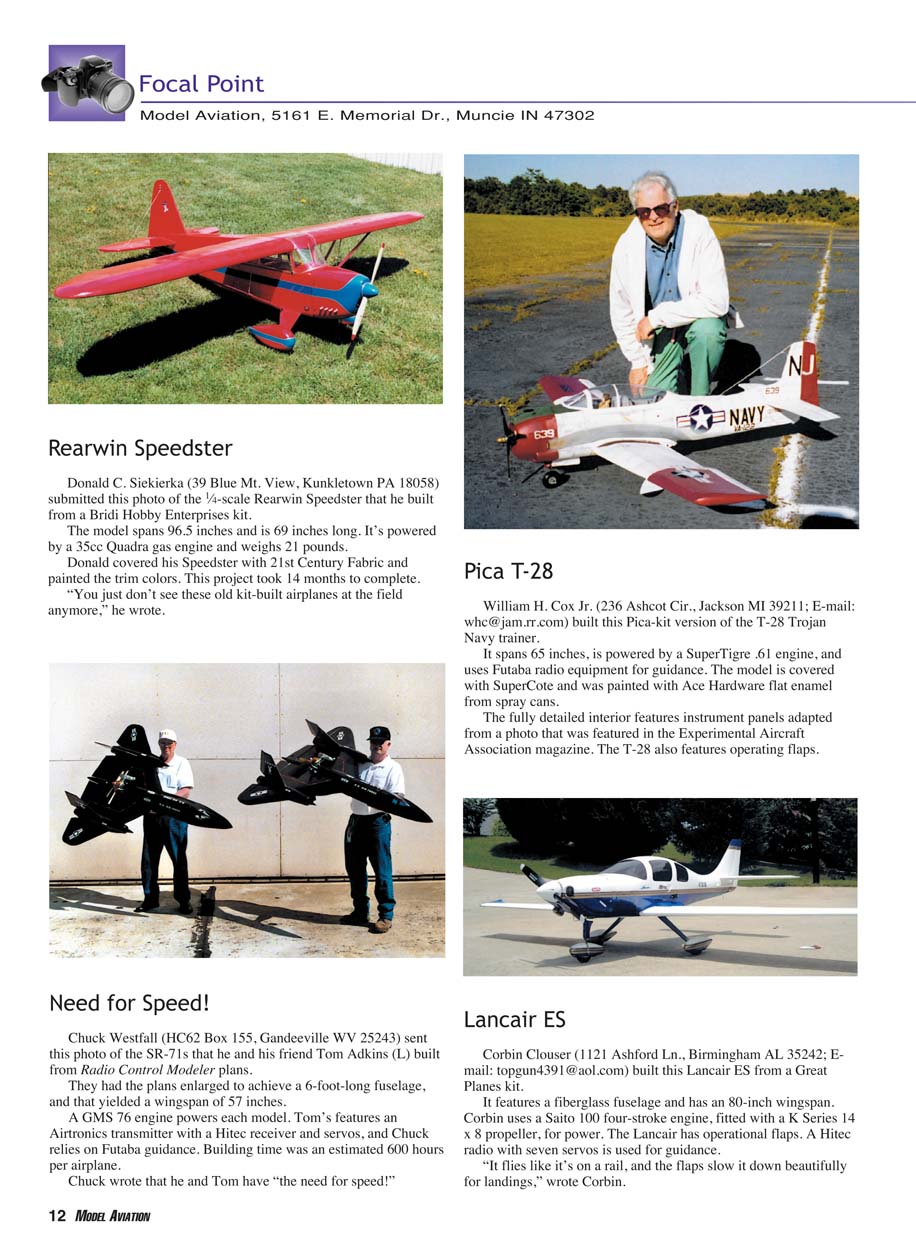
Fokker D.VI
James W. Mize (1318 Brindwood Ln. SE, Decatur, AL 35601; E-mail: [email protected]) built this Fokker D.VI from plans he developed from a scaled-up three-view that was published in the book Fighter Aircraft of the 1914–1918 War.
The aircraft is scaled 2 inches to the foot, yielding a 1/6-scale model. It spans 50 inches and features a scale undercambered airfoil. A Saito 56 four-stroke engine powers it.
Construction is spruce, balsa, and plywood, and the model is covered with Sig Koverall fabric. The camouflage pattern was developed on a computer and then printed onto the Koverall.
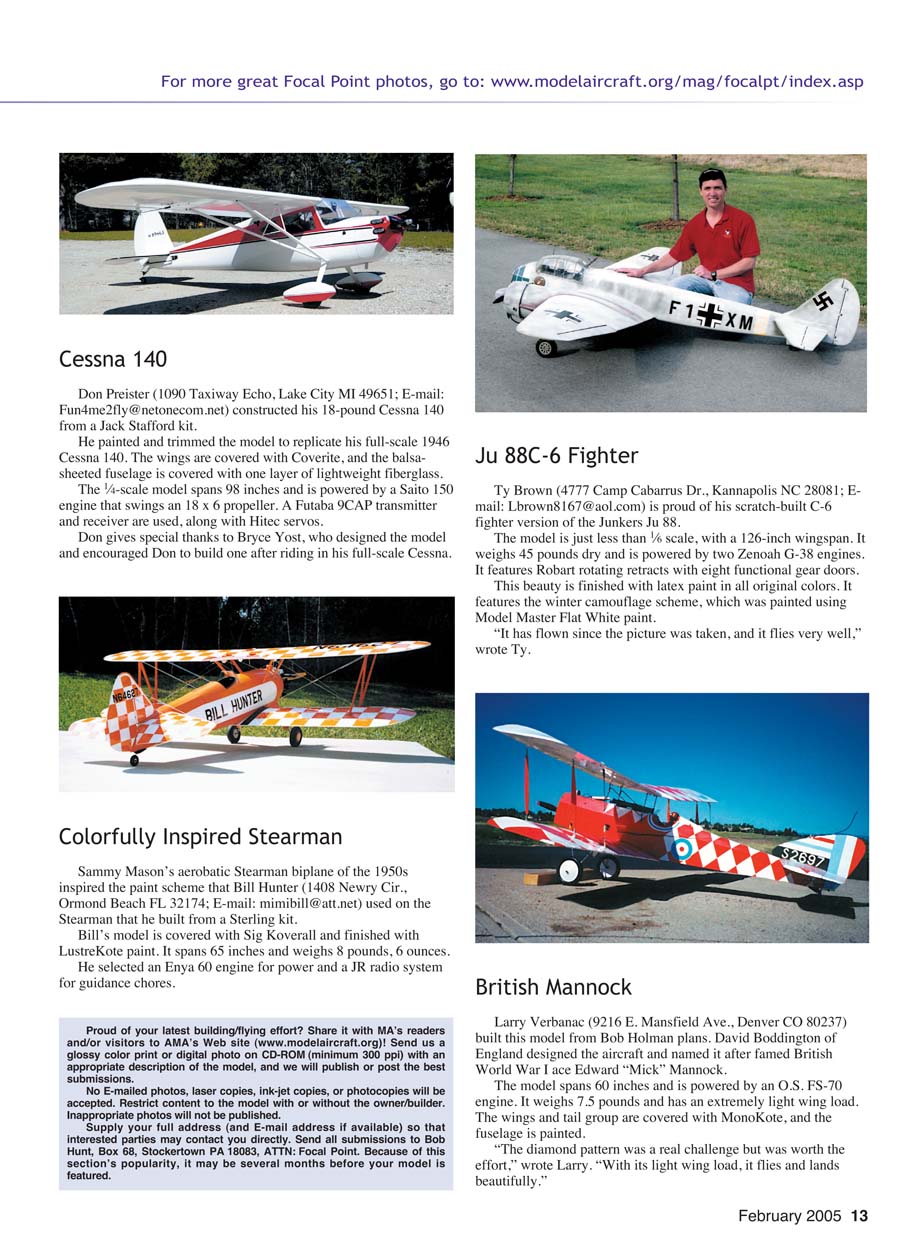
Mirage? Humbug!
Mark Wasilow (291 Santa Barbara, Irvine, CA 92606; E-mail: [email protected]) designed and built this model that he calls a "Mirage." His starting point was the Bob Baron CL Stunt Humbug design.
The Mirage features a 52-inch-span, sheeted-foam wing. It weighs 4.25 pounds dry and, according to Mark, flies 150-plus mph. An O.S. SX-50 engine fitted with an Ultrathrust racing muffler provides power, and a Hitec radio system handles control duties.
"The Mirage is very docile in slow flight and lands like a trainer," wrote Mark. "It can hold knife-edge flight from one end of the field to the other."
Hovering WildKatz
Jim Katz (616 Stratfordshire Dr., Matthews, NC 28105; E-mail: [email protected]) designed this F-4F Wildkatz 3-D airplane roughly 10 years ago, but he only recently built it about two years ago.
It spans 48 inches and has 785 square inches of wing area. An O.S. .46 FX engine fitted with an Ultrathrust muffler powers the 5-pound model.
The all-balsa airplane features MonoKote-covered wing and tail assemblies and a fuselage finished with PPG Deltron paints. Jim offers plans and instructions for this model.
"As you can see, hovering is no problem," he wrote.
Scratch-Built Bristol M.1
Gary Doeren (1169 Crooks St., Green Bay, WI 54301) built this model from 60-size Balsa USA plans that were enlarged to produce an 83-inch wingspan.
The M.1's finished weight is 16 pounds, which a Zenoah G-23 engine can easily pull aloft. The model was covered with white Solartex and finished with Rust-Oleum spray paints, after which a final clear coat of Deftone semigloss polyurethane was applied.
"The airplane flies very well with scalelike performance but is also capable of doing a great job of aerobatics," wrote Gary.
Twin Extra
Greg Waseman (43 Homeplate Ct., O'Fallon, MO 63366; E-mail: [email protected]) bashed two Sig Manufacturing Somethin' Extra kits into this unique twin Extra.
It spans 64 inches and weighs 9 pounds dry. Two O.S. 46 AX engines provide power. The model features dual JR R700 receivers, dual 1000 mAh batteries, nine servos, and a JR 8103 transmitter. An operational spoiler is included.
"I welcome any inquiries about the airplane," wrote Greg.
Super Cub on Floats
Teryn DalBello (21000 Brookpark Rd., Cleveland, OH 44135; E-mail: [email protected]) assembled this 1/4-scale Hangar 9 Super Cub and fitted 46-inch-long Sig Manufacturing floats using Sea Commander float struts. A Hitec radio system provides the guidance.
"Ever since I was a little boy I have been fascinated with the bush planes of Alaska and Canada, and now I am very lucky to be able to fly such a beautiful airplane," wrote Teryn. "It has about 20 flights on it and is being flown out of a beautiful private ranch in Pittsfield, Ohio."
Utility Bipe
Ed Zaun (10 Commodore Ct., Barnegat, NJ 08005; E-mail: [email protected]) built this Utility Bipe in roughly 60 hours from Martin Falandny plans that he purchased through Radio Control Modeler magazine.
The model spans 65.5 inches and weighs 8 pounds, 9 ounces. It's powered by an O.S. .65 LA Max engine and is fitted with a Futaba 6DA radio. Ed chose MonoKote for covering.
"I learned a lot building this model, and it flies very well but doesn't always want to land," he wrote.
Rearwin Speedster
Donald C. Siekierka (39 Blue Mt. View, Kunkletown, PA 18058) submitted this photo of the 1/4-scale Rearwin Speedster that he built from a Bridi Hobby Enterprises kit.
The model spans 96.5 inches and is 69 inches long. It's powered by a 35cc Quadra gas engine and weighs 21 pounds.
Donald covered his Speedster with 21st Century fabric and painted the trim colors. This project took 14 months to complete.
"You just don't see these old kit-built airplanes at the field anymore," he wrote.
Pica T-28
William H. Cox Jr. (236 Ashcot Cir., Jackson, MI 39211; E-mail: [email protected]) built this Pica-kit version of the T-28 Trojan Navy trainer.
It spans 65 inches, is powered by a SuperTigre .61 engine, and uses Futaba radio equipment for guidance. The model is covered with SuperCote and was painted with Ace Hardware flat enamel from spray cans.
The fully detailed interior features instrument panels adapted from a photo that was featured in the Experimental Aircraft Association magazine. The T-28 also features operating flaps.
Need for Speed!
Chuck Westfall (HC 62 Box 155, Gandeeville, WV 25243) sent this photo of the SR-71s that he and his friend Tom Adkins (left) built from Radio Control Modeler plans.
They had the plans enlarged to achieve a 6-foot-long fuselage, which yielded a wingspan of 57 inches.
A GMS 76 engine powers each model. Tom's features an Airtronics transmitter with a Hitec receiver and servos, and Chuck relies on Futaba guidance. Building time was an estimated 600 hours per airplane.
Chuck wrote that he and Tom have "the need for speed!"
Lancair ES
Corbin Clouser (1121 Ashford Ln., Birmingham, AL 35242; E-mail: [email protected]) built this Lancair ES from a Great Planes kit.
It features a fiberglass fuselage and has an 80-inch wingspan. Corbin uses a Saito 100 four-stroke engine, fitted with a K Series 14x8 propeller, for power. The Lancair has operational flaps. A Hitec radio with seven servos is used for guidance.
"It flies like it's on a rail, and the flaps slow it down beautifully for landings," wrote Corbin.
Cessna 140
Don Preister (1090 Taxiway Echo, Lake City, MI 49651; E-mail: [email protected]) constructed his 18-pound Cessna 140 from a Jack Stafford kit.
He painted and trimmed the model to replicate his full-scale 1946 Cessna 140. The wings are covered with Coverite, and the balsa-sheeted fuselage is covered with one layer of lightweight fiberglass.
The 1/4-scale model spans 98 inches and is powered by a Saito 150 engine that swings an 18 x 6 propeller. A Futaba 9CAP transmitter and receiver are used, along with Hitec servos.
Don gives special thanks to Bryce Yost, who designed the model and encouraged Don to build one after riding in his full-scale Cessna.
Ju 88C-6 Fighter
Ty Brown (4777 Camp Cabarrus Dr., Kannapolis, NC 28081; E-mail: [email protected]) is proud of his scratch-built C-6 fighter version of the Junkers Ju 88.
The model is just under 1/6 scale, with a 126-inch wingspan. It weighs 45 pounds dry and is powered by two Zenoah G-38 engines. It features Robart rotating retracts with eight functional gear doors.
This beauty is finished with latex paint in all original colors. It features the winter camouflage scheme, which was applied using Model Master Flat White paint.
"It has flown since the picture was taken, and it flies very well," wrote Ty.
Colorfully Inspired Stearman
Bill Hunter (1408 Newry Cir., Ormond Beach, FL 32174; E-mail: [email protected]) used the paint scheme inspired by Sammy Mason's aerobatic Stearman biplane of the 1950s on the Stearman that he built from a Sterling kit.
Bill's model is covered with Sig Koverall and finished with LustreKote paint. It spans 65 inches and weighs 8 pounds, 6 ounces.
He selected an Enya 60 engine for power and a JR radio system for guidance chores.
British Mannock
Larry Brown (9216 E. Mansfield Ave., Denver, CO 80237) built this model from Bob Holman plans. David Boddington of England designed the aircraft and named it after famed British World War I ace Edward "Mick" Mannock.
The model spans 60 inches and is powered by an O.S. FS-70 engine. It weighs 7.5 pounds and has an extremely light nose.
The wings and tail group are covered with MonoKote, and the fuselage is painted.
"The diamond pattern was a real challenge but was worth the effort," wrote Larry. "With its light wing load, it flies and lands beautifully."
Transcribed from original scans by AI. Minor OCR errors may remain.

