
Focal Point
Model Aviation, 5161 E. Memorial Dr., Muncie IN 47302
Tribute to the "Intimidator"
NASCAR fan and aeromodeler Randall Stamper (7224 W. Hinsdale Dr., Littleton CO 80128; E-mail: [email protected]) built this sporty Great Planes Super Skybolt and finished it in the colors of the Intimidator, Dale Earnhardt.
Randall used Black and Aluminum MonoKote to achieve this scheme. He obtained the graphics from a 1/10-scale RC race-car kit. An O.S. 120 four-stroke engine provides the power.
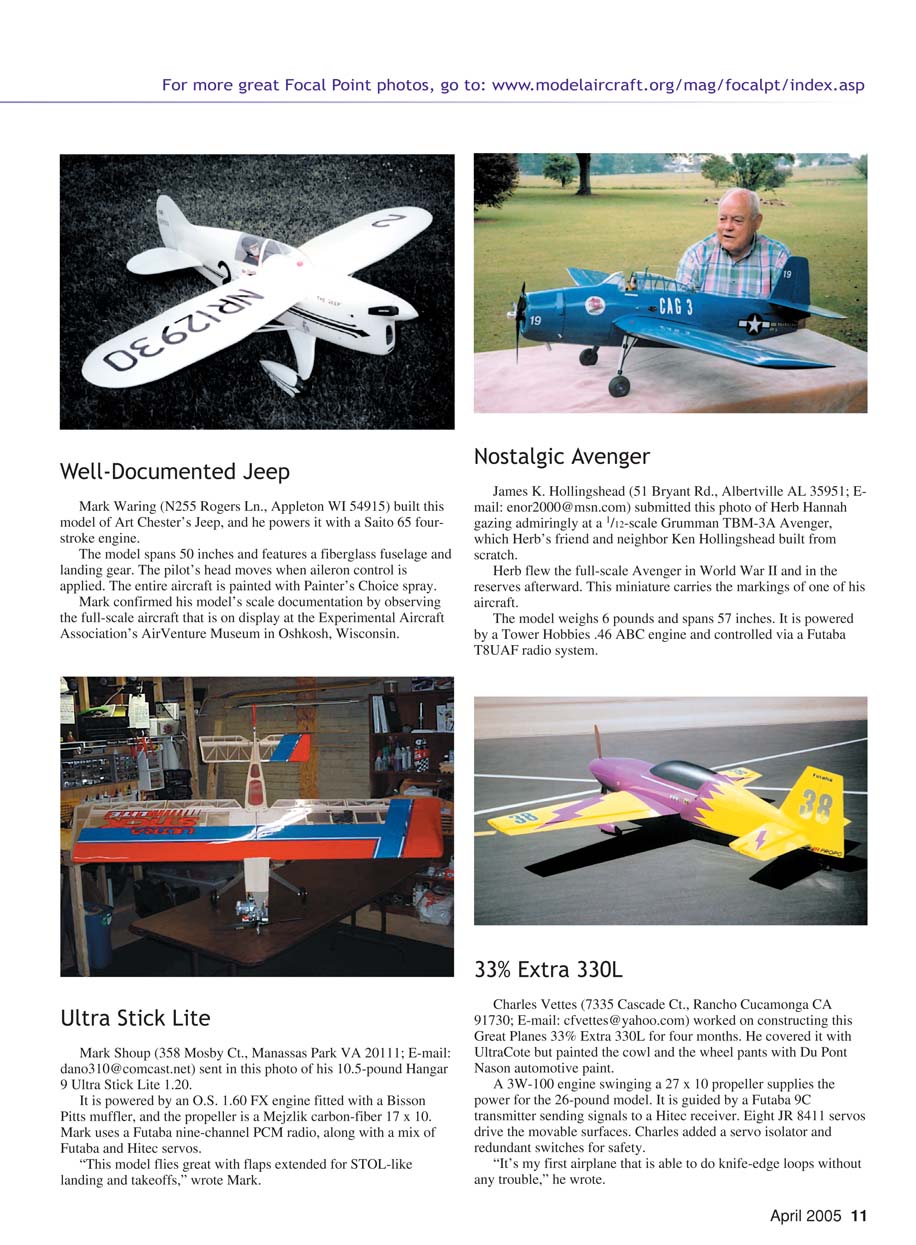
Curtiss-Wright CW-1
Fred M. Welsh (1308 Edgewood, Richardson TX 75081) completed this 1/6-scale Curtiss-Wright Junior in the spring of 2004. He built it from plans drawn by Ralph Fidance and published in the May 1974 Model Builder magazine.
The model weighs 6.5 pounds, spans 76 inches, and is powered by an O.S. FS-40 four-stroke engine. Fred covered this airplane with MonoKote and fabricated two false Wright J-5 cylinders to fit around the model engine, simulating the three-cylinder prototype power plant.
"Critical for takeoffs is the positive 4.1 degrees of engine incidence," he wrote. "Without it, the aircraft will not rotate from a high-speed taxi."
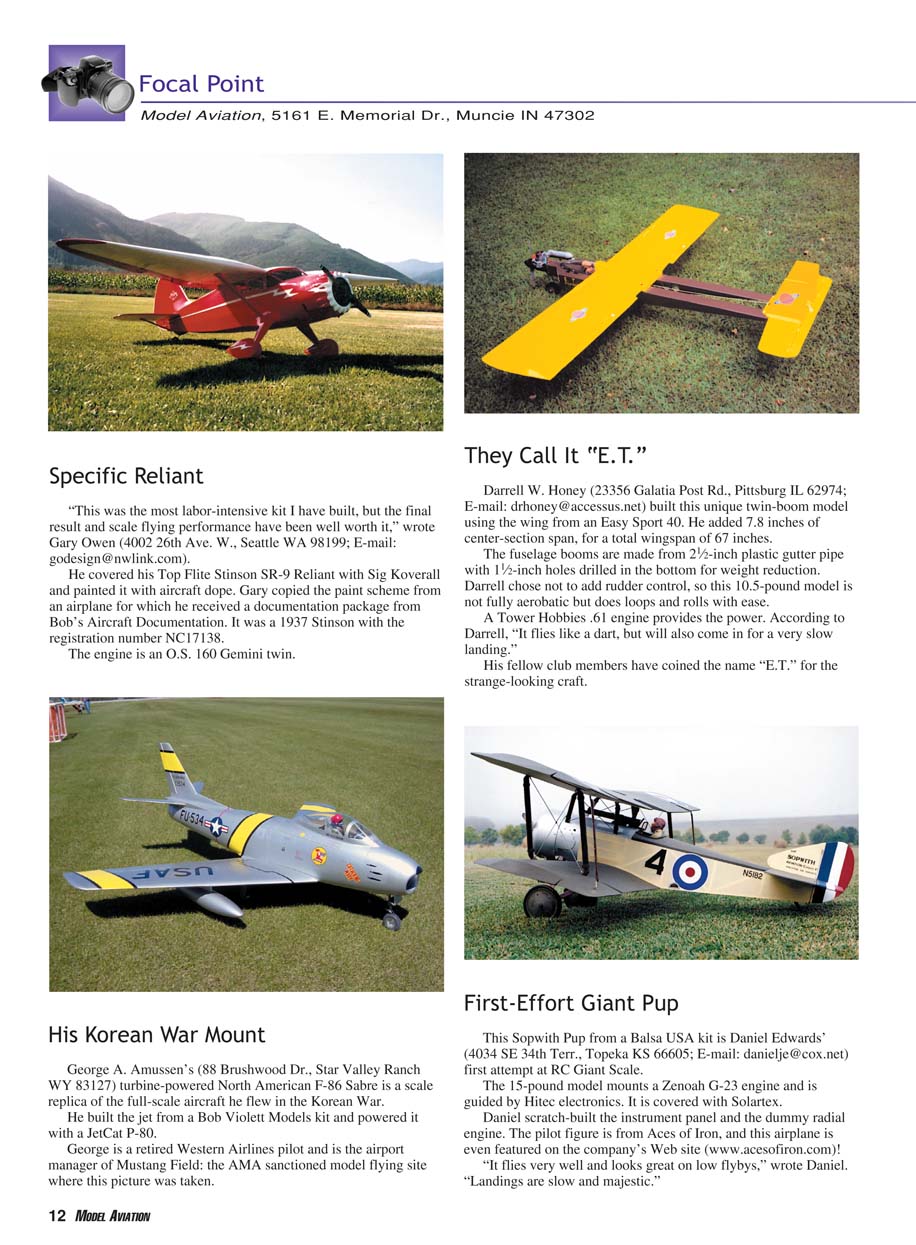
Kikker Bipe
Harry Claywell (340 W. State, Good Hope IL 61438) wanted a biplane but couldn't justify the cost of a kit, so he designed his own.
He constructed his original Kikker from balsa and plywood; it weighs 5 pounds, 13 ounces. The top wing spans 45 inches and the bottom wing is an inch shorter.
Harry used MonoKote to cover this colorful model, and the landing gear was salvaged from an ill-fated Sig Somethin' Extra. An O.S. .46 FX engine supplies the power.
"It turned out to be the nicest flying airplane in my fleet," wrote Harry.
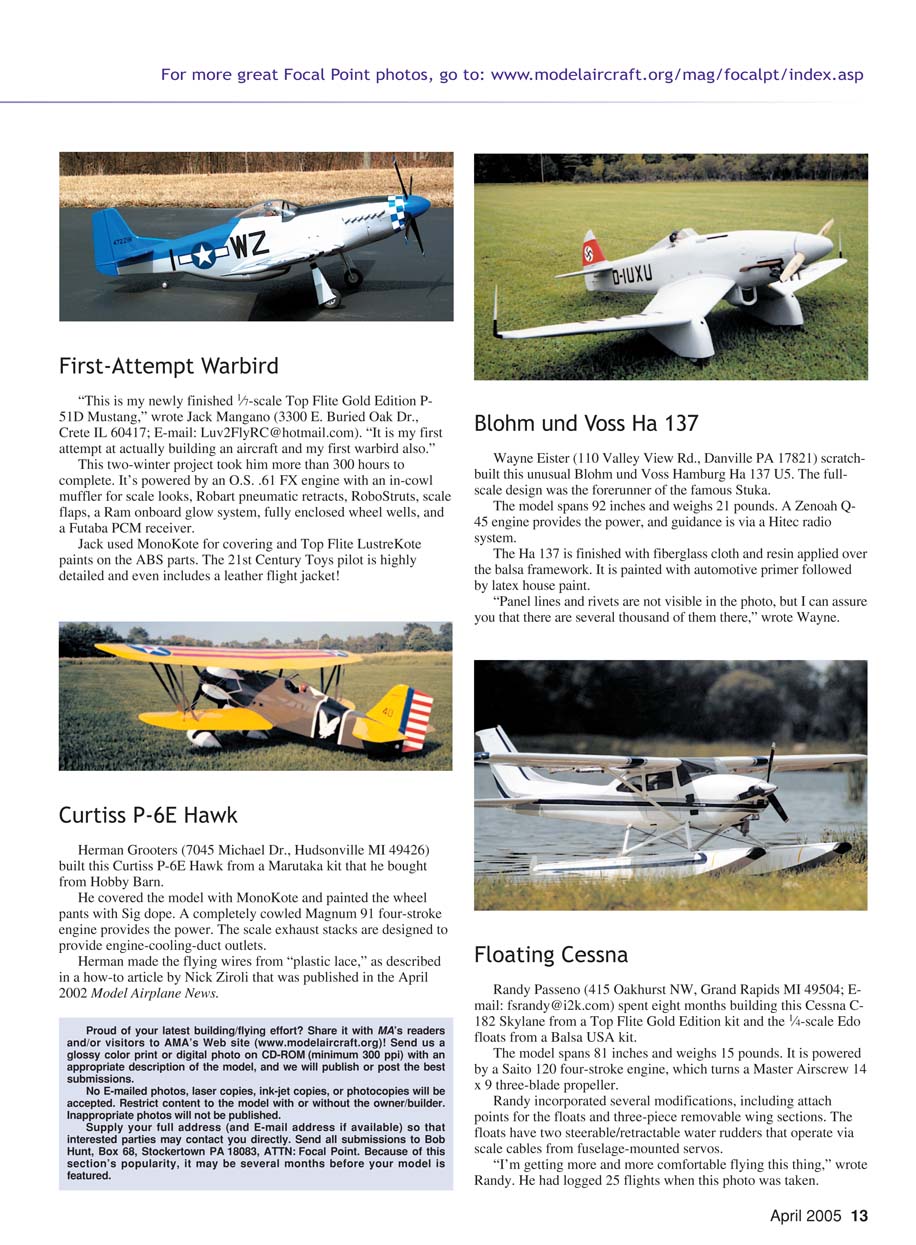
Hughes H-1 Racer
Greg Minden (4540 Vincente Ln., Las Vegas NV 89130) built his 1/5-scale Hughes H-1 from plans by Joe LeRoy.
The 77-inch-wingspan model is covered with Chrome UltraCote; Flite-Metal was used on the fiberglass cowl. It features Robart retracts and has a Moki 1.80 for power.
"It is very, very fast, just as a racer should be," wrote Greg.
Well-Documented Jeep
Mark Waring (N255 Rogers Ln., Appleton WI 54915) built this model of Art Chester's Jeep, and he powers it with a Saito 65 four-stroke engine.
The model spans 50 inches and features a fiberglass fuselage and landing gear. The pilot's head moves when aileron control is applied. The entire aircraft is painted with Painter's Choice spray.
Mark confirmed his model's scale documentation by observing the full-scale aircraft that is on display at the Experimental Aircraft Association's AirVenture Museum in Oshkosh, Wisconsin.
Nostalgic Avenger
James K. Hollingshead (51 Bryant Rd., Albertville AL 35951; E-mail: [email protected]) submitted this photo of Herb Hannah gazing admiringly at a 1/12-scale Grumman TBM-3A Avenger, which Herb's friend and neighbor Ken Hollingshead built from scratch.
Herb flew the full-scale Avenger in World War II and in the reserves afterward. This miniature carries the markings of one of his aircraft.
The model weighs 6 pounds and spans 57 inches. It is powered by a Tower Hobbies .46 ABC engine and controlled via a Futaba T8UAF radio system.
Ultra Stick Lite
Mark Shoup (358 Mosby Ct., Manassas Park VA 20111; E-mail: [email protected]) sent in this photo of his 10.5-pound Hangar 9 Ultra Stick Lite 1.20.
It is powered by an O.S. 1.60 FX engine fitted with a Bisson Pitts muffler, and the propeller is a Mejzlik carbon-fiber 17 x 10. Mark uses a Futaba nine-channel PCM radio, along with a mix of Futaba and Hitec servos.
"This model flies great with flaps extended for STOL-like landings and takeoffs," wrote Mark.
33% Extra 330L
Charles Vettes (7335 Cascade Ct., Rancho Cucamonga CA 91730; E-mail: [email protected]) worked on constructing this Great Planes 33% Extra 330L for four months. He covered it with UltraCote but painted the cowl and the wheel pants with DuPont Nason automotive paint.
A 3W-100 engine swinging a 27 x 10 propeller supplies the power for the 26-pound model. It is guided by a Futaba 9C transmitter sending signals to a Hitec receiver. Eight JR 8411 servos drive the movable surfaces. Charles added a servo isolator and redundant switches for safety.
"It's my first airplane that is able to do knife-edge loops without any trouble," he wrote.
Focal Point
Specific Reliant
"This was the most labor-intensive kit I have built, but the final result and scale flying performance have been well worth it," wrote Gary Owen (4002 26th Ave. W., Seattle WA 98199; E-mail: [email protected]).
He covered his Top Flite Stinson SR-9 Reliant with Sig Koverall and painted it with aircraft dope. Gary copied the paint scheme from an airplane for which he received a documentation package from Bob’s Aircraft Documentation. It was a 1937 Stinson with the registration number NC7138.
The engine is an O.S. 160 Gemini twin.
They Call It "E.T."
Darrell W. Honey (23356 Galatia Post Rd., Pittsburg IL 62974; E-mail: [email protected]) built this unique twin-boom model using the wing from an Easy Sport 40. He added 7.8 inches of center-section span, for a total wingspan of 67 inches.
The fuselage booms are made from 2½-inch plastic gutter pipe with 1½-inch holes drilled in the bottom for weight reduction. Darrell chose not to add rudder control, so this 10.5-pound model is not fully aerobatic but does loops and rolls with ease.
A Tower Hobbies .61 engine provides the power. According to Darrell, "It flies like a dart, but will also come in for a very slow landing."
His fellow club members have coined the name "E.T." for the strange-looking craft.
His Korean War Mount
George A. Amussen (88 Brushwood Dr., Star Valley Ranch WY 83127) built a turbine-powered North American F-86 Sabre that is a scale replica of the full-scale aircraft he flew in the Korean War.
He built the jet from a Bob Violett Models kit and powered it with a JetCat P-80.
George is a retired Western Airlines pilot and is the airport manager of Mustang Field, the AMA-sanctioned model flying site where this picture was taken.
First-Effort Giant Pup
This Sopwith Pup from a Balsa USA kit is Daniel Edwards’ (4034 SE 34th Terr., Topeka KS 66605; E-mail: [email protected]) first attempt at RC Giant Scale.
The 15-pound model mounts a Zenoah G-23 engine and is guided by Hitec electronics. It is covered with Solartex.
Daniel scratch-built the instrument panel and the dummy radial engine. The pilot figure is from Aces of Iron, and this airplane is even featured on the company’s website (www.acesofiron.com).
"It flies very well and looks great on low flybys," wrote Daniel. "Landings are slow and majestic."
First-Attempt Warbird
"This is my newly finished 1/2-scale Top Flite Gold Edition P-51D Mustang," wrote Jack Mangano (3300 E. Buried Oak Dr., Crete IL 60417; E-mail: [email protected]). "It is my first attempt at actually building an aircraft and my first warbird also."
This two-winter project took him more than 300 hours to complete. It’s powered by an O.S. .61 FX engine with an in-cowl muffler for scale looks, Robart pneumatic retracts, RoboStruts, scale flaps, a Ram onboard glow system, fully enclosed wheel wells, and a Futaba PCM receiver.
Jack used MonoKote for covering and Top Flite LustreKote paints on the ABS parts. The 21st Century Toys pilot is highly detailed and even includes a leather flight jacket!
Blohm und Voss Ha 137
Wayne Eister (110 Valley View Rd., Danville PA 17821) scratch-built this unusual Blohm und Voss Hamburg Ha 137 U5. The full-scale design was the forerunner of the famous Stuka.
The model spans 92 inches and weighs 21 pounds. A Zenoah Q-45 engine provides the power, and guidance is via a Hitec radio system.
The Ha 137 is finished with fiberglass cloth and resin applied over the balsa framework. It is painted with automotive primer followed by latex house paint.
"Panel lines and rivets are not visible in the photo, but I can assure you that there are several thousand of them there," wrote Wayne.
Curtiss P-6E Hawk
Herman Grooters (7045 Michael Dr., Hudsonville MI 49426) built this Curtiss P-6E Hawk from a Marutaka kit that he bought from Hobby Barn.
He covered the model with MonoKote and painted the wheel pants with Sig dope. A completely cowled Magnum 91 four-stroke engine provides the power. The scale exhaust stacks are designed to provide engine-cooling-duct outlets.
Herman made the flying wires from "plastic lace," as described in a how-to article by Nick Ziroli that was published in the April 2002 Model Airplane News.
Floating Cessna
Randy Passeno (415 Oakhurst NW, Grand Rapids MI 49504; E-mail: [email protected]) spent eight months building this Cessna C-182 Skylane from a Top Flite Gold Edition kit and the 1/4-scale Edo floats from a Balsa USA kit.
The model spans 81 inches and weighs 15 pounds. It is powered by a Saito 120 four-stroke engine, which turns a Master Airscrew 14 x 9 three-blade propeller.
Randy incorporated several modifications, including attach points for the floats and three-piece removable wing sections. The floats have two steerable/retractable water rudders that operate via scale cables from fuselage-mounted servos.
"I’m getting more and more comfortable flying this thing," wrote Randy. He had logged 25 flights when this photo was taken.
Transcribed from original scans by AI. Minor OCR errors may remain.

