
Focal Point
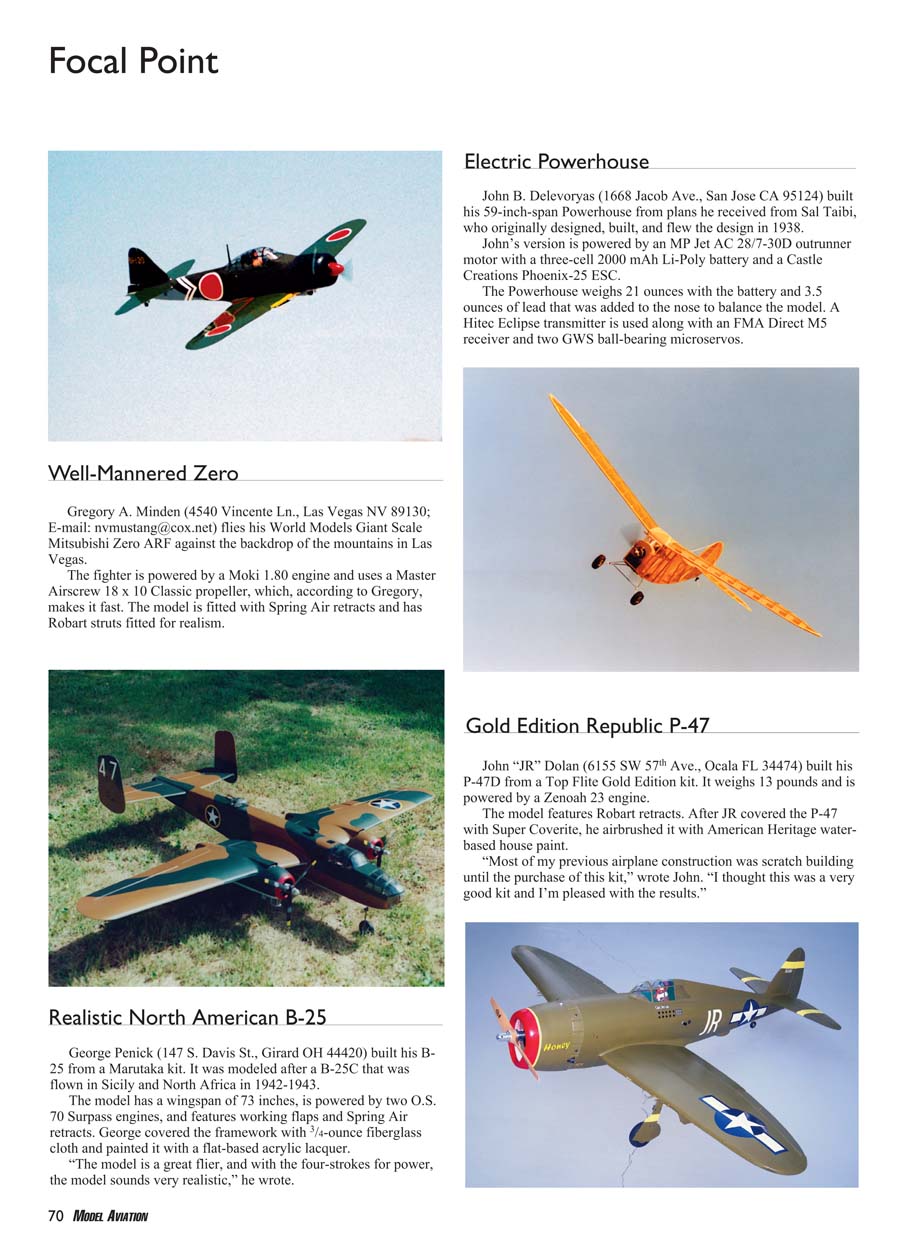
Well-Mannered Zero
Gregory A. Minden (4540 Vincente Ln., Las Vegas, NV 89130; E-mail: [email protected]) flies his World Models Giant Scale Mitsubishi Zero ARF against the backdrop of the mountains in Las Vegas.
The fighter is powered by a Moki 1.80 engine and uses a Master Airscrew 18x10 Classic propeller, which, according to Gregory, makes it fast. The model is fitted with Spring Air retracts and has Robart struts fitted for realism.
Electric Powerhouse
John B. Delevoryas (1668 Jacob Ave., San Jose, CA 95124) built his 59-inch-span Powerhouse from plans he received from Sal Taibi, who originally designed, built, and flew the design in 1938.
John's version is powered by an MP Jet AC 28/7-30D outrunner motor with a three-cell 2000 mAh Li-Poly battery and a Castle Creations Phoenix-25 ESC.
The Powerhouse weighs 21 ounces with the battery and has 3.5 ounces of lead added to the nose to balance the model. A Hitec Eclipse transmitter is used along with an FMA Direct M5 receiver and two GWS ball-bearing microservos.
Gold Edition Republic P-47
John "JR" Dolan (6155 SW 57th Ave., Ocala, FL 34474) built his P-47D from a Top Flite Gold Edition kit. It weighs 13 pounds and is powered by a Zenoah 23 engine.
The model features Robart retracts. After JR covered the P-47 with Super Coverite, he airbrushed it with American Heritage water-based house paint.
"Most of my previous airplane construction was scratch building until the purchase of this kit," wrote John. "I thought this was a very good kit and I'm pleased with the results."
Realistic North American B-25
George Penick (147 S. Davis St., Girard, OH 44420) built his B-25 from a Marutaka kit. It was modeled after a B-25C that was flown in Sicily and North Africa in 1942–1943.
The model has a wingspan of 73 inches, is powered by two O.S. 70 Surpass engines, and features working flaps and Spring Air retracts. George covered the framework with 3/4-ounce fiberglass cloth and painted it with a flat-based acrylic lacquer.
"The model is a great flier, and with the four-strokes for power, the model sounds very realistic," he wrote.
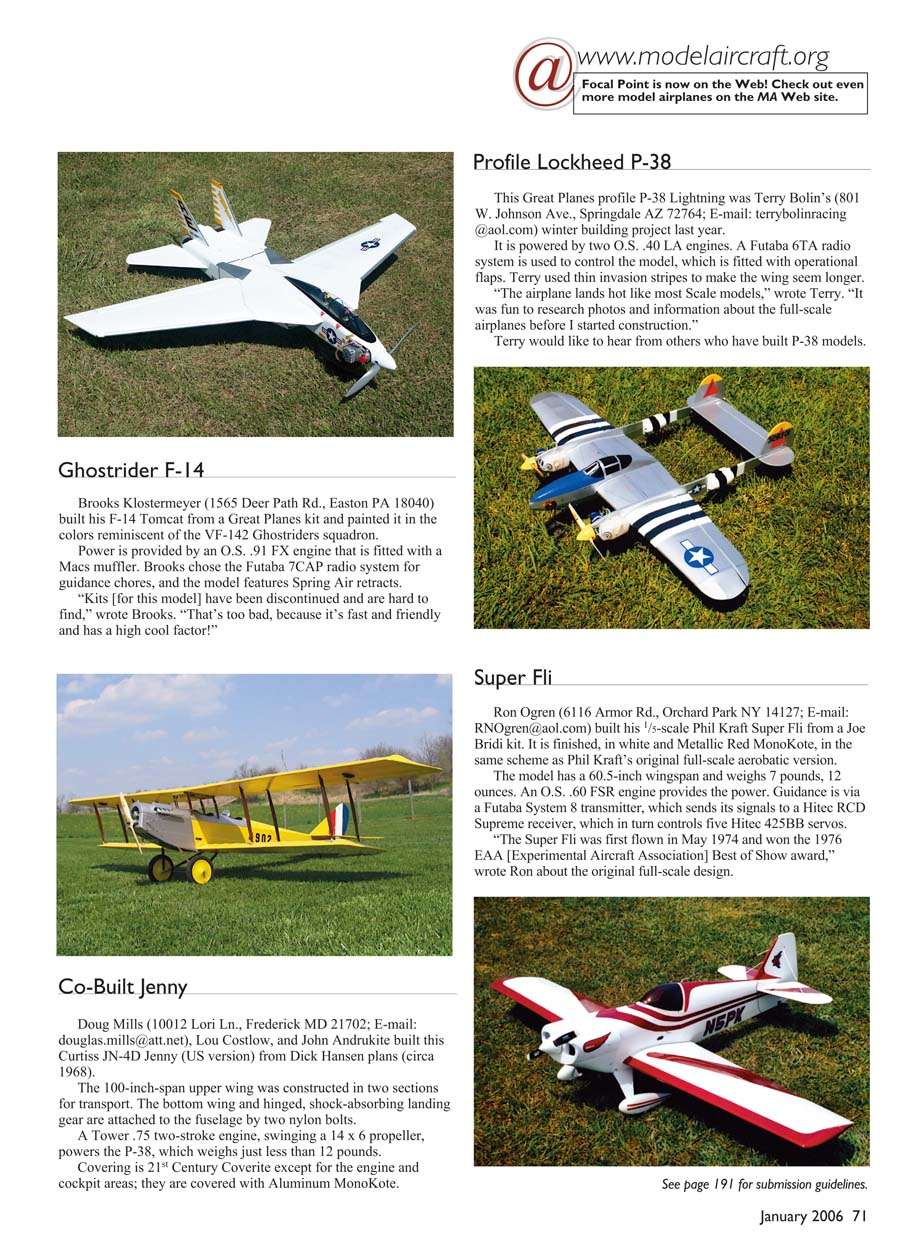
Ghostrider F-14
Brooks Klostermeyer (1565 Deer Path Rd., Easton, PA 18040) built his F-14 Tomcat from a Great Planes kit and painted it in colors reminiscent of the VF-142 Ghostriders squadron.
Power is provided by an O.S. .91 FX engine fitted with a Macs muffler. Brooks chose the Futaba 7CAP radio system for guidance chores, and the model features Spring Air retracts.
"Kits [for this model] have been discontinued and are hard to find," wrote Brooks. "That's too bad, because it's fast and friendly and has a high cool factor!"
Co-Built Jenny
Doug Mills (10012 Lori Ln., Frederick, MD 21702; E-mail: [email protected]), Lou Costlow, and John Andrukite built this Curtiss JN-4D Jenny (U.S. version) from Dick Hansen plans (circa 1968).
The 100-inch-span upper wing was constructed in two sections for transport. The bottom wing and hinged, shock-absorbing landing gear are attached to the fuselage by two nylon bolts.
A Tower .75 two-stroke engine, swinging a 14x6 propeller, powers the JN-4D, which weighs just under 12 pounds.
Covering is 21st Century Coverite except for the engine and cockpit areas; those are covered with Aluminum MonoKote.
Profile Lockheed P-38
This Great Planes profile P-38 Lightning was Terry Bolin’s (801 W. Johnson Ave., Springdale, AZ 72764; E-mail: [email protected]) winter building project last year.
It is powered by two O.S. .40 LA engines. A Futaba 6TA radio system is used to control the model, which is fitted with operational flaps. Terry used thin invasion stripes to make the wing seem longer.
"The airplane lands hot like most Scale models," wrote Terry. "It was fun to research photos and information about the full-scale airplanes before I started construction."
Terry would like to hear from others who have built P-38 models.
Super Fli
Ron Ogren (6116 Armor Rd., Orchard Park, NY 14127; E-mail: [email protected]) built his 1/5-scale Phil Kraft Super Fli from a Joe Bridi kit. It is finished in white and Metallic Red MonoKote, in the same scheme as Phil Kraft’s original full-scale aerobatic version.
The model has a 60.5-inch wingspan and weighs 7 pounds, 12 ounces. An O.S. .60 FSR engine provides the power. Guidance is via a Futaba System 8 transmitter, which sends its signals to a Hitec RCD Supreme receiver, which in turn controls five Hitec 425BB servos.
"The Super Fli was first flown in May 1974 and won the 1976 EAA [Experimental Aircraft Association] Best of Show award," wrote Ron about the original full-scale design.
Transcribed from original scans by AI. Minor OCR errors may remain.

