
Focal Point
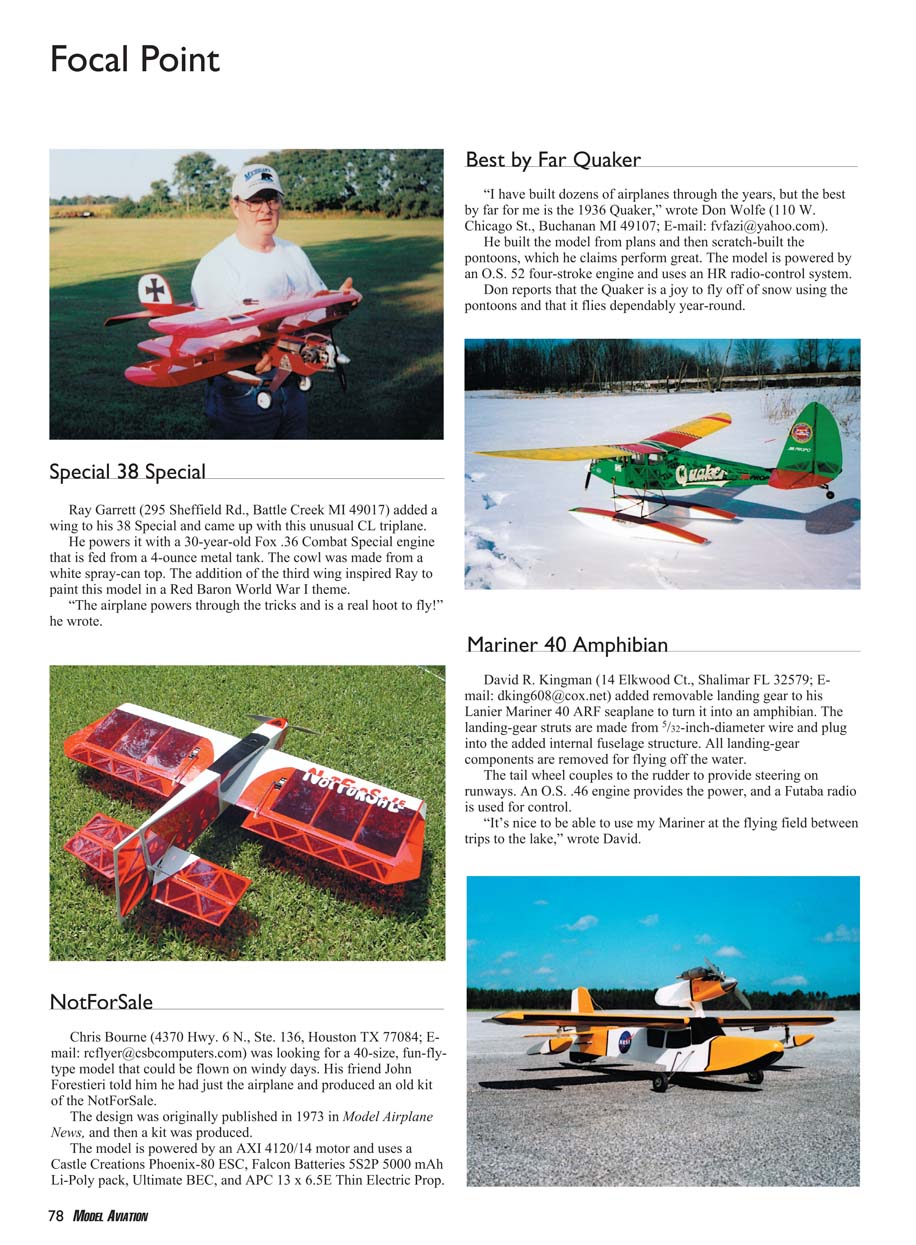
Special 38 Special
Ray Garrett (295 Sheffield Rd., Battle Creek, MI 49017) added a wing to his 38 Special and came up with this unusual CL triplane.
He powers it with a 30-year-old Fox .36 Combat Special engine that is fed from a 4-ounce metal tank. The cowl was made from a white spray-can top. The addition of the third wing inspired Ray to paint this model in a Red Baron World War I theme.
"The airplane powers through the tricks and is a real hoot to fly!" he wrote.
Not For Sale
Chris Bourne (4370 Hwy. 6 N., Ste. 136, Houston, TX 77084; E-mail: [email protected]) was looking for a 40-size, fun-fly-type model that could be flown on windy days. His friend John Forestieri told him he had just the airplane and produced an old kit of the Not For Sale.
The design was originally published in 1973 in Model Airplane News, and then a kit was produced.
The model is powered by an AXI 4120/14 motor and uses a Castle Creations Phoenix-80 ESC, Falcon Batteries 5S2P 5000 mAh Li-Poly pack, Ultimate BEC, and APC 13 x 6.5E Thin Electric Prop.
Best by Far Quaker
"I have built dozens of airplanes through the years, but the best by far for me is the 1936 Quaker," wrote Don Wolfe (110 W. Chicago St., Buchanan, MI 49107; E-mail: [email protected]).
He built the model from plans and then scratch-built the pontoons, which he claims perform great. The model is powered by an O.S. .52 four-stroke engine and uses an HR radio-control system.
Don reports that the Quaker is a joy to fly off of snow using the pontoons and that it flies dependably year-round.
Mariner 40 Amphibian
David R. Kingman (14 Elkwood Ct., Shalimar, FL 32579; E-mail: [email protected]) added removable landing gear to his Lanier Mariner 40 ARF seaplane to turn it into an amphibian. The landing-gear struts are made from 5/32-inch-diameter wire and plug into the added internal fuselage structure. All landing-gear components are removed for flying off the water.
The tail wheel couples to the rudder to provide steering on runways. An O.S. .46 engine provides the power, and a Futaba radio is used for control.
"It's nice to be able to use my Mariner at the flying field between trips to the lake," wrote David.
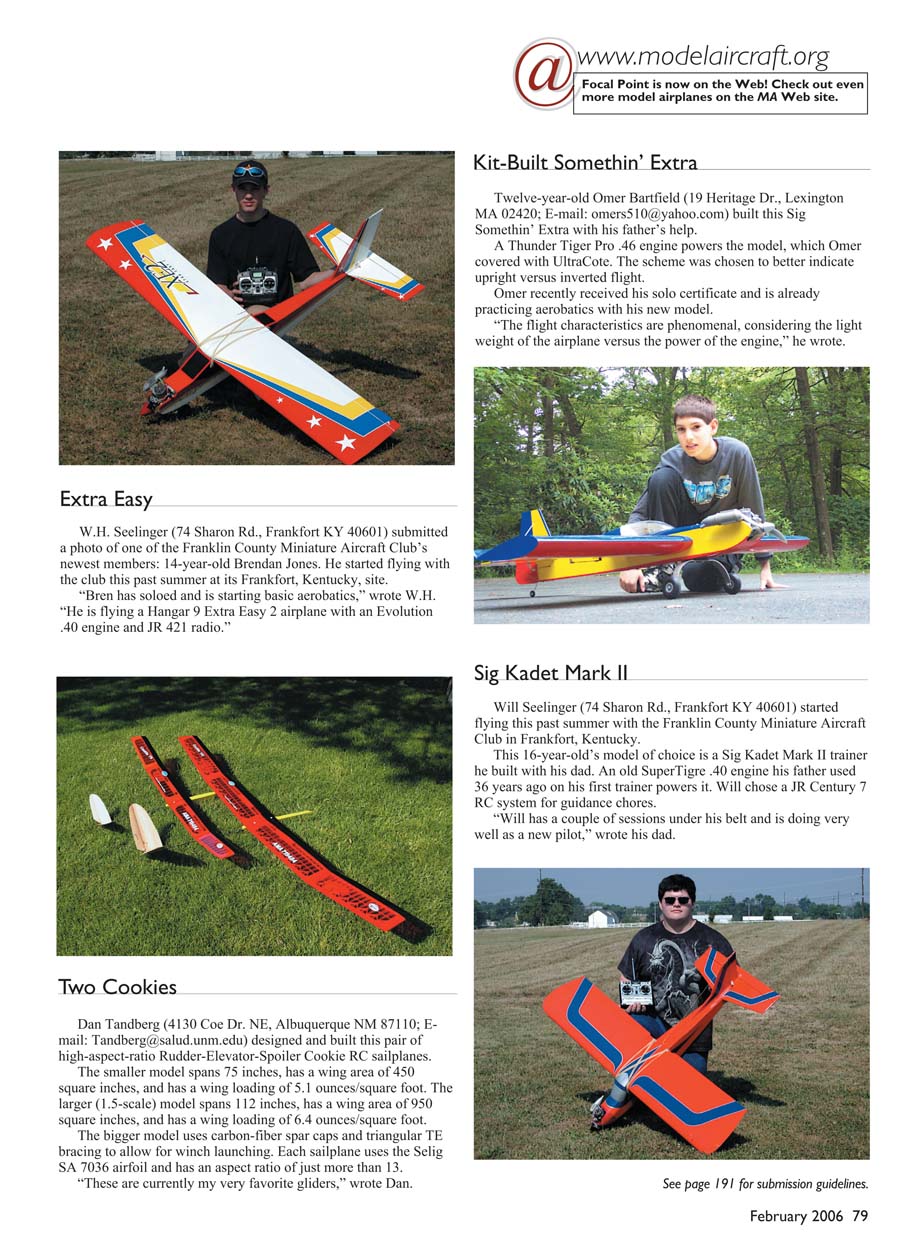
Extra Easy
W. H. Seelinger (74 Sharon Rd., Frankfort, KY 40601) submitted a photo of one of the Franklin County Miniature Aircraft Club’s newest members: 14-year-old Brendan Jones. He started flying with the club this past summer at its Frankfort, Kentucky, site.
"Bren has soloed and is starting basic aerobatics," wrote W. H. "He is flying a Hangar 9 Extra Easy 2 airplane with an Evolution .40 engine and JR 421 radio."
Two Cookies
Dan Tandberg (4130 Coe Dr. NE, Albuquerque, NM 87110; E-mail: [email protected]) designed and built this pair of high-aspect-ratio Rudder-Elevator-Spoiler Cookie RC sailplanes.
The smaller model spans 75 inches, has a wing area of 450 square inches, and has a wing loading of 5.1 ounces per square foot. The larger (1.5-scale) model spans 112 inches, has a wing area of 950 square inches, and has a wing loading of 6.4 ounces per square foot.
The bigger model uses carbon-fiber spar caps and triangular TE bracing to allow for winch launching. Each sailplane uses the Selig SA 7036 airfoil and has an aspect ratio of just more than 13.
"These are currently my very favorite gliders," wrote Dan.
Kit-Built Somethin' Extra
Twelve-year-old Omer Bartfield (19 Heritage Dr., Lexington, MA 02420; E-mail: [email protected]) built this Sig Somethin' Extra with his father's help.
A Thunder Tiger Pro .46 engine powers the model, which Omer covered with UltraCote. The scheme was chosen to better indicate upright versus inverted flight.
Omer recently received his solo certificate and is already practicing aerobatics with his new model.
"The flight characteristics are phenomenal, considering the light weight of the airplane versus the power of the engine," he wrote.
Sig Kadet Mark II
Will Seelinger (74 Sharon Rd., Frankfort, KY 40601) started flying this past summer with the Franklin County Miniature Aircraft Club in Frankfort, Kentucky.
This 16-year-old’s model of choice is a Sig Kadet Mark II trainer he built with his dad. An old SuperTigre .40 engine his father used 36 years ago on his first trainer powers it. Will chose a JR Century 7 RC system for guidance chores.
"Will has a couple of sessions under his belt and is doing very well as a new pilot," wrote his dad.
Transcribed from original scans by AI. Minor OCR errors may remain.

