
Focal Point
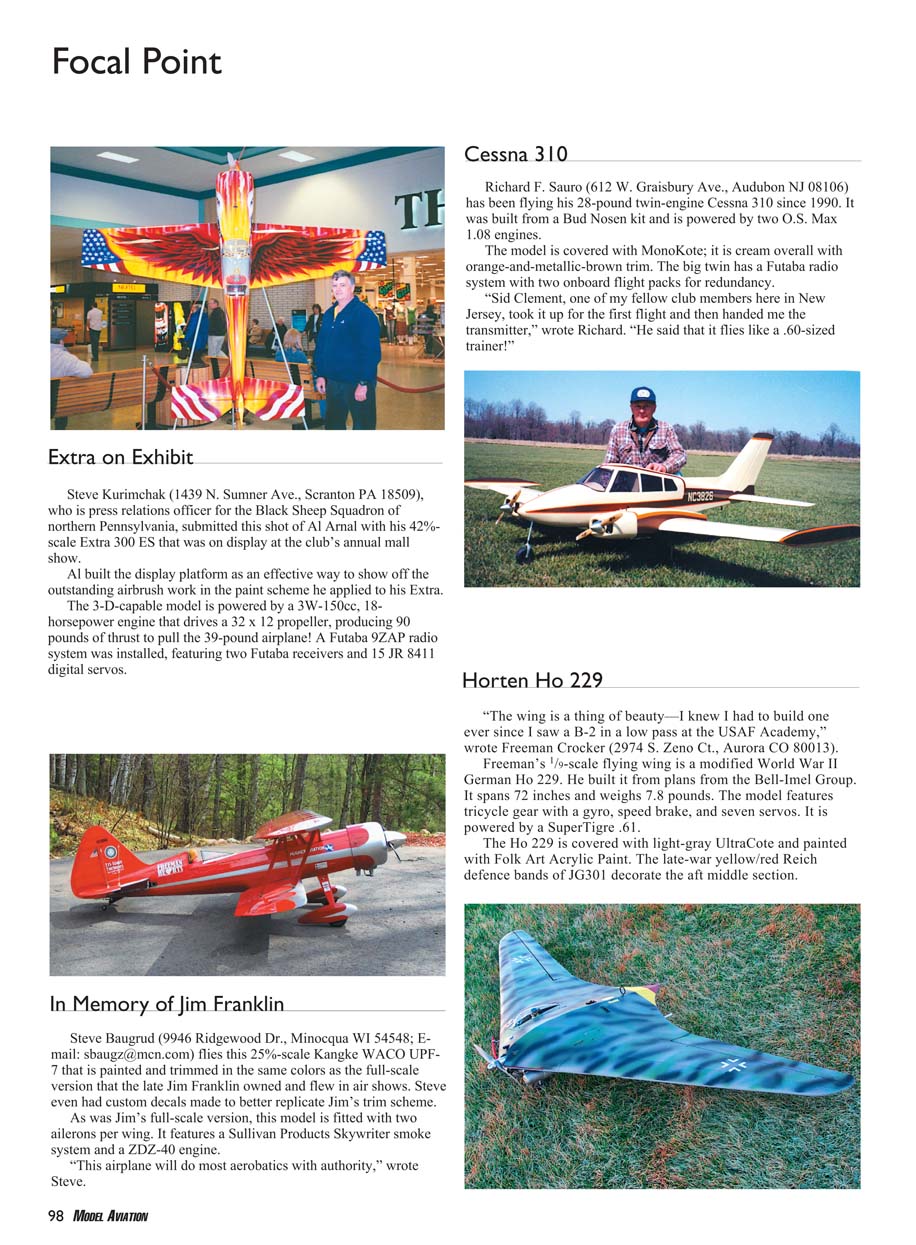
Extra on Exhibit
Steve Kurimchak (1439 N. Sumner Ave., Scranton, PA 18509), press relations officer for the Black Sheep Squadron of northern Pennsylvania, submitted this shot of Al Arnal with his 42%-scale Extra 300 ES that was on display at the club's annual mall show.
Al built the display platform as an effective way to show off the outstanding airbrush work in the paint scheme he applied to his Extra.
Highlights:
- 3-D-capable model powered by a 3W-150cc, 18-horsepower engine.
- Drives a 32 x 12 propeller and produces 90 pounds of thrust to pull the 39-pound airplane.
- Futaba 9ZAP radio system with two Futaba receivers and 15 JR 8411 digital servos.
In Memory of Jim Franklin
Steve Baugrud (9946 Ridgewood Dr., Minocqua, WI 54548; E-mail: [email protected]) flies a 25%-scale Kangke WACO UPF-7 painted and trimmed in the same colors as the full-scale version Jim Franklin owned and flew in air shows. Steve had custom decals made to better replicate Jim's trim scheme.
As with Jim's full-scale version, this model is fitted with two ailerons per wing. It features a Sullivan Products Skywriter smoke system and a ZDZ-40 engine.
"This airplane will do most aerobatics with authority," wrote Steve.
Cessna 310
Richard F. Sauro (612 W. Graisbury Ave., Audubon, NJ 08106) has been flying his 28-pound twin-engine Cessna 310 since 1990. It was built from a Bud Nosen kit and is powered by two O.S. Max 1.08 engines.
The model is covered with MonoKote; it is cream overall with orange-and-metallic-brown trim. The big twin has a Futaba radio system with two onboard flight packs for redundancy.
"Sid Clement, one of my fellow club members here in New Jersey, took it up for the first flight and then handed me the transmitter," wrote Richard. "He said that it flies like a .60-sized trainer!"
Horten Ho 229
"The wing is a thing of beauty—I knew I had to build one ever since I saw a B-2 in a low pass at the USAF Academy," wrote Freeman Crocker (2974 S. Zeno Ct., Aurora, CO 80013). Freeman's 1/9-scale flying wing is a modified World War II German Ho 229 built from plans from the Bell-Imel Group.
Specifications:
- Wingspan: 72 inches
- Weight: 7.8 pounds
- Power: SuperTigre .61
- Features: tricycle gear with a gyro, speed brake, and seven servos
The Ho 229 is covered with light-gray UltraCote and painted with Folk Art acrylic paint. The late-war yellow/red Reich defence bands of JG301 decorate the aft middle section.
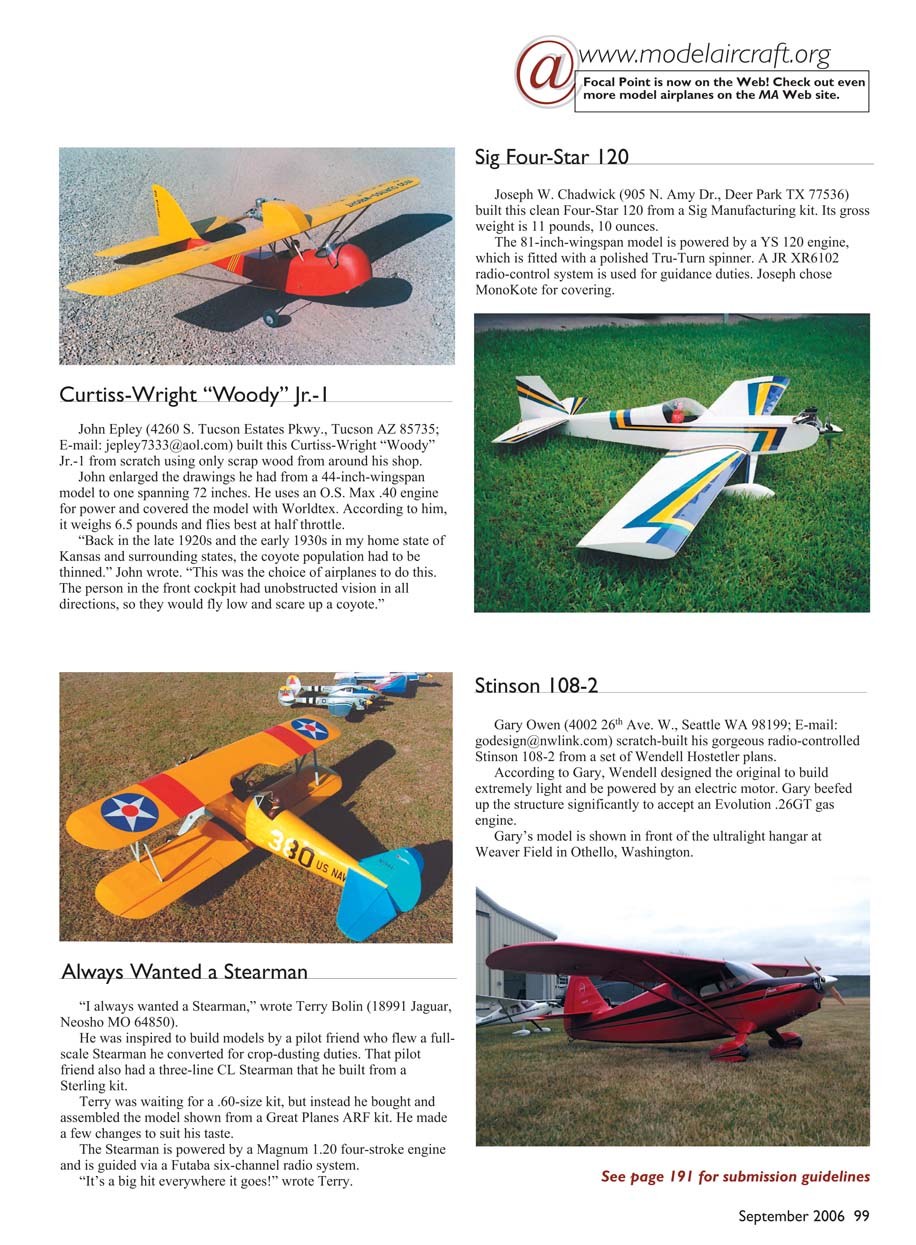
Curtiss-Wright "Woody" Jr.-1
John Epley (4260 S. Tucson Estates Pkwy., Tucson, AZ 85735; E-mail: [email protected]) built this Curtiss-Wright "Woody" Jr.-1 from scratch using only scrap wood from around his shop.
John enlarged drawings he had from a 44-inch-wingspan model to one spanning 72 inches. He uses an O.S. Max .40 engine for power and covered the model with Worldtex. According to him, it weighs 6.5 pounds and flies best at half throttle.
"Back in the late 1920s and the early 1930s in my home state of Kansas and surrounding states, the coyote population had to be thinned," John wrote. "This was the choice of airplanes to do this. The person in the front cockpit had unobstructed vision in all directions, so they would fly low and scare up a coyote."
Sig Four-Star 120
Joseph W. Chadwick (905 N. Amy Dr., Deer Park, TX 77536) built this clean Four-Star 120 from a Sig Manufacturing kit. Its gross weight is 11 pounds, 10 ounces.
The 81-inch-wingspan model is powered by a YS 120 engine, fitted with a polished Tru-Turn spinner. A JR XR6102 radio-control system is used for guidance duties. Joseph chose MonoKote for covering.
Always Wanted a Stearman
"I always wanted a Stearman," wrote Terry Bolin (18991 Jaguar, Neosho, MO 64850).
He was inspired to build models by a pilot friend who flew a full-scale Stearman he converted for crop-dusting duties. That friend also had a three-line CL Stearman built from a Sterling kit. Terry was waiting for a .60-size kit, but instead he bought and assembled the model shown from a Great Planes ARF kit and made a few changes to suit his taste.
The Stearman is powered by a Magnum 1.20 four-stroke engine and is guided via a Futaba six-channel radio system.
"It's a big hit everywhere it goes!" wrote Terry.
Stinson 108-2
Gary Owen (4002 26th Ave. W., Seattle, WA 98199; E-mail: [email protected]) scratch-built his radio-controlled Stinson 108-2 from a set of Wendell Hostetler plans.
According to Gary, Wendell designed the original to be extremely light and powered by an electric motor. Gary beefed up the structure significantly to accept an Evolution .26GT gas engine.
Gary's model is shown in front of the ultralight hangar at Weaver Field in Othello, Washington.
Transcribed from original scans by AI. Minor OCR errors may remain.

