
Focal Point
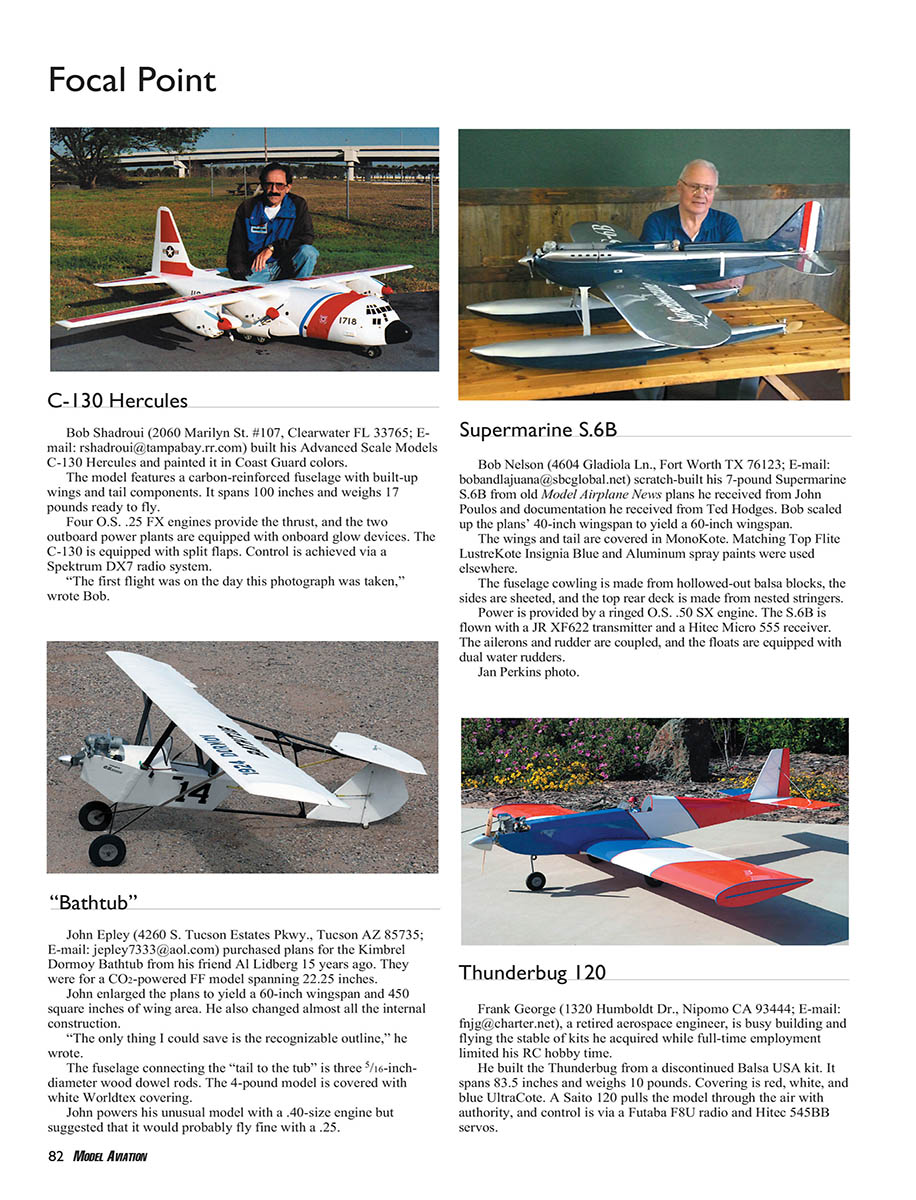
C-130 Hercules
Bob Shadroui (2060 Marilyn St. #107, Clearwater, FL 33765; E-mail: [email protected]) built his Advanced Scale Models C-130 Hercules and painted it in Coast Guard colors.
The model features a carbon-reinforced fuselage with built-up wings and tail components. It spans 100 inches and weighs 17 pounds ready to fly.
Four O.S. .25 FX engines provide the thrust, and the two outboard power plants are equipped with onboard glow devices. The C-130 is fitted with split flaps. Control is achieved via a Spektrum DX7 radio system.
"The first flight was on the day this photograph was taken," wrote Bob.
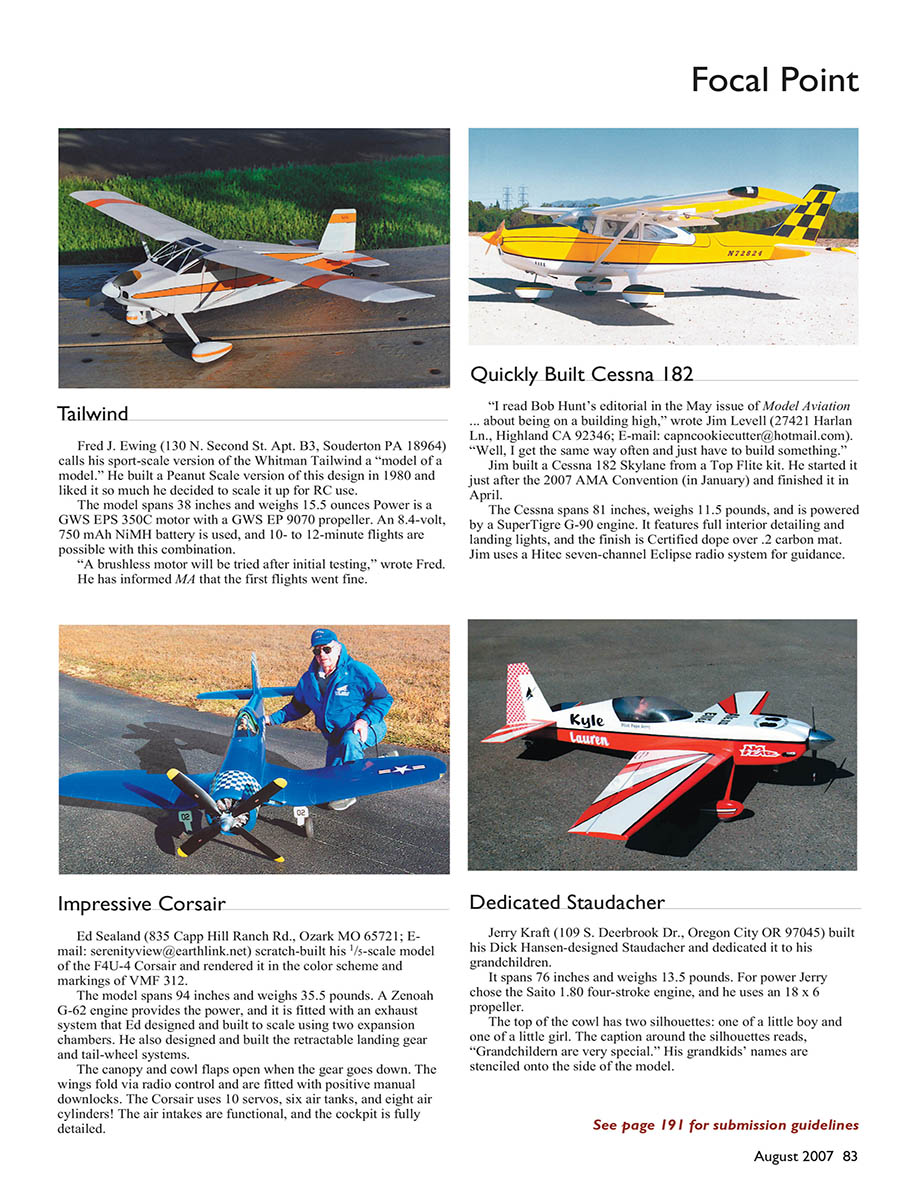
Supermarine S.6B
Bob Nelson (4604 Gladiola Ln., Fort Worth, TX 76123; E-mail: [email protected]) scratch-built his 7-pound Supermarine S.6B from old Model Airplane News plans he received from John Poulos and documentation he received from Ted Hodges. Bob scaled up the plans' 40-inch wingspan to yield a 60-inch wingspan.
The wings and tail are covered in MonoKote. Matching Top Flite LustreKote Insignia Blue and Aluminum spray paints were used elsewhere.
The fuselage cowling is made from hollowed-out balsa blocks, the sides are sheeted, and the top rear deck is made from nested stringers.
Power is provided by a ringed O.S. .50 SX engine. The S.6B is flown with a JR XF622 transmitter and a Hitec Micro 555 receiver. The ailerons and rudder are coupled, and the floats are equipped with dual water rudders.
"Bathtub"
John Epley (4260 S. Tucson Estates Pkwy., Tucson, AZ 85735; E-mail: [email protected]) purchased plans for the Kimbrel Dormoy "Bathtub" from his friend Al Lidberg 15 years ago. They were for a CO2-powered free-flight (FF) model spanning 22.25 inches.
John enlarged the plans to yield a 60-inch wingspan and 450 square inches of wing area. He also changed almost all the internal construction.
"The only thing I could save is the recognizable outline," he wrote.
The fuselage connecting the "tail to the tub" is three 5/16-inch-diameter wood dowel rods. The 4-pound model is covered with white Worldtex covering.
John powers his unusual model with a .40-size engine but suggested that it would probably fly fine with a .25.
Thunderbug 120
Frank George (1320 Humboldt Dr., Nipomo, CA 93444; E-mail: [email protected]), a retired aerospace engineer, is busy building and flying the stable of kits he acquired while full-time employment limited his RC hobby time. He built the Thunderbug from a discontinued Balsa USA kit. It spans 83.5 inches and weighs 10 pounds. Covering is red, white, and blue UltraCote.
A Saito 120 pulls the model through the air with authority, and control is via a Futaba F8U radio and Hitec 545BB servos.
Tailwind
Fred J. Ewing (130 N. Second St. Apt. B3, Souderton, PA 18964) calls his sport-scale version of the Whitman Tailwind a "model of a model." He built a Peanut Scale version of this design in 1980 and liked it so much he decided to scale it up for RC use.
The model spans 38 inches and weighs 15.5 ounces. Power is a GWS EPS 350C motor with a GWS EP 9070 propeller. An 8.4-volt, 750 mAh NiMH battery is used, and 10- to 12-minute flights are possible with this combination.
"A brushless motor will be tried after initial testing," wrote Fred. He has informed MA that the first flights went fine.
Quickly Built Cessna 182
"I read Bob Hunt's editorial in the May issue of Model Aviation ... about being on a building high," wrote Jim Levell (27421 Harlan Ln., Highland, CA 92346; E-mail: [email protected]). "Well, I get the same way often and just have to build something."
Jim built a Cessna 182 Skylane from a Top Flite kit. He started it just after the 2007 AMA Convention (in January) and finished it in April.
The Cessna spans 81 inches, weighs 11.5 pounds, and is powered by a SuperTigre G-90 engine. It features full interior detailing and landing lights, and the finish is Certified dope over 2-oz carbon mat. Jim uses a Hitec seven-channel Eclipse radio system for guidance.
Impressive Corsair
Ed Sealand (835 Capp Hill Ranch Rd., Ozark, MO 65721; E-mail: [email protected]) scratch-built his 1/5-scale model of the F4U-4 Corsair and rendered it in the color scheme and markings of VMF-312.
The model spans 94 inches and weighs 35.5 pounds. A Zenoah G-62 engine provides the power, and it is fitted with an exhaust system that Ed designed and built to scale using two expansion chambers. He also designed and built the retractable landing gear and tail-wheel systems.
The canopy and cowl flaps open when the gear goes down. The wings fold via radio control and are fitted with positive manual downlocks. The Corsair uses 10 servos, six air tanks, and eight air cylinders. The air intakes are functional, and the cockpit is fully detailed.
Dedicated Staudacher
Jerry Kraft (109 S. Deerbrook Dr., Oregon City, OR 97045) built his Dick Hansen–designed Staudacher and dedicated it to his grandchildren.
It spans 76 inches and weighs 13.5 pounds. For power Jerry chose the Saito 1.80 four-stroke engine, and he uses an 18 x 6 propeller.
The top of the cowl has two silhouettes: one of a little boy and one of a little girl. The caption around the silhouettes reads, "Grandchildren are very special." His grandkids' names are stenciled onto the side of the model.
Transcribed from original scans by AI. Minor OCR errors may remain.

