
Focal Point
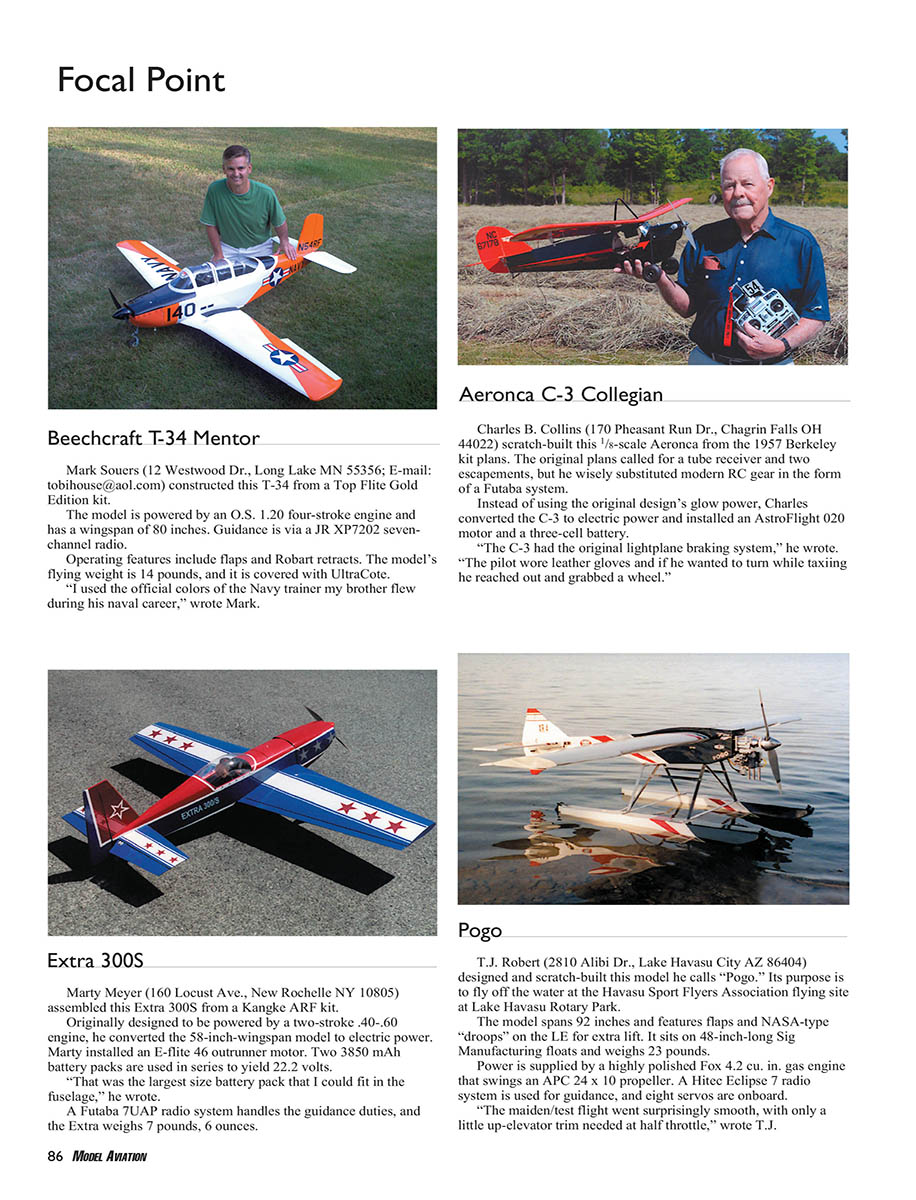
Beechcraft T-34 Mentor
Mark Souers (12 Westwood Dr., Long Lake, MN 55356; E-mail: [email protected]) constructed this T-34 from a Top Flite Gold Edition kit.
The model is powered by an O.S. 1.20 four-stroke engine and has a wingspan of 80 inches. Guidance is via a JR XP7202 seven-channel radio.
Operating features include flaps and Robart retracts. The model’s flying weight is 14 pounds, and it is covered with UltraCote.
“I used the official colors of the Navy trainer my brother flew during his naval career,” wrote Mark.
Aeronca C-3 Collegian
Charles B. Collins (170 Pheasant Run Dr., Chagrin Falls, OH 44022) scratch-built this 1/8-scale Aeronca from the 1957 Berkeley kit plans. The original plans called for a tube receiver and two escapements, but he substituted modern RC gear in the form of a Futaba system.
Instead of using the original design’s glow power, Charles converted the C-3 to electric power and installed an AstroFlight 020 motor and a three-cell battery.
“The C-3 had the original lightplane braking system,” he wrote. “The pilot wore leather gloves and if he wanted to turn while taxiing he reached out and grabbed a wheel.”
Extra 300S
Marty Meyer (160 Locust Ave., New Rochelle, NY 10805) assembled this Extra 300S from a Kangke ARF kit.
Originally designed to be powered by a two-stroke .40–.60 engine, he converted the 58-inch wingspan model to electric power. Marty installed an E-flite 46 outrunner motor. Two 3850 mAh battery packs are used in series to yield 22.2 volts.
“That was the largest size battery pack that I could fit in the fuselage,” he wrote.
A Futaba 7UAP radio system handles the guidance duties, and the Extra weighs 7 pounds, 6 ounces.
Pogo
T.J. Robert (2810 Alibi Dr., Lake Havasu City, AZ 86404) designed and scratch-built this model he calls “Pogo.” Its purpose is to fly off the water at the Havasu Sport Flyers Association flying site at Lake Havasu Rotary Park.
The model spans 92 inches and features flaps and NASA-type “droops” on the leading edge for extra lift. It sits on 48-inch-long Sig Manufacturing floats and weighs 23 pounds.
Power is supplied by a highly polished Fox 4.2 cu. in. gas engine that swings an APC 24 x 10 propeller. A Hitec Eclipse 7 radio system is used for guidance, and eight servos are onboard.
“The maiden/test flight went surprisingly smooth, with only a little up-elevator trim needed at half throttle,” wrote T.J.
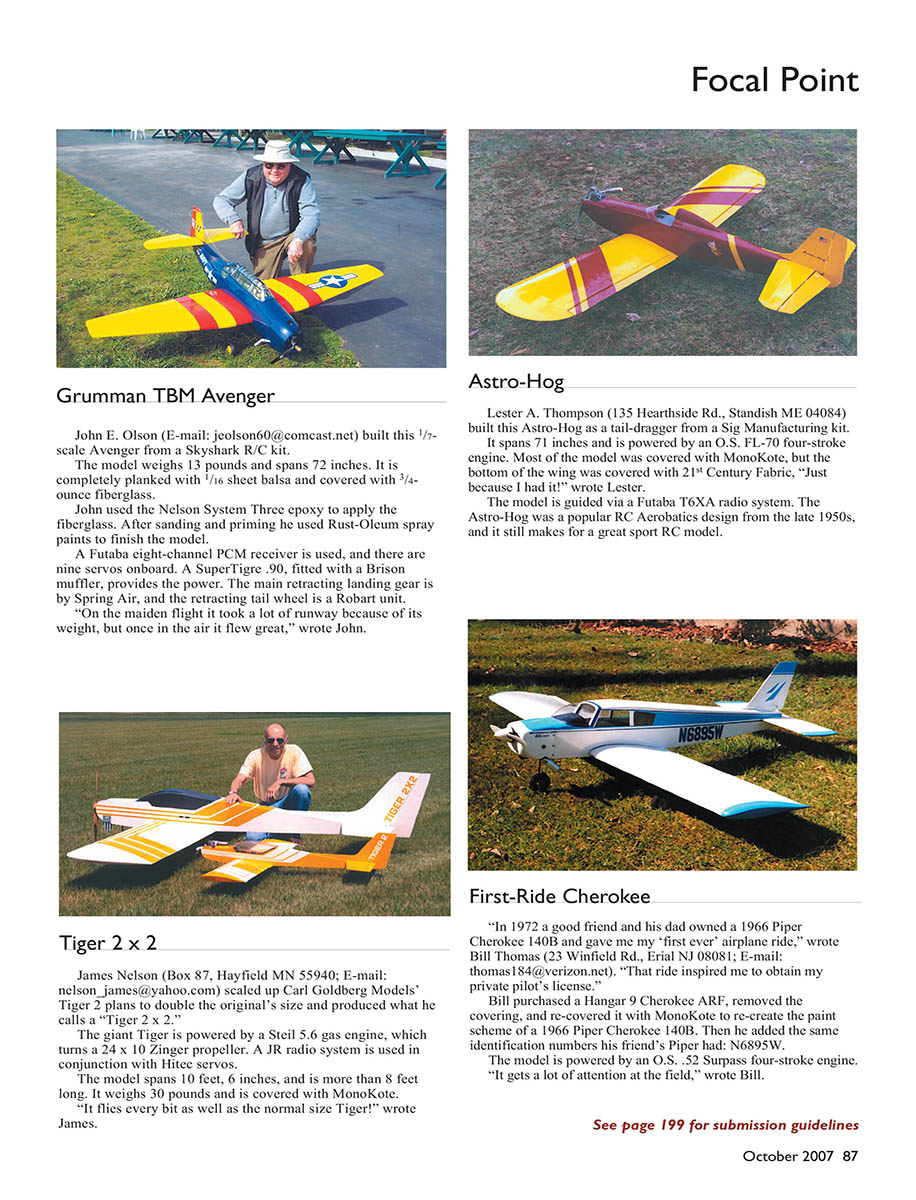
Grumman TBM Avenger
John E. Olson (E-mail: [email protected]) built this 1/7-scale Avenger from a Skyshark R/C kit. The model weighs 13 pounds and spans 72 inches. It is completely planked with 1/16-inch sheet balsa and covered with 3/4-ounce fiberglass.
John used the Nelson System Three epoxy to apply the fiberglass. After sanding and priming he used Rust-Oleum spray paints to finish the model.
A Futaba eight-channel PCM receiver is used, and there are nine servos onboard. A SuperTigre .90, fitted with a Brison muffler, provides the power. The main retracting landing gear is by Spring Air, and the retracting tail wheel is a Robart unit.
"On the maiden flight it took a lot of runway because of its weight, but once in the air it flew great," wrote John.
Astro-Hog
Lester A. Thompson (135 Hearthside Rd., Standish, ME 04084) built this Astro-Hog as a tail-dragger from a Sig Manufacturing kit. It spans 71 inches and is powered by an O.S. FL-70 four-stroke engine. Most of the model was covered with MonoKote, but the bottom of the wing was covered with 21st Century Fabric, “just because I had it!” wrote Lester.
The model is guided via a Futaba T6XA radio system. The Astro-Hog was a popular RC aerobatics design from the late 1950s, and it still makes for a great sport RC model.
Tiger 2 x 2
James Nelson (Box 87, Hayfield, MN 55940; E-mail: [email protected]) scaled up Carl Goldberg Models' Tiger 2 plans to double the original's size and produced what he calls a "Tiger 2 x 2."
The giant Tiger is powered by a Steil 5.6 gas engine, which turns a 24 x 10 Zinger propeller. A JR radio system is used in conjunction with Hitec servos.
The model spans 10 feet, 6 inches, and is more than 8 feet long. It weighs 30 pounds and is covered with MonoKote.
"It flies every bit as well as the normal size Tiger!" wrote James.
First-Ride Cherokee
"In 1972 a good friend and his dad owned a 1966 Piper Cherokee 140B and gave me my 'first ever' airplane ride," wrote Bill Thomas (23 Winfield Rd., Erial, NJ 08081; E-mail: [email protected]). "That ride inspired me to obtain my private pilot's license."
Bill purchased a Hangar 9 Cherokee ARF, removed the covering, and re-covered it with MonoKote to re-create the paint scheme of a 1966 Piper Cherokee 140B. Then he added the same identification numbers his friend's Piper had: N6895W.
The model is powered by an O.S. .52 Surpass four-stroke engine. "It gets a lot of attention at the field," wrote Bill.
Transcribed from original scans by AI. Minor OCR errors may remain.

