
TAMEcat
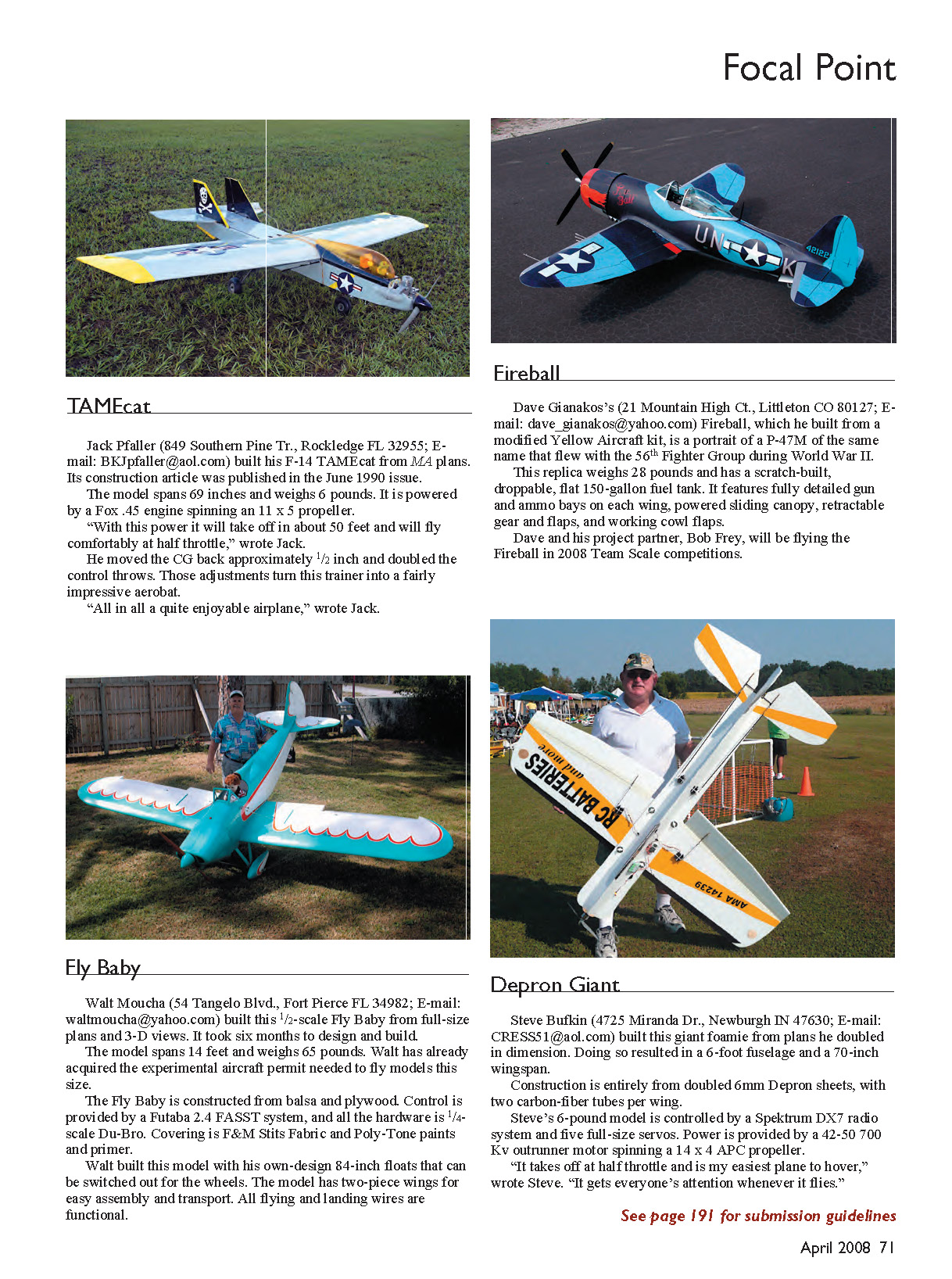
Jack Pfaller (849 Southern Pine Tr., Rockledge, FL 32955; E-mail: [email protected]) built his F-14 TAMEcat from MA plans. Its construction article was published in the June 1990 issue.
The model spans 69 inches and weighs 6 pounds. It is powered by a Fox .45 engine spinning an 11 x 5 propeller.
"With this power it will take off in about 50 feet and will fly comfortably at half throttle," wrote Jack.
He moved the CG back approximately 1/2 inch and doubled the control throws. Those adjustments turn this trainer into a fairly impressive aerobat.
"All in all a quite enjoyable airplane," wrote Jack.
Fireball
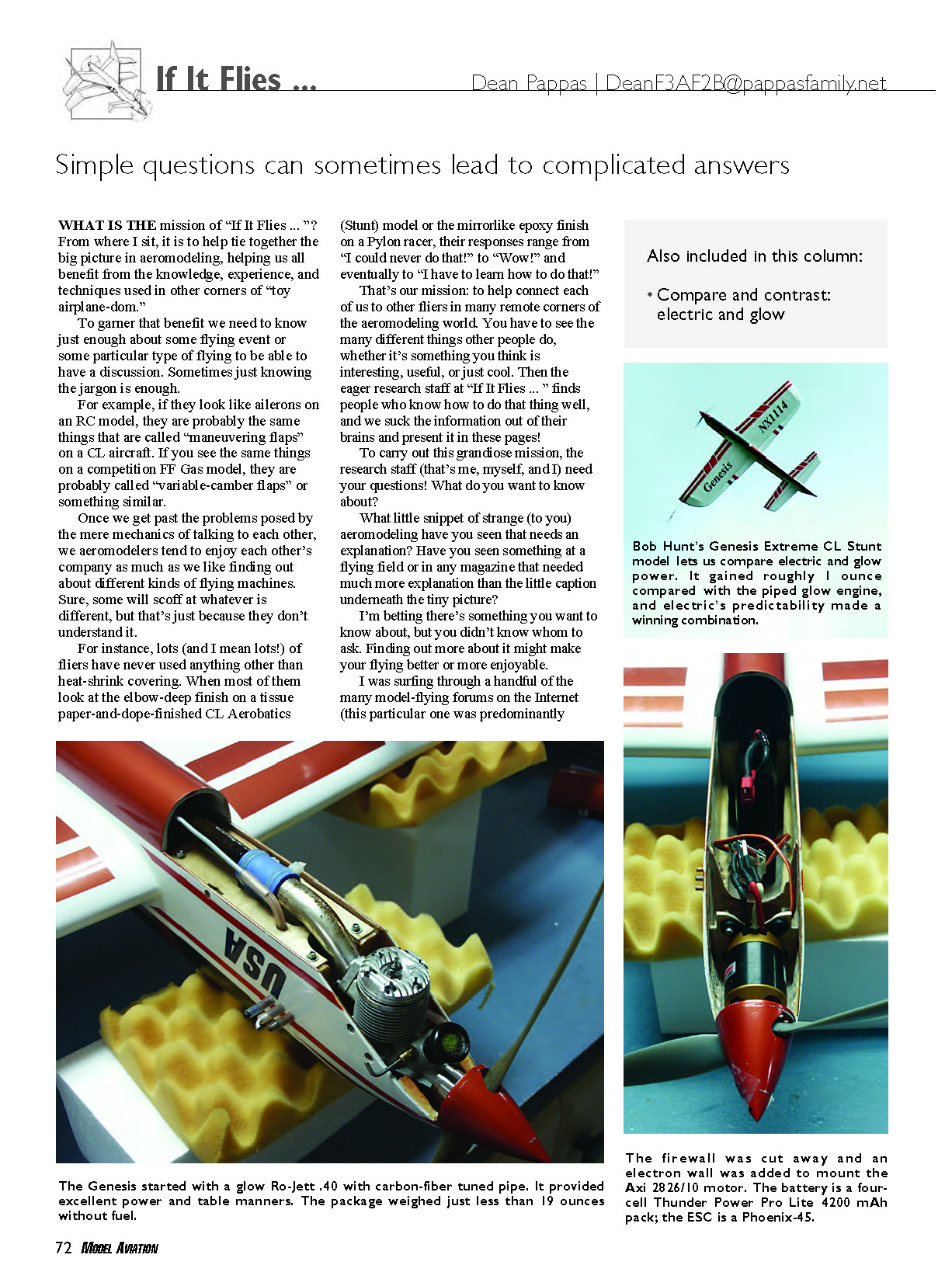
Dave Gianakos (21 Mountain High Ct., Littleton, CO 80127; E-mail: [email protected]) built his Fireball from a modified Yellow Aircraft kit. It is a portrait of a P-47M of the same name that flew with the 56th Fighter Group during World War II.
This replica weighs 28 pounds and has a scratch-built, droppable, flat 150-gallon fuel tank. It features fully detailed gun and ammo bays on each wing, a powered sliding canopy, retractable gear and flaps, and working cowl flaps.
Dave and his project partner, Bob Frey, will be flying the Fireball in 2008 Team Scale competitions.
Ely Baby
Walt Moucha (54 Tangelo Blvd., Fort Pierce, FL 34982; E-mail: [email protected]) built this 1/2-scale Fly Baby from full-size plans and 3-D views. It took six months to design and build.
The model spans 14 feet and weighs 65 pounds. Walt has already acquired the experimental aircraft permit needed to fly models this size.
The Fly Baby is constructed from balsa and plywood. Control is provided by a Futaba 2.4 FASST system, and all the hardware is 1/4-scale Du-Bro. Covering is F&M Stits Fabric with Poly-Tone paints and primer.
Walt built this model with his own-design 84-inch floats that can be switched out for wheels. The model has two-piece wings for easy assembly and transport. All flying and landing wires are functional.
Depron Giant
Steve Bufkin (4725 Miranda Dr., Newburgh, IN 47630; E-mail: [email protected]) built this giant foamie from plans he doubled in dimension. Doing so resulted in a 6-foot fuselage and a 70-inch wingspan.
Construction is entirely from doubled 6mm Depron sheets, with two carbon-fiber tubes per wing.
Steve's 6-pound model is controlled by a Spektrum DX7 radio system and five full-size servos. Power is provided by a 42–50 700 Kv outrunner motor spinning a 14 x 4 APC propeller.
"It takes off at half throttle and is my easiest plane to hover," wrote Steve. "It gets everyone's attention whenever it flies."
If It Flies ...
Dean Pappas | [email protected]
Simple questions can sometimes lead to complicated answers.
WHAT IS the mission of "If It Flies ..."? From where I sit, it is to help tie together the big picture in aeromodeling, helping us all benefit from the knowledge, experience, and techniques used in other corners of "toy airplane‑dom."
To garner that benefit we need to know just enough about some flying event or some particular type of flying to be able to have a discussion. Sometimes just knowing the jargon is enough.
For example, if they look like ailerons on an RC model, they are probably the same things that are called "maneuvering flaps" on a CL aircraft. If you see the same things on a competition FF Gas model, they are probably called "variable‑camber flaps" or something similar.
Once we get past the problems posed by the mere mechanics of talking to each other, we aeromodelers tend to enjoy each other's company as much as we like finding out about different kinds of flying machines. Sure, some will scoff at whatever is different, but that's just because they don't understand it.
For instance, lots (and I mean lots!) of fliers have never used anything other than heat‑shrink covering. When most of them look at the elbow‑deep finish on a tissue‑paper‑and‑dope CL Aerobatics (Stunt) model or the mirror‑like epoxy finish on a Pylon racer, their responses range from "I could never do that!" to "Wow!" and eventually to "I have to learn how to do that!"
That's our mission: to help connect each of us to other fliers in many remote corners of the aeromodeling world. You have to see the many different things other people do, whether it's something you think is interesting, useful, or just cool. Then the eager research staff at "If It Flies ..." finds people who know how to do that thing well, and we suck the information out of their brains and present it in these pages!
To carry out this grandiose mission, the research staff (that's me, myself, and I) needs your questions! What do you want to know about?
What little snippet of strange (to you) aeromodeling have you seen that needs an explanation? Have you seen something at a flying field or in any magazine that needed much more explanation than the little caption underneath the tiny picture?
I'm betting there's something you want to know about, but you didn't know whom to ask. Finding out more about it might make your flying better or more enjoyable.
I was surfing through a handful of the many model‑flying forums on the Internet (this particular one was predominantly electric) and came across a short thread that asked whether electric power was a suitable replacement for glow power in CL stunt ships. The thread wandered through a number of comments, some of which were opinion, some of which were speculation, and a few of which were actual experience. What the thread lacked was a clear example: an apples‑to‑apples comparison of the same airframe flown with glow power and then flown with electric power.
A friend, Bob Hunt, had just finished conversion of his excellent Genesis Extreme CL Stunt model from glow to electric power, so I asked him to let me watch his bench and flight testing and to compare notes. What Bob had done was an almost ideal experiment—same ship, same pilot, similar weight and balance, and nearly the same propeller diameter and pitch. The conversion provided a tidy comparison that is worth sharing with anyone considering going electric for CL stunt.
Also included in this column:
- Compare and contrast: electric and glow
Transcribed from original scans by AI. Minor OCR errors may remain.

