
Focal Point
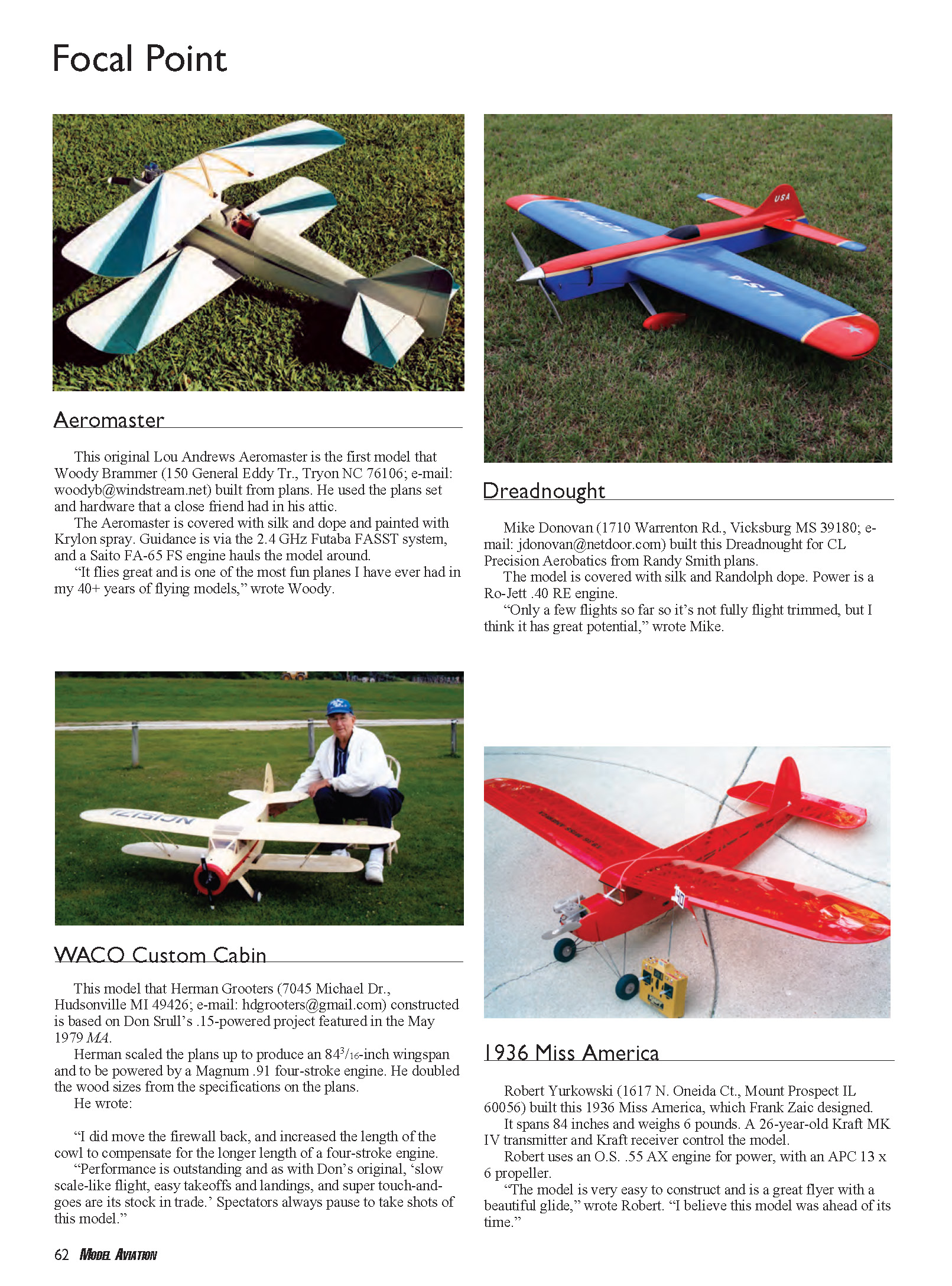
Aeromaster
This original Lou Andrews Aeromaster is the first model that Woody Brammer (150 General Eddy Tr., Tryon, NC 76106; e-mail: [email protected]) built from plans. He used the plan set and hardware that a close friend had in his attic.
The Aeromaster is covered with silk and dope and painted with Krylon spray. Guidance is via a 2.4 GHz Futaba FASST system, and a Saito FA-65 FS engine hauls the model around.
"It flies great and is one of the most fun planes I have ever had in my 40+ years of flying models," wrote Woody.
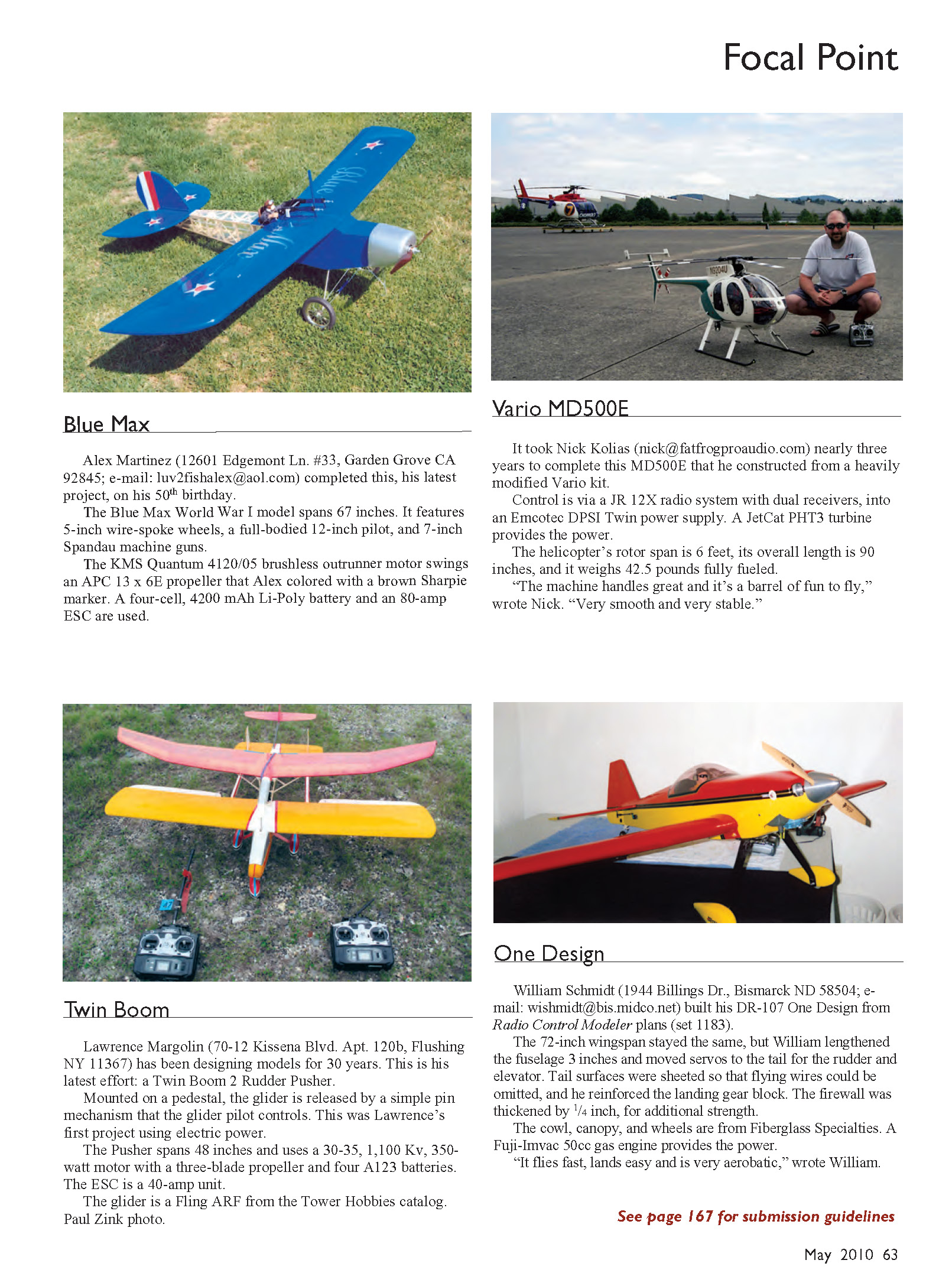
Dreadnought
Mike Donovan (1710 Warrenton Rd., Vicksburg, MS 39180; e-mail: [email protected]) built this Dreadnought for CL Precision Aerobatics from Randy Smith plans.
The model is covered with silk and Randolph dope. Power is a Ro-Jett .40 RE engine.
"Only a few flights so far so it's not fully flight trimmed, but I think it has great potential," wrote Mike.
WACO Custom Cabin
This model, constructed by Herman Grooters (7045 Michael Dr., Hudsonville, MI 49426; e-mail: [email protected]), is based on Don Srull's .15-powered project featured in the May 1979 MA.
Herman scaled the plans up to produce an 84 3/16-inch wingspan and to be powered by a Magnum .91 four-stroke engine. He doubled the wood sizes from the specifications on the plans. He moved the firewall back and increased the length of the cowl to compensate for the longer length of a four-stroke engine.
Performance is outstanding and, as with Don's original, "slow scale-like flight, easy takeoffs and landings, and super touch-and-goes are its stock in trade." Spectators always pause to take shots of this model.
1936 Miss America
Robert Yurkowski (1617 N. Oneida Ct., Mount Prospect, IL 60056) built this 1936 Miss America, which Frank Zaic designed.
The model spans 84 inches and weighs 6 pounds. A 26-year-old Kraft MK IV transmitter and Kraft receiver control the model. Robert uses an O.S. .55 AX engine for power, with an APC 13 x 6 propeller.
"The model is very easy to construct and is a great flyer with a beautiful glide," wrote Robert. "I believe this model was ahead of its time."
Focal Point
Blue Max
Alex Martinez (12601 Edgemont Ln. #33, Garden Grove, CA 92845; e-mail: [email protected]) completed this, his latest project, on his 50th birthday.
The Blue Max World War I model spans 67 inches. It features 5-inch wire-spoke wheels, a full-bodied 12-inch pilot, and 7-inch Spandau machine guns.
The KMS Quantum 4120/05 brushless outrunner motor swings an APC 13 x 6E propeller that Alex colored with a brown Sharpie marker. A four-cell 4200 mAh Li-Poly battery and an 80-amp ESC are used.
Vario MD500E
It took Nick Kolias ([email protected]) nearly three years to complete this MD500E, which he constructed from a heavily modified Vario kit.
Control is via a JR 12X radio system with dual receivers, into an Emcotec DPSI Twin power supply. A JetCat PHT3 turbine provides the power.
The helicopter’s rotor span is 6 feet, its overall length is 90 inches, and it weighs 42.5 pounds fully fueled.
"The machine handles great and it’s a barrel of fun to fly," wrote Nick. "Very smooth and very stable."
Twin Boom
Lawrence Margolin (70-12 Kissena Blvd., Apt. 120b, Flushing, NY 11367) has been designing models for 30 years. This is his latest effort: a Twin Boom 2-rudder pusher.
Mounted on a pedestal, the glider is released by a simple pin mechanism that the glider pilot controls. This was Lawrence’s first project using electric power.
The pusher spans 48 inches and uses a 30–35 size, 1,100 Kv, 350-watt motor with a three-blade propeller and four A123 batteries. The ESC is a 40-amp unit.
The glider is a Fling ARF from the Tower Hobbies catalog. Paul Zink photo.
One Design
William Schmidt (1944 Billings Dr., Bismarck, ND 58504; e-mail: [email protected]) built his DR-107 One Design from Radio Control Modeler plans (set 1183).
The 72-inch wingspan stayed the same, but William lengthened the fuselage 3 inches and moved servos to the tail for the rudder and elevator. Tail surfaces were sheeted so that flying wires could be omitted, and he reinforced the landing gear block. The firewall was thickened by 1/4 inch for additional strength.
The cowl, canopy, and wheels are from Fiberglass Specialties. A Fuji-Imvac 50cc gas engine provides the power.
"It flies fast, lands easy and is very aerobatic," wrote William.
Transcribed from original scans by AI. Minor OCR errors may remain.

