

Focal Point - 2010/06
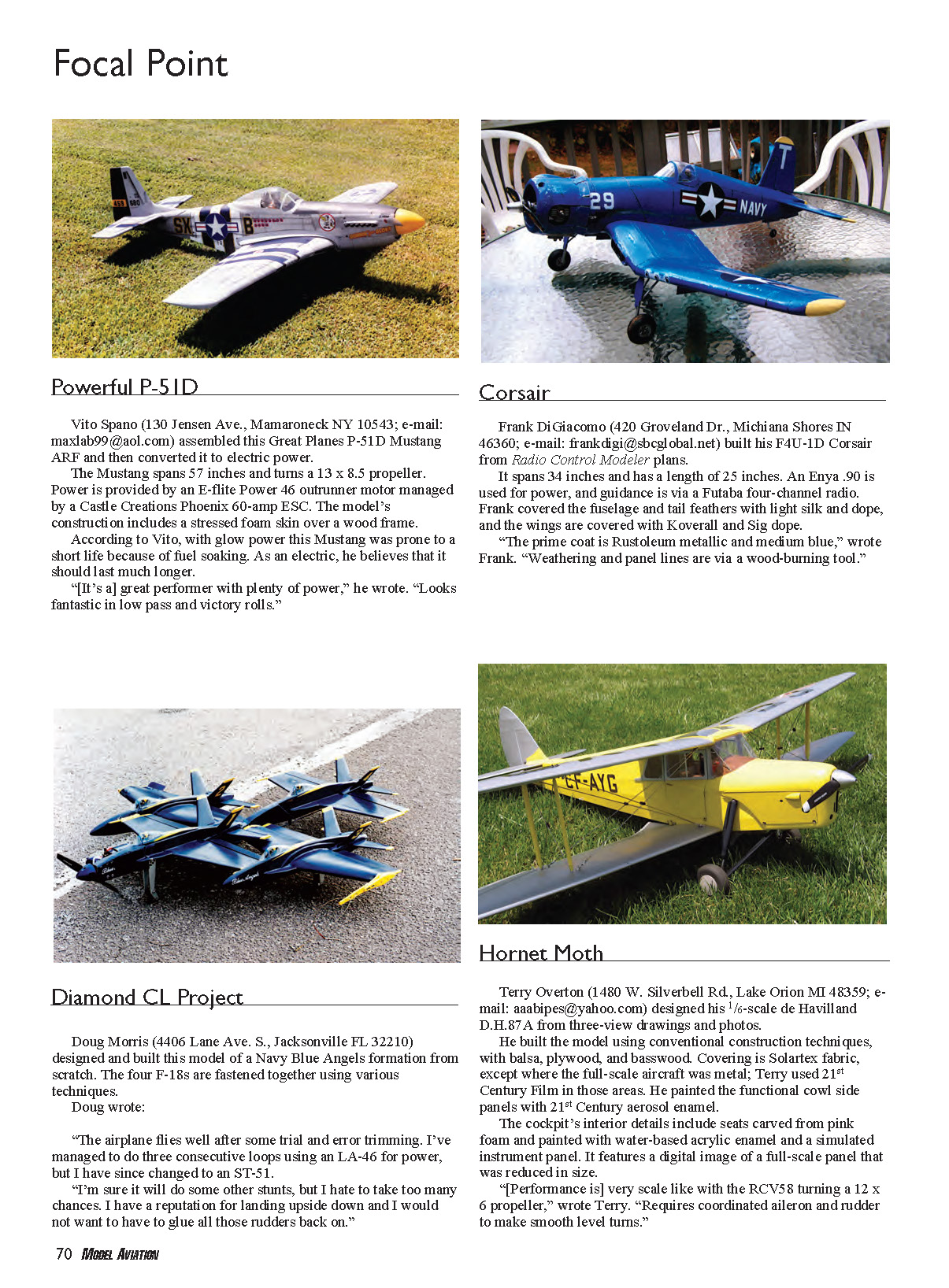
Powerful P-51D
Vito Spano (130 Jensen Ave., Mamaroneck, NY 10543; email: [email protected]) assembled this Great Planes P-51D Mustang ARF and converted it to electric power.
The Mustang spans 57 inches and turns a 13 x 8.5 propeller. Power is provided by an E-flite Power 46 outrunner motor managed by a Castle Creations Phoenix 60-amp ESC. The model's construction includes a stressed foam skin over a wood frame.
According to Vito, with glow power this Mustang was prone to a short life because of fuel soaking. As an electric, he believes it should last much longer.
"[It's a] great performer with plenty of power," he wrote. "Looks fantastic in low pass and victory rolls."
Corsair
Frank DiGiacomo (420 Groveland Dr., Michiana Shores, IN 46360; email: [email protected]) built his F4U-1D Corsair from Radio Control Modeler plans.
It spans 34 inches and has a length of 25 inches. An Enya .90 is used for power, and guidance is via a Futaba four-channel radio. Frank covered the fuselage and tail feathers with light silk and dope, and the wings are covered with Koverall and Sig dope.
"The prime coat is Rust-Oleum metallic and medium blue," wrote Frank. "Weathering and panel lines are via a wood-burning tool."
Diamond CL Project
Doug Morris (4406 Lane Ave. S., Jacksonville, FL 32210) designed and built this model of a Navy Blue Angels formation from scratch. The four F-18s are fastened together using various techniques.
Doug wrote: "The airplane flies well after some trial and error trimming. I've managed to do three consecutive loops using an LA-46 for power, but I have since changed to an ST-51.
"I'm sure it will do some other stunts, but I hate to take too many chances. I have a reputation for landing upside down and I would not want to have to glue all those rudders back on."
Hornet Moth
Terry Overton (1480 W. Silverbell Rd., Lake Orion, MI 48359; email: [email protected]) designed his 1/6-scale de Havilland D.H.87A from three-view drawings and photos.
He built the model using conventional construction techniques, with balsa, plywood, and basswood. Covering is Solartex fabric, except where the full-scale aircraft was metal; Terry used 21st Century Film in those areas. He painted the functional cowl side panels with 21st Century aerosol enamel.
The cockpit interior details include seats carved from pink foam and painted with water-based acrylic enamel and a simulated instrument panel. The panel features a digital image of the full-scale panel reduced in size.
"[Performance is] very scale like with the RCV58 turning a 12 x 6 propeller," wrote Terry. "Requires coordinated aileron and rudder to make smooth level turns."
Transcribed from original scans by AI. Minor OCR errors may remain.

