
FOCAL POINT
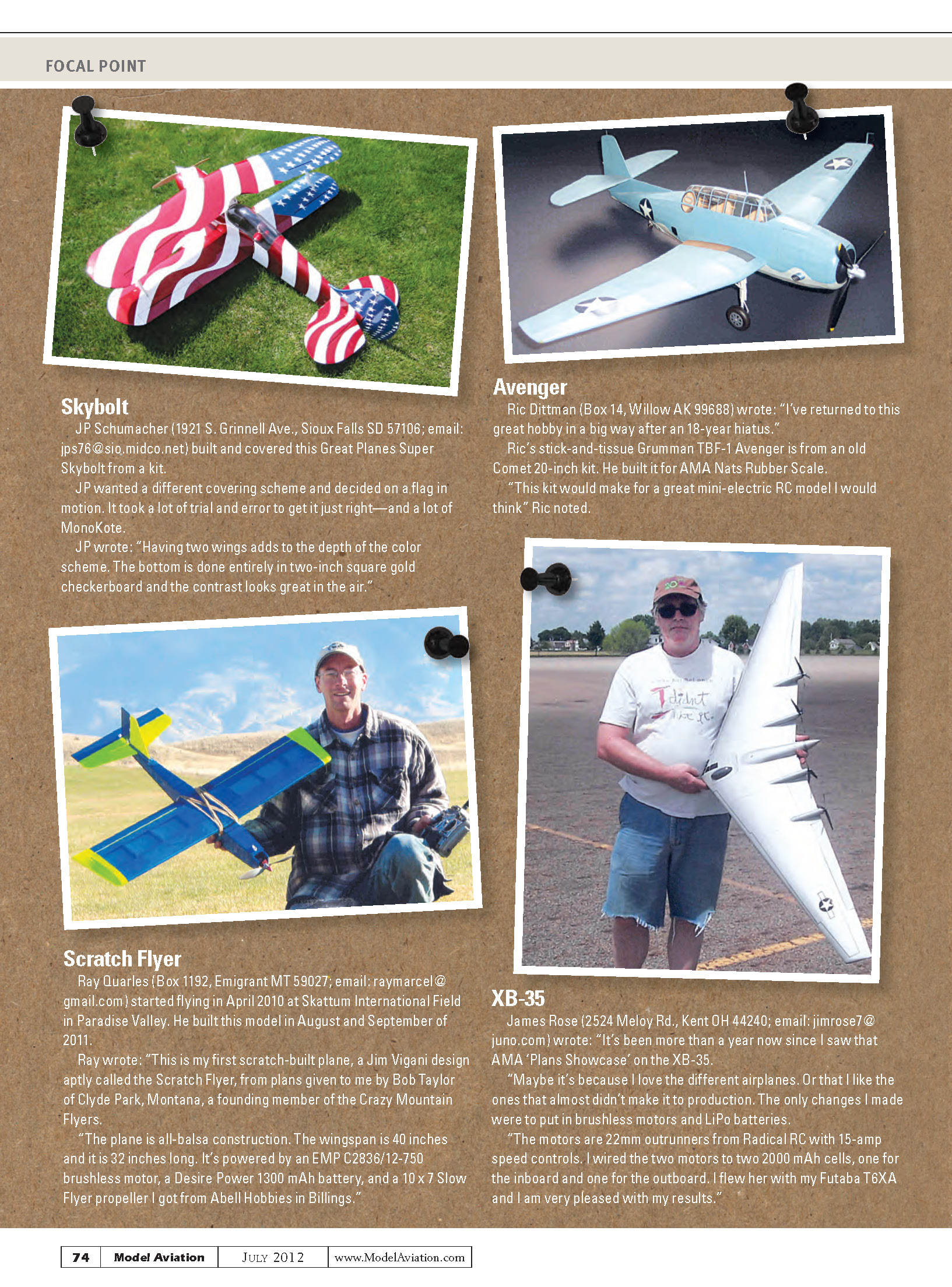
Skybolt
JP Schumacher (1921 S. Grinnell Ave., Sioux Falls, SD 57106; email: [email protected]) built and covered this Great Planes Super Skybolt from a kit.
JP wanted a different covering scheme and decided on a flag in motion. It took a lot of trial and error to get it just right—and a lot of MonoKote.
"Having two wings adds to the depth of the color scheme. The bottom is done entirely in two-inch square gold checkerboard and the contrast looks great in the air," JP wrote.
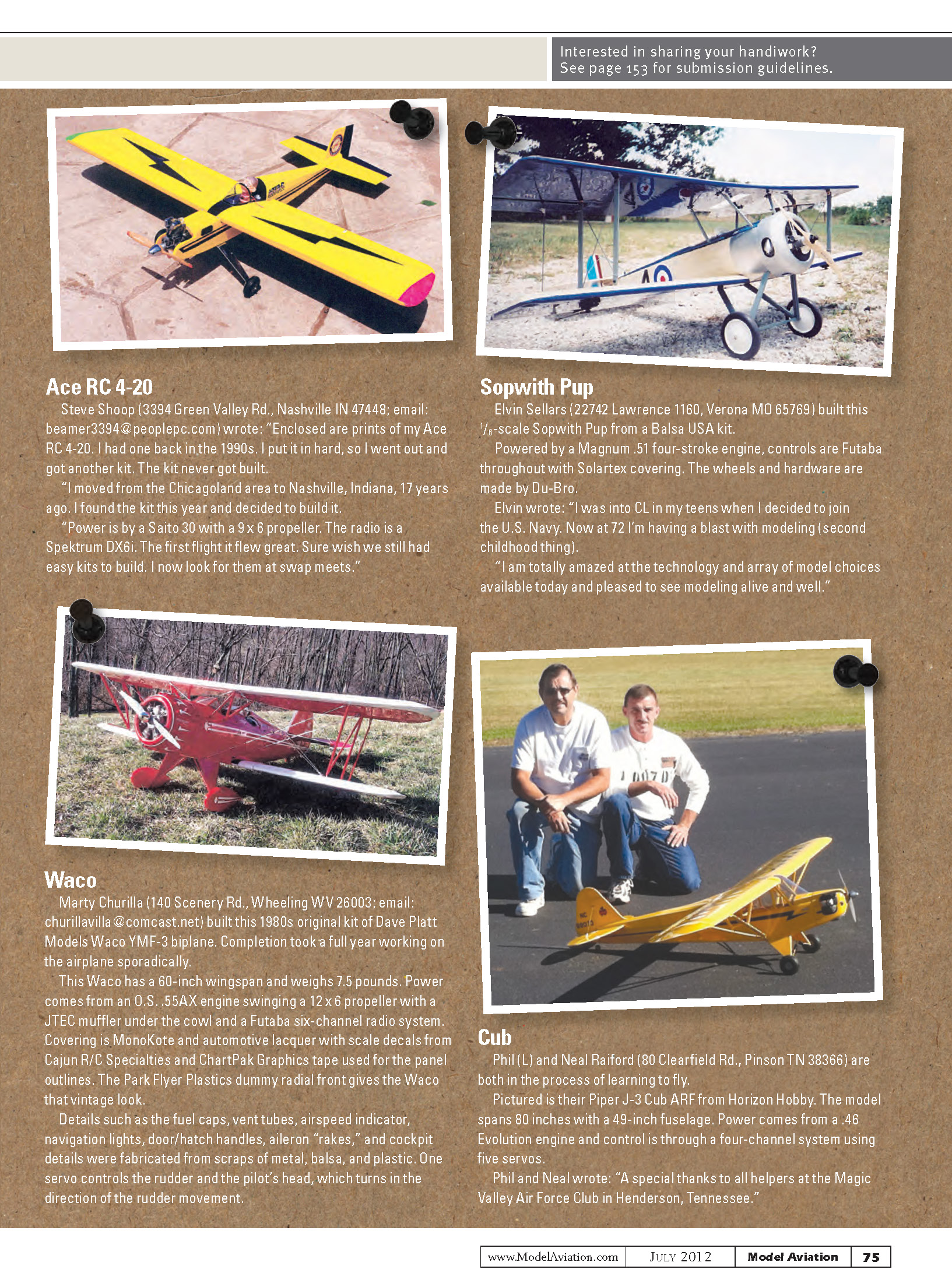
Avenger
Ric Dittman (Box 14, Willow, AK 99688) wrote: "I've returned to this great hobby in a big way after an 18-year hiatus."
Ric's stick-and-tissue Grumman TBF-1 Avenger is from an old Comet 20-inch kit. He built it for AMA Nats Rubber Scale.
"This kit would make for a great mini-electric RC model, I would think," Ric noted.
Scratch Flyer
Ray Quarles (Box 1192, Emigrant, MT 59027; email: [email protected]) started flying in April 2010 at Skattum International Field in Paradise Valley. He built this model in August and September of 2011.
"This is my first scratch-built plane, a Jim Vigani design aptly called the Scratch Flyer, from plans given to me by Bob Taylor of Clyde Park, Montana, a founding member of the Crazy Mountain Flyers," Ray wrote.
The plane is all-balsa construction. The wingspan is 40 inches and it is 32 inches long. It's powered by an EMP C2836/12-750 brushless motor, a Desire Power 1300 mAh battery, and a 10 x 7 Slow Flyer propeller Ray got from Abell Hobbies in Billings.
XB-35
James Rose (2524 Meloy Rd., Kent, OH 44240; email: [email protected]) wrote: "It's been more than a year now since I saw that AMA 'Plans Showcase' on the XB-35.
"Maybe it's because I love the different airplanes. Or that I like the ones that almost didn't make it to production. The only changes I made were to put in brushless motors and LiPo batteries."
The motors are 22mm outrunners from Radical RC with 15-amp speed controls. James wired the two motors to two 2000 mAh cells, one for the inboard and one for the outboard. He flew her with his Futaba T6XA and is very pleased with the results.
Ace RC 4-20
Steve Shoop (3394 Green Valley Rd., Nashville, IN 47448; email: [email protected]) wrote: "Enclosed are prints of my Ace RC 4-20. I had one back in the 1990s. I put it in hard, so I went out and got another kit. The kit never got built.
"I moved from the Chicagoland area to Nashville, Indiana, 17 years ago. I found the kit this year and decided to build it."
Power is by a Saito 30 with a 9 x 6 propeller. The radio is a Spektrum DX6i. On the first flight it flew great. "Sure wish we still had easy kits to build. I now look for them at swap meets," Steve said.
Sopwith Pup
Elvin Sellars (22742 Lawrence 1160, Verona, MO 65769) built this 1/6-scale Sopwith Pup from a Balsa USA kit. It is powered by a Magnum .51 four-stroke engine. Controls are Futaba throughout with Solartex covering. The wheels and hardware are made by Du-Bro.
"I was into CL in my teens when I decided to join the U.S. Navy. Now at 72 I'm having a blast with modeling (second childhood thing)," Elvin wrote.
"I am totally amazed at the technology and array of model choices available today and pleased to see modeling alive and well."
Waco
Marty Churilla (140 Scenery Rd., Wheeling, WV 26003; email: [email protected]) built this 1980s original kit of Dave Platt Models Waco YMF-3 biplane. Completion took a full year working on the airplane sporadically.
This Waco has a 60-inch wingspan and weighs 7.5 pounds. Power comes from an O.S. .55AX engine swinging a 12 x 6 propeller with a JTEC muffler under the cowl. The radio is a Futaba six-channel system. Covering is MonoKote and automotive lacquer with scale decals from Cajun R/C Specialties and ChartPak Graphics tape used for the panel outlines. The Park Flyer Plastics dummy radial front gives the Waco that vintage look.
Details such as the fuel caps, vent tubes, airspeed indicator, navigation lights, door/hatch handles, aileron "rakes," and cockpit details were fabricated from scraps of metal, balsa, and plastic. One servo controls the rudder and the pilot's head, which turns in the direction of the rudder movement.
Cub
Phil (L) and Neal Raiford (80 Clearfield Rd., Pinson, TN 38366) are both in the process of learning to fly.
Pictured is their Piper J-3 Cub ARF from Horizon Hobby. The model spans 80 inches with a 49-inch fuselage. Power comes from a .46 Evolution engine and control is through a four-channel system using five servos.
"A special thanks to all helpers at the Magic Valley Air Force Club in Henderson, Tennessee," Phil and Neal wrote.
Transcribed from original scans by AI. Minor OCR errors may remain.

