
Focal Point - 2015/06
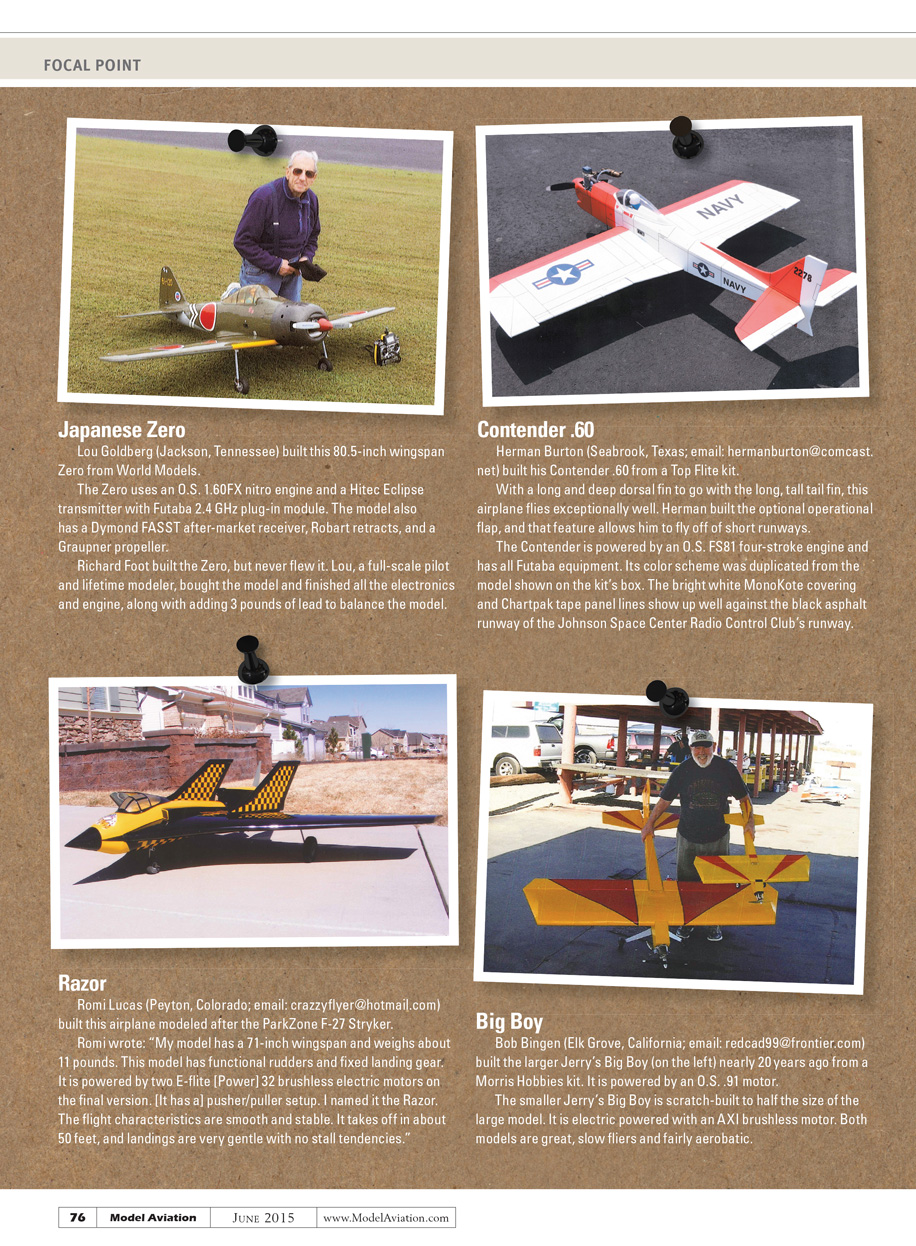
Japanese Zero
Lou Goldberg (Jackson, Tennessee) built this 80.5-inch wingspan Zero from World Models.
The Zero is powered by an O.S. 1.60FX nitro engine and uses a Hitec Eclipse transmitter with a Futaba 2.4 GHz plug-in module. The radio system includes a Dymond FASST aftermarket receiver. Other equipment includes Robart retracts and a Graupner propeller.
Richard Foot originally built the Zero but never flew it. Lou, a full-scale pilot and lifetime modeler, bought the model, finished the electronics and engine installation, and added 3 pounds of lead to properly balance the airplane.
Razor
Romi Lucas (Peyton, Colorado; email: [email protected]) built this airplane modeled after the ParkZone F-27 Stryker and named it the Razor.
The model has a 71-inch wingspan and weighs about 11 pounds. It features functional rudders and fixed landing gear. The final version is powered by two E-flite Power 32 brushless electric motors in a push-pull configuration. Flight characteristics are smooth and stable; it takes off in about 50 feet and lands gently with no stall tendencies.
Contender .60
Herman Burton (Seabrook, Texas; email: [email protected]) built his Contender .60 from a Top Flite kit.
The airplane has a long, deep dorsal fin and a tall tail fin and flies exceptionally well. Herman installed the optional operational flap, which allows operations from short runways. It is powered by an O.S. FS81 four-stroke engine and uses all Futaba radio equipment. The color scheme duplicates the model shown on the kit box. The bright white MonoKote covering and Chartpak tape panel lines contrast well against the black asphalt runway of the Johnson Space Center Radio Control Club.
Big Boy
Bob Bingen (Elk Grove, California; email: [email protected]) built the larger Jerry’s Big Boy nearly 20 years ago from a Morris Hobbies kit. The large Big Boy is powered by an O.S. .91 motor.
The smaller Jerry’s Big Boy is a scratch-built half-scale version. It is electric powered with an AXI brushless motor. Both models are slow, stable fliers and are fairly aerobatic.
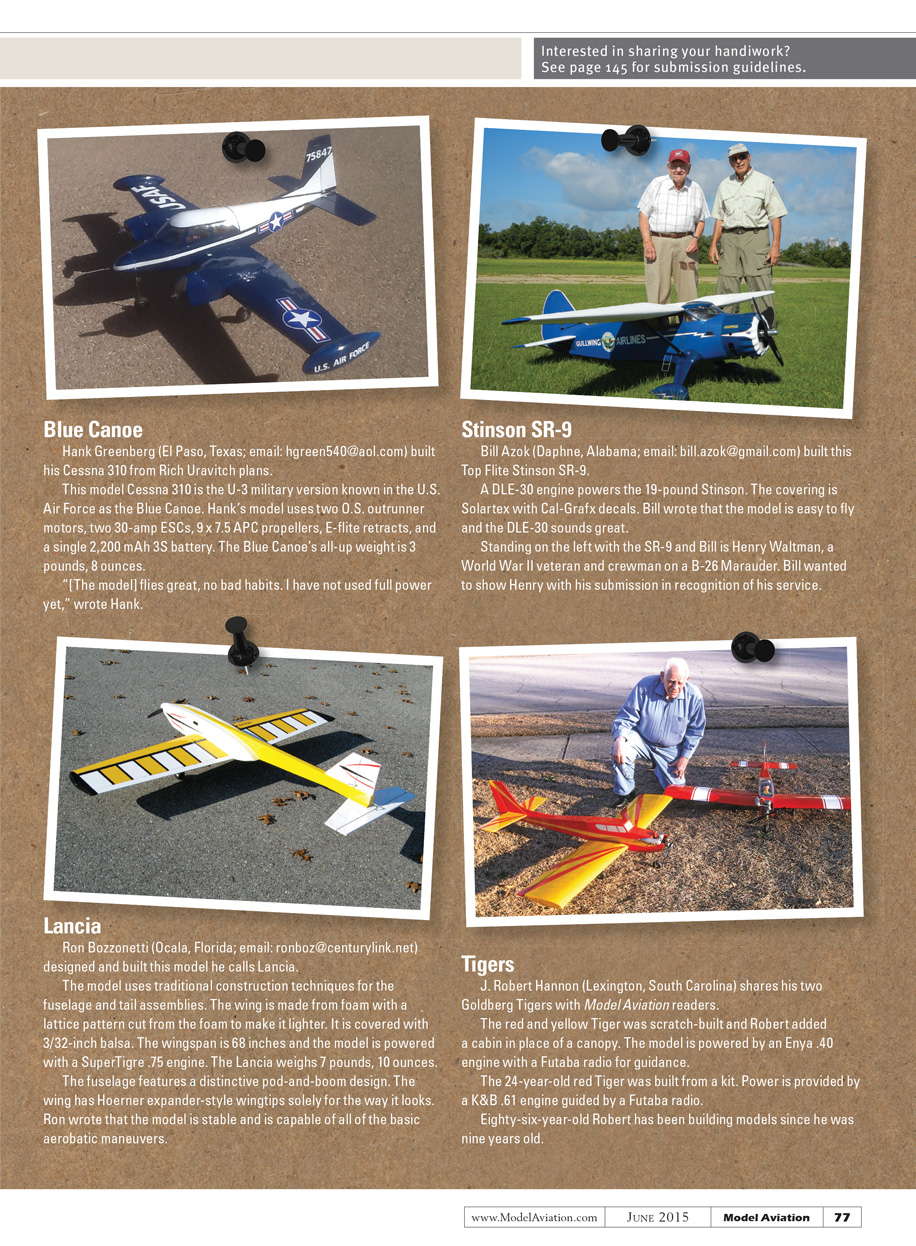
Blue Canoe
Hank Greenberg (El Paso, Texas; email: [email protected]) built his Cessna 310 from Rich Uravitch plans.
This model represents the U-3 military version known in the U.S. Air Force as the Blue Canoe. Hank’s model uses two O.S. outrunner motors, two 30-amp ESCs, 9 x 7.5 APC propellers, E-flite retracts, and a single 2,200 mAh 3S battery. The all-up weight is 3 pounds, 8 ounces. “[The model] flies great, no bad habits. I have not used full power yet,” wrote Hank.
Stinson SR-9
Bill Azok (Daphne, Alabama; email: [email protected]) built this Top Flite Stinson SR-9.
A DLE-30 engine powers the 19-pound Stinson. The covering is Solartex with Cal-Grafx decals. Bill reports the model is easy to fly and the DLE-30 sounds great. Standing on the left in the photo with Bill is Henry Waltman, a World War II veteran and crewman on a B-26 Marauder; Bill included Henry to recognize his service.
Lancia
Ron Bozzonetti (Ocala, Florida; email: [email protected]) designed and built this model he calls Lancia.
The fuselage and tail assemblies use traditional balsa-and-plywood construction. The wing is foam with a lattice pattern cut from the foam for weight savings and is covered with 3/32-inch balsa. Wingspan is 68 inches and the model is powered by a SuperTigre .75 engine. The Lancia weighs 7 pounds, 10 ounces. The fuselage features a distinctive pod-and-boom design, and the wing has Hoerner-expander-style wingtips primarily for appearance. Ron reports the model is stable and capable of all basic aerobatic maneuvers.
Tigers
J. Robert Hannon (Lexington, South Carolina) shares two Goldberg Tiger models.
The red-and-yellow Tiger was scratch-built; Robert added a cabin in place of a canopy. It is powered by an Enya .40 engine and flown with a Futaba radio. The other Tiger is a 24-year-old kit-built model powered by a K&B .61 engine with Futaba radio gear. Eighty-six-year-old Robert has been building models since he was nine years old.
Transcribed from original scans by AI. Minor OCR errors may remain.

