
Focal Point
Model Aviation, <REDACTED>
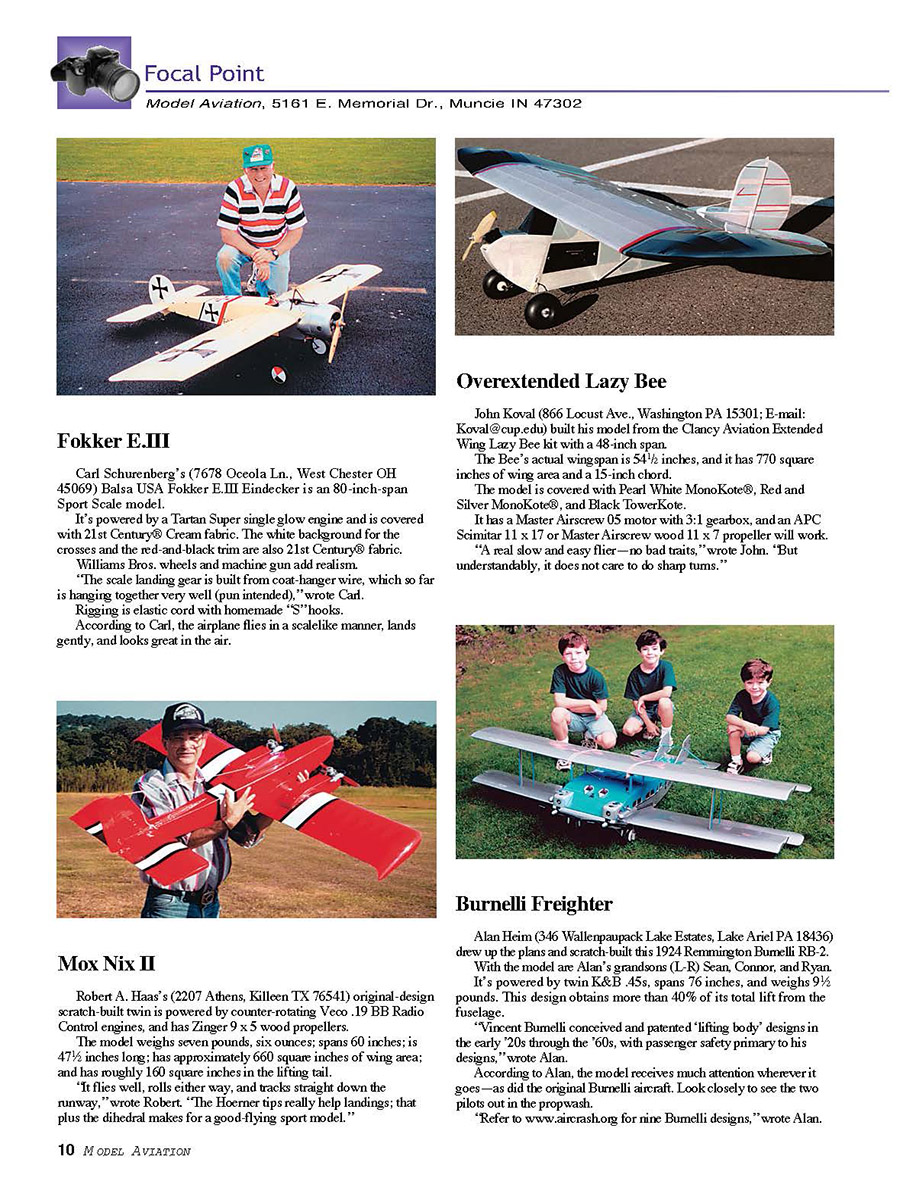
Fokker E.III
Carl Schurenberg (<REDACTED>) Balsa USA Fokker E.III Eindecker is an 80-inch-span Sport Scale model.
It's powered by a Tartan Super single glow engine and is covered with 21st Century Cream fabric. The white background for the crosses and the red-and-black trim are also 21st Century fabric. Williams Bros. wheels and machine gun add realism.
"The scale landing gear is built from coat-hanger wire, which so far is hanging together very well (pun intended)," wrote Carl.
Rigging is elastic cord with homemade "S" hooks.
According to Carl, the airplane flies in a scale-like manner, lands gently, and looks great in the air.
Overextended Lazy Bee
John Koval (<REDACTED>) built this model from the Clancy Aviation Extended Wing Lazy Bee kit with a 48-inch span.
The Bee's actual wingspan is 54½ inches, and it has 770 square inches of wing area and a 15-inch chord.
The model is covered with Pearl White MonoKote, Red and Silver MonoKote, and Black TowerKote.
It has a Master Airscrew .05 motor with 3:1 gearbox, and an APC Scimitar 11 x 17 or Master Airscrew wood 11 x 7 propeller will work.
"A real slow and easy flier—no bad traits," wrote John. "But, understandably, it does not care to do sharp turns."
Mox Nix II
Robert A. Haas (<REDACTED>) original-design scratch-built twin is powered by counter-rotating Veco .19 BB Radio Control engines, and has Zinger 9 x 5 wood propellers.
The model weighs seven pounds, six ounces; spans 60 inches; is 47½ inches long; has approximately 660 square inches of wing area; and has roughly 160 square inches in the lifting tail.
"It flies well, rolls either way, and tracks straight down the runway," wrote Robert. "The Hoerner tips really help landings; that plus the dihedral makes for a good-flying sport model."
Burnelli Freighter
Alan Heim (<REDACTED>) drew up the plans and scratch-built this 1924 Remington Burnelli RB-2.
With the model are Alan's grandsons (L–R) Sean, Connor, and Ryan. It's powered by twin K&B .45s, spans 76 inches, and weighs 9½ pounds. This design obtains more than 40% of its total lift from the fuselage.
"Vincent Burnelli conceived and patented 'lifting body' designs in the early '20s through the '60s, with passenger safety primary to his designs," wrote Alan.
According to Alan, the model receives much attention wherever it goes—as did the original Burnelli aircraft. Look closely to see the two pilots out in the open.
"Refer to www.aircrash.org for nine Burnelli designs," wrote Alan.
Focal Point
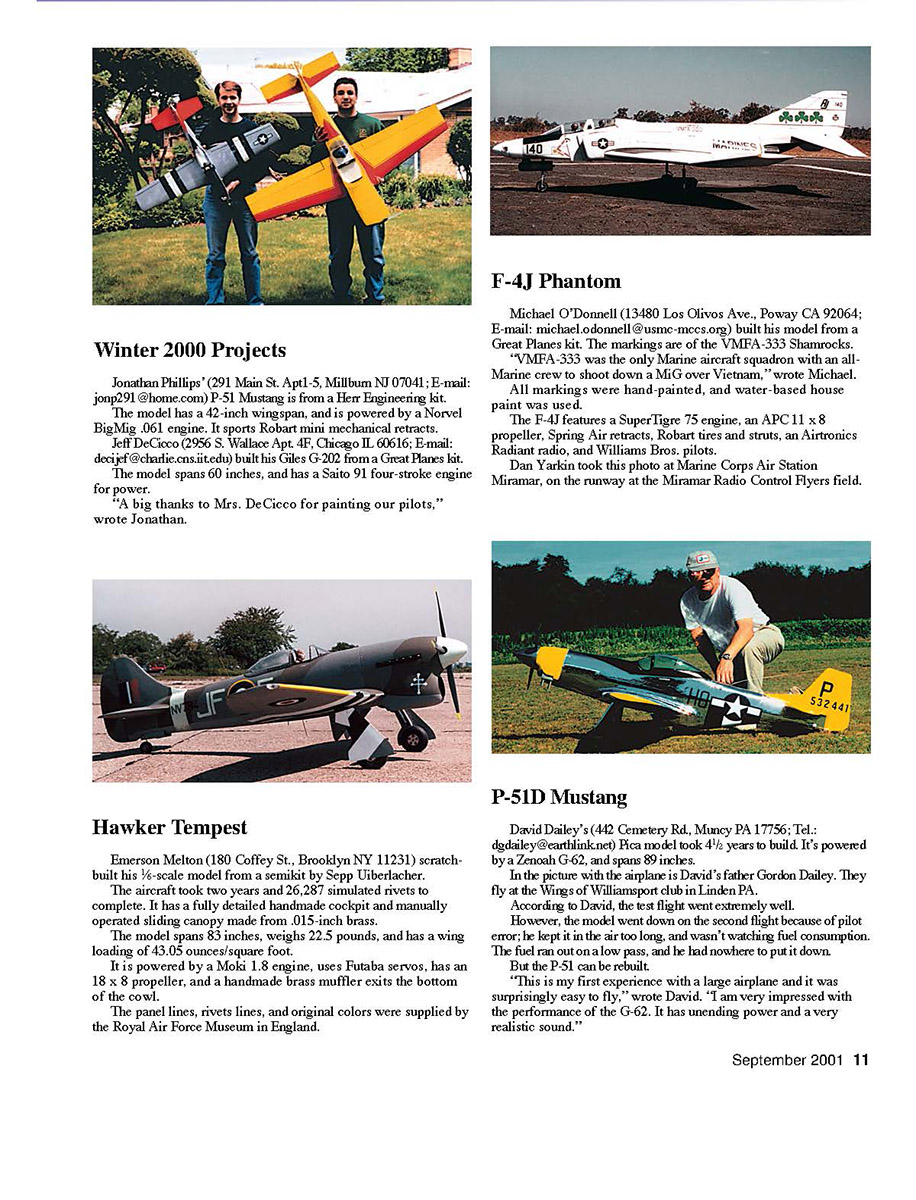
Winter 2000 Projects
Jonathan Phillips (<REDACTED>) P-51 Mustang is from a Herr Engineering kit. The model has a 42-inch wingspan, and is powered by a Norvel BigMig .061 engine. It sports Robart mini mechanical retracts.
Jeff DeCicco (<REDACTED>) built his Giles G-202 from a Great Planes kit. The model spans 60 inches, and has a Saito 91 four-stroke engine for power.
"A big thanks to Mrs. DeCicco for painting our pilots," wrote Jonathan.
F-4J Phantom
Michael O’Donnell (<REDACTED>) built his model from a Great Planes kit. The markings are of the VMFA-333 Shamrocks.
"VMFA-333 was the only Marine aircraft squadron with an all-Marine crew to shoot down a MiG over Vietnam," wrote Michael. All markings were hand-painted, and water-based house paint was used.
The F-4J features a SuperTiger 75 engine, an APC 11 x 8 propeller, Spring Air retracts, Robart tires and struts, an Airtronics Radiant radio, and Williams Bros. pilots.
Dan Yarkin took this photo at Marine Corps Air Station Miramar, on the runway at the Miramar Radio Control Flyers field.
Hawker Tempest
Emerson Melton (<REDACTED>) scratch-built his 1/5-scale model from a semikit by Sepp Uberlacher. The aircraft took two years and 26,287 simulated rivets to complete. It has a fully detailed handmade cockpit and manually operated sliding canopy made from .015-inch brass.
The model spans 83 inches, weighs 22.5 pounds, and has a wing loading of 43.05 ounces/square foot.
It is powered by a Moki 1.8 engine, uses Futaba servos, has an 18 x 8 propeller, and a handmade brass muffler exits the bottom of the cowl.
The panel lines, rivet lines, and original colors were supplied by the Royal Air Force Museum in England.
P-51D Mustang
David Dailey (<REDACTED>) P-51 model took 4½ years to build. It’s powered by a Zenoah G-62, and spans 89 inches.
In the picture with the airplane is David’s father Gordon Dailey. They fly at the Wings of Williamsport club in Linden, PA.
According to David, the test flight went extremely well. However, the model went down on the second flight because of pilot error; he kept it in the air too long, and wasn’t watching fuel consumption. The fuel ran out on a low pass, and he had nowhere to put it down. But the P-51 can be rebuilt.
"This is my first experience with a large airplane and it was surprisingly easy to fly," wrote David. "I am very impressed with the performance of the G-62. It has unending power and a very realistic sound."
Focal Point
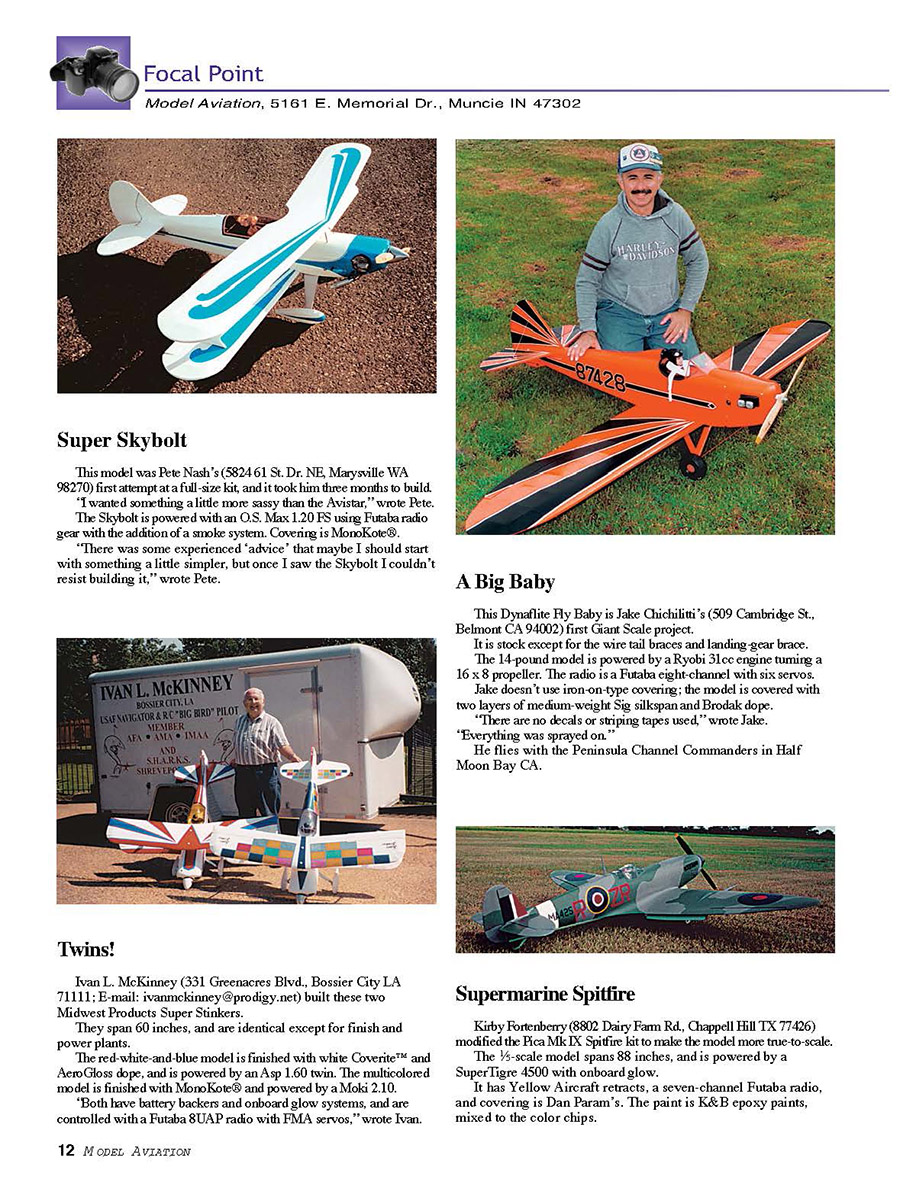
Super Skybolt
This model was Pete Nash’s (<REDACTED>) first attempt at a full-size kit, and it took him three months to build. "I wanted something a little more sassy than the Avistar," wrote Pete. The Skybolt is powered with an O.S. Max 1.20 FS using Futaba radio gear with the addition of a smoke system. Covering is MonoKote. "There was some experienced 'advice' that maybe I should start with something a little simpler, but once I saw the Skybolt I couldn't resist building it," wrote Pete.
A Big Baby
This Dynaflite Fly Baby is Jake Chichilitti’s (<REDACTED>) first Giant Scale project.
It is stock except for the wire tail braces and landing-gear brace. The 14-pound model is powered by a Ryobi 31cc engine turning a 16 x 8 propeller. The radio is a Futaba eight-channel with six servos. Jake doesn’t use iron-on type covering; the model is covered with two layers of medium-weight Sig silkspan and Brodak dope. "There are no decals or striping tapes used," wrote Jake. "Everything was sprayed on."
He flies with the Peninsula Channel Commanders in Half Moon Bay, CA.
Twins!
Ivan L. McKinney (<REDACTED>) built these two Midwest Products Super Stinkers.
They span 60 inches, and are identical except for finish and power plants.
- The red-white-and-blue model is finished with white Coverite and AeroGloss dope, and is powered by an ASP 1.60 twin.
- The multicolored model is finished with MonoKote and powered by a Moki 2.10.
"Both have battery backers and onboard glow systems, and are controlled with a Futaba 8UAP radio with FMA servos," wrote Ivan.
Supermarine Spitfire
Kirby Fortenberry (<REDACTED>) modified the Pica Mk IX Spitfire kit to make the model more true-to-scale.
The 3/4-scale model spans 88 inches, and is powered by a SuperTiger 4500 with onboard glow.
It has Yellow Aircraft retracts, a seven-channel Futaba radio, and covering is Dan Parma's. The paint is K&B epoxy paints, mixed to the color chips.
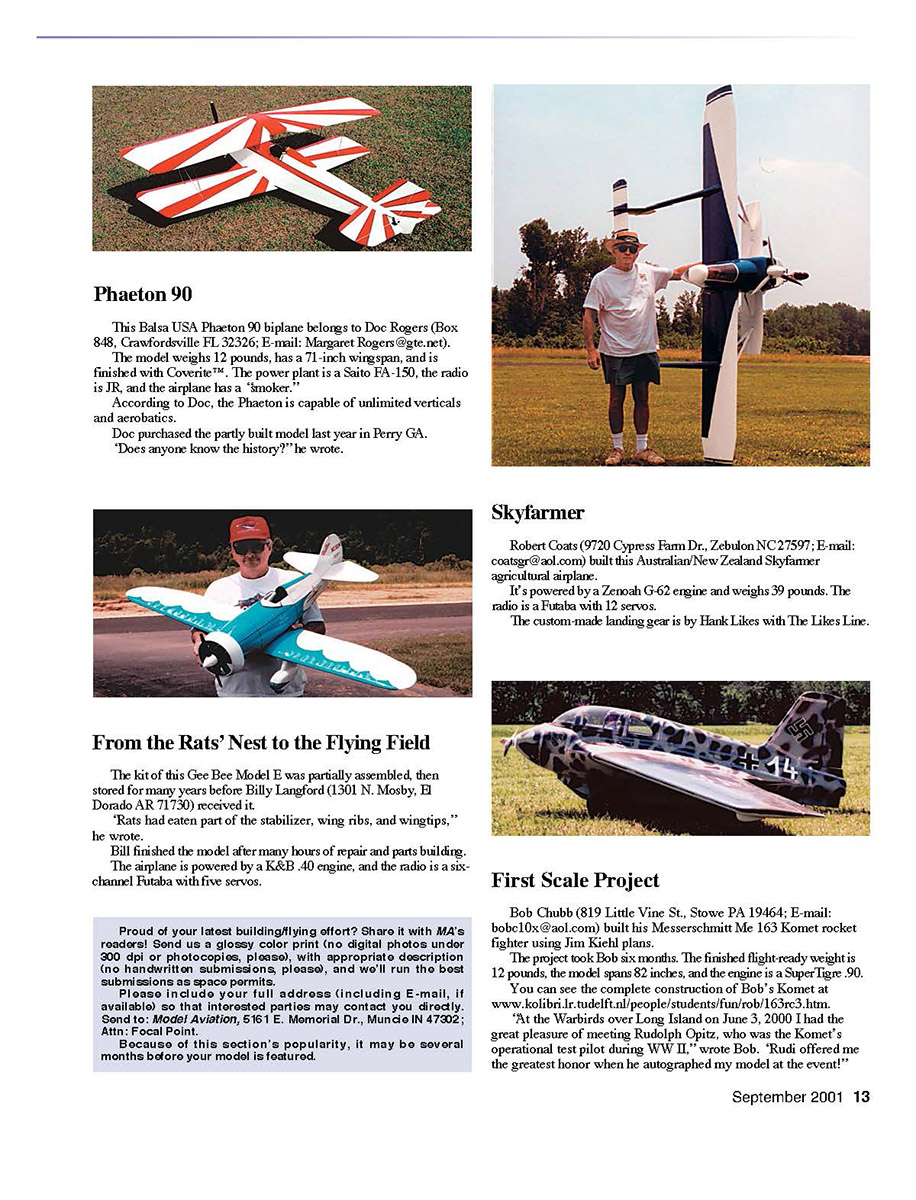
Phaeton 90
This Balsa USA Phaeton 90 biplane belongs to Doc Rogers (<REDACTED>).
The model weighs 12 pounds, has a 71-inch wingspan, and is finished with Coverite. The power plant is a Saito FA-150, the radio is JR, and the airplane has a "smoker."
According to Doc, the Phaeton is capable of unlimited verticals and aerobatics.
Doc purchased the partly built model last year in Perry, GA. "Does anyone know the history?" he wrote.
Skyfarmer
Robert Coats (<REDACTED>) built this Australian/New Zealand Skyfarmer agricultural airplane.
It's powered by a Zenoah G-62 engine and weighs 39 pounds. The radio is a Futaba with 12 servos.
The custom-made landing gear is by Hank Likes with The Likes Line.
From the Rats' Nest to the Flying Field
The kit of this Gee Bee Model E was partially assembled, then stored for many years before Billy Langford (<REDACTED>) received it.
"Rats had eaten part of the stabilizer, wing ribs, and wingtips," he wrote.
Bill finished the model after many hours of repair and parts building. The airplane is powered by a K&B .40 engine, and the radio is a six-channel Futaba with five servos.
Proud of your latest building/flying effort? Share it with MA's readers! Send us a glossy color print (no digital photos under 300 dpi or photocopies, please), with appropriate description (no handwritten submissions, please), and we'll run the best submissions as space permits.
Please include your full address (including E-mail, if available) so that interested parties may contact you directly. Send to: Model Aviation, <REDACTED>; Attn: Focal Point.
Because of this section's popularity, it may be several months before your model is featured.
First Scale Project
Bob Chubb (<REDACTED>) built his Messerschmitt Me 163 Komet rocket fighter using Jim Keihl plans.
The project took Bob six months. The finished flight-ready weight is 12 pounds, the model spans 82 inches, and the engine is a Super Tigre .90.
You can see the complete construction of Bob's Komet at www.kolibri.tudelft.nl/people/students/fun/rob/163rc3.htm.
"At the Warbirds over Long Island on June 3, 2000 I had the great pleasure of meeting Rudolph Opitz, who was the Komet's operational test pilot during WW II," wrote Bob. "Rudi offered me the greatest honor when he autographed my model at the event!"
Transcribed from original scans by AI. Minor OCR errors may remain.

