
Focal Point
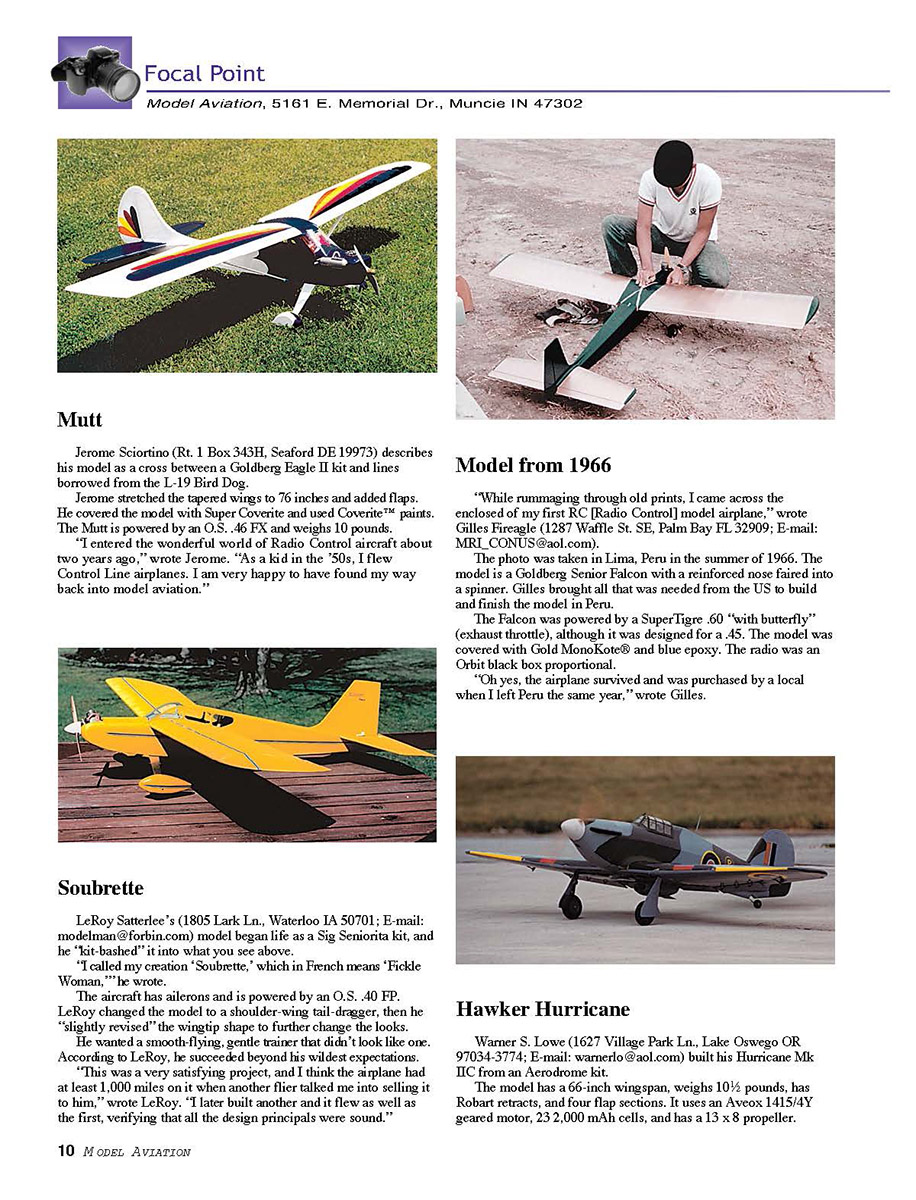
Mutt
Jerome Sciortino (Rt. 1 Box 343H, Seaford DE 19973) describes his model as a cross between a Goldberg Eagle II kit and lines borrowed from the L-19 Bird Dog.
Jerome stretched the tapered wings to 76 inches and added flaps. He covered the model with Super Coverite and used Coverite paints. The Mutt is powered by an O.S. .46 FX and weighs 10 pounds.
"I entered the wonderful world of Radio Control aircraft about two years ago," wrote Jerome. "As a kid in the '50s, I flew Control Line airplanes. I am very happy to have found my way back into model aviation."
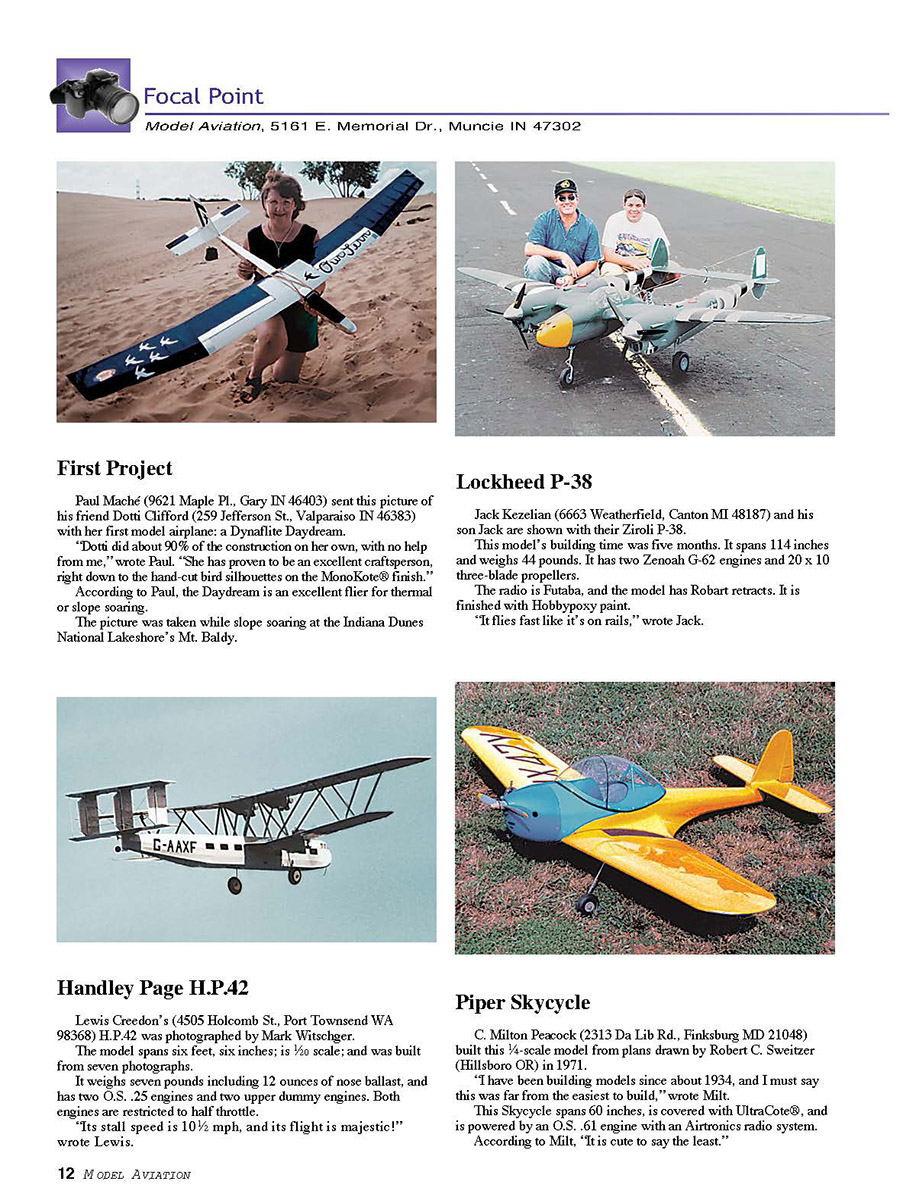
Soubrette
LeRoy Satterlee (1805 Lark Ln., Waterloo IA 50701; E-mail: [email protected]) says his model began life as a Sig Seniorita kit, and he "kit-bashed" it into what you see above.
"I called my creation 'Soubrette,' which in French means 'Fickle Woman,'" he wrote.
The aircraft has ailerons and is powered by an O.S. .40 FP. LeRoy changed the model to a shoulder-wing tail-dragger, then he slightly revised the wingtip shape to further change the looks.
He wanted a smooth-flying, gentle trainer that didn't look like one. According to LeRoy, he succeeded beyond his wildest expectations.
"This was a very satisfying project, and I think the airplane had at least 1,000 miles on it when another flier talked me into selling it to him," wrote LeRoy. "I later built another and it flew as well as the first, verifying that all the design principles were sound."
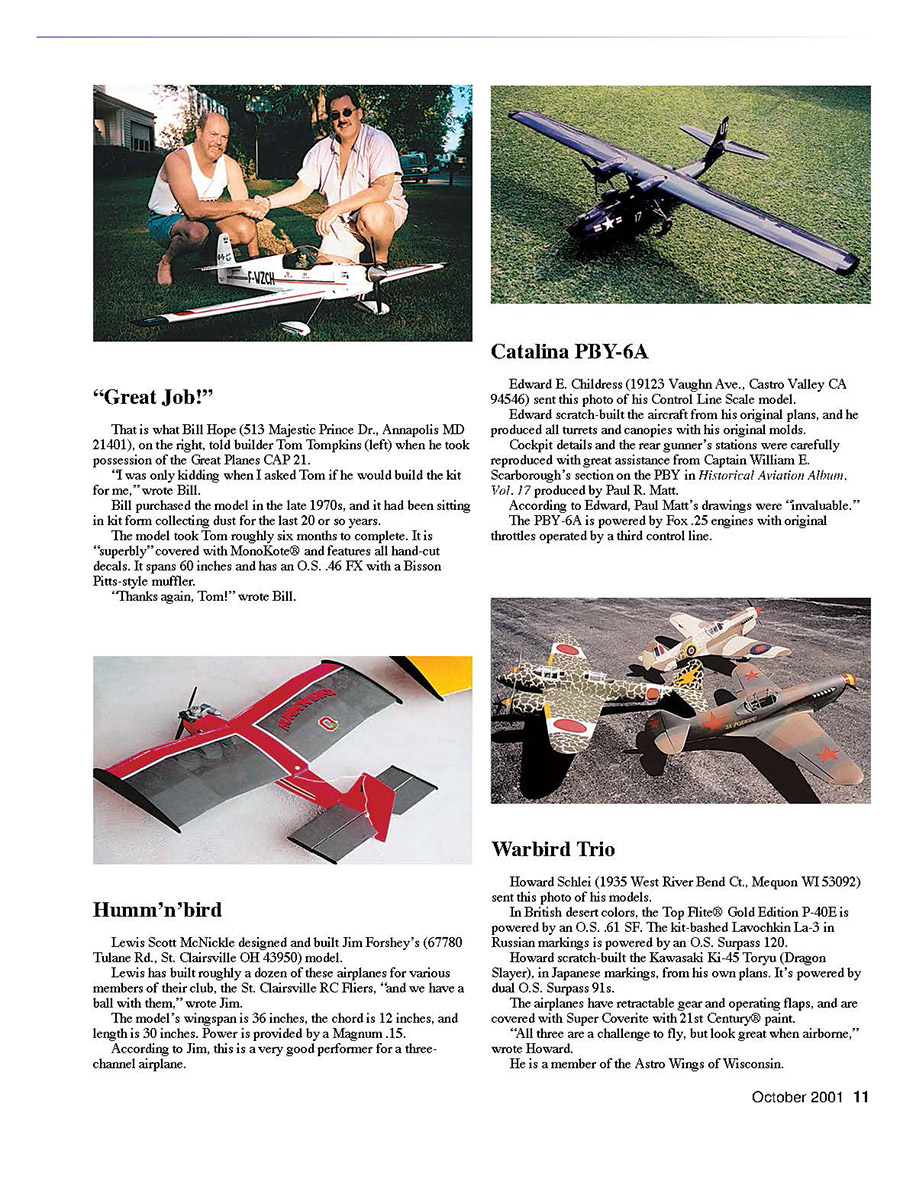
Model from 1966
"While rummaging through old prints, I came across the enclosed of my first RC [Radio Control] model airplane," wrote Gilles Fireagle (1287 Waffle St. SE, Palm Bay FL 32909; E-mail: [email protected]).
The photo was taken in Lima, Peru in the summer of 1966. The model is a Goldberg Senior Falcon with a reinforced nose faired into a spinner. Gilles brought all that was needed from the US to build and finish the model in Peru.
The Falcon was powered by a SuperTigre .60 "with butterfly" (exhaust throttle), although it was designed for a .45. The model was covered with Gold MonoKote® and blue epoxy. The radio was an Orbit black box proportional.
"Oh yes, the airplane survived and was purchased by a local when I left Peru the same year," wrote Gilles.
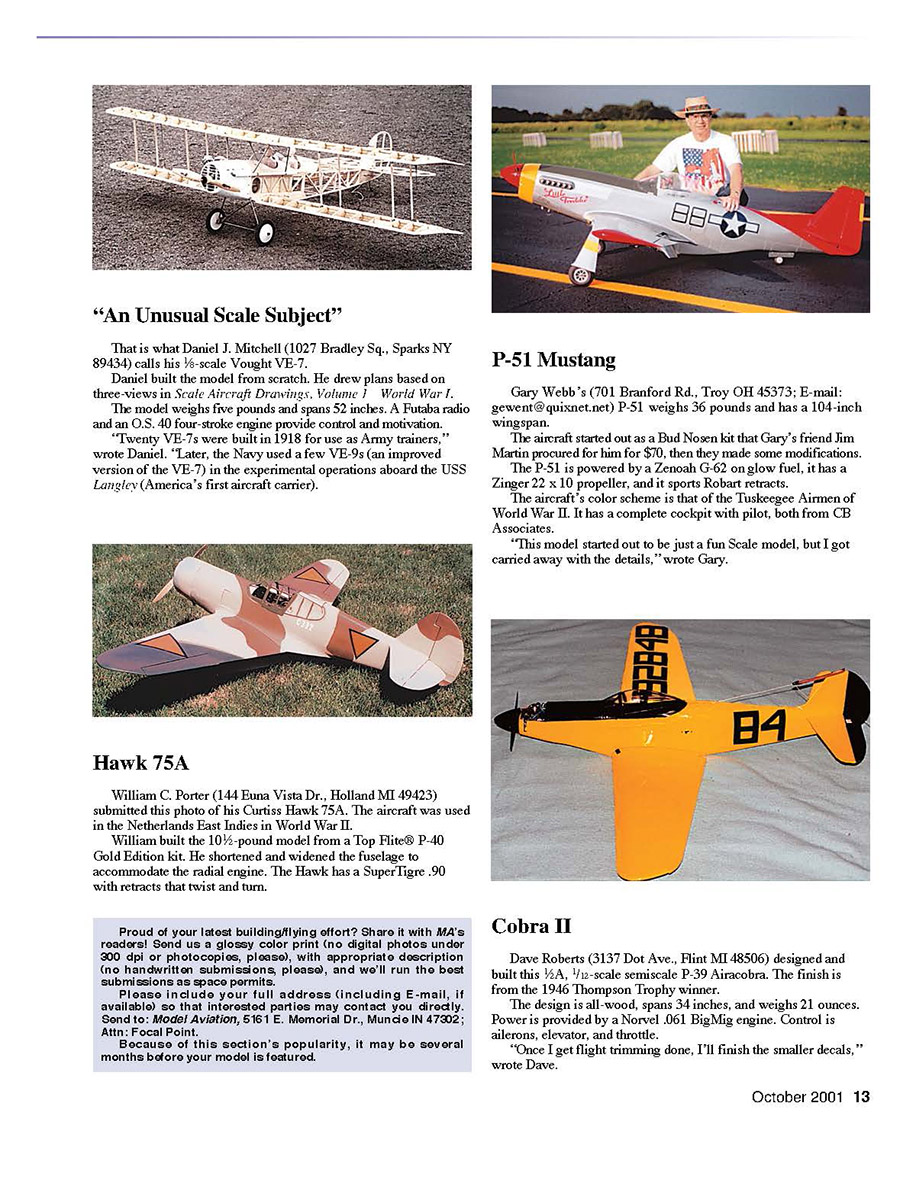
Hawker Hurricane
Warner S. Lowe (1627 Village Park Ln., Lake Oswego OR 97034-3774; E-mail: [email protected]) built his Hurricane Mk IIc from an Aerodrome kit.
The model has a 66-inch wingspan, weighs 10½ pounds, has Robart retracts, and four flap sections. It uses an Aveox 1415/4Y geared motor, 23 2,000 mAh cells, and has a 13 x 8 propeller.
"Great Job!"
That is what Bill Hope (513 Majestic Prince Dr., Annapolis MD 21401), on the right, told builder Tom Tompkins (left) when he took possession of the Great Planes CAP 21.
"I was only kidding when I asked Tom if he would build the kit for me," wrote Bill.
Bill purchased the model in the late 1970s, and it had been sitting in kit form collecting dust for the last 20 or so years. The model took Tom roughly six months to complete. It is superbly covered with MonoKote® and features all hand-cut decals. It spans 60 inches and has an O.S. .46 FX with a Bisson Pitts-style muffler.
"Thanks again, Tom!" wrote Bill.
Humm'n'bird
Lewis Scott McNickle designed and built Jim Forshey's (67780 Tulane Rd., St. Clairsville OH 43950) model.
Lewis has built roughly a dozen of these airplanes for various members of their club, the St. Clairsville RC Fliers, "and we have a ball with them," wrote Jim.
The model's wingspan is 36 inches, the chord is 12 inches, and length is 30 inches. Power is provided by a Magnum .15.
According to Jim, this is a very good performer for a three-channel airplane.
Catalina PBY-6A
Edward E. Childress (19123 Vaughn Ave., Castro Valley CA 94546) sent this photo of his Control Line scale model.
Edward scratch-built the aircraft from his original plans, and he produced all turrets and canopies with his original molds. Cockpit details and the rear gunner's stations were carefully reproduced with great assistance from Captain William E. Scarborough's section on the PBY in Historical Aviation Album, Vol. 17 produced by Paul R. Matt.
According to Edward, Paul Matt's drawings were invaluable.
The PBY-6A is powered by Fox .25 engines with original throttles operated by a third control line.
Warbird Trio
Howard Schlei (1935 West River Bend Ct., Mequon WI 53092) sent this photo of his models.
In British desert colors, the Top Flite® Gold Edition P-40E is powered by an O.S. .61 SF. The kit-bashed Lavochkin La-3 in Russian markings is powered by an O.S. Surpass 120.
Howard scratch-built the Kawasaki Ki-45 Toryu (Dragon Slayer), in Japanese markings, from his own plans. It's powered by dual O.S. Surpass 91s.
The airplanes have retractable gear and operating flaps, and are covered with Super Coverite with 21st Century® paint.
"All three are a challenge to fly, but look great when airborne," wrote Howard.
He is a member of the Astro Wings of Wisconsin.
Focal Point
First Project
Paul Maché (9621 Maple Pl., Gary IN 46403) sent this picture of his friend Dotti Clifford (259 Jefferson St., Valparaiso IN 46383) with her first model airplane: a Dynaflite Daydream.
"Dotti did about 90% of the construction on her own, with no help from me," wrote Paul. "She has proven to be an excellent craftsperson, right down to the hand-cut bird silhouettes on the MonoKote® finish."
According to Paul, the Daydream is an excellent flier for thermal or slope soaring. The picture was taken while slope soaring at the Indiana Dunes National Lakeshore's Mt. Baldy.
Lockheed P-38
Jack Kezelian (6663 Weatherfield, Canton MI 48187) and his son Jack are shown with their Ziroli P-38.
This model's building time was five months. It spans 114 inches and weighs 44 pounds. It has two Zenoah G-62 engines and 20 x 10 three-blade propellers.
The radio is Futaba, and the model has Robart retracts. It is finished with Hobbycote paint.
"It flies fast like it's on rails," wrote Jack.
Handley Page H.P.42
Byres Croedon (4505 Holcomb St., Port Townsend WA 98368) H.P.42 was photographed by Mark Witschger.
The model spans six feet, six inches; is 1/20 scale; and was built from seven photographs. It weighs seven pounds including 12 ounces of nose ballast, and has two O.S. .25 engines and two upper dummy engines. Both engines are restricted to half throttle.
"Its stall speed is 10 1/2 mph, and its flight is majestic!" wrote Byres.
Piper Skycycle
C. Milton Peacock (2313 Da Lib Rd., Finksburg MD 21048) built this 1/4-scale model from plans drawn by Robert C. Sweitzer (Hillsboro OR) in 1971.
"I have been building models since about 1934, and I must say this was far from the easiest to build," wrote Milt.
This Skycycle spans 60 inches, is covered with UltraCote®, and is powered by an O.S. .61 engine with an Airtronics radio system.
According to Milt, "It is cute to say the least."
An Unusual Scale Subject
That is what Daniel J. Mitchell (1027 Bradley Sq., Sparks NY 89434) calls his 1/8-scale Vought VE-7.
Daniel built the model from scratch. He drew plans based on three-views in Scale Aircraft Drawings, Volume I — World War I.
The model weighs five pounds and spans 52 inches. A Futaba radio and an O.S. 40 four-stroke engine provide control and motivation.
"Twenty VE-7s were built in 1918 for use as Army trainers," wrote Daniel. "Later, the Navy used a few VE-9s (an improved version of the VE-7) in experimental operations aboard the USS Langley (America's first aircraft carrier)."
P-51 Mustang
Gary Webb (701 Branford Rd., Troy OH 45373; E-mail: [email protected]) P-51 weighs 36 pounds and has a 104-inch wingspan.
The aircraft started out as a Bud Nosen kit that Gary's friend Jim Martin procured for him for $70, then they made some modifications.
The P-51 is powered by a Zenoah G-62 on glow fuel, has a Zinger 22 x 10 propeller, and sports Robart retracts.
The aircraft's color scheme is that of the Tuskegee Airmen of World War II. It has a complete cockpit with pilot, both from CB Associates.
"This model started out to be just a fun Scale model, but I got carried away with the details," wrote Gary.
Hawk 75A
William C. Porter (144 Euna Vista Dr., Holland MI 49423) submitted this photo of his Curtiss Hawk 75A. The aircraft was used in the Netherlands East Indies in World War II.
William built the 10½-pound model from a Top Flite® P-40 Gold Edition kit. He shortened and widened the fuselage to accommodate the radial engine. The Hawk has a SuperTigre .90 with retracts that twist and turn.
Cobra II
Dave Roberts (3137 Dot Ave., Flint MI 48506) designed and built this 1/4, 1/12-scale semiscale P-39 Airacobra. The finish is from the 1946 Thompson Trophy winner.
The design is all-wood, spans 34 inches, and weighs 21 ounces. Power is provided by a Norvel .061 BigMig engine. Control is ailerons, elevator, and throttle.
"Once I get flight trimming done, I'll finish the smaller decals," wrote Dave.
Transcribed from original scans by AI. Minor OCR errors may remain.

