
Focal Point
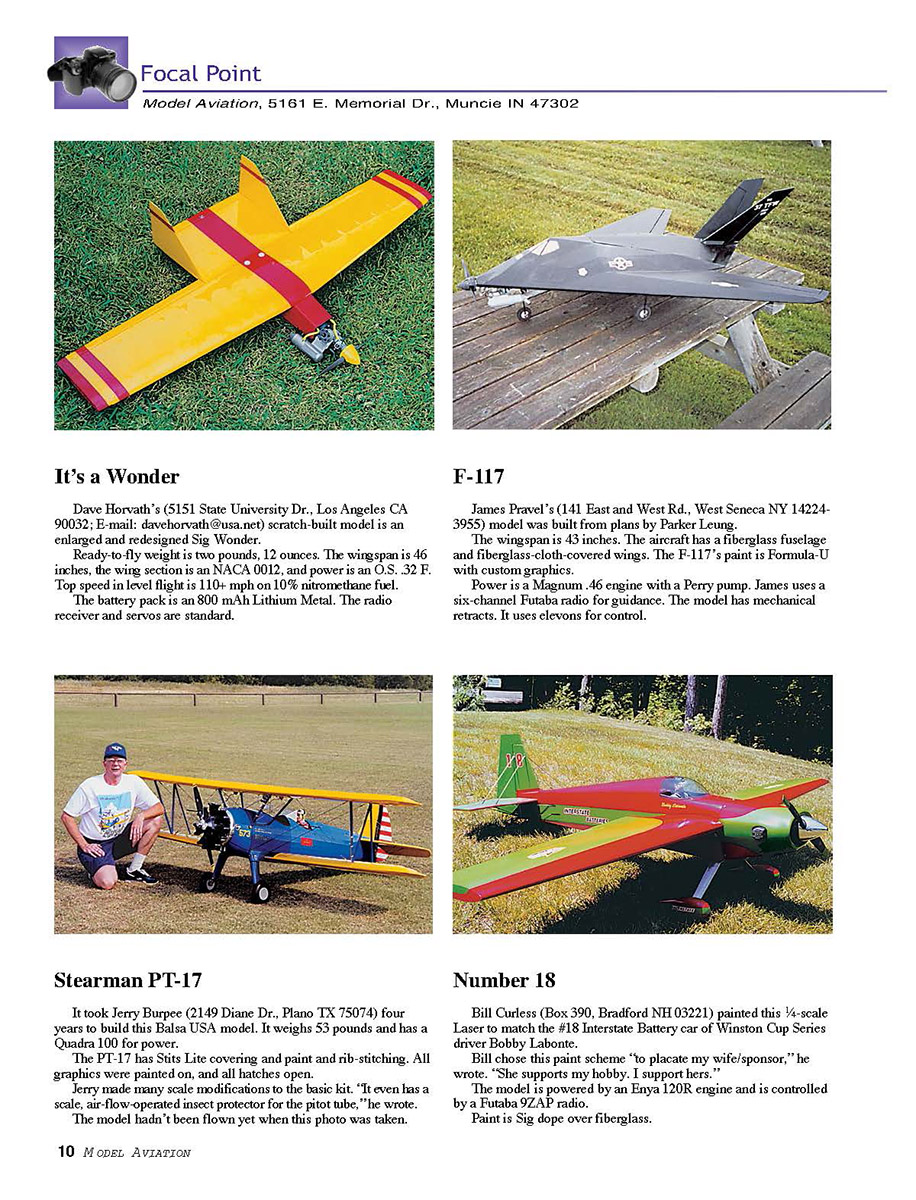
It's a Wonder
Dave Horvath's (5151 State University Dr., Los Angeles CA 90032; E-mail: [email protected]) scratch-built model is an enlarged and redesigned Sig Wonder.
Ready-to-fly weight is two pounds, 12 ounces. The wingspan is 46 inches, the wing section is an NACA 0012, and power is an O.S. .32 F. Top speed in level flight is 110+ mph on 10% nitromethane fuel.
The battery pack is an 800 mAh Lithium Metal. The radio receiver and servos are standard.
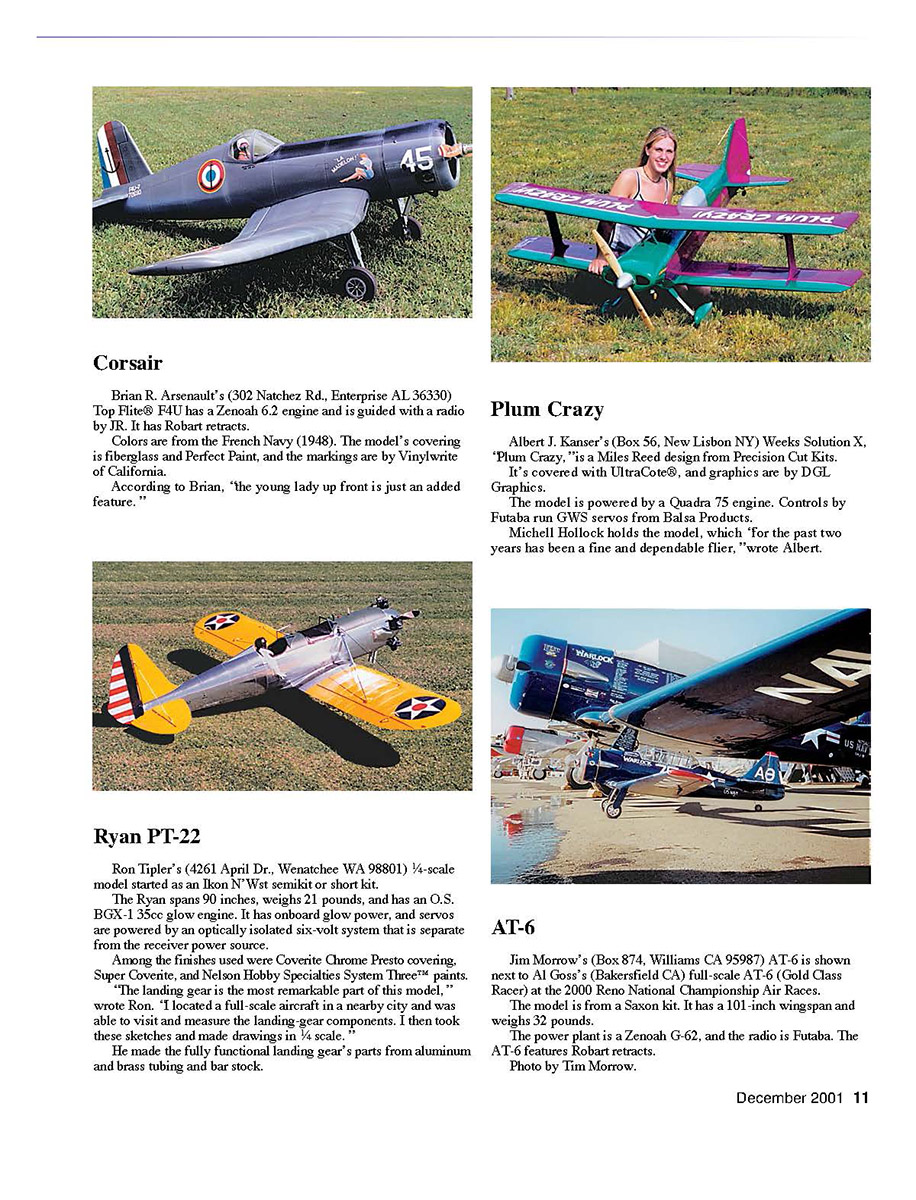
F-117
James Pravel's (141 East and West Rd., West Seneca NY 14224-3955) model was built from plans by Parker Leung.
The wingspan is 43 inches. The aircraft has a fiberglass fuselage and fiberglass-cloth-covered wings. The F-117's paint is Formula-U with custom graphics.
Power is a Magnum .46 engine with a Perry pump. James uses a six-channel Futaba radio for guidance. The model has mechanical retracts. It uses elevons for control.
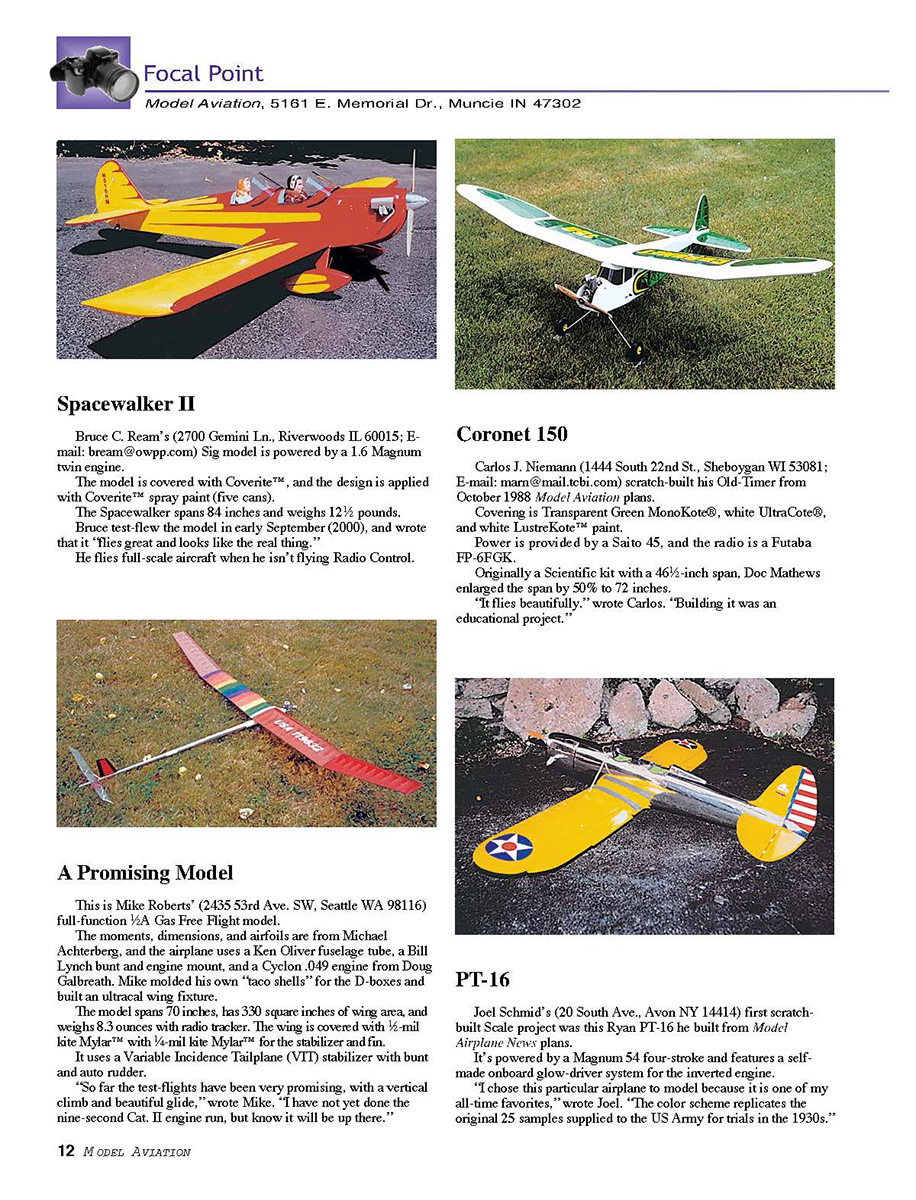
Stearman PT-17
It took Jerry Burpee (2149 Diane Dr., Plano TX 75074) four years to build this Balsa USA model. It weighs 53 pounds and has a Quadra 100 for power.
The PT-17 has Stits Lite covering and paint and rib-stitching. All graphics were painted on, and all hatches open.
Jerry made many scale modifications to the basic kit. "It even has a scale, air-flow-operated insect protector for the pitot tube," he wrote.
The model hadn't been flown yet when this photo was taken.
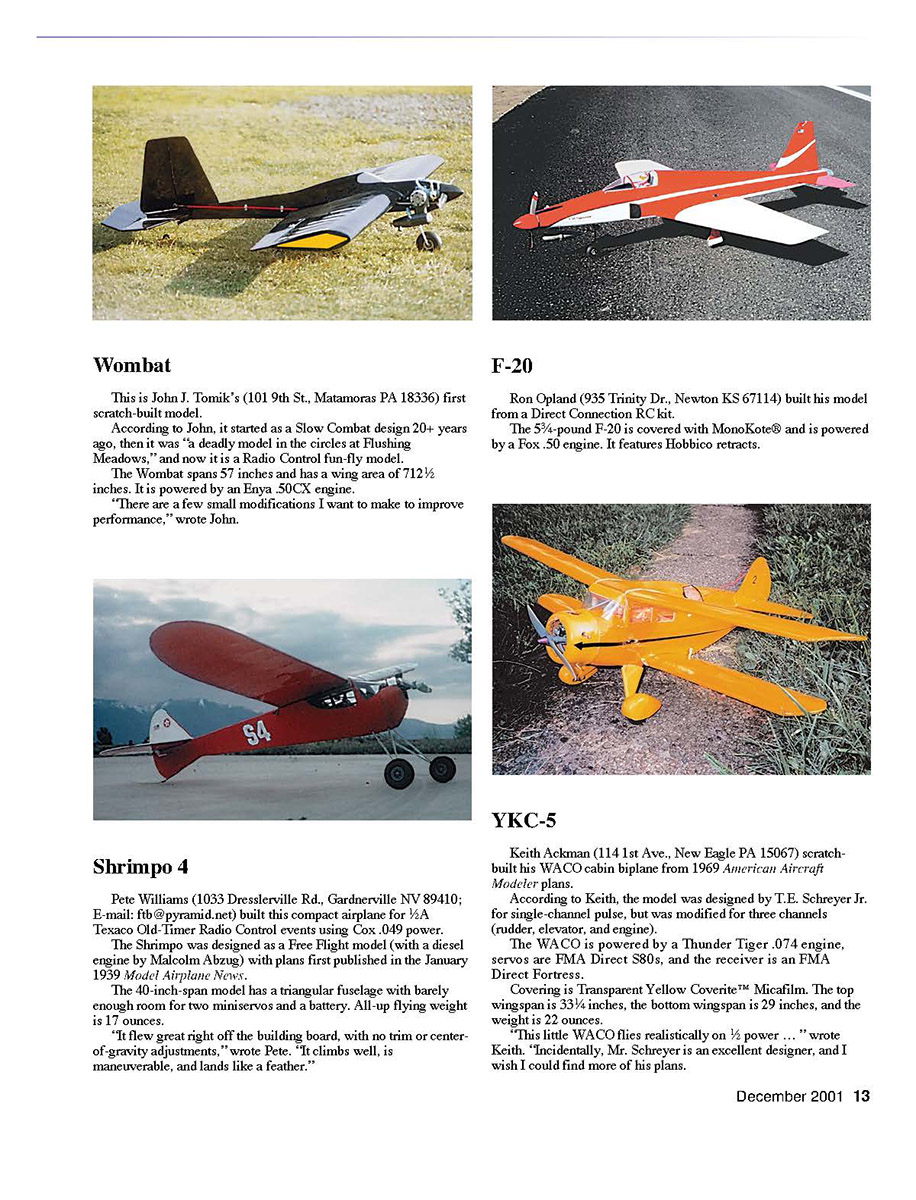
Number 18
Bill Curless (Box 390, Bradford NH 03221) painted this 1/4-scale Laser to match the #18 Interstate Battery car of Winston Cup Series driver Bobby Labonte.
Bill chose this paint scheme "to placate my wife/sponsor," he wrote. "She supports my hobby. I support hers."
The model is powered by an Enya 120R engine and is controlled by a Futaba 9ZAP radio.
Paint is Sig dope over fiberglass.
Corsair
Brian R. Arsenault's (302 Natchez Rd., Enterprise AL 36330) Top Flite® F4U has a Zenoah 6.2 engine and is guided with a radio by JR. It has Robart retracts.
Colors are from the French Navy (1948). The model's covering is fiberglass and Perfect Paint, and the markings are by Vinylwrite of California.
According to Brian, "the young lady up front is just an added feature."
Plum Crazy
Albert J. Kanser's (Box 56, New Lisbon NY) Weeks Solution X, "Plum Crazy," is a Miles Reed design from Precision Cut Kits.
It's covered with UltraCote®, and graphics are by DGL Graphics.
The model is powered by a Quadra 75 engine. Controls by Futaba run GWS servos from Balsa Products.
Mitchell Hollock holds the model, which "for the past two years has been a fine and dependable flier," wrote Albert.
Ryan PT-22
Ron Tipler's (4261 April Dr., Wenatchee WA 98801) 1/4-scale model started as an Ikon N'West semikit or short kit.
The Ryan spans 90 inches, weighs 21 pounds, and has an O.S. BGX-1 35cc glow engine. It has onboard glow power, and servos are powered by an optically isolated six-volt system that is separate from the receiver power source.
Among the finishes used were Coverite Chrome Presto covering, Super Convite, and Nelson Hobby Specialties System Three™ paints.
"The landing gear is the most remarkable part of this model," wrote Ron. "I located a full-scale aircraft in a nearby city and was able to visit and measure the landing-gear components. I then took these sketches and made drawings in 1/4 scale."
He made the fully functional landing gear's parts from aluminum and brass tubing and bar stock.
AT-6
Jim Morrow's (Box 874, Williams CA 95987) AT-6 is shown next to Al Goss's (Bakersfield CA) full-scale AT-6 (Gold Class Racer) at the 2000 Reno National Championship Air Races.
The model is from a Saxon kit. It has a 101-inch wingspan and weighs 32 pounds.
The power plant is a Zenoah G-62, and the radio is Futaba. The AT-6 features Robart retracts.
Photo by Tim Morrow.
Spacewalker II
Bruce C. Ream's (2700 Gemini Ln., Riverwoods IL 60015; E-mail: [email protected]) Sig model is powered by a 1.6 Magnum twin engine.
The model is covered with Coverite™, and the design is applied with Coverite™ spray paint (five cans).
The Spacewalker spans 84 inches and weighs 12½ pounds.
Bruce test-flew the model in early September (2000), and wrote that it "flies great and looks like the real thing."
He flies full-scale aircraft when he isn't flying Radio Control.
Coronet 150
Carlos J. Niemann (1444 South 22nd St., Sheboygan WI 53081; E-mail: [email protected]) scratch-built his Old-Timer from October 1988 Model Aviation plans.
Covering is Transparent Green MonoKote®, white UltraCote®, and white LustreKote® paint.
Power is provided by a Saito 45, and the radio is a Futaba FP-6FGK.
Originally a Scientific kit with a 46½-inch span, Doc Mathews enlarged the span by 50% to 72 inches.
"It flies beautifully," wrote Carlos. "Building it was an educational project."
A Promising Model
This is Mike Roberts' (2435 53rd Ave. SW, Seattle WA 98116) full-function 1/2A Gas Free Flight model.
The moments, dimensions, and airfoils are from Michael Achterberg, and the airplane uses a Ken Oliver fuselage tube, a Bill Lynch blunt and engine mount, and a Cyclon .049 engine from Doug Galbreath. Mike molded his own "taco shells" for the D-boxes and built an ultracal wing fixture.
The model spans 70 inches, has 330 square inches of wing area, and weighs 8.3 ounces with radio tracker. The wing is covered with 1/2-mil kite Mylar™ with 1/4-mil kite Mylar™ for the stabilizer and fin.
It uses a Variable Incidence Tailplane (VIT) stabilizer with built and auto rudder.
"So far the test-flights have been very promising, with a vertical climb and beautiful glide," wrote Mike. "I have not yet done the nine-second Cat. II engine run, but know it will be up there."
PT-16
Joel Schmid's (20 South Ave., Avon NY 14414) first scratch-built Scale project was this Ryan PT-16 he built from Model Airplane News plans.
It's powered by a Magnum 54 four-stroke and features a self-made onboard glow-driver system for the inverted engine.
"I chose this particular airplane to model because it is one of my all-time favorites," wrote Joel. "The color scheme replicates the original 25 samples supplied to the US Army for trials in the 1930s."
Wombat
This is John J. Tomik's (101 9th St., Matamoras PA 18336) first scratch-built model.
According to John, it started as a Slow Combat design 20+ years ago, then it was "a deadly model in the circles at Flushing Meadows," and now it is a Radio Control fun-fly model. The Wombat spans 57 inches and has a wing area of 712½ inches. It is powered by an Enya .50GX engine.
"There are a few small modifications I want to make to improve performance," wrote John.
F-20
Ron Opland (935 Trinity Dr., Newton KS 67114) built his model from a Direct Connection R/C kit.
The 5¾-pound F-20 is covered with MonoKote® and is powered by a Fox .50 engine. It features Hobbico retracts.
Shrimpo 4
Pete Williams (1033 Dresslerville Rd., Gardnerville NV 89410; E-mail: [email protected]) built this compact airplane for 1/8 A Texaco Old-Timer Radio Control events using Cox .049 power.
The Shrimpo was designed as a Free Flight model (with a diesel engine by Malcolm Abzug) with plans first published in the January 1939 Model Airplane News.
The 40-inch-span model has a triangular fuselage with barely enough room for two miniservos and a battery. All-up flying weight is 17 ounces.
"It flew great right off the building board, with no trim or center-of-gravity adjustments," wrote Pete. "It climbs well, is maneuverable, and lands like a feather."
YKC-5
Keith Ackman (114 1st Ave., New Eagle PA 15067) scratch-built his WACO cabin biplane from 1969 American Aircraft Modeller plans.
According to Keith, the model was designed by T.E. Schreyer Jr. for single-channel pulse, but was modified for three channels (rudder, elevator, and engine).
The WACO is powered by a Thunder Tiger .074 engine, servos are an FMA Direct S80s, and the receiver is an FMA Direct Fortress.
Covering is Transparent Yellow Coverite™ Micalfilm. The top wingspan is 33¾ inches, the bottom wingspan is 29 inches, and the weight is 22 ounces.
"This little WACO flies realistically on ½ power ...," wrote Keith. "Incidentally, Mr. Schreyer is an excellent designer, and I wish I could find more of his plans."
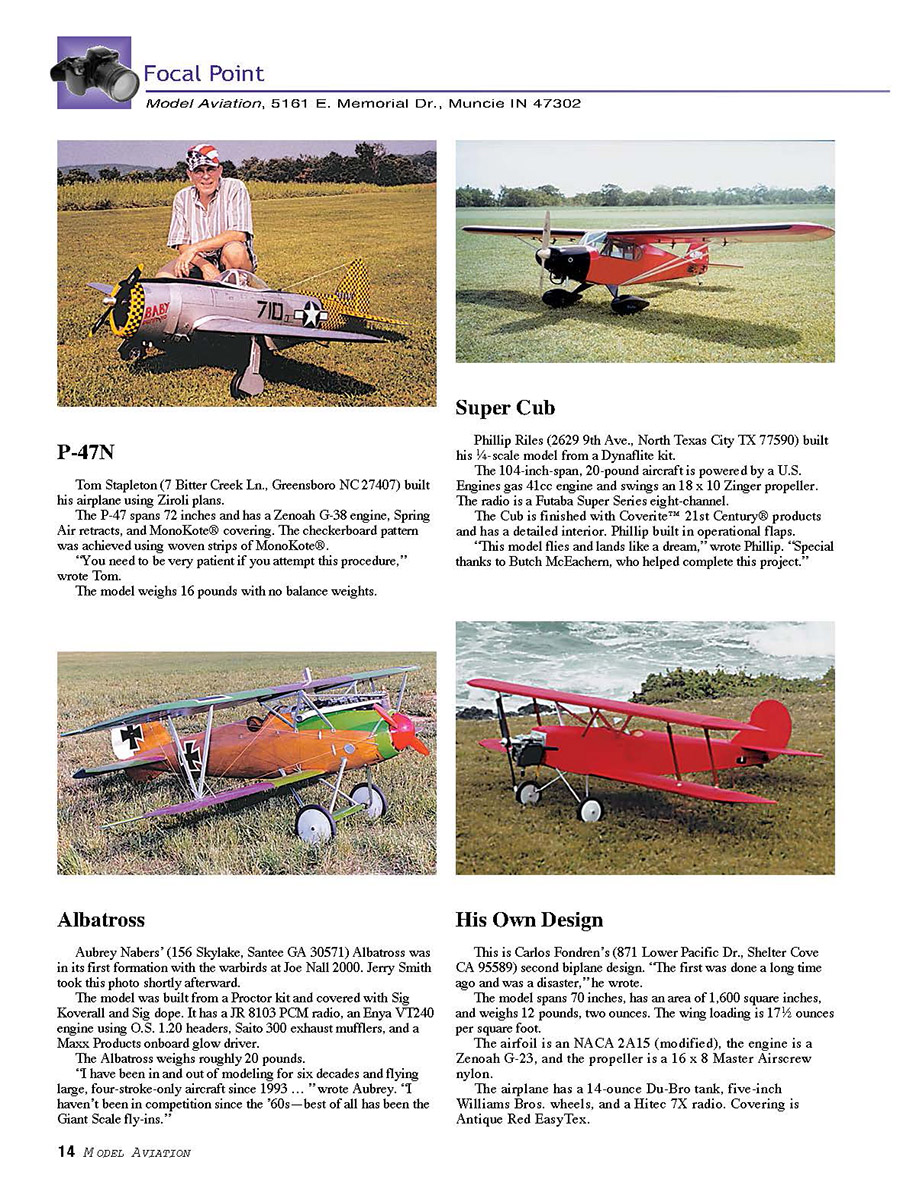
P-47N
Tom Stapleton (7 Bitter Creek Ln., Greensboro NC 27407) built his airplane using Ziroli plans.
The P-47 spans 72 inches and has a Zenoah G-38 engine, Spring Air retracts, and MonoKote® covering. The checkerboard pattern was achieved using woven strips of MonoKote®.
"You need to be very patient if you attempt this procedure," wrote Tom.
The model weighs 16 pounds with no balance weights.
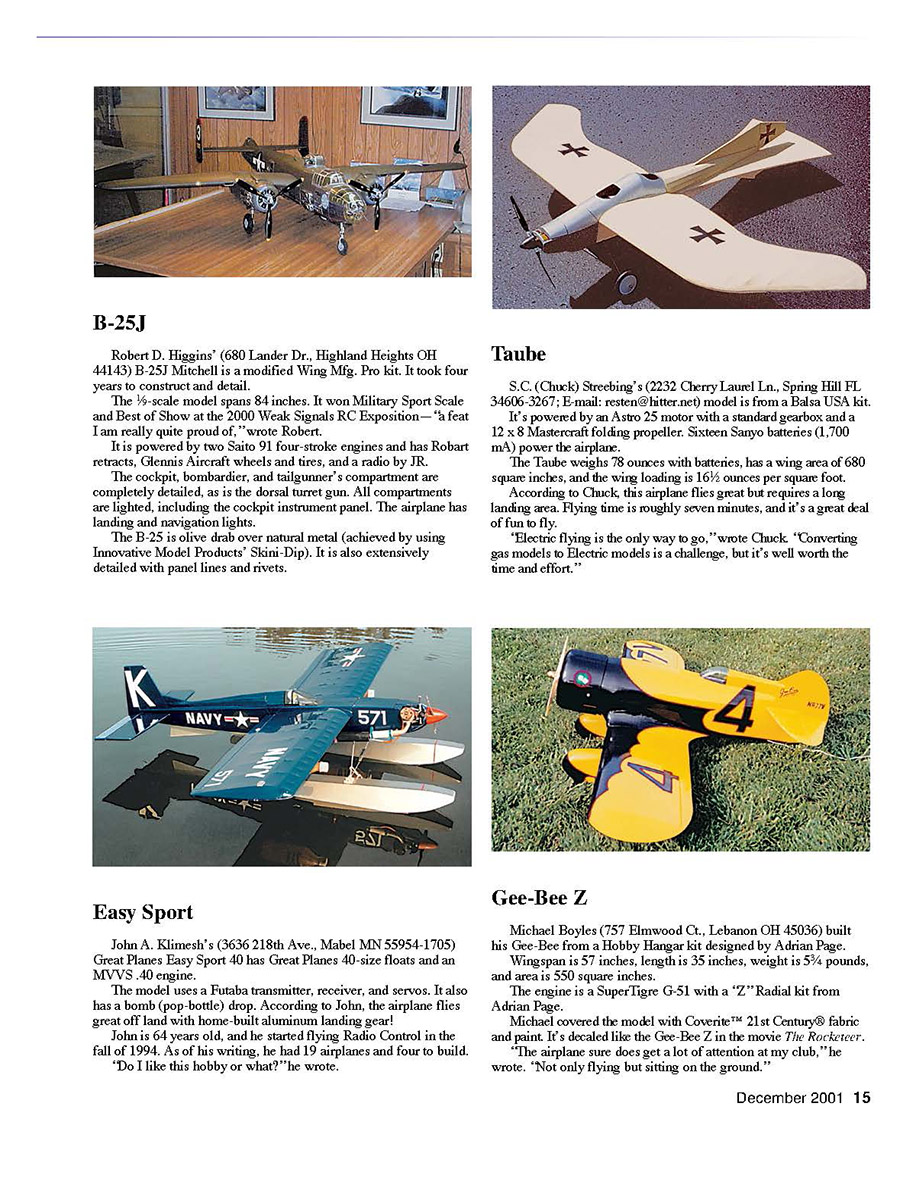
Super Cub
Phillip Riles (2629 9th Ave., North Texas City TX 77590) built his 1/4-scale model from a Dynaflite kit.
The 104-inch-span, 20-pound aircraft is powered by a U.S. Engines gas 41cc engine and swings an 18 x 10 Zinger propeller.
The radio is a Futaba Super Series eight-channel.
The Cub is finished with Coverite™ 21st Century® products and has a detailed interior. Phillip built in operational flaps.
"This model flies and lands like a dream," wrote Phillip. "Special thanks to Butch McEachern, who helped complete this project."
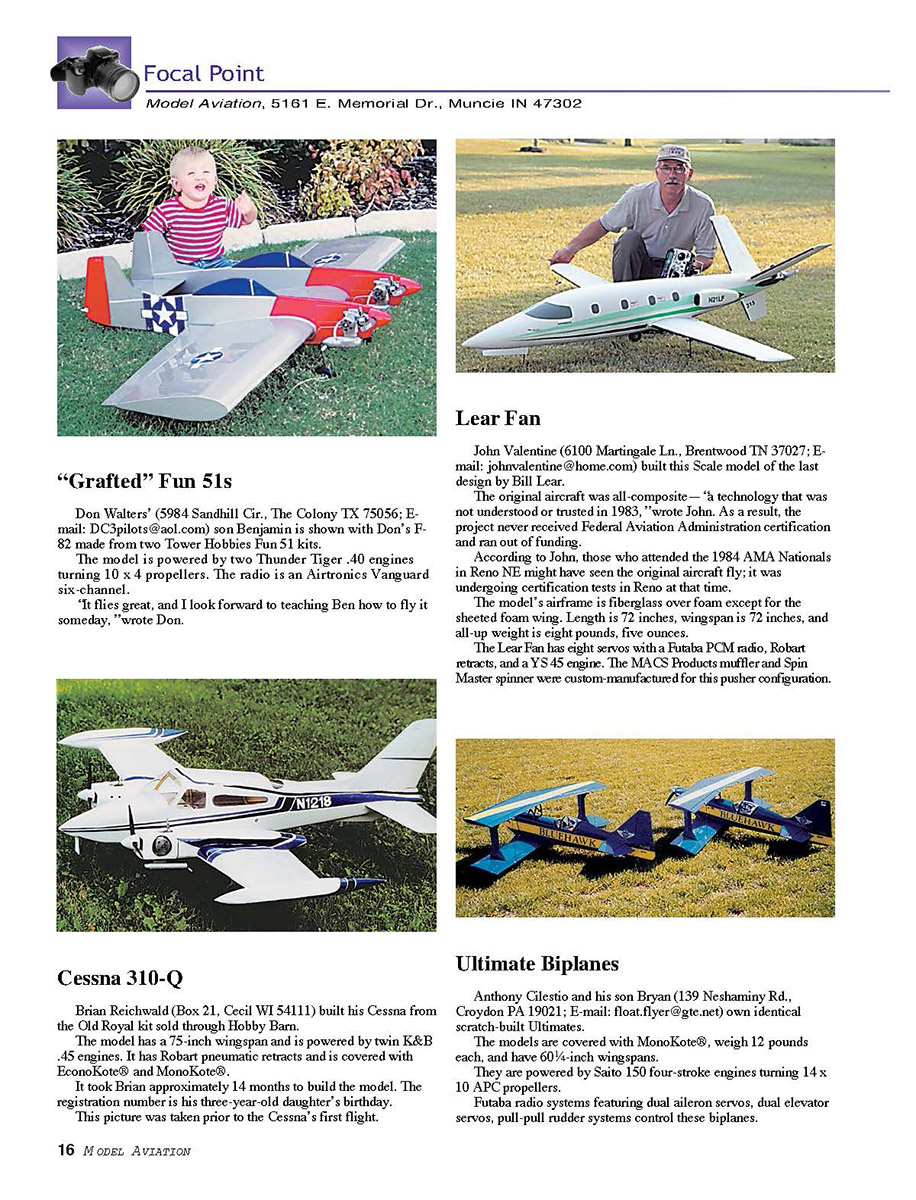
Albatross
Aubrey Nabers' (156 Skylake, Santee GA 30571) Albatross was in its first formation with the warbirds at Joe Nall 2000. Jerry Smith took this photo shortly afterward.
The model was built from a Proctor kit and covered with Sig Koverall and Sig dope. It has a JR 8103 PCM radio, an Enya VT240 engine using O.S. 1.20 headers, Saito 300 exhaust mufflers, and a Maxx Products onboard glow driver.
The Albatross weighs roughly 20 pounds.
"I have been in and out of modeling for six decades and flying large, four-stroke-only aircraft since 1993 ..." wrote Aubrey. "I haven't been in competition since the '60s — best of all has been the Giant Scale fly-ins."
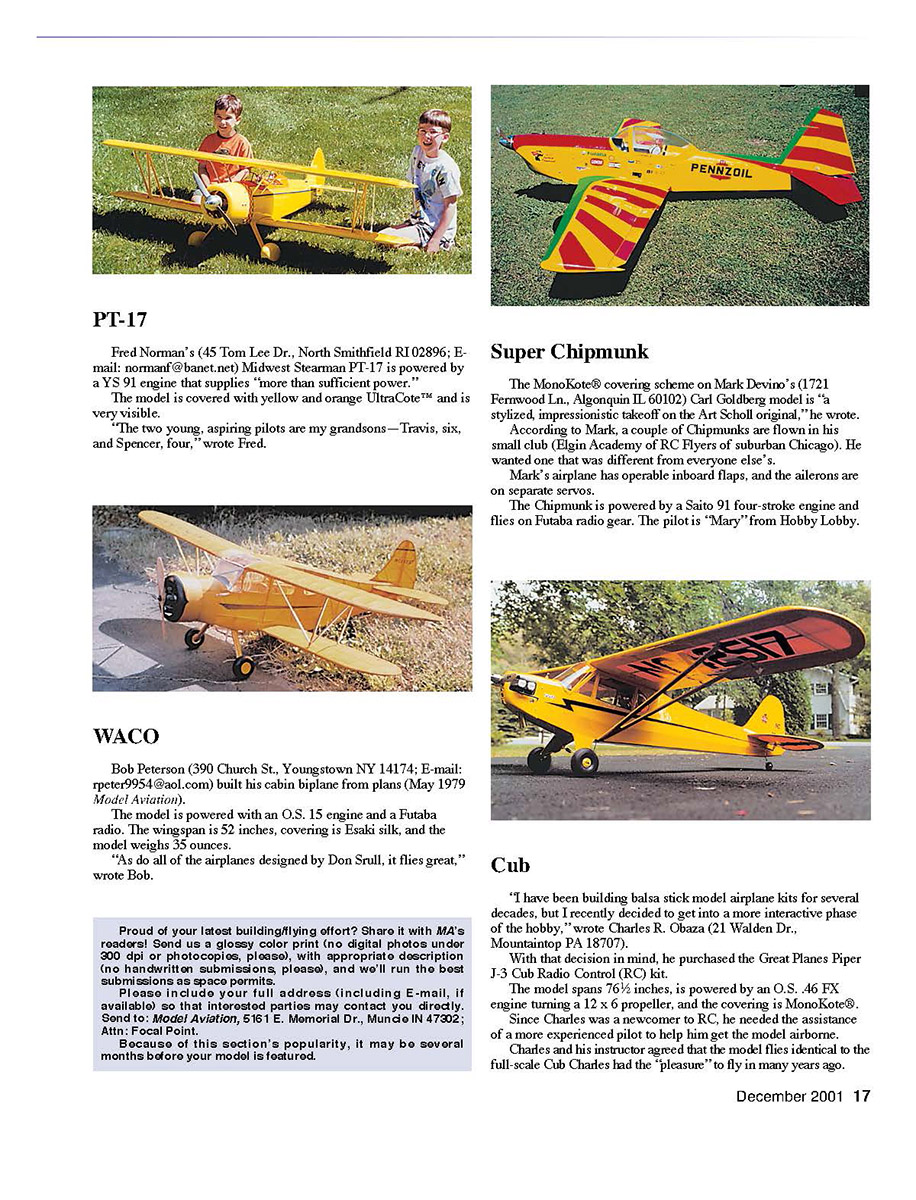
His Own Design
This is Carlos Fondren's (871 Lower Pacific Dr., Shelter Cove CA 95589) second biplane design. "The first was done a long time ago and was a disaster," he wrote.
The model spans 70 inches, has an area of 1,600 square inches, and weighs 12 pounds, two ounces. The wing loading is 17½ ounces per square foot.
The airfoil is an NACA 2A15 (modified), the engine is a Zenoah G-23, and the propeller is a 16 x 8 Master Airscrew nylon.
The airplane has a 14-ounce Du-Bro tank, five-inch Williams Bros. wheels, and a Hitec 7X radio. Covering is Antique Red EasyTex.
B-25J
Robert D. Higgins' (680 Lander Dr., Highland Heights OH 44143) B-25J Mitchell is a modified Wing Mfg. Pro kit. It took four years to construct and detail. The 1/5-scale model spans 84 inches. It won Military Sport Scale and Best of Show at the 2000 Weak Signals RC Exposition—"a feat I am really quite proud of," wrote Robert.
It is powered by two Saito 91 four-stroke engines and has Robart retracts, Glennis Aircraft wheels and tires, and a radio by JR. The cockpit, bombardier, and tailgunner's compartment are completely detailed, as is the dorsal turret gun. All compartments are lighted, including the cockpit instrument panel. The airplane has landing and navigation lights.
The B-25 is olive drab over natural metal (achieved by using Innovative Model Products' Skini-Dip). It is also extensively detailed with panel lines and rivets.
Taube
S.C. (Chuck) Streebing's (2232 Cherry Laurel Ln., Spring Hill FL 34606-3267; E-mail: [email protected]) model is from a Balsa USA kit. It's powered by an Astro 25 motor with a standard gearbox and a 12 x 8 Mastercraft folding propeller. Sixteen Sanyo batteries (1,700 mA) power the airplane.
The Taube weighs 78 ounces with batteries, has a wing area of 680 square inches, and the wing loading is 16½ ounces per square foot. According to Chuck, this airplane flies great but requires a long landing area. Flying time is roughly seven minutes, and it's a great deal of fun to fly.
"Electric flying is the only way to go," wrote Chuck. "Converting gas models to Electric models is a challenge, but it's well worth the time and effort."
Easy Sport
John A. Klimesh's (3636 218th Ave., Mabel MN 55954-1705) Great Planes Easy Sport 40 has Great Planes 40-size floats and an MVVS .40 engine.
The model uses a Futaba transmitter, receiver, and servos. It also has a bomb (pop-bottle) drop. According to John, the airplane flies great off land with home-built aluminum landing gear!
John is 64 years old, and he started flying Radio Control in the fall of 1994. As of his writing, he had 19 airplanes and four to build. "Do I like this hobby or what?" he wrote.
Gee-Bee Z
Michael Boyles (757 Elmwood Ct., Lebanon OH 45036) built his Gee-Bee from a Hobby Hangar kit designed by Adrian Page. Wingspan is 37 inches, length is 35 inches, weight is 3¾ pounds, and area is 550 square inches.
The engine is a SuperTigre G-51 with a "Z" Radial kit from Adrian Page.
Michael covered the model with Coverite™ 21st Century® fabric and paint. It's decaled like the Gee-Bee Z in the movie The Rocketeer.
"The airplane sure does get a lot of attention at my club," he wrote. "Not only flying but sitting on the ground."
"Grafted" Fun 51s
Don Walters (5984 Sandhill Cir., The Colony TX 75056; E-mail: [email protected]) son Benjamin is shown with Don's F-82 made from two Tower Hobbies Fun 51 kits.
The model is powered by two Thunder Tiger .40 engines turning 10 × 4 propellers. The radio is an Airtronics Vanguard six-channel.
"It flies great, and I look forward to teaching Ben how to fly it someday," wrote Don.
Lear Fan
John Valentine (6100 Martingale Ln., Brentwood TN 37027; E-mail: [email protected]) built this Scale model of the last design by Bill Lear.
The original aircraft was all-composite—"a technology that was not understood or trusted in 1983," wrote John. As a result, the project never received Federal Aviation Administration certification nor an order of funding.
According to John, those who attended the 1984 AMA Nationals in Reno NE might have seen the original aircraft fly; it was undergoing certification tests in Reno at that time.
The model's airframe is fiberglass over foam except for the sheeted foam wing. Length is 72 inches, wingspan is 72 inches, and all-up weight is eight pounds, five ounces.
The Lear Fan has eight servos with a Futaba PCM radio, Robart retracts, and a YS 45 engine. The MACS Products muffler and Spin Master spinner were custom-manufactured for this pusher configuration.
Cessna 310-Q
Brian Reichwald (Box 21, Cecil WI 54111) built his Cessna from the Old Royal kit sold through Hobby Barn.
The model has a 75-inch wingspan and is powered by twin K&B .45 engines. It has Robart pneumatic retracts and is covered with EconoKote® and MonoKote®.
It took Brian approximately 14 months to build the model. The registration number is his three-year-old daughter's birthday.
This picture was taken prior to the Cessna's first flight.
Ultimate Biplanes
Anthony Clesisto and his son Bryan (139 Neshaminy Rd., Croydon PA 19021; E-mail: [email protected]) own identical scratch-built Ultimates.
The models are covered with MonoKote®, weigh 12 pounds each, and have 60¼-inch wingspans.
They are powered by Saito 150 four-stroke engines turning 14 × 10 APC propellers.
Futaba radio systems featuring dual aileron servos, dual elevator servos, pull-pull rudder systems control these biplanes.
PT-17
Fred Norman's (45 Tom Lee Dr., North Smithfield RI 02896; E-mail: [email protected]) Midwest Stearman PT-17 is powered by a YS 91 engine that supplies "more than sufficient power."
The model is covered with yellow and orange UltraCote™ and is very visible.
"The two young, aspiring pilots are my grandsons — Travis, six, and Spencer, four," wrote Fred.
Super Chipmunk
The MonoKote® covering scheme on Mark Devino's (1721 Fernwood Ln., Algonquin IL 60102) Carl Goldberg model is "a stylized, impressionistic takeoff on the Art Scholl original," he wrote.
According to Mark, a couple of Chipmunks are flown in his small club (Elgin Academy of RC Flyers of suburban Chicago). He wanted one that was different from everyone else's.
Mark's airplane has operable inboard flaps, and the ailerons are on separate servos.
The Chipmunk is powered by a Saito 91 four-stroke engine and flies on Futaba radio gear. The pilot is "Mary" from Hobby Lobby.
WACO
Bob Peterson (390 Church St., Youngstown NY 14174; E-mail: [email protected]) built his cabin biplane from plans (May 1979 Model Aviation).
The model is powered with an O.S. 15 engine and a Futaba radio. The wingspan is 52 inches, covering is Esaki silk, and the model weighs 35 ounces.
"As do all of the airplanes designed by Don Srull, it flies great," wrote Bob.
Cub
"I have been building balsa stick model airplane kits for several decades, but I recently decided to get into a more interactive phase of the hobby," wrote Charles R. Obaza (21 Walden Dr., Mountaintop PA 18707).
With that decision in mind, he purchased the Great Planes Piper J-3 Cub Radio Control (RC) kit.
The model spans 76½ inches, is powered by an O.S. .46 FX engine turning a 12 x 6 propeller, and the covering is MonoKote®.
Since Charles was a newcomer to RC, he needed the assistance of a more experienced pilot to help him get the model airborne.
Charles and his instructor agreed that the model flies identical to the full-scale Cub Charles had the "pleasure" to fly in many years ago.
Transcribed from original scans by AI. Minor OCR errors may remain.

