
Focal Point
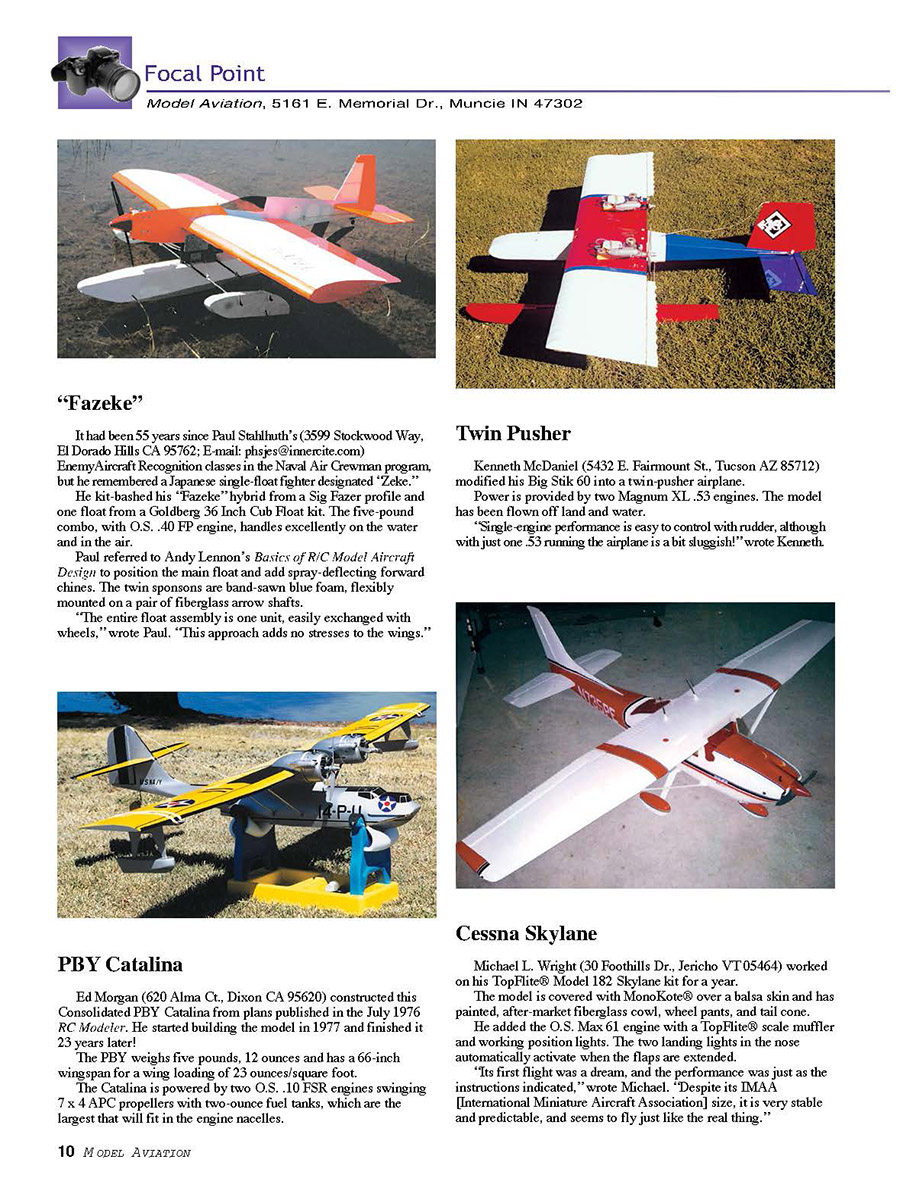
"Fazeke"
It had been 55 years since Paul Stahlhuth's (<REDACTED>) Enemy Aircraft Recognition classes in the Naval Air Crewman program, but he remembered a Japanese single-float fighter designated "Zeke."
He kit-bashed his "Fazeke" hybrid from a Sig Fazeer profile and one float from a Goldberg 36 Inch Cub Float kit. The five-pound combo, with O.S. .40 FP engine, handles excellently on the water and in the air.
Paul referred to Andy Lennon's Basics of R/C Model Aircraft Design to position the main float and add spray-deflecting forward chines. The twin sponsons are band-sawn blue foam, flexibly mounted on a pair of fiberglass arrow shafts.
"The entire float assembly is one unit, easily exchanged with wheels," wrote Paul. "This approach adds no stresses to the wings."
Canard
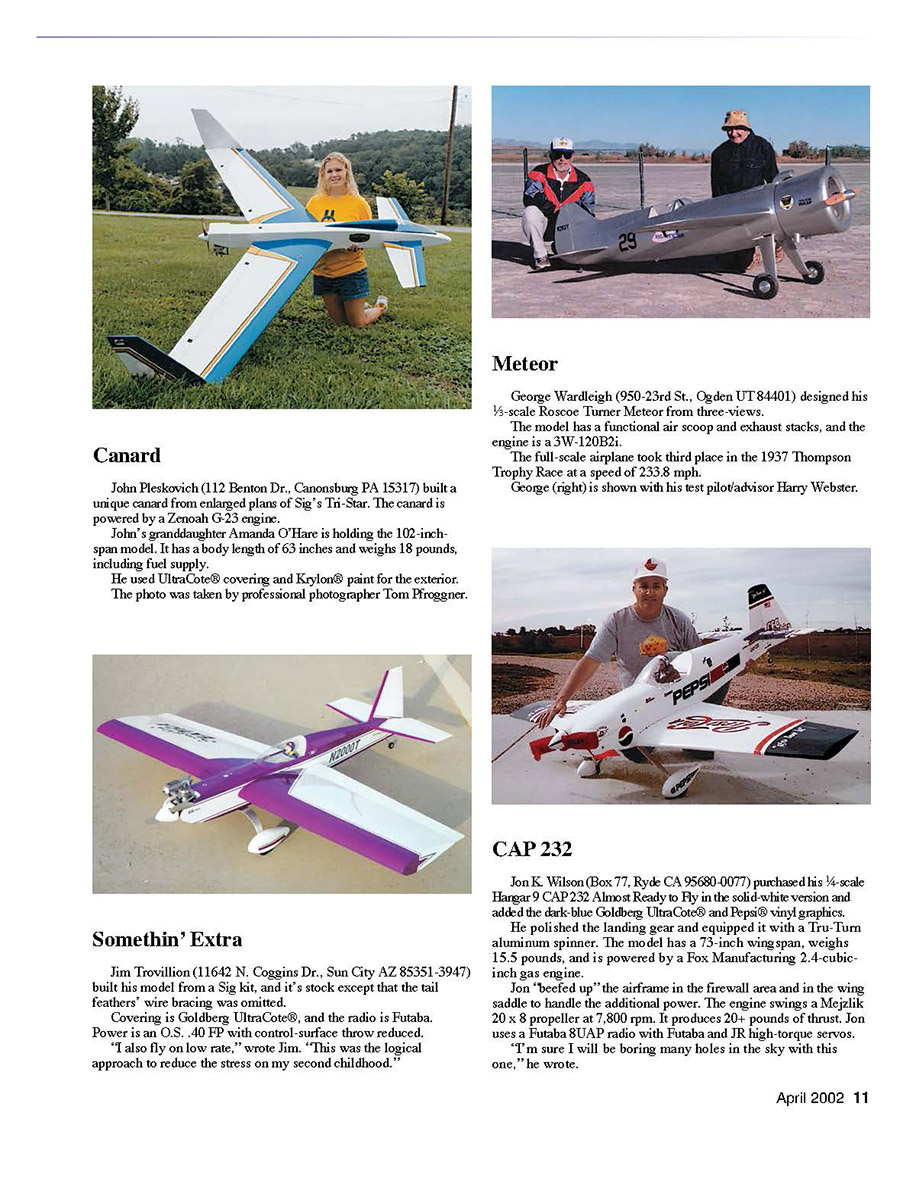
John Pleskovich (<REDACTED>) built a unique canard from enlarged plans of Sig's Tri-Star. The canard is powered by a Zenoah G-23 engine.
John's granddaughter Amanda O'Hare is holding the 102-inch-span model. It has a body length of 63 inches and weighs 18 pounds, including fuel supply.
He used UltraCote® covering and Krylon® paint for the exterior. The photo was taken by professional photographer Tom Pfrogner.
Somethin' Extra
Jim Trovillion (<REDACTED>) built his model from a Sig kit, and it's stock except that the tail feathers' wire bracing was omitted.
Covering is Goldberg UltraCote®, and the radio is Futaba. Power is an O.S. .40 FP with control-surface throw reduced.
"I also fly on low rate," wrote Jim. "This was the logical approach to reduce the stress on my second childhood."
Meteor
George Wardleigh (<REDACTED>) designed his 1/3-scale Roscoe Turner Meteor from three-views.
The model has a functional air scoop and exhaust stacks, and the engine is a 3W-120B2i.
The full-scale airplane took third place in the 1937 Thompson Trophy Race at a speed of 233.8 mph.
George (right) is shown with his test pilot/advisor Harry Webster.
CAP 232
Jon K. Wilson (<REDACTED>) purchased his 1/4-scale Hangar 9 CAP 232 Almost Ready to Fly in the solid-white version and added the dark-blue Goldberg UltraCote® and Pepsi® vinyl graphics.
He polished the landing gear and equipped it with a Tru-Turn aluminum spinner. The model has a 73-inch wing span, weighs 15.5 pounds, and is powered by a Fox Manufacturing 2.4-cubic-inch gas engine.
Jon "beefed up" the airframe in the firewall area and in the wing saddle to handle the additional power. The engine swings a Mejzlik 20 x 8 propeller at 7,800 rpm. It produces 20+ pounds of thrust. Jon uses a Futaba 8UAP radio with Futaba and JR high-torque servos.
"I'm sure I will be boring many holes in the sky with this one," he wrote.
Focal Point
Twin Kougar
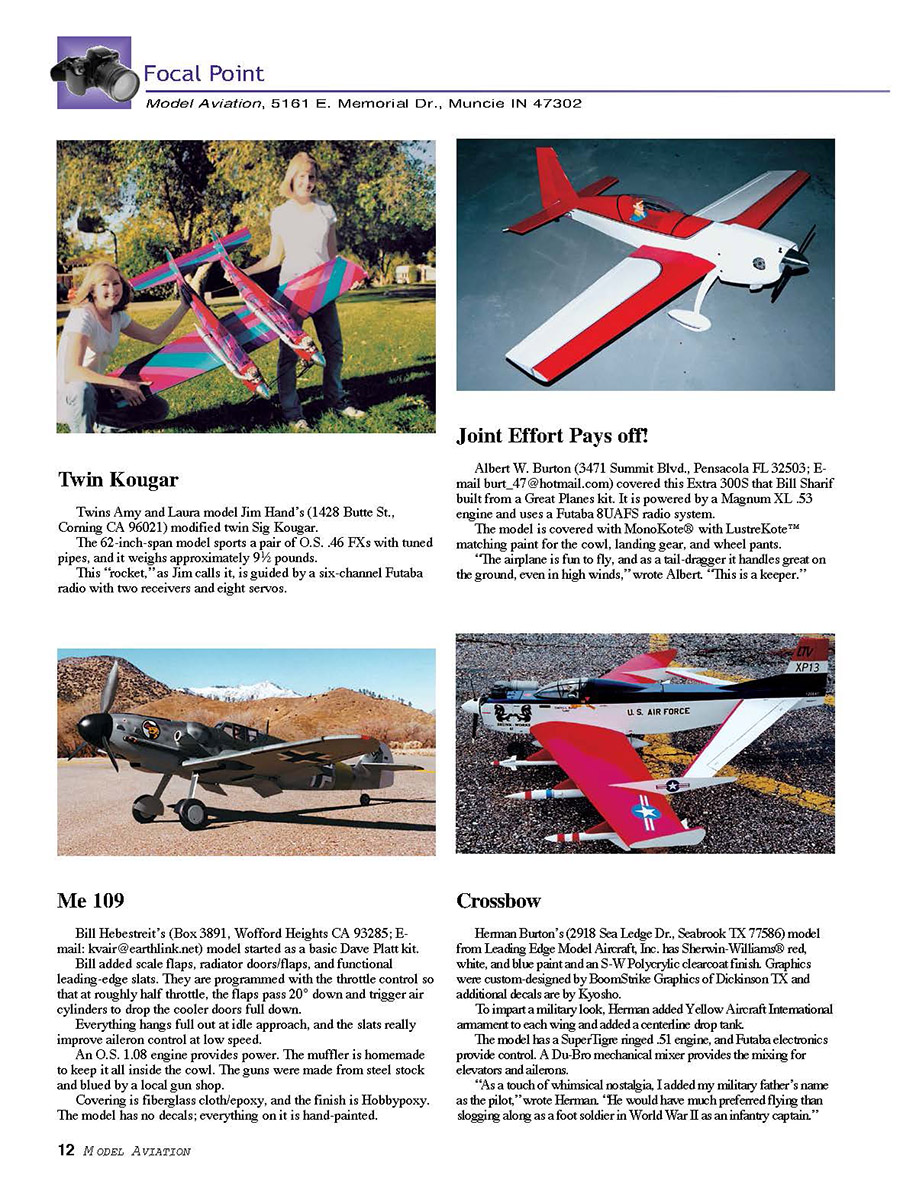
Twins Amy and Laura model Jim Hand's (<REDACTED>) modified twin Sig Kougar.
The 62-inch-span model sports a pair of O.S. .46 FXs with tuned pipes, and it weighs approximately 9½ pounds.
This "rocket," as Jim calls it, is guided by a six-channel Futaba radio with two receivers and eight servos.
Joint Effort Pays off!
Albert W. Burton (<REDACTED>) covered this Extra 300S that Bill Sharif built from a Great Planes kit. It is powered by a Magnum XL 53 engine and uses a Futaba 8UAFS radio system.
The model is covered with MonoKote® with LustreKote™ matching paint for the cowl, landing gear, and wheel pants.
"The airplane is fun to fly, and as a tail-dragger it handles great on the ground, even in high winds," wrote Albert. "This is a keeper."
Me 109
Bill Hebestreit's (<REDACTED>) model started as a basic Dave Platt kit.
Bill added scale flaps, radiator doors/flaps, and functional leading-edge slats. They are programmed with the throttle control so that at roughly half throttle, the flaps pass 20° down and trigger air cylinders to drop the cooler doors full down.
Everything hangs full out at idle approach, and the slats really improve aileron control at low speed.
An O.S. 1.08 engine provides power. The muffler is homemade to keep it all inside the cowl. The guns were made from steel stock and blued by a local gun shop.
Covering is fiberglass cloth/epoxy, and the finish is Hobbypoxy. The model has no decals; everything on it is hand-painted.
Crossbow
Herman Burton's (<REDACTED>) model from Leading Edge Model Aircraft, Inc. has Sherwin-Williams® red, white, and blue paint and an S-W Polycrylic clearcoat finish. Graphics were custom-designed by BoomStrike Graphics of Dickinson TX and additional decals are by Kyosho.
To impart a military look, Herman added Yellow Aircraft International armament to each wing and added a centerline drop tank.
The model has a SuperTigre ringed .51 engine, and Futaba electronics provide control. A Du-Bro mechanical mixer provides the mixing for elevators and ailerons.
"As a touch of whimsical nostalgia, I added my military father's name as the pilot," wrote Herman. "He would have much preferred flying than slogging along as a foot soldier in World War II as an infantry captain."
The Ultimate
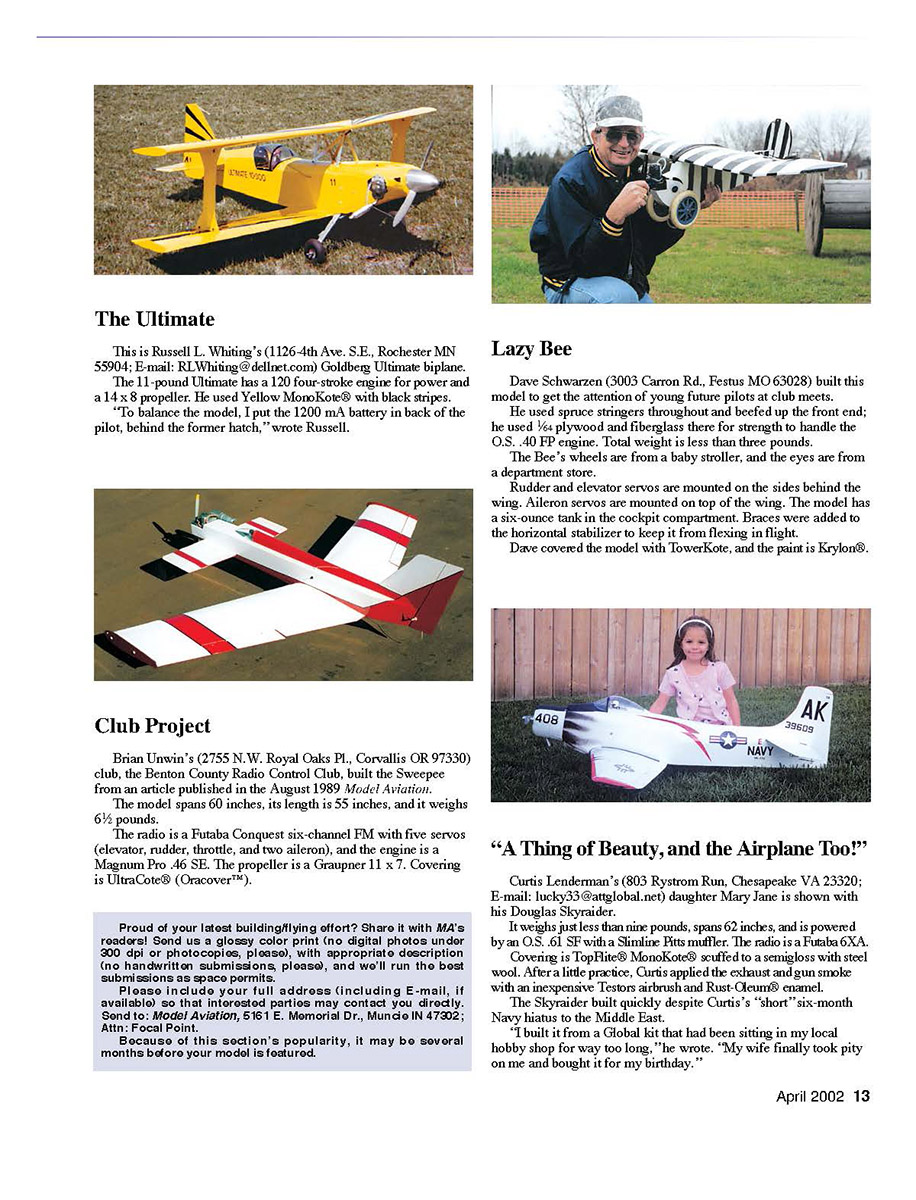
This is Russell L. Whiting's (<REDACTED>) Goldberg Ultimate biplane.
The .11-pound Ultimate has a 120 four-stroke engine for power and a 14 x 8 propeller. He used Yellow MonoKote® with black stripes.
"To balance the model, I put the 1200 mA battery in back of the pilot, behind the former hatch," wrote Russell.
Club Project
Brian Unwin's (<REDACTED>) club, the Benton County Radio Control Club, built the Sweeptee from an article published in the August 1989 Model Aviation.
The model spans 60 inches, its length is 55 inches, and it weighs 6½ pounds.
The radio is a Futaba Conquest six-channel FM with five servos (elevator, rudder, throttle, and two aileron), and the engine is a Magnum Pro .46 SE. The propeller is a Graupner 11 x 7. Covering is UltraCote® (Oracover™).
Proud of your latest building/flying effort? Share it with MA's readers! Send us a glossy color print (no digital photos under 300 dpi or photocopies, please), with appropriate description (no handwritten submissions, please), and we'll run the best submissions as space permits.
Please include your full address (including E-mail, if available) so that interested parties may contact you directly. Send to: Model Aviation, 5161 E. Memorial Dr., Muncie IN 47302; Attn: Focal Point.
Because of this section's popularity, it may be several months before your model is featured.
Lazy Bee
Dave Schwarzen (<REDACTED>) built this model to get the attention of young future pilots at club meets.
He used spruce stringers throughout and beefed up the front end; he used ¼ plywood and fiberglass there for strength to handle the O.S. .40 FP engine. Total weight is less than three pounds.
The Bee's wheels are from a baby stroller, and the eyes are from a department store.
Rudder and elevator servos are mounted on the sides behind the wing. Aileron servos are mounted on top of the wing. The model has a six-ounce tank in the cockpit compartment. Braces were added to the horizontal stabilizer to keep it from flexing in flight.
Dave covered the model with TowerKote, and the paint is Krylon®.
"A Thing of Beauty, and the Airplane Too!"
Curtis Lenderman's (<REDACTED>) daughter Mary Jane is shown with his Douglas Skyraider.
It weighs just less than nine pounds, spans 62 inches, and is powered by an O.S. .61 SF with a Simmie Pitts muffler. The radio is a Futaba 6XA.
Covering is TopFlite® MonoKote® surfaced to a semigloss with steel wool. After a little practice, Curtis applied the exhaust and gun smoke with an inexpensive Testors airbrush and Rust-Oleum® enamel.
The Skyraider built quickly despite Curtis's "short" six-month Navy hiatus to the Middle East.
"I built it from a Global kit that had been sitting in my local hobby shop for way too long," he wrote. "My wife finally took pity on me and bought it for my birthday."
Transcribed from original scans by AI. Minor OCR errors may remain.

