
Focal Point
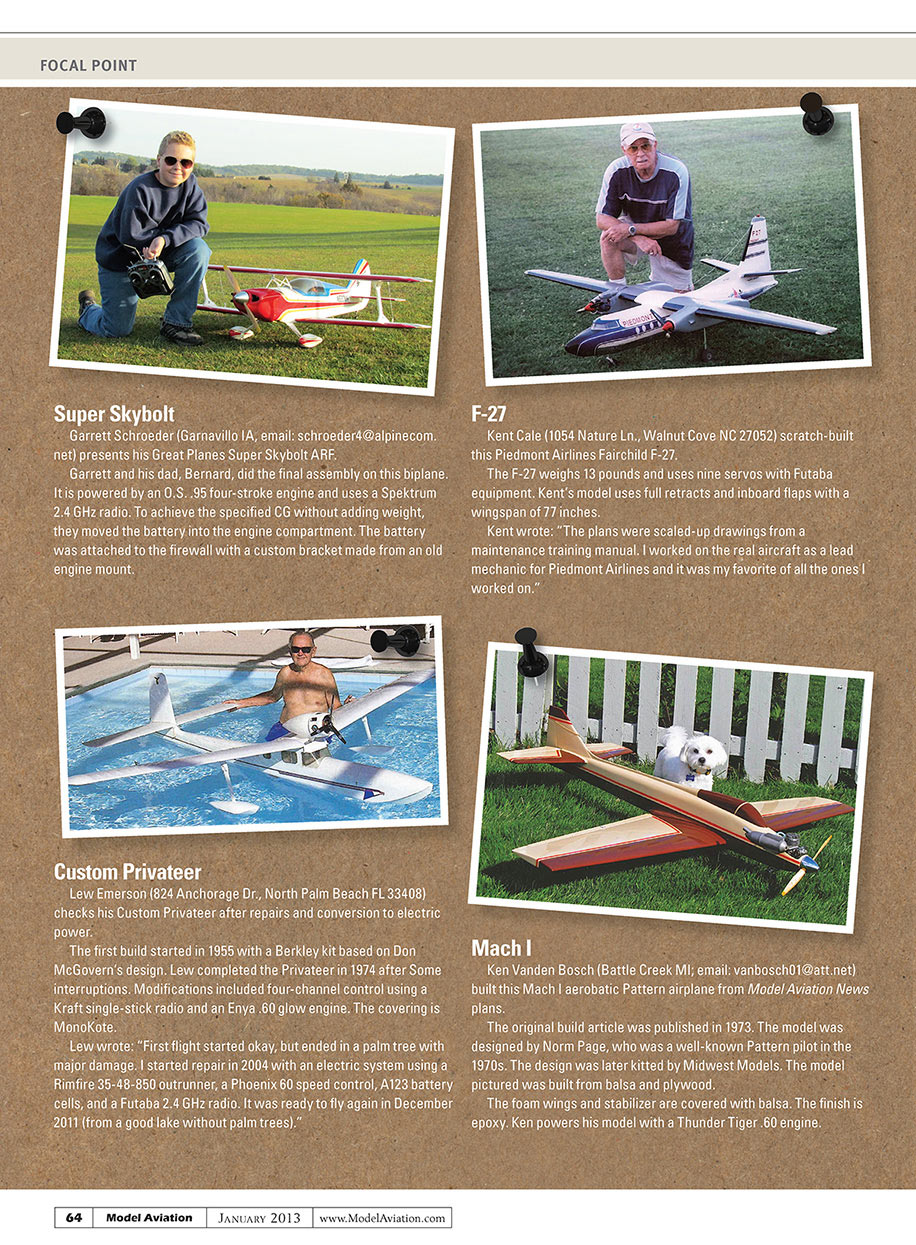
Super Skybolt
Garrett Schroeder (Garnavillo IA, email: [email protected]) presents his Great Planes Super Skybolt ARF.
Garrett and his dad, Bernard, did the final assembly on this biplane. It is powered by an O.S. .95 four-stroke engine and uses a Spektrum 2.4 GHz radio. To achieve the specified CG without adding weight, they moved the battery into the engine compartment. The battery was attached to the firewall with a custom bracket made from an old engine mount.
F-27
Kent Cale (1054 Nature Ln., Walnut Cove NC 27052) scratch-built this Piedmont Airlines Fairchild F-27.
The F-27 weighs 13 pounds and uses nine servos with Futaba equipment. Kent’s model uses full retracts and inboard flaps with a wingspan of 77 inches.
Kent wrote: “The plans were scaled-up drawings from a maintenance training manual. I worked on the real aircraft as a lead mechanic for Piedmont Airlines and it was my favorite of all the ones I worked on.”
Custom Privateer
Lew Emerson (824 Anchorage Dr., North Palm Beach FL 33408) checks his Custom Privateer after repairs and conversion to electric power.
The first build started in 1955 with a Berkley kit based on Don McGovern’s design. Lew completed the Privateer in 1974 after some interruptions. Modifications included four-channel control using a Kraft single-stick radio and an Enya .60 glow engine. The covering is MonoKote.
Lew wrote: “First flight started okay, but ended in a palm tree with major damage. I started repair in 2004 with an electric system using a Rimfire .35-48-850 outrunner, a Phoenix 60 speed control, A123 battery cells, and a Futaba 2.4 GHz radio. It was ready to fly again in December 2011 (from a good lake without palm trees).”
Mach I
Ken Vanden Bosch (Battle Creek MI; email: [email protected]) built this Mach I aerobatic Pattern airplane from Model Aviation News plans.
The original build article was published in 1973. The model was designed by Norm Page, who was a well-known Pattern pilot in the 1970s. The design was later kitted by Midwest Models. The model pictured was built from balsa and plywood.
The foam wings and stabilizer are covered with balsa. The finish is epoxy. Ken powers his model with a Thunder Tiger .60 engine.
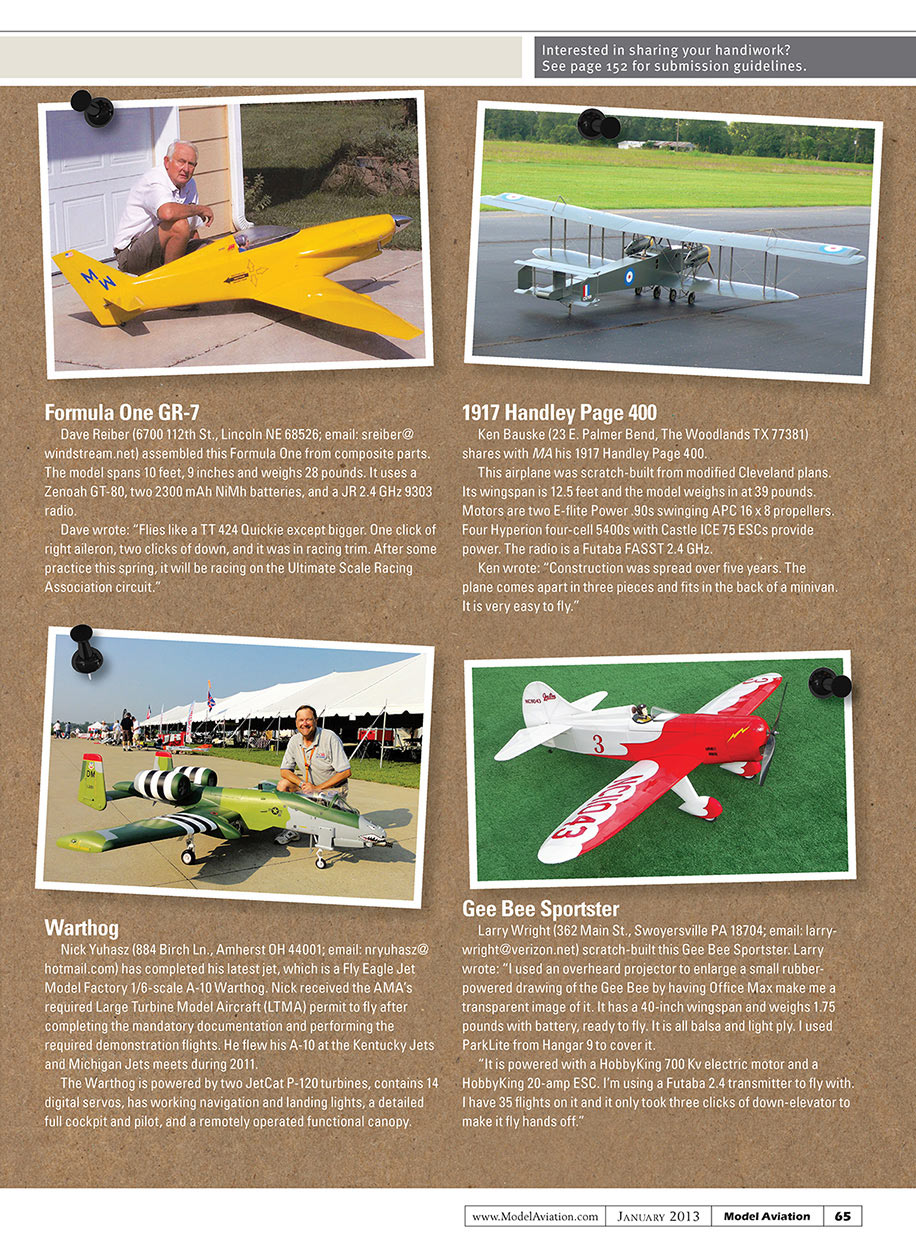
Formula One GR-7
Dave Reiber (6700 112th St., Lincoln NE 68526; email: [email protected]) assembled this Formula One from composite parts. The model spans 10 feet, 9 inches and weighs 28 pounds. It uses a Zenoah GT-80, two 2300 mAh NiMH batteries, and a JR 2.4 GHz 9303 radio.
Dave wrote: "Flies like a TT 424 Quickie except bigger. One click of right aileron, two clicks of down, and it was in racing trim. After some practice this spring, it will be racing on the Ultimate Scale Racing Association circuit."
1917 Handley Page 400
Ken Bauske (23 E. Palmer Bend, The Woodlands TX 77381) shares with MA his 1917 Handley Page 400.
This airplane was scratch-built from modified Cleveland plans. Its wingspan is 12.5 feet and the model weighs in at 39 pounds. Motors are two E-flite Power .90s swinging APC 16 x 8 propellers. Four Hyperion four-cell 5400s with Castle ICE 75 ESCs provide power. The radio is a Futaba FASST 2.4 GHz.
Ken wrote: "Construction was spread over five years. The plane comes apart in three pieces and fits in the back of a minivan. It is very easy to fly."
Warthog
Nick Ryuhasz (884 Birch Ln., Amherst OH 44001; email: [email protected]) has completed his latest jet, which is a Fly Eagle Jet Model Factory 1/6-scale A-10 Warthog. Nick received the AMA's required Large Turbine Model Aircraft (LTMA) permit to fly after completing the mandatory documentation and performing the required demonstration flights. He flew his A-10 at the Kentucky Jets and Michigan Jets meets during 2011.
The Warthog is powered by two JetCat P-120 turbines, contains 14 digital servos, has working navigation and landing lights, a detailed full cockpit and pilot, and a remotely operated functional canopy.
Gee Bee Sportster
Larry Wright (362 Main St., Swoyersville PA 18704; email: [email protected]) scratch-built this Gee Bee Sportster. Larry wrote: "I used an overhead projector to enlarge a small rubber-powered drawing of the Gee Bee by having Office Max make me a transparent image of it. It has a 40-inch wingspan and weighs 1.75 pounds with battery, ready to fly. It is all balsa and light ply. I used ParkLite from Hangar 9 to cover it.
"It is powered with a HobbyKing 700 Kv electric motor and a HobbyKing 20-amp ESC. I'm using a Futaba 2.4 transmitter to fly with. I have 35 flights on it and it only took three clicks of down-elevator to make it fly hands off."
Transcribed from original scans by AI. Minor OCR errors may remain.

